X-Men United #3 annotations
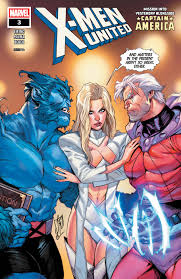 X-MEN UNITED #3
“The Loneliest Ghost”
Writer: Eve L Ewing
Artist: Tiago Palma
Colour artist: Brian Reber
Letterer: Joe Sabino
Editor: Tom Brevoort
COVER: Emma Frost intervenes in an argument between Beast and Magneto. Charitably, something approaching this does happen in a subplot.
THE X-MEN:
Emma Frost. She’s unhappy with Beast’s time-travel glitches. At the end of the issue, she has a missed call from Lourdes Chantel; we haven’t seen Lourdes since she was killed by Orchis in the 2023 Hellfire Gala one-shot, though she was presumably among the many mutants resurrected in X-Men Forever #2 at the tail end of the Krakoan era.
Magneto. He grumbles that the mission was doomed from the start – although the actual problem that’s emerged is a technical time travel issue that has nothing to do with his argument in the previous issue that Captain America is only trying to assuage his own guilt. That said, his views from that scene are essentially echoed by Vernon Weaver in this story (see below).
Kitty Pryde. Also unhappy with Beast’s performance. At the end, she has nine missed calls from Nina, her love interest from Exceptional X-Men.
Beast. Well, he’s trying to fix the largely-impenetrable time travel problem, and eventually does. The idea seems to be that the four away team members have been sent to the same place at different times. Nothing really seems to come of this, though, and they all seem to meet a Vernon Weaver of roughly the same age who seems to be experiencing the same conversation with all four of them. Since Weaver’s powers don’t seem to have anything to do with time travel, this is presumably meant to be some side effect of the time travel confusion. But it’s not honestly clear to me what the point of the quantum stuff is, other than to string out the story a bit before everyone sits down to have a chat.
For added confusion, the opening caption describes the past sequences as taking place in “the past (or a reasonable simulacrum)”. Overall, the intention does seem to be that it’s the past.
Wolverine (Laura Kinney). She gives a speech about how Weaver needs to forgive himself for what he did as an involuntary test subject, drawing the natural analogies with the way she was exploited by the Facility. She mentions that her own mother forgave her for killing her – this is Laura’s interpretation of Sarah Kinney’s dying words from X-23 #6 (which is a reasonable interpretation, but the word “forgive” isn’t actually used).
GUEST STAR:
Captain America (Steve Rogers). Not much to add, to be honest – he helps to calm down Weaver, listens to his story, and is appropriately remorseful. He’s grateful to the X-Men for their help and would have liked to thank Axo personally; he’s a little hurt at the suggestion that Axo sees him as a military authority figure.
STUDENT MENTORS:
Axo. He does what he’s told to help fix the time travel problem. He declines the opportunity to meet with Steve Rogers – Kitty ascribes this to him being busy, but Emma claims that he “harbours an aversion to militarised authority”. I’m not sure how seriously we should take that, since it sounds more like Melée.
Melée. At first she makes a reasonable attempt to calm Weaver, using her powers purely defensively, but later she offers to simply phase him into the furniture. She seems to be serious, even though all of her teammates want to talk Weaver down or (in Laura’s case) subdue him in a more gentle fashion. Possibly the idea is that she doesn’t have the skill to beat him in any less drastic way, and it doesn’t really occur to her that her more experienced colleagues can handle him.
STUDENTS:
Jitter. She uses her powers to calm Weaver down using “negotiation” and “hypnotherapy”. It’s fair enough in principle that Jitter can copy this sort of skill, but we’re very much into the territory of ignoring or circumventing her one-minute time limit here. Her ability is to copy other people’s skills for one minute, not to do more in a minute than they ever could. Reading the story as a whole, I think Ewing is intending to write Jitter as hyper-competent when using her copied skills, but Weaver’s emotional swings wind up are so abrupt that he comes across as mentally unstable.
ANTAGONISTS:
Vernon Weaver. Not really a villain at all, so we’ll go with “antagonist”. This is the character from the end of the previous issue who was implied to be Maurice Canfield, but it turns out that he isn’t. He’s new, and he’s a retcon into Canfield’s back story.
Weaver is a mutant, which presumably accounts for him still being alive and relatively active at the age of well over 100. However, his actual power seems to be to produce stone-like prorusions on his forearms and forehead, which he uses as bludgeoning weapons. Quite reasonably, Weaver is very upset about what happened to the test subjects from Truth: Red White & Blue. He initially seems inclined to fight anyone who he regards as a US government representative although he doesn’t appear to have any personal animus against Steve Rogers beyond that.
According to Weaver’s account, he was born in Georgia, and lived with his father after his mother died. They farmed land where his grandfather had once been a slave. His father was killed in a lynching; the immediate trigger is left intentionally unclear, but the strong implication is that his father’s pride in his World War I military service had something to do with it. Vernon then fled to Philadelphia, where he was taken in by the wealthy Camfield family. He seems to have been effectively adopted by them (though presumably not officially, since he hasn’t changed his name). He claims to be responsible for getting Maurice into radical politics, by opening his eyes to the wider world.
Weaver says that when Maurice was forcibly enlisted by the government (in Truth: Red, White & Blue #1, after being convicted for protesting against the war), he voluntarily enlisted in order to be with his brother. He was also among the Camp Cathcart test subjects, and had to kill one of the other subjects, Dalton, in self-defence. He escaped, thus avoiding getting killed in action along with most of the other “successful” test subjects, but he didn’t make it back to Philadelphia until the Camfield family were all dead (which happens by the end of Truth #4).
Quite what happens after that is very vague. Since he’s been living in the Camfield family home all this time, presumably we should take it that he inherited the estate in the absence of any other relatives – although he doesn’t seem to have kept it in particularly good condition. In the epilogue, he’s helping to fund something called the Maurice Camfield Freedom School, but he suggests that the funding comes from Steve Rogers and that he himself is only “rich in life experience”. (The school is presumably associated with the Philadelphia Freedom Schools organisation.)

Maybe there are clear indications and I missed them, but was there any time travel at all? Vernon seems to be at much the same age in the present time scenes.
A deeply odd storyline for the first few issues of a new school-oriented title, and I question the decision to sidetrack things in favor of exploring Captain America (Truth) ephemera.
There was no reason why Vernon should have been a mutant on top of being a failed Captain America prototype, as it doesn’t seem to impact the story.
Also, Jitter being a negotiator or hypnotherapist for one minute feels rather… dubious. She’s only as good as the best human with those skills, presumably, and neither one of those approaches is particularly quick, and requires the subject to be willing to listen and interact. And again, we don’t know what the refractory period of her powers are. A minute? An hour? Can she even use them back to back? What’s to stop her from chain-casting over and over? Can she use different skills in sequence, but each one has a recharge time?
Yeah, I’m not sure Ewing gets how some of this should work. As a school title, this is falling short and I don’t see it getting a long run under Marvel’s current series length policies if it doesn’t pick up quickly.
The claim at the beginning that this is taking place in the past (or a reasonable simulacrum) is odd. As Luis points out, Vernon seems the same age at the end of the story as in the “past” sequences. Plus, the idea that it’s taking place in the past is odd. Suppose it takes place a year ago. Did Steve tell Vernon to ask me for scholarship money in a year? And Vernon waited patiently?
This is the second time this week that the X-Men use dangerous and exotic methods to get information they probably could have gotten through Google.
Agreed that it’s bizarre that Ewing used this as the plot for issues 2-3 of a new school series. Especially since the solicits claim that there’s a Shadow King plot coming up. You’d think that Eve would do the Shadow King plot first so we see how well (or not) the school can protect its students against a classic villain. And maybe later do the plot with Vernon.
For what it’;s worth, the recap page describes Graymatter Lane as a “mind palace”. So I guess the school IS on the astral plane?
So it seems that Ewing was asked to write for Marvel based upon her ability to write empathy driven character arcs as her prior children’s book and based upon her insightful nonfiction writings. This served her well on Iron Heart and Monica Rambeou. I didn’t read her Black Panther work.
So with Exceptional X-men, I was not surprised that it was focused on the character interactions and character growth. This is the stuff that I like. It was aimed at me in a way that no Wolverine comic ever could be.
Then with dwindling sales because I don’t individually make up for the legion of sales that oh say… Deadpool fans brings in.
X-Men United feels like a dirty laundry list of things that Exceptional wasn’t. Big team, formally organized school oriented, technobabble, lots of mindless fighting… I am no longer the target audience.
So if Ewing isn’t fully embracing this new direction and is instead making a detour back to her strengths than I am all for it.
I don’t want her to write to her weaknesses instead of her strengths. Seeing Kitty (not) dealing with Nina makes me happy. Schrodinger’s Cap makes me smile. E-wing moving truck makes me laugh. Let her get cancelled while making human stories with social interest instead of staying around making boring comics that don’t have an engaged audience.
I don’t think there was actual time-travel, it was all the Sinister/Axo tech making simulations. I do think the money came through due to telepathic contact within the simulation. Gosh, this is unnecessarily fuzzy though.
After Steve Rogers, were there any in the Weapons program that wasn’t a mutant or at least like Deadpool a mutate? I guess Nuke wasn’t, but he had a bunch of augmentations that seemed fairly close. Super strength, regeneration, and anyway… Vernon being a mutant seems to be consistent with past stories, while if he wasn’t then it would be jarringly weird.
Yeah, technically, I believe that only Weapon X was using mutants, with the idea of turning mutants into weapons for humanity to use against other mutants. Weapon X then split off becoming its own project separate from Weapon Plus, continuing to experiment solely with mutants. I don’t think any of the other Weapon Plus programs were technically mutants. It was about engineering super-soldiers or human Sentinels to use in a war against mutants. Fantomex isn’t technically considered a mutant either as he lacks the X-gene, he was engineered using nanotechnology and artificially evolved in the World. He’s closer to the Children of the Vault. He rebelled against his breeding and refered to himself as a mutant though.
@Chris V
Thank you
Some of the early Weapon Plus subjects were animals. Brute Force were retconned into it I believe. And there’s that squirrel-Wolverine from Squirrel Girl who’s at least semi-canon from Weapon Plus.
As it’s been expanded and explained:
Pre-Weapon I was the original Project Rebirth, experimenting on John Steele.
Weapon I was the Captain America program, which covered Protocide and the experiments on African-American soldiers.
Weapon II: Animals, including Brute Force and (non-canonically We3)
Weapon III: a mutant who later became known as the Skinless Man.
Weapon IV: Project Sulfur, leading to the creation of the Man-Thing.
Weapon V: Vietnam-era, use of symbiotes.
Weapon VI: Resulted in Luke Cage getting his powers.
Weapon VII: Vietnam-era, again experimenting on soldiers. Gave us Nuke, Cyber, the UK’s Super-Soldiers.
Weapon VIII: Experimented on criminals. Surprising, no notable results.
Weapon IX: Supposedly resulted in Typhoid Mary.
Weapon X: Mutants again. I think we all know where that went.
Weapon XI: Rob Liefeld thinks it gave us Kane.
Weapon XII: Huntsman.
Weapon XIII: Fantomex.
Weapon XIV: The Stepford Cuckoos
Weapon XV: Ultimaton
Weapon XVI:A living religion
Weapon Infinity: Project Deathlok
and so on. Now, I think some of these are nonsense, especially since the programs overlap, get resurrected, get sidetracked, get retconned, and some just feel underwhelming or irrelevent.
On the one hand, the whole “what if X meant 10?!?” was a novel retcon back in the day, but boy did it open a mess of worms in connecting so many different characters and storylines in ways they didn’t necessarily need.
Yeesh!
That’s true. I now remember reading an interview where Morrison stated the idea behind WE3 (Vertigo) came from creating the concept of either Weapon II or III (one of those).
Ohh, the animal tests were We3, I didn’t notice the link. Or I knew and forgot. It’s still cool, either way.
Well they weren’t really, Weapon II a rubbish talking squirrel with all of Wolverine’s powers. Take it up with Howard the Duck if there’s any dispute.
Not sure if I realized before but the idea of so many unrelated characters having their power origins tied to attempts to recreate Captain America got written into the 616 right around the same time (maybe a little later by like a year or two) as the Ultimate comics were saying the very same thing
@TheOtherMichael,
Originally , Grant Morrisson intended in his New XMen : The World stotyline that Weapons 2 to 4 to be animals (the WE3 cast) , but it was later retconned by Remender that Weapon 3 was the Skinless Man (all based on a throwaway reference (English-edgelord-style) by Warren Ellis to living-skin bullets in 1994/5 on his Excalibur run , and Weapon 4 was retconned by Steve Orlando to be the program involving pre-ManThing Ted Sallis (canonically, his origin was trying to recreate the Super Soldier Serum after all) . Meanwhile , GM said that Weapons 8 * , 9 , 10 were supposed to be X-gene mutants.
Thus , my No-Prize headcanon is that Weapon 8 is actually the Project Armaggeddon that eugenically created Domino and her kid brother , as well as Topaz (Revelation’s Choirister) and her bf (and Neena’s implied fraternal twin brother) Prototype, and Weapon 9 is actually the SHIELD psychic program once headed by Mentallo and/or the 616-version of Jim Shooter’s New Universe’s Psi-Force program that created Al Ewing’s 616 version of the TroubleShooters .
And Weapon 11 , to me , is either Operation Zero Tolerance or The Hound Program , since it bridges the main Weapon X Program (upgraded mutants or mutant-derived mutates) with the cyborg Super-Sentinels (Weapon 12 and beyond) since the 616-Hound was apparently a Caliban-like X-gene-mutant whose power was to track down other X-gene mutants , who was enhanced to become a cyborg (who looked like a 1990s Japanese** bioweapon monster)
* In an AU in a relatively recent 2020’s limited series, Jed McKay made Weapon 8 be apparently the same program that in 616 accidentally created The Spider Queen
** he was designed by Japanese-American artist Jeff Matsuda
Expecting the USA and Canada to be coordinating their numbering systems on often patently clandestine initiatives for pursuing a fairly obvious general-purpose military goal through a wide variety of means and teams sounds a bit naive for me.
I like making numbered lists as much as anyone, but that is not how things work in reality – or even in fiction.
Unless, of course, there is some sort of world-wide mastermind imposing that discipline to all the lesser sinister conspiracies without their even realizing it. Someone such as Romu… I mean, Fu Manchu.
And let’s not forget the assertion in Steve Seagel’s Alpha Flight that the X in Weapon X was actually the Greek letter Chi, aligning it with Department H’s broader naming practices.
And of course a whole bunch of this was “established” in the Weapon Plus one shot with Wolverine and Captain America, which led into several other one-shots involving “Man-Slaughter” (Man-Thing knockoff written by Ben Percy, sigh) and Carnage.
I don’t think it’s been followed up on much since, but that’s where we got the most recent claims regarding Weapons II, IV-VII and IX.
But hey, if you take any of this seriously, there have been so many offshoots, splinter programs, rogue ops and conflicting stories that almost everything is up for debate.
Hell, I’m surprised no one has claimed (yet) (in mainline continuity) (ignoring that Marvel Knights Spider-Man storyline about a massive government/military/corporate conspiracy, who was that, Millar? Of course it was Millar) that there was a Weapon Plus program using radioactive materials on unsuspecting civilians, thus giving us Daredevil, Hulk, Spider-Man, and so many more.
But… why the time displacement if it made no difference to the rest of the story? I think there’s a lot of potential to the idea of mission participants encountering their target in different times. I wonder if this was a plot point that was changed, or if it was just thrown in without much care. This issue was better than the first two, but still not great.
Wow! Thank you all for the Weapons program overview!
“But… why the time displacement if it made no difference to the rest of the story?”
I think the gist is that the time travel aspect allowed the program to search and find information and patterns that no longer exist. They were sent without time travel while in the astral plane into a simulation that was built using time travel based research data. Am I certain? Heck no. It is as counter intuitive as being told that if you die in your dreams (school/astral/mind-palace) than you will die in real life. What is the overall point? That they can do Rachel Summers style chronoscanning while in a holodeck? Seems convoluted and fuzzy. Pointless. Let’s explore the opposite interpretation that they physically time travelled. Why would they approach Vernon in separate times but he is shown experiencing them as linear? If they were actually physically arriving at different times, and not just separate individual simulations, then why wouldn’t he say something along the lines of ‘I dealt with someone just like you last week’? He seems to be experiencing in what for him would be real time, with X-Men popping into and out of the room, not reacting like the encounters were years apart.
@Si
Is “a rubbish talking squirrel” meaning that the talking squirrel is rubbish or that the talking squirrel say rubbish things as in trash-talking? — Asking for a friend who is definitely not named Doreen.
@Woodswalked:
No-Prize theory: they were actually sent back to different past times but Vernon doesnt remember it because he’s simply an old man tsk tsk tsk
@LuisDantas
As per the most recent PC-retcons , 616-Fu Manchu (aka Shang-Chi’s dad) , was originally / actually a revolutionary too noble to resort to bioweapons . Furthermore, even when he later became a villain , he had already developed such a grudge against the 8 Nation Alliance (Western Powers) who defeated / humiliated / subjugated the Chinese Qing Dynasty, that he became a bitter racist who intentionally limited his global criminal empire to countries that had significantly sizeable ethnic Han Chinese populations.
Thus maybe the truth of the secret identity of the original mastermind of the 616-Weapons Plus Programs , which are mostly based in the Atlantic Anglosphere (USA, Canada, UK) ia more awesome , sublime even .
[…] UNITED #3. (Annotations here.) Well, this isn’t working. There’s a whole load of problems here. There’s nothing […]