X-Men United #6 annotations
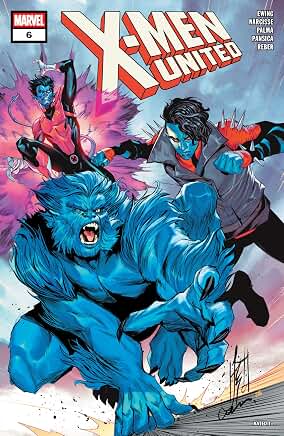 X-MEN UNITED #6
“Shadow Play, part 2”
Writers: Eve L Ewing & Evan Narcisse
Pencillers: Tiago Palma & Eduardo Pansica
Inkers: Tiago Palma & Oren Junior
Colourist: Brian Reber
Letterer: Joe Sabino
Editor: Annalise Bissa
COVER: A generic image of Beast, Nightcrawler and Axo in action, with Axo’s colour-changing matching the other two. Nothing along these lines happens in the issue.
Curiously, this story is billed as “Shadow Play, part 2”. The previous issue was indeed entitled “Shadow Play”, but it was the second part of a storyline that had begun in the previous issue. Still, if Marvel say it’s part 2, then part 2 it is.
By way of recap, then: In issue #4, Iceman ropes Cyclops, Emma Frost, Rogue, Deathdream and Ben Liu into a team-building exercise that involves an RPG in a fantasy landscape created using Ben’s powers. An outside entity hijacks the scenario and Deathdream gets dragged away into a portal. In issue #5, Deathdream emerges back in Graymatter Lane, and alerts the other students. It turns out that “all of the adults” are also missing. One of the students, Mal Chance, is privately approached by the Shadow King, who is apparently responsible for all this. A psychic attack on the students as a whole is fended off by Sophie Cuckoo.
THE X-MEN:
The other adult X-Men who vanished last issue turn out to have been Kitty Pryde, Magneto, the Beast, Psylocke, Nightcrawler, Gambit and Wolverine. They find themselves in a desolate landscape which the three Louisiana X-Men identify as the Penumbra, from the “Dark Artery” arc in Uncanny X-Men #13-16. This issue describes it simply as “a place of eternal torment for those who murder mutants”, which is fair enough as a one-line summary.
Shuvahrak claims that their dark counterparts represent the following sins against other mutants:
- Wolverine has “filicide”, presumably because he’s killed so many other mutants. He shrugs this off as something he’s well aware of and has spent plenty of time thinking about already.
- Nightcrawler has “hypocrisy and coercion”. This is presumably to do with his religious beliefs and (depending on your point of view) his rather inconsistent application of them, where the main problem with Wolverine killing people is that it might be bad for Wolverine’s soul, for example. An unsympathetic point of view might see Nightcrawler’s expressions of religion as somewhat manipulative at time. Some of these points also seem to represent the X-Men’s own sense of guilt, rather than necessarily an objective view of their behaviour.
- Beast has “temporal manipulation”, which would be the time he brought the Silver Age X-Men to the present day in the Brian Bendis All-New X-Men series. However, this doesn’t logically apply to the Beast currently in the X-Men, who’s a clone of the original Beast from an earlier point in his personal timeline.
- Gambit has “treason and massacre”, presumably referring to his role in leading the Marauders to the Morlock tunnels, which enabled the Morlock Massacre. Gambit is supposed to have been unaware that the intention was to kill the Morlocks.
- Magneto has “abuse and torture”, which could cover a lot of his behaviour in his Silver Age days.
- Psylocke has “vicious reprisal”, which again is pretty open-ended in terms of her history.
- Kitty Pryde has “mercurial abandonment”, probably referring back to the Exceptional X-Men character arc about her running from the X-Men.
Emma Frost, Cyclops, Iceman, Rogue and Ben Liu make it back to Graymatter Lane from the fantasy realm. Emma immediately starts fighting the psychic attacker as if she was defending her own children, consistent with the defensiveness that’s been a part of her character ever since the original Hellions were killed. Emma seems able to restore normalcy pretty much immediately, but drives off the attacker without figuring out who it is.
Emma is very panicky about the idea of the kids learning about the Shadow King as a threat, but Cyclops and Magneto both argue persuasively that secrecy is just going to create doubt that the Shadow King can exploit. Cyclops seems to see this as a metaphor for how the fractured X-Men teams need to come together, and Emma is driven to concede that Cyclops was apparently right to be worried about the risk of infiltration back in issue #1.
Emma also suggests that what’s happening might be something to do with the threat (or warning, depending on your point of view) that she received from Lourdes Chantel in issue #4 just before the main storyline kicked off. If that’s right – and it is how stories tend to work – then the actual villains behind this story would presumably be the unidentified women we saw Lourdes talking to at the end of the scene.
Prodigy effectively chairs the group discussion to figure out what might be going on.
Magik and Storm have cameos.
STUDENT MENTORS:
Bronze. She still has the Lockheed clone Marigold perched on her shoulder at all times.
Rift. He returns Calico, Loolo and Loa to Haven House. Again, I’m going to point out that this series can’t get its basic premise straight: we were specifically told last issue that people’s bodies remain in the real world when they enter Graymatter Lane. (“And their bodies are back wherever they left them when they entered the campus.”) Somehow, this doesn’t stop Rift being able to transport Calico, Loolo and Loa direct from Graymatter Lane to Haven House, where only Calico should have a body waiting for her.
Axo. He recognises the seriousness of the Shadow King being able to access to Graymalkin and seems to fear that it’s an unfixable problem.
Melée just has a cameo.
SUPPORTING CAST:
Calico. We’re clearly before she gets her New Mutants costume (since she isn’t wearing it, and Gambit’s still around). She takes the lead in her field group, which makes some sense since she’s the one most familiar with the location. However, she comes across as much more normal and balanced in this story. She seems able to hear Shuvahrak talking in the Penumbra, when the others present can’t – presumably because she’s been to the Penumbra before.
The rationale for Calico returning to Haven House at all has also changed since last issue. In issue #5, it was Scout who decided to send one team to the Factory and one to Haven House, apparently in the expectation of either finding the missing X-Men’s sleeping bodies or finding clues about where they had been taken. In this issue, Calico claims that she came up with the idea of returning to Haven House, partly because it has a vaguely magical way of helping out, and partly because she didn’t have any other ideas beyond asking an adult for help.
Loolo. She does her obnoxious warrior routine.
Loa. Her powers can’t phase through a force field.
Chelsea St Juniors. She’s under the Shadow King’s influence, and makes a clumsy attempt to hold Calico, Loolo and Loa at bay with her force field powers.
Ember. Calico rides him into the Penumbra with no apparent resistance; he wasn’t at all keen on the place last time.
Sophie Cuckoo. She refers to Emma as “mother”, apparently unironically.
Scout. She argues that the Shadow King is responsible, based on her experience of being manipulated with him in the Krakoan-era New Mutants series. Emma seems to regard this as news too terrifying to be shared with the rest of the kids, and Scout is quite put out at what she sees as an attempt to shut down her contribution.
Wither shows up at the end of the issue, with next issue’s guest star Blade in tow. Wither has done very little since dying in X-Force #25 back in 2010. He did get resurrected on Krakoa but didn’t do much beyond making cameos. His only other appearance of any significance since then was in a Gwenpool two-partner in Love Unlimited Infinity Comic #43-44, where he seemed to have learned how to control his powers.
Ms Marvel, Galicia, Ransom, Deathdream, Jitter, Indra, Icarus, Mal Chance and Match all have cameos.
VILLAINS:
Shuvahrak (?). In the Penumbra, the X-Men are confronted by a group of evil duplicates of themselves, led by a person who sounds like Shuvahrak from the Dark Artery storyline, but looks like an evil duplicate of Emma Frost. This person seems surprised that they perceive her as Emma, and her behaviour is absolutely nothing like the largely impassive Shuvahrak from “Dark Artery”, being much more chatty and human-like. None of the X-Men seem to register this, however.
She speaks in white-on-black speech ballons with a wavering white outline, which is how Ransom’s dialogue appeared when Shuvahrak was speaking through him in Uncanny X-Men #16. She says that she “told you X-Men specifically never to return”; that was also in Uncanny X-Men #16. (“Go. Never come back here. Never.”)
Shuvahrak claims that “When I was doomed to guardianship of this realm, I was told that its name is Ojiji”, also known as “the Mirror-Mirror” or “the Wraith Lands”. “Ojiji” is Yoruba for shadow, but is apparently also used figuratively to refer to a “shadow self” – a person’s hidden side, broadly. She claims that the X-Men’s shadow-selves go to this realm even while alive, to suffer penance for their betrayals of other mutants. There’s nothing about this in “Dark Artery”, where the whole point of the Penumbra was that Shuvahrak had created it as a place of punishment for humans who had betrayed mutant relatives. The story also seems confused about whether the shadow version of the X-Men are hidden sides being punished for their treatment of other mutants, or simply some sort of symbolic representations of their sins themselves.
She claims that the X-Men were brought to the Penumbra by “your ancient kinsman … the first shiver in an unknown shadow”, presumably meaning the Shadow King. She suggests that he simply wanted them to be exposed to their shadow-selves.
Since Shuvahrak and her companions all vanish as soon as Calico and her team show up, it’s possible that this is all an illusion of some sort. However, the very fact that Calico can reach them by way of a short run from Haven House seems to confirm that this really is the Penumbra.
The Shadow King. The voice that speaks to Chelsea is the Shadow King, recognisable by the green border (which is how his voice appeared last issue when speaking to Mal Chance). Since Shuvahrak also has black-on-white dialogue, this is less than ideal in terms of keeping them distinct.

It’s been a good long while since a professional writer has been this hapless, clumsy and at a complete loss for basic consistency and coherence on an X-book. Even Jeff Lemire did better.
Interesting that there’s a co-writer here. Along with the cancellation announcement, the suddent “part 2” designation here, and last issue not resembling the solicitation copy much at all, I wonder if there have been some late storyline changes owing to the title getting the axe.
“This person seems surprised that they perceive her as Emma”
The dialogue seems to suggest they perceive her as Emma because Emma represents “the betrayal of presumption. Of control. Of manipulation.”
“She argues that the Shadow King is responsible, based on her experience of being manipulated with him in the Krakoan-era New Mutants series. ”
That wasn’t supposed to be the real Shadow King but every writer seems to have forgotten about that, so maybe I should too.
This story is a complete mess. The villain is the Shadow King. But no wait, that’s Shuvaharak confronting the X-Men, not the Shadow King. But no wait, Lourdes and whoever she’s working for (presumably Justina Laguardia) are really behind everything.
@Diana- I’ve heard Eve Ewing described as as “a sociology professor moonlighting as a writer”. That might be part of the problem- she’s not truly a writer first and foremost.
I believe filicide is the act of killing one’s own children. Logan has killed Daken once or twice, and then he also killed a bunch of his own kids in Aaron’s Red Right Hand run.
Michael-Exceptional X-Men wasn’t bad. It was something different in the “From the Ashes” line. While Eve Ewing’s writing wasn’t perfect, I’d have liked to see more X-books like that compared to the majority of Brevoort’s line.
I don’t know. This is really bad, but that doesn’t explain Jeff Lemire “as an extremely talented comic book writer moonlighting as someone pretending they can write the X-Men”, or Gail Simone turning in scripts that are often as sensible as a Howard Mackie script. It seems to me that most writers struggle to write the X-Men comic. The number of writers who have been able to turn in X-Men comics that make sense and are worth reading really is a very small handful. You could even argue that one of those writers, Hickman, was truly writing his own science fiction series that just happened to use the names of the older characters. It makes you wonder how much of it comes down to Uncanny X-Men almost being a creator owned comic for Claremont, and when a comic is the personal work of one writer, other writers often struggle to be able to handle those characters. Even Claremont couldn’t write the X-Men properly again after he returned.
Kitty has a history of ‘mercurial abandonment’ if we read that as ‘leaving the X-Men’ – going to college and bartending, leaving the O5 kids to hang out with space bum Peter Quill, whatever she was doing right before X-Men Gold and now the Exceptional phase.
You know, the details keep changing (and the basic premise refuses to make sense), but I still broadly enjoy this arc. At least it makes an attempt to use this premise.
Shane it’s apparently going to be derailed by Wither, of all people.
The X-Men, like the Spider-Man office, often suffers from editorial mandates that really bring down the quality. Lemire was hamstrung by the stupid terrigen mist and Inhumans vs X-Men plots.
I think there’s something to what Chris V was saying above, the X-Men were defined by one authorial voice for so many years that it seems to trip up writers that are otherwise quite good at what they do. There have been so many writers that have turned out lackluster runs on the series (the aforementioned Lemire and Simone, Brubaker, Fraction, Milligan, Seagle). How many actually turned out a great, solid run on the core X-Men title? Mike Carey is really the only one that comes to mind for me, maybe Jason Aaron for Wolverine and the X-Men if I’m feeling generous.
X-Men United, however, remains terrible on just about every level. I didn’t like Exceptional X-Men very much, the student characters were absolutely insufferable and made the Outliers look good in comparison, but it had good artwork and I liked the focus on Kitty. This series has none of the few redeeming qualities of is predecessor and is a chore to read through. It’s incoherent and can’t keep its own premise consistent from page to page. An absolute failure on every level.
Welp, this goes on the list of worst runs of a main X-Men title, right? Chris Claremont (Revolution), Chuck Austen, Jason Latour (if you consider WATX a main title), and this. There are some runs I have major criticisms of like Bendis, Milligan, Lemire, Rosenberg, Guggenheim, and Fraction but I don’t think they’re incompetent. This book is incompetent. I think you could have a real conversation about whether Ewing or Latour were worse writers. Latour’s run was historically convoluted. This book is shockingly under-thought out.
At least, it’ll be forgotten. The Mansion idea is promising but underdeveloped/again, incompetent.
@Michael- “a sociology professor moonlighting as a writer.” That’s very apt.
The most charitable read of the situation I can give is that Ewing is better suited for small casts and more intimate narratives, and the pitch for X-Men United was probably the most sprawling cast we’ve seen in a while. It was always doomed to fail, let alone with the oversight of one of the worst editors the brand has seen in a while.
Wow. I jumped off this book early as it hadn’t worked for me. But I’m shocked at the self assured judgment of Eve L. Ewing as a writer. She has written plenty worthwhile at Marvel. Not to mention, for my money, the best book of the From the Ashes era. She’s far from the only talented writer to have an X-book that doesn’t click.
If the whole line was strong and this had a solid, can’t miss direction but didn’t work, sure, I’d me more inclined to question her talent. But this is far from the only baffling X-book going right now. If she got a tough assignment that editorial kept shifting priorities around, that makes her a big 2 comic writer. Not just a “moonlighting professor”.
@Scott: I don’t know where the “moonlighting professor” bit comes from originally, and I share your distaste for it… but I will say that Ewing’s missteps on this particular book go beyond *just* “not clicking”, and into the realm of “a professional writer with a modicum of skill and experience wouldn’t do this.”
It appears modern day Marvel, or really Disney, is set on nosediving the X-Men’s stories into the ground. This modern day run has been devastatingly bad; it hurts to see them in the hands of big corp execs and writers.
I think that I like Eve Ewing’s writings better than most here. If you didn’t like Exceptional, than I feel your judgement of her writing is valid. This though…
Since she can’t explain to the readers what Graymalkin is, I don’t think that she understands it either. That tells me that it isn’t her idea. This isn’t her pitch, it is an assignment that she is trying to connect other people’s dots with. Her fault in accepting the paycheck sure, but not representative of her overall writing skill.
Howard Mackie was mentioned in comparison to Simone, which I don’t think is apt. It seems to be a better comparison here. He had a mini that was a wildly popular hit. Editorial turned it into a longer run that he had absolutely no plot for. He ended up scripting over barely seen random art and making readers feel betrayed and the readers ended up triggered with outrage simply by reading his name. This is the closer comparison.
I want to read more from Eve Ewing. I like her other works. United is terrible.
Chris V made a solid point about how hard it is to write for another’s IP. We have built in expectations as an already existing fan base with diverse starting points.
Editorial needs a direction.
“Kitty has a history of ‘mercurial abandonment’”
She has a live in partner girlfriend that she hasn’t broken up with, but is ghosting.
You don’t remember this? She apparently doesn’t either.
@Woodswalked: To use a recent example, I don’t believe editorial directed Ewing to use Lourdes Chantal of all characters; that was far more likely to have been a decision Ewing made herself, only for her to very clearly have no idea what Lourdes’ relationship with Emma actually is. She made similar errors in Exceptional with Kitty’s, shall we say, inaccurate recollection of how she joined the X-Men and how Xavier treated her.
Research fails aside, this run has some basic problems with characterization, plot structure and concept presentation that go beyond the typical pitfalls one would encounter writing for an IP. Let’s not even get into her depiction of her own teen mutants – characters *she herself* introduced – being written in this book as if they’re senior instructors.
@Diana: How could Ewing have chosen the character unless she’d read about them to begin with? Lourdes Chantel is a rather obscure character, even taking into account her Krakoan Age appearances in Marauders.
Further, Ewing’s work on Exceptional X-Men reads to me as a writer who’s not particularly interested in having villains in the stories. Sinister showed up quite late to allow for a more conventional superhero plot, and the early issues functionally had no antagonists.
My sense is that this is a character she was directed to in some way by editorial, much as the similarly obscure, minor characters like the Dark Gods wound up in Stephanie Phillips’s Phoenix. That was Brevoort’s idea of expanding the cosmic side of the Marvel Universe.
With all of the above in mind, I’d guess that Ewing was given a list of X-books women who’d been linked to the Hellfire Club or to Emma’s past in general, and Lourdes was on that list. And then no one provided any guidance regarding the character beyond that.
I liked Exceptional X-Men, have enjoyed other comics work by Eve Ewing, and even liked the (non-Ewing) divisively wackadoodle Storm series featuring sudden sky fortresses, alien fbi agents, confusing time and location jumps , countless story threads truncated by two cancellations and majestic hippo steeds, but this… this is a mess.
I can’t remember the last time a single comic kept me asking “huh?” every time I turned the page. And just when everything seems about to boil over… everyone is suddenly out of (immediate) danger and back at graymalkin.
… Huh?
Maybe combining the early cancellation/mercy killing with sudden co-authorship has scaled the chaos up a level.
FWIW, Eve Ewing’s bio on the platform I use refers to her sociology work, non-comics writing, community work and education. It does not refer to any comics writing. Maybe this is where the “moonlighting” comment comes from.
Few quick reiterations.
As someone who didn’t like Exceptional, your criticisms are part of what I have characterized as “valid.”
Editorial, I am pointing to for responsibility of the premise, which is not the whole of the book. It is however, the largest difference between Exceptional and United, and is the part of the book that makes me want United to end, and a return to something closer to Exceptional. That means a smaller cast, more intimate scale, less sprawling convoluted excuses for fight sequences. You are perfectly correct that editorial isn’t responsible for all of her choices.
Josh likes the premise, and a different writer might find a way to make it work. Ewing isn’t
I liked Exceptional, I liked Mutant X, I like United. I also state that United is terrible, and that it should be canceled.
So we are mostly chatting here about how competent she is as a comic book writer. Dissertations, poetry, children’s books aside. I liked IronHeart.
What I like most about United is the characterization. We seem to disagree most here. I find the character voices read true to past presentations and are also consistent within the book itself. As much as I miss Vita Ayala, she wrote every character in her own voice. Gail Simone, who I respect, has written dialog for Jubilee that made my head snap. Morrison’s take on Magneto/Xorn felt like a fundamental misunderstanding. Hickman wanted Storm and Wolverine to have a child. (Thank you to editorial either Breevort or Buckley for stopping this) . These are largely IP specific writing issues as opposed to general competency. I agree with you about Lourdes, but it doesn’t stand out to me stronger than most other titles.
“senior instructors” – Yes. This seems adequately explained as they are senior only in time spent with the Sinister/Axo empathy engine Graymalkin nonsense. That rings true.
What are the plot structure issues? I may have missed them by lumping it into the “concept presentation” problems that I am seeing as the Graymalkin premise. The technobabble in the whole Captain America arc might be an example of how understanding the concept is required for following the plot. Which is the prime example of why United doesn’t work for me.
Morrison’s take on Magneto was not a misunderstanding of the character. You can argue it was a huge mistake (and I would mostly agree with you), but it was based in Morrison’s looking at the history of Magneto. The first aspect that a lot of people seem to forget is that Morrison turned Magneto into a drug addict. He felt he was aging and being overshadowed by a younger generation who saw him as an outdated old man (and Morrison saw truth in that idea), so he turned to Kick as a way to (he felt) rejuvenate himself and become relevant to the mutant cause again (and we know that Kick was Sublime and Sublime’s agenda).
Also, Morrison was taking Magneto back to his Silver Age roots. It was the Magneto of Lee and Kirby again. Plus, it’s not as if there wasn’t precedent for this more recently, as the ‘90s “extreme” writers were working to try to undo everything Claremont did with Magneto and turn him into a genocidal lunatic again (circa “Fatal Attractions”).
We also have to look at Morrison’s reaction to Magneto in the time it was written, immediately post-9/11. Morrison found little room for excuses being made by people doing horrible things in the name of past sins. Morrison saw Magneto as a terrorist making excuses for the fact that he was killing people. I’m sure with more distance from 2001, Morrison might have felt a bit differently about a character like Magneto. Morrison simply did not sympathize with Magneto’s ideology.
Although, one might argue that taking the firm stance of “Never again!” leading to a potential genocide may be more relevant again in the 2020s, but I won’t open that can of worms…
Also, Hickman wanted Storm and Black Panther to have a child, not Wolverine. The child would be artificially aged and tutored in The World and emerge as a saviour who could unite mutants and humans.
Still a horrible idea though. One good editorial change from Hickman’s tenure.
*Brevoort not Breevort… sigh
*”your criticisms” – I meant Diana’s
*Other Other Michael – Is that a typo? We have multiple Michaels, but two Other Michaels makes me confused.
“Morrison was taking Magneto back to his Silver Age roots. It was the Magneto of Lee and Kirby again.” “Morrison saw Magneto as a terrorist.”
Yep, that is a fundamental misunderstanding.
“with more distance from 2001, Morrison might have felt a bit differently”
No way! This is one of the only statements where I think you are just incorrect. Why would Morrison suddenly not see Magneto as a terrorist?
“Storm and Black Panther”
That’s right! Thank you!
@Chris V: You would have been better served not bringing that last bit up at all, then. There may not be a cap on ignorant Westerners acting like they know the first thing about the Middle East, but by God I’ve had my fill.
@Woodswalked: I don’t entirely buy “the IP excuse” simply because plenty of writers *have* successfully changed or developed characters who weren’t theirs. We have Gillen’s Sinister now. We have Aaron’s Kid Omega. Jamie Madrox will never go back to being who he was before Peter David.
Diana-If you agree with Israel and Trump’s actions, that is your view-point.
@Chris V- I think the problem with Morrison’s interpretation of Magneto is that he WASN’T just taking him back to his Silver Age roots. Other writers had written Magento as a “Silver Age villain” like Alan Davis, Lobdell and Nicieza but they stressed his charisma and intelligence. Morrison’s Magneto is a petty man who controls one of the fundamental forces of the universe. But that’s Graviton’s niche in the Marvel Universe.
A Magneto who was an actual threat to the X-Men’s message of coexistence would have worked but not this idiot who botches killing Beak and then lamely tries to claim he was just testing him.
Morrison also suggested killing off Rogue and replacing her with a version that was more like the X-Men Evolution Rogue but thankfully Claremont and the editors vetoed that.
@Chris V: I had family at the Nova festival. Shut your mouth and find some Reddit rathole where you can proudly share your blind, know-nothing insinuations with the other yokels.
@Michael: It’s worth recalling that the event *immediately* preceding Morrison’s run was Eve of Destruction. Granted, that’s not a storyline that’s well-regarded these days and most people (quite reasonably) skip it, but let’s agree that Morrison wasn’t exactly reaching into the distant past for their interpretation of the character.
I don’t entirely buy “the IP excuse” simply because plenty of writers *have* successfully changed or developed characters who weren’t theirs. We have Gillen’s Sinister now. We have Aaron’s Kid Omega. Jamie Madrox will never go back to being who he was before Peter David.
I include Ewing as a writer who has successfully developed existing characters. You and I clearly see this differently. I like her character dialogs. They work for me, and are one of her strengths that makes me want to read more. Ewing’s Kitty, Emma, even her Rouge read perfect pitch in character. We don’t have to agree, and here it seems we don’t.
“We have Gillen’s Sinister now. We have Aaron’s Kid Omega. Jamie Madrox ”
Gosh, I love those. Aren’t they great! I want more of those.
“IP excuse”
There is a ton of ways to be a bad writer.
Three time Eisner award winner Jeff Lemire can write. You don’t win Eisners without being a competent writer. Was he a bad X-men writer? That is reflecting his ability with the IP, not general competence.
Something else that had good punctuation, use of pacing, plot coherence, and used very competent general writing skill…
Chuck Austen’s The Draco
So what is better than the Draco? Wrong answers only please.
@Diana- Regarding Lourdes, I’m wondering if the problem is Ewing’s interpretation of the character. Ewing seems to think that Emma faking Lourdes’s death and setting her up in a fake identity so she could escape an abusive boyfriend was a form of manipulation. Which is ridiculous. There are plenty of characters who can legitimately claim to have been manipulated by Emma but Lourdes isn’t one of them.
Sometimes writers have bizarre takes on characters that nobody else agrees on. Al Ewing has argued that Spider-Man trying to kill the Venom symbiote wasn’t self defense because the Venom symbiote wasn’t try to kill or rape Peter, it was just trying to permanently bond with him against his will. Most fans think this is ridiculous- Peter should definitely get to consent to a major life-altering decision like that.
That first paragraph isn’t mine. I did not mean to post it. Plagiarism, even accidental, is bad writing.
oops
@Woodswalked: Hold up, our very own Paul didn’t break out the f-bombs and all-caps bold text back in 2004 so we could sit here 20 years later and debate whether The Draco of all things had plot coherence. Come on now.
@Michael: That’s pretty much it, yes. It was the exact same problem I had with her take on Kitty, acting as though Xavier ruined Kitty’s life by forcibly recruiting her to be a child soldier when that’s quite literally not what happened.
Much like with Lourdes, there’s an odd misreading of basic backstory that doesn’t come off as an intentional retcon (because if that were the case, I’d at least give her some leeway to see where she’s going) so much as complete ignorance and disinterest. To which I say: if Ewing doesn’t care, why should I?
I thought the whole idea of Morrison’s run is that Magneto is barely there at all. It’s Sublime (in the form of Kick) mostly running Magneto’s body, but not *entirely* in control of his mind.
Sublime pushes Magneto over the edge, they fight for dominance, the X-Men take advantage of Magneto’s distraction and kill him. Any decisions Magneto makes in New X-Men can be attributed to Sublime. Sublime doing a bad impersonation of Magneto, at that.
@Thom H.: That’s for people who did a close reading of NXM 🙂 General fandom tends to rely more on an interview Morrison gave where he called Magneto a “mad old terrorist” or something to that effect.
And you have to figure Morrison were trolling even back then, because if that was genuinely how they felt, why give Magneto exactly that out in “Here Comes Tomorrow”? Why write off everything that happened in “Planet X” as Sublime’s doing?
Where *they* called Magneto a “mad old terrorist”. Pardon the slip.
@Woodswalked: “with more distance from 2001, Morrison might have felt a bit differently”
No way! This is one of the only statements where I think you are just incorrect. Why would Morrison suddenly not see Magneto as a terrorist?
If we want to read Morrison’s Magneto as commentary on Bin Laden, it’s very much a comfortingly-shallow take on Bin Laden, the sort of thing western media was flooded with at the time to stifle any actual introspection into the role American intervention in the Middle East had played in building up fanatical military regimes like the Taliban.
I think the charitable suggestion is that if Morrison was writing a Bin Laden allegory today, he’s still be a mad terrorist twat, but with motivations slightly more nuanced than “bad old man is angry the world has moved on and become so much more progressive and enlightened than him.”
@yrzhe: But as Thom points out, literally everything you’re saying bumps up against the black-and-white text of NXM #154, in which Morrison reveals that Magneto was under Sublime’s control the whole time. It can’t be a Bin Laden allegory if Bin Laden is shown to be an empty puppet rather than someone with agency who could (and should) be held accountable for his actions.
@Diana
That’s a valid point, but Morrison himself is the one who coined the “mad terrorist twat” phrase when discussing his take on Magneto, so even if it hadn’t been his intention at the time I don’t think he’s against the comparison.
@yrzhe: The only way I can square that quote with what Morrison actually wrote is to assume they were just trying to be provocative with the former. This was the tail end of the Jemas era, it’s not beyond the pale to think Morrison was out to drum up some outrage.
The alternative is to assume they meant what they said, and then went out of their way to absolve Magneto at the very end of their run for no apparent reason.
Morrison was doing more than one thing with Magneto. We have a shallow metaphor for a political terrorist in the light of Morrison buying into media hype immediately around 9/11/01 to drum up support for the “war on terror”. We have Magneto as a stand-in for a figure more like Che Guevara. Morrison was also making the point that the 20th century was over and all the old ideologies which had drug the world down to the point it was in by the 21st century were (rightly) outdated/dead and needed to be replaced. Outside of Magneto is “just a terrorist making excuses for doing heinous acts”, there was also the idea that Magneto was worth more to the world dead than alive. So, Magneto was also the old revolutionary who refused to evolve. Unlike Xavier, who Morrison also saw holding outdated, unworkable ideologies; but unlike Magneto, Xavier was willing to learn and grow. Xavier was the one who would step aside and let the next generation (Scott and Emma) take over with new and better ideas. Plus, Magneto was the drug addict who was under the control of Sublime, so yes, Magneto was basically already dead and had become the vessel for Sublime’s anti-evolution agenda. Magneto was never a victim. He made the choice to use Kick (yes, not knowing the truth, but regardless). He refused to let go of his failed ideologies, believing he could relive the errors of the 20th century again and lead a new revolution by turning to drugs, only to be revealed as a pathetic old man who refused to see the errors of his ideologies. In the end, he had to die.
So, while Yrzhe is correct that Morrison’s Magneto seems shallow at first, we see that Morrison always has more than one idea he’s juggling at one time. When we look at Morrison seeing Magneto in multiple lights, it rises up above the simply shallow “Magneto is just Bin Laden”.
For whatever reason (and I am sure it has come up before by people other than me), this discussion is making me think that Morrison intended Kick to be compared to a certain ‘blue pill’ that wikipedia tells me hit the market in 1996.
Morrison has a thing for reducing complex character to mustache-twirling villains with zero redeeming qualities. The Talia situation was even worse than the Magneto situation. Even the fact that Talia return to the League of Assassins was the result of her sister torturing her into insanity very recently was completely ignored so she could be retconned into a permanent villain who it made no sense that Batman ever cared about or would ever be the mother of his child. And unlike with Magneto, Morrison’s mistakes with Talia were never fixed, so the character who had been torn between 2 worlds and had been fully good in the early 2000s was gone forever.
@woodswalked: not a typo, simply another Michael, but one who rarely comments. In the event I write something thoughtless, however, I don’t want other Michaels to take the blame, so I will use a different name going forward.
@Chris V- That’s the problem. Magento is meant to be a challenge to the X-Men on an ideological level. So Morrison’s treatment of him made him completely unusable in the future.
@Gary- As I understand it, part of the problem was that Morrison misremembered Son of the Demon. Morrison remembered a story where Ra’s knocked Bruce out by drugging him. remembered that Bruce had sex with Talia during Son of the Demon and conflated that into Burce being drugged and nonconsenting when he had sex with Talia.
Morrison sometimes has a horrible memory- during New X-Men, Shaw was described as being a telepath. And the editors let Morrison get away with it. But the Shaw thing was just annoying, while Talia’s character was permanently derailed.
I’ve deleted an exchange which had crossed the line into personal argument.
I apologize for my part in that. This isn’t the place or the time, and there’s no settling that particular score.
[…] UNITED #6. (Annotations here.) This seems to be cancelled with issue #10, and it’s now acquired a co-writer. To some extent, […]
@MWayne
That is very considerate of you.
Please don’t think that my confusion is anything else.
@Michael: I thought making Magneto unusable was part of the point. A lot of Morrison’s run seemed intended to draw a line under things like the Xavier/Magneto conflict, the Phoenix Force, and universal anti-mutant prejudice so that the franchise could grow in a new direction.
It wasn’t just Morrison – for a while there it seemed like Marvel was doing its best to get rid of the big-name villains. Brubaker killed off Red Skull, Bendis seemed to definitively get rid of Kingpin, Doom seemed pretty much finished after Waid was done with him.
@Taibak- the problem is that the villains that Morrison tried to replace him with (Cassandra Nova and Sublime) didn’t really catch on. Cassandra Nova was used relatively sparingly until the 3K plot. It doesn’t help that Morrison argued that Cassandra Nova was redeemable but Magento wasn’t. And Sublime’s origin was considered implausible by comic book standards (and he was considered a rip off of That Which Endures) and he never really caught on.
None of the X-Men’s other major villains played a significant role in Morrison’s run. Apocalypse was dead, Sinister and Mystique were absent and Shaw was a glorified nightclub owner. What later writers actually did after Magneto was revealed to be alive and an ally of Xavier was use Apocalypse, Sinister, Mystique and Shaw as villains.
@Diana- I always thought Waid intended Doom’s death In Ben’s body to be a typical Doom death- namely, the next writer has to explain how Doom survived. It didn’t feel permanent, especially since Reed says in that arc that if he left Doom in Hell, Doom would probably be running Hell within 6 months.
Similarly, the fact that Sam questions whether the Skull is really dead this time makes me wonder if Brubaker intended the Skull to stay dead, despite Steve’s reassurances.
As for the Kingpin, Bendis’s last issue ended with Matt and the Kingpin in the same prison.