Uncanny X-Men #36 annotations
 UNCANNY X-MEN vol 6 #36
“Wild Ride, part 4: Rights of Rage”
Writer: Gail Simone
Artist: Luciano Vecchio
Colour artist: Matthew Wilson
Letterer: Clayton Cowles
Editor: Tom Brevoort
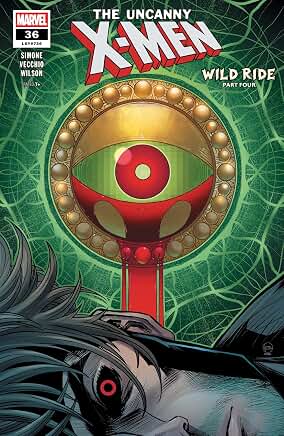
COVER: Gambit staring vacantly in the foreground, with his Eye of Agamotto crying blood behind him.
PAGE 1. Flashback: The Iron Cathedral.
So yeah, I feel like sticking with this format again for a while. It’s probably a better fit for this issue anyway.
The Iron Cathedral. This was first mentioned by Rogue in issue #33, and was mentioned again by Repent at the end of the previous issue, which also showed an image of it. That panel was rather clearer than this issue in showing it to be in the open air, with other parts of the landscape visible around it.
It seems to be an iron framework in the general shape of a cathedral. Repent explains later in the issue that the iron repels demons, which presumably means that it helps to exorcise them.
The dagger. The one seen in this flashback is the same one that Gabriel had in issue #33, and gave to Gambit in issue #34. However, Repent is also holding it in his origin flashback in the next scene.
The dialogue. Translated roughly, it reads:
“Father, is there no other way?”
“She’s got the devil in her, as you well know.”
“Francesca, please.”
“It’s just that I know the Benatti family. They are good, God-fearing people.”
“I am innocent! I renounce the Devil!”
“Send the soldier home, brother. I need to return at dawn.”
“I understand. What do you want me to do?”
“Tie her to the [leggio]. And bring me the dagger.”
“Yes, father.”
The word leggio means “lectern”, but it clearly refers here to the platform that Francesca is being tied to, which looks more like an altar of some sort.
PAGES 2-4. Rogue, Gambit, Gabriel and Repent on the train.
Frecciarossa. A Frecciarossa (“Red Arrow”) train is Italy’s high speed train service. Once again, we’re travelling by ordinary transport rather than risk using Gambit’s demonic teleportation ability.
Gambit is wearing sunglasses, which in theory could be to stop people noticing his eyes, but in practice seems more likely to be to do with him feeling ill. It’s not like he wears them normally, and it’s not like Repent is making any effort to conceal his pointed ears.
Repent. He gives his real name as Vicente Herrera. On his own account, his mother died in childbirth while possessed by a demon, which then entered him as the nearest available host. He says that he underwent multiple exorcisms which served only to drive him mad, and that he was incarcerated in the monastery from issues #33-34, where he studied for the priesthood. In rather vague terms, he then alludes to using the dagger to at least partially exorcise his demon at the cost of his left eye, his right arm and “my sanity” – though he seems sane enough in these issues.
According to Gabriel, Repent’s demon is still “partially inside him”, and gives him a charm effect on women in particular – the sort of effect Gambit would more normally have. This effect is specific to Repent’s demon. It doesn’t seem to work on Rogue, who regards him as vaguely satanic. That might be because she’s too preoccupied with Gambit to be receptive.
Quite what it means for a demon to be “partially” inside Repent isn’t explained further; there’s no suggestion that the rest of the demon is somehow hovering around the area, so apparently it’s been separated from the remainder. Or maybe the rest of the demon was somehow destroyed.
PAGES 5-10. The X-Men kill Calamity.
Meanwhile, over in the B-plot, we pick up with the X-Men’s attack on the compound that Howler escaped from, where they had just run across Calamity shortly before the end of the last issue. If you want to nitpick, the A- and B-plots are clearly running on different time frames – Rogue and co have time to get a train from Spain to Italy while the rest of the X-Men are still fighting Calamity – but that isn’t really a problem.
Calamity was described by a guard last issue as a mutant who was working for the compound. He insists that he isn’t being mind controlled and that he’s happy with his position of authority. Mind you, he also says that he’s 22 and “used to be one of them”, which surely implies that he’s had a fairly traumatic past himself and that this is more of a cycle-of-abuse thing. Wolverine and M don’t see it that way, and just kill him, even though subduing him seems like it would be possible.
As for the other X-Men present, Quicksilver seems shocked. We don’t see Nightcrawler’s reaction, but frankly, it’s not like Wolverine killing people is new to him – every so often he fears for Wolverine’s soul, but he never really seems to regard it as much of a problem beyond that.
PAGES 11-14. Rogue, Gambit & co arrive at the Iron Cathedral.
It’s not clear what’s making the sky red – it can’t be dawn, since it was already daylight in the train scene.
“Mutants didn’t truly begin with the atomic age, you know.” Back in the Silver Age, the idea was that mutants were the result of an upsurge in radiation levels caused by the development of nuclear weapons and nuclear energy – hence “Children of the Atom”, though that term was actually lifted from a 1953 book of the same name. However, it’s been clear for years that there have been mutants around on Marvel’s Earth for thousands of years, albeit perhaps in smaller numbers.
Repent talks in terms of Earth itself “attempt[ing] mutation as a viable evolutionary option”, which is a slightly odd way for a Catholic priest to frame it. The established Marvel history, to the extent that it matters, is that the human race were altered to gain the ability to become mutants by the Celestials.
The Darkborn. Repent says that this was a term used in the past for mutants who were persecuted as being demonically possessed. This is obviously a reference to the way in which various people, mostly women, were burned as witches in years gone by. An obvious difference here is that in the Marvel Universe, demonic possession is a real thing, so presumably a fair number of legitimate exorcisms also took place in the Iron Cathedral. Of course, this is hardly the only way in which the mutant metaphor gets a bit complicated when you look too closely.
Repent‘s mutant power is to transmute any liquid into holy water. This is one of those staggeringly convenient mutant powers that’s very hard to rationalise in terms of random mutation, but hey, he was possessed by a demon from birth – who knows how that’s affected him.
Rogue can use her powers to absorb the demon that’s possessing Gambit. Whether she’s literally draining it out of him or just weakening it by copying its abilities is hard to say, but either way it seems to weaken Gambit long enough for her to separate him from the Eye of Agamotto.
PAGES 15-19. Gunther’s compound is destroyed.
Tobe. He’s one of the two guards that Jubilee spoke to at the front gate last issue.
Word of Strength. Quicksilver seems struck mostly by the banality of the whole thing. He sees this simply as the torture of children for profit. That’s essentially how it’s played throughout this issue. However, we were specifically told last issue that this compound was associated with the Word of Strength cult from issues #20-21. That doesn’t get mentioned at all in this issue.
Nightcrawler mentions a “wealthy audience … attempting to flee”; presumably these were the vague figures in the balcony behind Calamity in the previous issue, though there was nothing to indicate that they weren’t cultists of some sort. The New Mutants stop them escaping, and they do seem to get carted away by the police on the next page.
Howler. We saw last issue that he had left Haven House to go after the X-Men. He takes the opportunity to kill Gunther and his driver. Everyone seems to regard this as pretty reasonable given what’s happened to him.
PAGE 20. The police arrive.
The New Orleans authorities are not particularly anti-mutant and are relatively pro X-Men after they fought the aliens in issues #30-32. One might assume that they don’t have any sympathy for Gunther’s compound anyway. They seem very willing to turn a blind eye to everything.
“You already done a stretch for our kind, M.” When she was undercover as a prisoner in Graymalkin.
PAGE 21.Gambit recovers.
Gambit now has an X-shaped cut in his chest – presumably this is what Gabriel meant by telling Rogue to “cut your symbol into his flesh”.
The Eye of Agamotto is taken into Gabriel’s care, and apparently Gambit is indeed completely free of the demon now, though Repent warns that the psychological impact will take longer to heal.

Darkborn is the new Witchbreed, I guess?
I liked the deliberate attempt to contrast M’s approach to mentoring the team with Rogue and Wolverine, the former being more compassionate and the latter being more hot-headed. I wonder if they’ll follow up on that. I definitely see M as being a bit more ruthless and cold, so that moment of worked for me and, I think, makes her more interesting as a character.
“An obvious difference here is that in the Marvel Universe, demonic possession is a real thing, so presumably a fair number of legitimate exorcisms also took place in the Iron Cathedral.”
You’d never know that from Simone’s writing though- Simone makes it seem like all the people that were exorcised there were innocent on the one hand and on the other hand it’s the perfect place to go to cure Remy, who’s suffering from a real possession.
“Repent‘s mutant power is to transmute any liquid into holy water. This is one of those staggeringly convenient mutant powers that’s very hard to rationalise in terms of random mutation, but hey, he was possessed by a demon from birth – who knows how that’s affected him.”
Holy water is just water that’s been blessed by a priest. Maybe the idea is that his mutant power is the ability to turn any liquid into water and since he’s a priest, it automatically becomes holy water.
We were discussing earlier about how it would be too easy for Illyana to cure Remy just by stabbing him with her Soulsword. So instead of Remy being cured by being stabbed with a magic sword, he’s cured by being stabbed by a magic knife.
I guess that Gambit Gone takes place after this issue. I wonder when Tomb of Apocalypse takes place. since Remy seemed to have the Eye in that series but Jubilee referred to the Outliers as the New Mutants.
Brevoort said in the letters page that the Outliers might feature in a New Mutants limited series next year.
Transmute liquids into holy water is indeed convenient and random. Nice party trick.
Of course, there’s no possible way to properly and comprehensively explain how mutant powers work and manifest. Not when some run on biology, some on magic, some on religion, some on randomness…
I rather liked the theory set forth in the Wild Cards universe, or with Milestone’s “Q Juice” that it’s in part affected and influenced by the person. The universe/power/virus/juice asks you a question on a quantum level and you get what you need/want/are expecting/fear the most on a subconscious level.
But really, if we tried to figure out why some mutants are literal reality warpers and others can change the color of a flower…
I hate the whole Gambit Gone concept. I wonder how much of a say Gail had in it.
I have a loose idea in my head that every single mutant is potentially an omega level reality warper. It’s just some want it more. The only reason different powers exist is it’s easier to specialise.
So was Repent’s resemblance to Belasco just a total coincidence? It seems very weird to introduce another completely unrelated demonic character with a missing right arm.
We’re really accumulating historical terms for mutants. Witchbreed, darkborn, killcrop. Darkborn sounds a bit too D&D imho. Still, if you’re going to use mutants as a minority metaphor, then they should properly have a history.
For the sake of my own sanity, I automatically assumed his power is turning liquid to water and that he blesses it then.
@Jeremy H:
You mean like how Becca’s mom is a rich woman who abused a mutant teenager by killing her horse but has no connection to Emma?
Or how Ellis’s brother is a mutant reality warper who jumps bodies but has no connection to Proteus?
Or how Proctor is a manipulative cult leader with the mutant ability to enhance others’ abilities but has no connection to Fabian Cortez?
I don’t think, in the round, Gail is suggesting that everyone exorcised at the Iron Cathedral was an innocent mutant. The whole plot hinges on Rogue having sought it out as a genuine exorcism site, and it clearly does work for its intended purpose.
I just have to say again: kudos to Paul for trying to wring some kind of basic sense and storytelling logic out of this mess. I don’t know when Gail Simone became such a weak, muddled writer but this run has done her reputation *no* favors.
“Quicksilver seems struck mostly by the banality of the whole thing”
I imagine many readers are having a similar reaction of sorts to Simone’s entire run.
Michael-Are you saying Gail Simone’s Uncanny X-Men is the equivalent of Doug Moench’s run on Fantastic Four*? Somehow, that doesn’t seem wrong. A writer who’d receive high-praise for his Master of Kung-Fu and Moon Knight being horribly mismatched with a more prominent title.
*Although, I doubt the editor is forcing Simone to create new characters to fill in for classic villains who are off-limits to her for some odd reason.
@Chris V- Moench also claimed editorial interference was the reason for his poor run on Thor. Although it does seem like while there probably was editorial interference, the core problem is that Moench’s style just isn’t a good fit with a book like Thor.
@MasterMahan
It reminds me of the Walking Dead, where every new group the main cast encountered had their own name for the Walkers. It seems logical that different groups in different times and cultures and contexts would have a different name for mutants.
Unless Repent is becoming a recurring character (god forbid), all of Rogue’s threats against him and bad thoughts about him were a complete waste of time, because they never actually affected the story in any way. “Ah don’t like him, ah don’t trust him, ah’m gonna kill him…oh, wait, ah followed his instructions to the letter and it worked. Whoops, never mind.”
The Calamity thing was weird as hell. Unless you’re actually going to grapple with the idea, mentioning that he’s a “cycle of violence” victim right before the heroes kill him is incredibly stupid. Maybe that’ll come up later too, but all I can judge is this issue, and for the purposes of his issue, Calamity could just as easily have been a paid guard.
The scene with the cops was also dumb. The cops go out of their way to explain they’re on the X-Men’s side on this point, they’re fans, they’re horrified at what happened to the kids. And Wolverine still ends the scene threatening them, because apparently the only way Simone knows how to write character interactions these days is either threats or soppy, weepy family moments.
Not mentioning the Word of Strength this issue is certainly amateurish, but it’s the lesser of its sins. Presumably SOMEDAY, Simone plans to do something interesting with that group…maybe even introduce some genuine characters from it…and when they do, this issue just allows “mutant children pit-fighting” to be added to their list of offenses.
Oh, I’m sure the eventual payoff for the Word of Strength will be at *least* as interesting and well-written as the payoff for Graymalkin.
@Michael
Hey, comics has a long history of creating vaguely similar knockoffs when the original might not be available, going back to The Spirit and Midnight. Or John Constantine and Willoughby Kipling. Or… eh, you get the point.
Gail’s just making sure to stock the pantry with plenty of spare characters for times of need.
I think about half of Warren Ellis’ creations are John Constantine stand-ins. His Pryde & Wisdom series was great. Some fans thought that Pete Wisdom was vaguely reminiscent of a knockoff JC, so Ellis upped the odds by introducing his female JC knockoff Constance Johanna to meet Wisdom. “You think I’ve based a lot of my characters on wannabe Constantines, well, I’m about to blow your mind.” Of course, there is also Jack Carter from Planetary turning into Spider Robinson.
[…] X-MEN #38. (Annotations here.) This is the final part of “Wild Ride”, which means Gambit gets his exorcism, and the […]
To be fair, cynical cool chain-smoking guys with five o’clock shadow and trenchcoats were an overused cliche in fiction long before John Constantine was created, they just weren’t especially common in superhero comics.
And Wisdom is arguably an author self-insert for Ellis, especially since he has sex with Kitty.
yrzhe-True. I know Ellis has read and watched a lot of noir fiction also. But, you also have the character Gravel, which Ellis admitted were HB stories he might have told had he not quit the book after “Shoot” got censored. So, that’s at least three explicitly based on our John.
Michael-I don’t really buy it. Wisdom doesn’t share very much with Ellis (outside of the same cynical voice he tends to use for all his characters), and Ellis said he based Pete Wisdom on a detective from a British TV show I had never heard about. Everyone thought he had ripped off JC, so he introduced Constance Johanna to show them a real rip-off of the Constantine character by him.
I mean, knock-off John Constantines by former writers of Hellblazer is a small but diverse genre of its own. Mike Carey went off to write a whole book series (the Felix Castor novels), while Spurrier at least shifted the spotlight to the niece in Damn Them All.
“I hate the whole Gambit Gone concept. I wonder how much of a say Gail had in it.”
Has she even acknowledged it in Uncanny? I don’t recall seeing anything even suggesting that she’s incorporating it, but the issues of this series kind of blur together for me.
Spurrier’s Damn Them All did serve a good purpose, as it allowed Spurrier to kill of JC and replace him with Gemma, which was something DC would never allow. John’s been killed three times to end his series (HB #300, both final issues of Spurrier’s series), yet still Constantine remains alive in the DCU. That was the direction the book needed to move.
I remember around the time of the Constantine film, when Mike Carey was writing Hellblazer, the fans of the book were utterly CONVINCED that the writer was going to replace John with Gemma as the main character. Color me interested in Damn Them All, though, I wasn’t aware of that series and I greatly enjoyed Spurrier’s Hellblazer run.
Back to Uncanny – I very much dislike Repent as a codename. I wonder if there are any good verb codenames? It just doesn’t sound right to me, but maybe something obvious – and good – slipped my mind.
I highly recommend it. It’s as good or, maybe, even better than Spurrier’s Hellblazer (at least “Dead in America”, maybe not his first run, although that one did get truncated by being cancelled), and I also loved Spurrier’s HB. I’m not saying that because I was disappointed in Spurrier’s John Constantine, at all. It was the first time that Hellblazer had felt like Hellblazer since before the Peter Milligan run. So, that’s how good I found Damn Them All. It stands on its own perfectly, but it works even better if you realize that Spurrier is winking at readers who realize the series is Spurrier continuing his HB if they allowed him to kill off John and replace him with Gemma.
Felix Castor reference, all right!
I gotta get back to reading those one day. Can’t remember if I got two books in or three.
I finished the series. I had a friend in the UK who sent me his books two through five in mass-market paperback at a time when only book one, and still in hardcover, was all that was available in the US/Canada. They were a lot of fun but not a huge amount of substance. Still, leagues better than the two prose Hellblazer novels written by Cyberpunk/horror legend John Shirley. The very definition of “did it because of needing the money”. The best part of the existence of those two novels was that, at the time, I was a member of a HB fan forum and Shirley showed up to ask us some questions about JC.
Not to brag, but Mike Carey was a member of the site for a short period too.
…I have to be honest, I’m sure he feels fulfilled now, and good for him, I wish him the best, but Mike Carey writes much better comics than books…
I’m still sad he turned down that Moira X comic. I’m sure he probably felt it was a bit too close to his work on Legacy, but considering how *superb* his work on Legacy was, I can’t say I would’ve minded more of that. It’s not like Gillen wasn’t retreading familiar ground with his delightful Sinister storylines.