X-Men #40 annotations
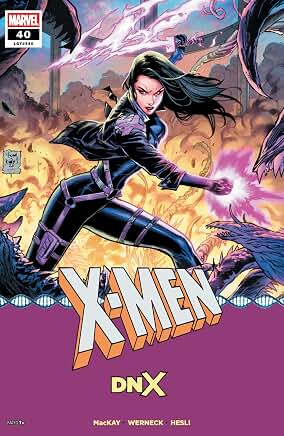 X-MEN vol 7 #40
“A Blade”
Writer: Jed MacKay
Artist: Lucas Werneck
Colour artist: Arthur Hesli
Letterer: Clayton Cowles
Editor: Tom Brevoort
COVER: Psylocke in action. Specifically, she’s fighting a monster whose tentacles are on the edges of the frame, and we’ll find out later that this is Myriad.
PAGES 1-3. Psylocke sets off after the 3K X-Men.
Ben Liu. In DNX #3, he used his powers to summon up the UFO thingies that are now keeping 3K’s airship in the air. To provoke him into using his powers, Scott basically trapped him on the airship and left him to get on with it. Understandably, Ben isn’t very happy about this, and Scott’s rather cursory congratulations probably aren’t helping. To be fair, Scott does acknowledge that Ben has a point and shifts tack to saying that it’ll have to wait until the crisis has passed.
Cassandra Nova. She was defeated by Quentin Quire and Jean Grey (using the Phoenix Force) in issue #37. It’s not clear how literally Cyclops means it when he says that she’s brain dead – as a psychic entity, the concept of brain death might not even be strictly relevant to her. Later in the issue, Psylocke doesn’t seem to think that she’s dead, and describes her as being “in our custody”.
Psylocke. This is her spotlight issue, and much of it is about whether she’s going to kill the 3K X-Men if given the chance. Her justification for going after the 3K X-Men is that they need to be contained, and (by implication) that her powers aren’t going to be particularly useful in dealing with the Juniper situation anyway. However, she tells us later in the issue that she intends to kill them “so that someone would pay for what 3K has done”.
Interestingly, Magneto offers to go with her, perhaps accepting her explanation at face value, but he doesn’t press the point. Cyclops specifically reminds her that “I trust your judgment implicitly” which, in context of the flashbacks that follow, is a clear indication that he knows she’s considering killing 3K.
PAGES 4-5. Flashback: Cyclops and Psylocke discuss whether she should have killed Andreas von Strucker.
This flashback appears to come shortly after issue #25, where the X-Men fought a new incarnation of Fenris led by the Strucker twins, Andrea and Andreas. In the original story, she and Andreas have a sword fight, which she wins. She then seems to be about to decapitate him, but relents when Andrea begs for forgiveness on the grounds that “He’s all I have”. Psylocke then tells Andreas that “Death would only be a release from your humiliation.” A couple of pages later, O*N*E show up with the media in tow.
Somewhat to Psylocke’s surprise, Cyclops says that if it wasn’t for the media, he would have agreed with her killing Andreas. As outright Nazis, Fenris were exceedingly unpopular even on Krakoa, but this is surprisingly harsh for Cyclops, in circumstances where capture was clearly an option.
Psylocke gives a speech about how she was raised by the Hand to be a killer and that used to be her solution to every problem; while she’s now trying to be a better person, this seems to translate into being more discriminating about whether to kill people and taking responsibility for the decision.
“Andreas von Strucker will not change.” This is an interesting comment, since the Strucker twins could equally be seen as having been shaped by the forces that raised them (and this was one of the things she and Andreas were talking about in issue #25). Psylocke seems to be drawing a distinction between herself and Andreas, not so much on the basis of how bad he is now, but on the basis of his inability to change. But Andreas did have a phase when he was a member of the Thunderbolts as the Swordsman. His reversion to type subsequently is certainly a point of distinction with Psylocke, but it’s open to interpretation whether Psylocke really has a basis for this claim, or whether she’s rationalising why it would be okay to kill the white supremacist. (The main story turns on Psylocke changing her mind about whether someone can change, after all.)
PAGES 6-7. Psylocke encounters a monster.
Her narration is just recapping the wider plot of DNX. The monster that attacks her is Myriad, as we’ll see later in the story.
PAGE 8. Flashback: Cyclops and Psylocke’s conversation continues.
Psylocke asks why she was chosen to be second in command, and basically gets told that she’s the only person on the team competent for the job. This is maybe a bit harsh on Magik, given her role on Krakoa, but she’s still probably more chaotic and unpredictable than Psylocke.
Psylocke seems to think that her background as an assassin makes her unsuited to lead – not on moral grounds, but simply because she was used as a weapon by other people instead of making decisions. Given Cyclops’ general characterisation in this book, he may well think that appointing her to this role will also help to focus her on escaping that role.
PAGES 9-17. Psylocke defeats Myriad.
Myriad has been aligned with 3K since issue #18, but we haven’t seen her in DNX so far (in fact, she was last seen in issue #24). The basic point of this scene is for Psylocke to start off treating the creature she’s fighting as a random monster to be killed, and to reconsider on realising who she’s actually fighting. In fact, Psylocke’s initial reaction is that Myriad presence illustrates that she hasn’t been killing enough people, when she could have been nipping evil in the bud.
Myriad’s knowledge of the X-Men stems almost entirely from Cassandra Nova, who has told her that Psylocke is the worst of the bunch, and the most murderous. This isn’t entirely wrong, given Psylocke’s assassin career. Cassandra’s claim that Psylocke was “born without mercy” is much more dubious, given Psylocke’s back story being raised by the Hand, but interestingly, Psylocke seems inclined to agree with the claim; she still isn’t drawing a clear distinction between her innate qualities and how she was shaped by the Hand.
PAGE 18. Flashback: Cyclops and Psylocke continue talking.
Basically, Cyclops tells Psylocke that her self-doubt is a good thing, something which is an unfamiliar concept to her.
PAGES 19-20. Psylocke spares Myriad.
Psylocke is prompted to reconsider, and decides that they’ve both been “led” to perceive one another as monsters. She essentially decides that Myriad has been driven into this role and is capable of change after all. The comparison is a little awkward, because Myriad spent most of her life absorbed within her twin sister Piper, and relatively little in the custody of Cassandra; still, Cassandra appears to be her guiding influence once she had a separate life.

So Jean rendered Cassandra Nova “brain-dead”. Then why couldn’t she help out with the falling ship once Cassandra was defeated?
“this is surprisingly harsh for Cyclops, in circumstances where capture was clearly an option.”
Scott also suggested killing Astra and Joseph in the Hellfire Murder. MacKay seems to view Scott as capable of premeditated murder under the right circumstances.
It’s interesting that this issue focuses on Kwannon in her role as leader. It’s clear that one way or another Scott will not be leading the X-Men once DNX is over. So I wonder what’s going to happen to Kwannon. She isn’t on the covers of issues 44 and 45 and I can’t see Magneto or Jean taking orders from Kwannon.
Another side quest in the main title while everyone else is involved in DNX. Just like the Fantastic Four storyline was still very much a Fantastic Four story by way of Ryan North, only set in the margins of DNX as a way of getting Magneto back up and running to factory specs.
Not that I mind these spotlight issues on the various members of the team, but it’s interesting that the real meat of DNX has been contained to the miniseries, while the regular titles crossing over into it have done their best to keep to the margins. It’s a lot different from the crossover events which spill into any number of titles and force you to read them to keep up.
Scott really is an example of the worst excesses of the Charles Xavier Child Soldier Training Program (First Generation). Or maybe he’s the star pupil. Take your pick. He’s the one least able to leave it all behind, no matter how often he tries, and we’ve seen him capable of killing under the right circumstances for many years now. His attitude now isn’t a surprise. And it’s telling when we do look at who he’s surrounded himself with. I mean, who’s the conscience of his team? Glob? It’s certainly not Juggernaut or Magneto…
@Michael: One can easily No-Prize Jean’s involvement by saying that telepathy is unaffected by distance (which has largely been canonical since Lilandra first made contact with Xavier), while telekinesis is. For Jean to stop the base, she would probably have to be in the general vicinity of Earth.
Oddly, Magneto *was* recently the conscience of the team, talking down Quentin and Idie after Glob was shot.
“Andreas von Strucker will not change.”
As Paul aptly pointed out, Andreas DID change for the better during Nicieza’s New Thunderbolts run, coming to terms with and altering some of his supremacist beliefs. But of course then Warren Ellis immediately wiped all that away when he soft-relaunched the book.
In that context, Psylocke’s comment could be read as sort of a meta-commentary — yes, as a comic writer, you can try to develop and progress characters. But there’ll always be a traditionalist lurking in the wings, waiting to revert every character to their earliest on-page portrayal.
I’m laughing at the idea that Ellis is a “traditionalist”. Ellis didn’t revert Andreas back to his old characterization. Ellis treated all his Thunderbolts characters as badly damaged people with severe problems. He made Swordsman creepy by revealing he had skinned his sister after she died and the hilt of his sword was made out of her skin so that his powers still worked. Ellis also revealed that Andreas only agreed to work with Osborn because Norman had promised to clone his sister, so he’d have her back. I honestly don’t remember much about Nicieza’s use of Andreas, but Ellis’ portrayal of him wasn’t that far different.
Besides, no one has reverted Magneto yet after all these years.
If only some would do a read through podcast of Thunderbolts so we could eventually find out how much Eliis changed the swordsman.
Ha, no, Ellis is certainly no traditionalist, that’s for certain. But he inarguably did erase most or all of the character growth Nicieza had done with Swordsman, and it’s that reverted version that’s stuck around since then.
Magneto is one of those unique cases that both defies AND proves the rule. John Byrne, of course, always hated Claremont’s attempts to humanize Magneto. There’s the story about Byrne telling Marvel he didn’t have time to pencil an issue of “New Mutants,” but upon being told it would involve Magneto returning to villainy, said he’d MAKE the time. And Magneto DID revert to full villainy for most of the ‘90s and up through Morrison’s run, with the pendulum only swinging back toward a more sympathetic portrayal after that.
Then of course there’s stuff like Howard Mackie clumsily turning Sandman back into a villain for, uh, reasons.
Yeah, Magneto did revert all the way back to (at least)1979 for the 1990s up till Morrison, but he’s stayed reformed for around twenty years now.
@Chris V- It was Nicieza who established that Andreas skinned his sister and that’s how his powers still worked.
I think the problem some writers had with Nicieza redeeming Andreas Strucker is that in the Claremont-Romita run he was a white supremacist who tried to rape a black woman. I can see why some people have issues redeeming a character like that.
Cyclops has indeed a history to order premeditated killings, from sending Wolverine after Mystique to using X-Force as his hit squad during the Utopia years, so there’s nothing new here.
The X-Men are well known for a longstanding tradition of redeeming their villains. The pioneer being Rogue who, although she appeared as a villain for only a few issues, still did enough damage (to Carol) for a long-term impact. Then came Magneto with his decade-long relapse but who ultimately became firmly established on the side of the heroes; Mystique has wavered back and forth, Exodus turned from villain to ambiguous, Frenzy did a full heel-face turn, and so on (Avalanche, Greycrow…). During Krakoa, even En Sabah Nur (!!) became somewhat of an anti-hero. So Kwannon is certainly not so special.
Ironically the Thunderbolts, who have long had the official premise of putting villains on the path of redemption, have had a much lower rate of permanent success (Songbird being the only one I could name off the top of my head). So when MacKay uses Andreas von Strucker as the one Psylocke declares to be unchangeable, this can either mean that she doesn’t know about his temporary redemption or – maybe more likely – she resents him precisely for his eventual backsliding, which she may see as a potential risk for herself too.
Hey, don’t forget Abe! Though being dead for a decade has definitely helped stop him from backsliding.
But Andreas did have a phase when he was a member of the Thunderbolts as the Swordsman
Well, so much for carefully not spoiling that in the podcast!
Funnily enough, character development written by Ellis in the Thunderbolts was also ignored by other writers. I’m thinking specifically of Doc Samson actually connecting with Speedball (sorry, Penance), making him use his old powers and generally initiating a reverse from the whole self-harm thing… which came to nothing and Robbie was stuck in the iron maiden suit for several more years. Until the Chris Yost New Warriors, I believe?
Anyway, in the ‘stuff from Thunderbolts ignored by everyone else’ from that era I’m most sorry that Songbird didn’t get to play a part in Osborn’s defeat in Siege.