Daredevil Villains #60: The King of the Sewers
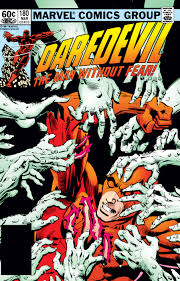 DAREDEVIL #180 (March 1982)
“The Damned”
Writer, penciller: Frank Miller
Finisher, colourist: Klaus Janson
Letterer: Sam Rosen
Editor: Denny O’Neil
Frank Miller’s first run as writer covers issues #168 to #191, but it’s built heavily around the trinity that we’ve already covered: Elektra, the Kingpin and the Hand. There are some edge cases in the rest of Miller’s run who might have qualified for this feature, to be sure. The Kingpin’s mayoral candidate Randolph Winston Cherryh gets a major speaking part, but he’s still basically a Kingpin pawn. There’s a subplot about the board of Glenn Industries trying to seize control of the company from Heather, but they’re mostly anonymous white collar criminals. And there are generic drug dealers and the like who drive the plot of individual stories. But these are gimmick-free criminals with a single story, and they all share the spotlight with more recognisable characters.
Once we score all of those guys off the list, this turns out to be our final entry from the Miller run. For those of you who might be wondering, issue #177 doesn’t have a villain – it’s an issue of Stick helping Daredevil to get his radar back. Issues #178-179 are the Kingpin. Issue #181 is Bullseye. Issues #182-184 have the Punisher as guest villain on loan from Spider-Man. Issue #185 is the Kingpin again. Issue #186 is Stilt-Man. Issues #187-190 are the Hand and the Kingpin. And issue #191 is Bullseye.
Daredevil Villains #59: The Hand
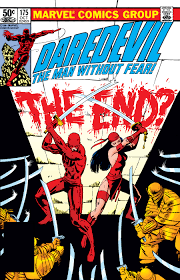 DAREDEVIL #174-176 (September to November 1981)
“The Assassination of Matt Murdock” / “Gantlet” (sic) / “Hunters”
Writer, penciller: Frank Miller
Finisher: Klaus Janson
Colourists: Glynis Wein & Klaus Janson (#174), Christie Scheele & Bob Sharen (#175), Glynis Wein (#176)
Letterer: Joe Rosen
Editor: Denny O’Neil
We’ve already had Elektra and the Kingpin, and now we complete the trinity of enduring creations from Frank Miller’s Daredevil.
Ah, the ninja! Historically, an expert in stealth, spycraft and infiltration. Over time, a part of Japanese folklore, with quasi-magical abilities. And in the Marvel Universe, a bunch of anonymous guys in bright red who attack in large groups and die. Or at least, that’s how they come across if you first encounter them in later stories. They’re the ultimate redshirts.
But what about their first incarnation? After all, recurring villains tend to rack up a string of defeats over the years – that’s the nature of the beast. Surely it was different when they started? Right?
The Hand make their debut in issue #174, when they assassinate one of Elektra’s targets before she reaches him. The narrator tells us that they’re “the same order of master assassins that taught her the many ways of murder before she broke training to operate on her own.” We’re told that the Hand want to kill Elektra because she left. But that’s not why they’re here – instead, the Hand have been hired to kill Matt Murdock.
Four anonymous ninjas do indeed attack Matt in his apartment. You might think that this was overkill when dealing with a blind lawyer – the random target in the prologue was taken out by a single ninja with a crossbow – but it sets the tone for the Hand right from the off. Why bother with stealth when you can just chuck expendable swordsmen at the problem? Now, these particular ninjas don’t know that Matt is Daredevil, and so they have an excuse for being taken by surprise when he fights back. And Matt duly beats them, almost singlehandedly – Elektra helps him out with the last one. In the aftermath, we learn that the ninjas always commit suicide and into gas when they’re defeated.
Daredevil Villains #58: Ladykiller
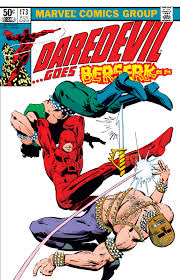 DAREDEVIL #173 (August 1981)
“Ladykiller”
Writer, breakdown art: Frank Miller
Finished art: Klaus Janson
Colourist: Glynis Wein
Letterer: Joe Rosen
Editor: Denny O’Neil
Our last two entries kicked off Frank Miller’s writer/artist run in style, with Elektra and the Kingpin. Up next will be the Hand. And in the middle… there’s this guy. When people talk about the highs of the Frank Miller run, they’re not thinking of this issue. It hasn’t aged so well.
Miller actually intended “Ladykiller” to be the name of the story. The character himself is only referred to as Michael Reese, when he’s named at all. The name “Ladykiller” only gets used in-universe in Amazing Spider-Man #219, where Daredevil mentions this story in passing for no particular reason. It’s an odd story to reference purely for a bit of Marvel Universe world-building, because Michael Reese is a sex offender, and this is a story about rape. Now, this is still a Code-approved comic from 1981, and so it can’t say in terms that it’s a story about rape, but it’s less than subtle in getting that point across.
As subject matter, this can go badly in superhero comics. It can easily come across as exploitative. It can also simply feel like a clumsy attempt to be adult, clashing horribly with the traditional superhero tropes in a way that ends up drawing attention to all the residual elements still unchanged from children’s comics past. And that’s pretty much what happens here.
Daredevil Villains #57: The Kingpin
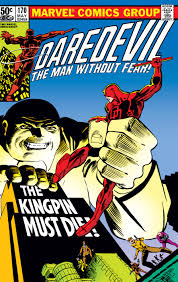 DAREDEVIL #170-172 (May to July 1981)
“The Kingpin Must Die!” / “In the Kingpin’s Clutches”
Writer, penciller: Frank Miller
Finisher: Klaus Janson
Colourist: Glynis Wein
Letterer: Joe Rosen
Editor: Denny O’Neill
We’ve skipped issue #169 (which is a Bullseye story), and so we go straight from Elektra to Frank Miller’s other major addition to the series.
The Kingpin had been around since 1967 as a Spider-Man villain. I don’t normally cover guest villains in this feature. But the Kingpin is an outright import into Daredevil’s rogue’s gallery, even if he’ll continue to be shared with Spider-Man.
On one level, there’s nothing new in Miller’s Kingpin. He’s built entirely out of elements taken from earlier Kingpin stories. But the Kingpin had never really worked before in the way that he does under Miller. So we should take a look at the Kingpin stories that came before this.
The Kingpin debuted in Amazing Spider-Man #50-52 (1965), by Stan Lee and John Romita Sr. It’s the “Spider-Man no more!” story, the one where Spider-Man dumps his costume in a trash can. The Kingpin installs himself as head of the New York mobs, and of course Spider-Man comes out of retirement to defeat him. At this stage, the Kingpin has some Silver Age gimmickry such as an “obliterator beam” in his cane – which will keep showing up for years to come. But the main premise is that the Kingpin plans to run the underworld like business. He seems to think he’s respectable, and takes offence at the idea that killing his opponents counts as murder.
Daredevil Villains #56: Elektra
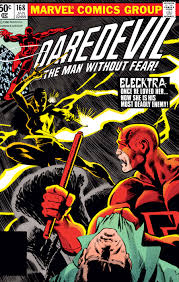 DAREDEVIL #168 (January 1981)
“Elektra”
Writer, penciller: Frank Miller
Inker, embellisher: Klaus Janson
Colourist: “Dr Martin”.
Letterer: Joe Rosen
Editor: Denny O’Neil
This feature began with me wondering why there were so few major Daredevil villains, despite the book having been around since the early sixties. Back in the first post, I wrote: “There’s the Kingpin, the Hand, Bullseye, um, Typhoid… um… does Elektra count…?”
Over fifty posts in, we’ve only met one character from that list: Bullseye. Typhoid won’t show up until 1988. But the other three are about to join the book in rapid succession, because we’ve now reached Frank Miller’s run – initially as writer / artist, with Klaus Janson as his finisher and inker, though Janson takes over on art entirely towards the end.
It’s a statement of the obvious, but Miller’s run genuinely is a quantum leap in quality. It’s not that the plots are that much deeper than before, so much as that the storytelling really kicks up a gear. Miller turned Daredevil into a book that people were talking about, and the sales increase got it back onto a monthly schedule again. And this run is the template for Daredevil going forward.
Daredevil Villains #55: Edwin Cord
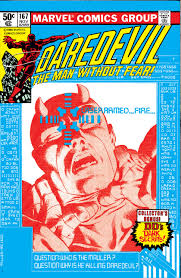 DAREDEVIL #167 (November 1980)
“…The Mauler!”
Writer: David Michelinie
Penciller: Frank Miller
Inker: Klaus Janson
Letterer: Joe Rosen
Colourist: Glynis Wein
Editor: Denny O’Neil
So here’s what happened since our last instalment. Issues #163 and #164 don’t have villains: the first one guest stars the Hulk, and the other is the story where Daredevil admits his secret identity to Ben Urich, who decides not to publish. Issue #165 has Dr Octopus, on loan from Amazing Spider-Man. Issue #166 brings back the Gladiator. And that’s the end of Roger McKenzie’s run as writer.
By this point, Denny O’Neil has taken over as editor, and as of issue #168, Frank Miller will be writing as well as pencilling. But first, we have another fill-in.
This one is a rather better fit than the Steve Ditko story we looked at last time. For a start, it still has the regular art team of Frank Miller and Klaus Janson. But this time, our guest writer is David Michelinie. At this point, he’s about 30 issues into his run on Iron Man, and he’s already completed “Demon in a Bottle”. So this feels like a contemporary Marvel comic from 1980.
Daredevil Villains #54: Mr Hyle
 DAREDEVIL #162 (January 1980)
“Requiem for a Pug”
Writer: Michael Fleisher
Artist: Steve Ditko
Colourist: Petra Goldberg
Letterer: Jim Novak
Editor: Allen Milgrom
So here’s where we are. Frank Miller is already established as Daredevil‘s artist. In just a few issues time, he’ll take over as writer and bring the book back to commercial success and critical acclaim. Daredevil will go into the 1980s as the book of the moment.
But we’ll get back to that. In the meantime, here’s a fill-in issue by Michael Fleisher and Steve Ditko. “Requiem for a Pug” is a melodramatic throwback which re-enacts Daredevil’s origin story and dares to ask: what if the Fixer had been a black guy with a leopard?
The story opens with Daredevil helping to shut down a “meson-reactor” which is about to explode. In the process, he’s exposed to vast amounts of radiation. Radiation, as we all know, is magic stuff that makes the plot happen. So as Matt makes his way home that night, he collapses in an alley. Then he wakes up the next morning as an amnesiac. Because that’s what radiation poisoning does.
Daredevil Villains #53: Eric Slaughter
 DAREDEVIL #159 and #161 (July & November 1979)
“Marked for Murder!” / “To Dare the Devil”
Writer: Roger McKenzie
Penciller: Frank Miller
Inker: Klaus Janson
Colourist: Glynis Wein
Letterer: Jim Novak (#159) and Diana Albers (#161)
Editors: Mary Jo Duffy & Al Milgrom
As I explained last time, Roger McKenzie’s run largely rested on existing villains. There are only two candidates for inclusion in this feature, and even they both debut playing second fiddle to more established bad guys. The new Ani-Men were henchmen of Death-Stalker, and Eric Slaughter is hired by Bullseye.
But their stories are also the earliest issues to be drawn by Frank Miller. And Slaughter has a better claim to inclusion than the Ani-Men, since he makes several repeat appearances over the next few years. Most notably, he’s the villain in issue #168, the debut of Elektra. He’s not exactly the focal point of that story either, mind you, but he does enough to justify us looking at him.
Slaughter’s debut story is simple. Bullseye hires him to kill Daredevil. The story is rather vague about Slaughter’s actual role in the underworld. He’s an elderly man who has a gang of thugs working for him, and who it seems are expected to do the actual killing. Daredevil has heard of Slaughter, but “thought he’d retired years ago”. Still, there’s no suggestion here that Slaughter has to round up some men in order to take on this contract. So apparently he’s some sort of gang leader who’s managed to avoid Matt’s notice. Frank Miller isn’t much clearer on this point, to be honest. Issue #181 describes Slaughter as running a “freelance assassination operation”, but in issue #168 he’s providing bodyguards. Either way, the operation can’t be particularly elite, because Turk holds down a job there, and he’s a comic relief moron.
Daredevil Villains #52: The Ani-Men II
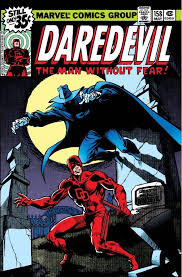 DAREDEVIL #157-158 (March-May 1979)
“The Ungrateful Dead” / “A Grave Mistake”
Writers: Roger McKenzie (#157-158) with Mary Jo Duffy (#157)
Pencillers: Gene Colan (#157) and Frank Miller (#158)
Inker: Klaus Janson
Colourist: Glynis Wein (#157) and George Roussos (#158)
Letterer: Joe Rosen
Editor: Al Milgrom
The second iteration of the Ani-Men only just about merit inclusion in this feature. They’re supporting players in the a Death-Stalker story, and a retread of an idea from the 1960s. But they scrape their way in because the second part is the debut of Frank Miller on art – and because there are only two real candidates for inclusion the whole Roger McKenzie run.
McKenzie takes over with issue #151, and his run offers the Purple Man (#151 and #154), Death-Stalker (#152 and #155-158), Mr Hyde and the Cobra (#153), Bullseye (#159-161) and guest villain Dr Octopus (#165-166). Issue #162 is a fill-in. Issue #163 has no villain – the Hulk guest stars to serve as the antagonist. And issue #164 is mostly a recap of Daredevil’s origin story. And that’s it. That’s the whole run. Bear in mind that the book is bimonthly at this point, so that’s two years of mostly retread villains.
This run does introduce Ben Urich, a genuinely major character who debuts in issue #153. He spends this run figuring out Daredevil’s dual identity and then deciding to keep it secret anyway. The run also introduces Becky Blake, a wheelchair-using lawyer, who promptly disappears into the background.
Daredevil Villains #51: Smasher
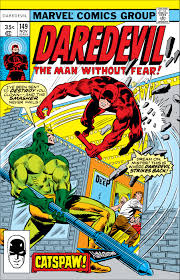 DAREDEVIL #149 (November 1977)
“Catspaw!”
Writer: Jim Shooter
Penciller: Carmine Infantino
Inker, colourist: Klaus Janson
Letterer: Denise Wohl
Editor: Archie Goodwin
Marv Wolfman is gone, and next up is Jim Shooter, whose short run lasts from issues #144 to #151. Even some of those are co-written: the first two are co-credited to Gerry Conway, while the last sees him hand over to incoming writer Roger McKenzie. By this point, Daredevil is floundering. With issue #147, the book is relegated to a bimonthly schedule, and it’s going to stay there until the 1980s.
This is the only Shooter issue that we’ll be covering, since the rest of his run relies on existing villains: the Man-Bull (#144), the Owl (#145), Bullseye (#146), Death-Stalker (#148) and the Purple Man (everything else).
There were reasons for this. For one thing, on Shooter’s own account, he was generally averse to creating new characters on Marvel’s 1970s work-for-hire terms – although he did introduce Paladin as a supporting character in issue #150. But in any event, Shooter’s top priority was to tie up some storylines that had been left unresolved by Marv Wolfman.
