Daredevil Villains #75: The Trixter
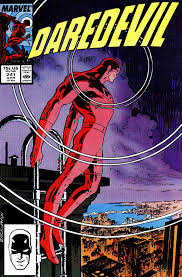 DAREDEVIL #241 (April 1987)
“Black Christmas”
Writer: Ann Nocenti
Penciler: Todd McFarlane
Inker: Al Milgrom
Letterer: Joe Rosen
Colourist: Christie Scheele
Editor: Ralph Macchio
With Daredevil still lacking a regular artist, this issue features guest art from a pre-stardom Todd McFarlane. Not all that pre-stardom, mind you – he’d been working for Marvel and DC for a couple of years by this point, and his run on Incredible Hulk started the same month. He’s still not an obvious fit for an Ann Nocenti story. But this is fill-in work, so it’s quite conservative and largely in line with Marvel house style. (The generic cover art, which is by Mike Zeck and Klaus Janson, looks nothing like the interior.)
It’s Christmas Day in New York, and the Trixter is spending it alone in a 42nd Street hotel room. According to his monologue, he’s a world famous magician and master of disguise, whose real name is a secret. He implies that he doesn’t even remember his own real name, having spent so much of his life subsumed in his Trixter persona or his various disguises. He finds his life empty. He’s fascinated by Daredevil, who he regards as “a bit of a trickster, a stuntman” – but who chose to be a hero instead of an entertainer. So, apparently hoping to learn something, he decides to meet Daredevil and let him “decide my fate.” He seems to be contemplating suicide depending on how his meeting with Daredevil goes.
So the Trixter goes to a costume shop (which is inexplicably open on Christmas Day and where the owner doesn’t seem to recognise him at all) and asks for a Daredevil costume. They don’t stock those, so he ends up leaving with a horned skull mask instead.
Next, the Trixter shows up at the Rockefeller Center, wearing the skull mask and an angel costume, for a bit of illicit tightrope walking. Again, there are a remarkable number of bystanders around, considering that it’s meant to be Christmas Day. Daredevil shows up, and senses that the Trixter is wearing some sort of device that issues “chaotic force waves” which are “adding stress to walls, loosening bricks”. Since this is potentially dangerous, Daredevil goes onto the wire and asks the Trixter politely to turn his device off. The Trixter tries to question Daredevil about why he became a hero, only to be disappointed by a bland answer about doing what feels right. A bit of fighting follows, with the Trixter apparently probing for some sort of display of vulnerability on Daredevil’s part to make him feel less inadequate about his own life. After feigning suicide by hanging, the Trixter reveals that he was faking it, and leaves.
Daredevil catches up with him later, by which time he’s performing as a street dancer. Once again, the crowd show no signs of recognising him, yet he doesn’t seem to be in disguise, and Daredevil confirms that he’s a “world-famous stuntman”.
After a brief diversion to deal with a subplot, Daredevil catches up with the Trixter again as he starts scaling the Empire State Building. By this point his device is actually causing some masonry to fall. Trixter gets to save Daredevil from a fall at one point, but doesn’t seem to find this act of heroism particularly satisfying. At the top of the building, the Trixter somehow manages to lash himself to the spire in order that he can die by lightning strike in a thunderstorm. Did I not mention that there was a thunderstorm on? Don’t worry, neither did the story. In fact, the art up to this point shows clear blue skies.
The Trixter seems to have a last minute change of heart, and seems encouraged by Daredevil telling him that his audience appreciates him, but then just gets struck by lightning and dies. And that’s that.
There’s a lot to admire in the Ann Nocenti run, and a lot of very successful creations to come, but this is what bad Ann Nocenti looks like. In theory, the Trixter is someone who was very similar to Daredevil but chose to become an entertainer rather than a hero, feels that he’s wasted his life, and is having an existential crisis about it. But the parallels feel forced. He’s a kind of stuntman, sure, but he’s not a trickster figure. The story would have worked much better with Spider-Man, who is both closer to being a trickster and has an entertainment industry back story.
On top of that, the Trixter himself is a fundamentally confused creation. He’s introduced as an illusionist, and a stuntman, and a master of diguise, when only the stuntman part seems to matter. The disguise element seems to be intended to suggest that he’s lost his sense of his core identity, but there’s a difference between disappearing into a public persona (which seems to be the real idea) and adopting a series of personalities (which is an angle that will eventually work for the Human Target). Besides, we never get any sense of the Trixter’s public persona – nobody seems to recognise him and nothing plays off the fact that he’s famous. It’s just asserted as a fact rather than actually being adequately set up. Nor does he ever come across as a natural entertainer – he’s just a guy who does stuff in public. There’s a huge mismatch between what the story claims for the Trixter, and what he actually shows.
I mentioned last time that the Nocenti run opens with a string of characters defined by mental illness: Jack Hazzard in issue #236, Sabretooth in issue #238, Rotgut in issues #239-240. Well, here’s number four. But the others feel more plausibly human, if unwell – or at least more plausibly animalistic, in Sabretooth’s case. Hazzard and Rotgut have recognisable human impulses, if fractured through mental illness. But the Trixter simply doesn’t. There’s nothing to hold on to with him.
You could, of course, say that that’s the whole point of the story. He doesn’t think there’s anything to himself beneath the surface, after all. But even if that is deliberate, where does it take us? The story doesn’t actually have anything to say about the value of entertainment, the impulse to entertain, or the impulse to be a hero – Daredevil simply doesn’t engage in the question of why he does what he does, not even to the point of citing his origin story. Nocenti has a tendency to create characters who are primarily delivery systems for her argument, which is fine when she has something to say about the subject. Here, she really doesn’t.

There’s a weird bit in this story where Matt fails to notice that a scammer is pretending to be a nun collecting for charity. Which is odd, considering that Matt can tell if people are lying by reading their heartbeats.
Nocenti raises the possibility that the Trixter’s death was just one more trick but no writer cared enough the Trixter to bring him back.
TIL – This was the only appearance. At the time, I thought it to be a reinterpretation of a silver age character. It continued her broader themes, but apparently I wasn’t missing a pre-internet reference here.
These posts bring me joy. Thank you!
This could be a short story by Chekov.
Thom is spot-on.
This isn’t one of Nocenti’s more memorable issues (she’d have better Christmas stories to come), but I’d argue the DD/Trixter confrontation isn’t the highlight of this story either, as fights and supervillains (as mentioned, she still does well with a number of the villains she uses) are rarely Nocenti’s forte. It’s more about the mood. It’s not perfect (Nocenti returns to this for a later Christmas story), but it’s a story about everyone being depressed on Christmas.
Marvel.com’s synopsis for this issue gives this issue a date of Christmas Eve, rather than Christmas Day, which makes more sense. The shop being open. The crowd. Karen decorating for Christmas. Who puts up a nativity scene on Christmas Day? On Christmas Eve, sure.
Silly villain, Trix are for kids.
The Marvel Unlimited synopsis is wrong. The opening scene is Christmas Eve, but the rest of the issue is expressly Christmas Day. It’s referenced at several points.
Thanks for the review, Paul.
It gave me a clear reason to read #241 again, and it is very much worth a second read.
It brings to mind quite a few noteworthy details.
First of all, we must discuss the Fatboys for at least a bit. They are street-level view characters if any character ever is. A group of at least four kids (we see seven in the early panels of #241) that were introduced in Nocenti’s Longshot series and had about 19 appearances in all, most of them in Daredevil. While Nocenti doesn’t quite write most of their appearances, they are very much Ann Nocenti characters and they make the most impact in her Daredevil run. Daredevil takes a very patronizing attitude towards them, as #241’s opening scene makes painfully clear. They would be Daredevil’s conscience if Matt ever bothered to listen to them, and they were the kids that helped Daredevil deal with Rotgut’s threat in the previous storyline (and entry in this series).
The Fatboys are performing a very carefully worded scam right there in the first – and page-sized – panel, oblivious to Daredevil approaching them in his unlikely “disguise” of large hat and overcoat over his full DD costume. Interestingly, the scam involves two of them in the classic (and unconfortable) position of one hangin over the shoulders of the other inside a Santa costume (as it turns out, the bottom half of Santa is a black boy, his face invisible, while the top half is a white boy – literally being carried over the other kid’s shoulders for added symbolism). There is a subtle implication that Daredevil may fail to detect the false nun either because the conperson is lying to itself, or because Daredevil has decided on advance that the nun will fulfill a role in the lesson that he wants to teach the Fatboys, or both.
Trixter’s very nature is loosely defined, quite possibly on purpose. There is no good reason – or even any reason whatsoever – for him to be carrying a device that weakens solid objects in his vicinity. His self-description is very suspect and there is a weird speech coming from him as he leaves the costume store, which makes us wonder whether the has some sort of supernatural power, or instead has convinced himself that he does, or perhaps he simply likes to scare people that he does not like. Adding to the uneasiness and sense that no one has true control over the circunstances, the mask that he is wearing at that time is presented as a real skull (from a buffallo, perhaps) that he impulsively puts over his own head and that the store’s owner fails to take away from his head, settling instead for charging Trixter for it (just seconds after claiming that the piece was not for sale).
The store owner also points out that Trixter has “a peculiar effect” on the store that makes things start falling over, which may be an early indication of the device that he is presumably carrying.
There is no good reason – or even any reason whatsoever – for Trixter to be carrying a device that weakens solid objects in his vicinity. But Daredevil’s radar sense confirms that there are “chaotic force waves (that seem to be) mechanical in nature” emanating from Trixter as he walks the high wire. In fact, we do not know that such a device even exists; Daredevil assumes that it must and demands Trixter to turn it off. There is never confirmation that the device is real as opposed to hypothetical.
Both Daredevil and the policemen are presented as a tad too worried about appearances and reputations. The policemen themselves point out that it makes them rather ineffectual.
Trixter is obsessed with appearing as something of a demon – and, while on the high wire, as an angel as well. At one time he wears red eyes and unnaturally pointed fingers and ears under the skull; those are gone in his next appearance, but by then his feet somehow take the appearance of cloven hooves (while he is breakdancing, no less). Due to the wonders of comics plot convenience, he manages to climb a building with said hooves and even find the time to save Daredevil from a nasty fall just minutes later – by which point he is also wearing a very cheap fake angel halo. He is clearly unbalanced, and his reaction to the lightning after he has somehow tied himself up to a steeple that is also a lightning rod implies some sort of lapse of awareness – perhaps due to dissociation, but the wording wants to make us wonder if he was possessed or something.
There are subtle yet powerful hints across the issue that Daredevil may be having mental health issues. The most significant among them he manages to forget that he has a Christmas dinner appointment with Karen and a friend of hers that has a new boyfriend.
Ultimately, Trixter isn’t a character worth exploring much. He is just a delivery system for some comparison and exposition for Daredevil, for the Fatboys, and for Nocenti’s own ideas to express on panel, develop and take form.
This story is a good follow-up for Rotgut’s two-parter. It presents or at least hints on most of the main themes of Ann Nocenti’s run very effectively, down to having Karen’s friend arbitrarily wondering if Matt isn’t cheating on Karen simply because he failed to attend the Christmas dinner. Karen herself comes across as very well-meaning but perhaps a bit too purposefully oblivious to the dangers of her current life situation. Almost as an afterthought we are also told that Karen’s friend (Hilda) knows that Karen used to be an addict and that Hilda herself used to be one.
Trixter says in his opening monologue that the purpose of the device is to attract Daredevil’s attention: “It would be easy to lure him out. I have just the device that will do it.” Quite WHY he has this thing lying around is anyone’s guess, but he does.
While we never see the device itself, Daredevil can sense the force waves from it, and there’s no real reason to doubt that it exists, I think.
Hilda didn’t used to be an addict. She was shooting up in Karen’s bathroom on Christmas. Karen asks her (paraphrasing), “How could you? Knowing…”
Yes, DD is eventually shown to have been suffering from PTSD after the events of “Born Again” during a large portion of the Nocenti run. I wasn’t going to mention it yet, as it only comes up much later in her run, but it makes a lot of the perspective we are being shown in a large portion of Nocenti’s DD read differently, as we’re unsure how much of it we are seeing through DD’s interpretations.
My mistake about Hilda (and the device). I ought to read more carefully.
I wonder how much of this issue’s oddity can be placed on Todd McFarlane. The inconsistent weather reminds me of a Hulk issue he drew in which the sky was supposed to be dark because of the new moon, but McFarlane drew a huge full moon in several scenes. The unseen device might be a case of Nocenti trying to write around the art’s limitations without success. I wonder if the issue was done Marvel-style or script to art.
Granted, this issue would be a bust no matter who drew it, but McFarlane’s storytelling choices may have made it worse.
The only thing I remember of the Fatboys is that time some of them were kidnapped by Mojo and turned into his Bratpack in a New Mutant annual… the same story which essentially imported Betsy Braddock into the X-Men circle just in time for Mutant Massacre and cemented her as one of the team forevermore.
Pretty sure I just assumed they were another one of those Claremont creations, but then again, pretty sure Mojo targeted the Fatboys because they’d been involved in the Longshot series so… I never was all that conversant in Nocenti’s work.
Most of them felt very much like background characters to give some shared world color to the mutant stories.
McFarlane is a fascinating figure for me, in so much as I rarely re-read any of his stuff (and I haven’t read Spawn in a decade or so since Erik Larsen’s run ended) but when I do check out things like his Spider-Man, Hulk, or other issues, his work just jumps off the page and is hugely memorable.
His writing of course isn’t great but his art, at his best, is so dynamic and interesting. It’s a shame in many ways that he essentially ceased doing interior art (outside of an absolute handful of occasions) after the mid-90s.
I love that New Mutants annual. It introduced so much into the X-Men’s world: Psylocke and Captain Britain, Mojo and Spiral, Doug and Warlock merging together, a rough draft of Jubilee. I would never expect so much worldbuilding to be done in an annual, but Claremont laid claim to quite a few characters and ran with them. I assume with Nocenti’s urging or assistance.
And it was peppered with ideas that never came to fruition: Psylocke and Doug’s attraction (probably best left alone), Psylocke’s prosthetic eyes, Xuan’s younger siblings’ potential mutant powers, the Fatboys/Bratpack’s potential mutant powers. You could still write a couple of miniseries using some of those ideas.
Oh, and of course Alan Davis knocked the art out of the park. That annual was maybe his first work for Marvel in the US after leaving DC.
I missed the Longshot mini and that annual when they were published, so to me the whimsical fantasy elements all seemed like nonsense. It was a terrible fit for the X-Men, an series ostensibly about civil rights and social strife. I never understood Mojo or why anyone liked that corner pf the X-universe.
That makes two of us, @Oldie.
I read most of Longshot’s mini, but it was a very difficult, unpleasant read. Mojo is just not a very good character, and I see no reason to use such wild fantasy in X-Men stories.
In the Longshot series, Mojo is an evil force of nature, greed and pestilence given form. It’s one of the only places he’s been a scary, credible villain. In the X-books, he’s often a buffoon. As much as I like Excalibur: Mojo Mayhem and his use in NYX, I don’t think Mojo’s a good X-Men opponent, either.
I don’t mind the X-Men going to more outlandish places. Bring on the leprechauns of Cassidy Keep and the Impossible Man. I’m down. But I get bored with Mojo quickly. I guess the writers have more fun writing a satire of Marvel as a company than I do reading it.
There’s definitely some value in Chis Claremont’s reappropriation of Mojo as a vehicle for media satire and hysterical consumer culture. Especially during the ’80s in general, but particularly in the context of X-Men achieving greater and greater commercial highs and rapidly expanding as a full-fledged franchise. At the time of New Mutants Annual 10, we were up to three ongoing series under the X-umbrella, with Excalibur and Wolverine to follow over the next two years. Claremont’s take on Mojo (like so much of his run lending itself to meta-analysis) can be read as airing some grievances and personal frustrations as the line increasingly ballooned out from under him. I imagine it’s a reinvention that Nocenti looked upon approvingly, given her own sensibilities and efforts to maintain some semblance of quality control alongside Claremont (and Louise Simonson) despite the increasing emphasis on quantity over quality.
So as a commentary and creative outlet in exorcising some demons, Claremont’s Mojo was definitely good for… another one or two stories, I guess. Beyond that, you’re just regurgitating the same plot and message (like a lot of the more visually interesting, but one-note Spider-Man villains). Diminishing returns set in quickly, which is painfully ironic given what Mojo represents conceptually as an early criticism of corporate enshittification.
@Chris V- The other problem is that the idea that Mojo was an anti-life force seemed to disappear the more Mojo was used. In X-Men Annual 10, Rogue tries to absorb Mojo and finds out that she can’t because he’s an obscenity that goes on forever. But that was the last time we really got the sense that Mojo twisted nature inside out.
Huh — I didn’t realize people disliked Mojo so much. I stopped reading shortly after Claremont left, so the Mojo appearances I read were relegated to a handful of annuals. I guess I missed the height of his overexposure.
As far as I’m concerned, the best thing to come out of importing the Mojoverse into the X-verse was Spiral. Aside from being a great visual, she added a bit of chaos to the X-Men’s world. How weird was it that she joined Freedom Force?
I remember thinking at the time that it would be cool if Spiral and Magik became rivals. That sounds kind of basic now, but I was probably 14 so I’ll give myself a pass.
Mojo has indeed changed a lot. Perhaps even more in perceived level of menace than in character concept as such.
In the Longshot series and the Claremont Annuals he was an obscene force of perverted nature, endangering ecosystems, callously exploring others, torturing Betsy Braddock out of personal convenience. To top it out, he seemed to be in no danger of ever suffering consequences for his cruel actions.
He was overused fairly soon – somehow it barely registers that he was overthrown back in the 1990s.
Of course, the very idea of a barely functional, barely rational, obese, yellowish, empathyless, entertainment-obsessed, entitled, overpampered villain hasn’t aged very well. Not in entertainment, anyway.
We’re in a post satire word where reality TV has taken over politics. A meme could start WWIII. Poor old Mojo just can’t keep up with that.
They should consider launching Mojo as a straight up horror book. I think there’s something to it.
Also, really good insight, Cyke68.
#Thom H- I think that one major reason why Spiral was added to Freedom Force was because Mystique’s Brotherhood lacked the raw power to fight the foes that the plots required them to. In Uncanny X-Men 199, Freedom Force fights the X-Men and Magneto. In Uncanny X-Men 206, Freedom Force fights a line up of X-Men that includes Rogue and Rachel (who has the Phoenix Force at this point). In Avengers Annual 15, Freedom Force fights a line up of Avengers consisting of Hercules, Black Knight, Monica Rambeau, Captain America, Wasp, Wonder Man, iron Man, Tigra, Hawkeye and Mockingbird. Blob, Pyro and Avalanche are dangerous but the old Brotherhood lacked the raw power to be serious threats in these circumstances without Spiral.
I also love Spiral’s design. Great visual. Too bad she’s mostly known for appearing in overly convoluted stories that are hard to get enthusiastic about.
In think there’s a place for a satire of the entertainment industry in X-Men lore, but Mojo never landed for me. Again, it was too wacky and over-the-top. I simply can’t read an X-Babies story and fit it into the same continuity as God Loves, Man Kills.