X-Men #27 annotations
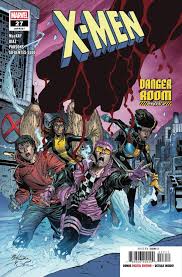 X-MEN vol 7 #27
“Danger Room, part 2”
Writer: Jed MacKay
Penciller: Netho Diaz
Inker: Sean Parsons
Colourist: Fer Sifuentes-Sujo
Letterer: Clayton Cowles
Editor: Tom Brevoort
COVER: Ben Liu, Animalia, Kid Omega and Temper react with shock as something with bloody hands approaches the Factory – it’s possibly meant to be Glob Herman staggering home, since nobody actually attacks the Factory in this issue.
THE X-MEN:
This is mostly an introducing-the-villains issue, so the X-Men themselves don’t actually do or say that much.
Cyclops, Juggernaut, Magik and the Beast are shown defiantly fighting Beyond’s techno-organic monsters.
Psylocke. We only see her in the Marauder as it comes under missile fire while she’s on her way to Greycrow. (Come to think of it, why didn’t she just get Magik to teleport her there before the mission?) According to Charlene Jackson (see below), the Danger Room’s “stated objective” in going after Psylocke was to separate her from the X-Men in order to weaken the team, by depriving them of her psychic abilities and her second-in-command role. Jackson and Maxine Danger both seem strongly inclined to see her dead anyway, which begs the question of why the stated objective was anything else – is it simply for plausible deniability, or does Frank Bohannon not actually want the X-Men dead? He didn’t spell out last issue what the Danger Room were meant to achieve, after all. See also the position with Glob Herman.
Kid Omega and Temper are at the Factory, reacting to Glob’s injuries.
SUPPORTING CAST:
Glob Herman. He’s not dead, though he is “fighting for his life” in the Factory’s medical bay (with Magneto apparently doing his best to treat Glob in Beast’s absence). Since Glob was shot at point blank range last issue, it seems reasonable to infer that the gunman wasn’t necessarily trying to kill him.
Xorn. He appears with Psylocke on the Marauder.
Magneto, Ben Liu and Animalia appear at the Factory tending to the injured Glob Herman.
Paula Robbins. She appears with the X-Men on the ship.
VILLAINS:
Maxine Danger. She describes herself as “something between a high-functioning sociopath and a narcissistic solipsist”. She claims to dislike prisons because of the waste of human potential (i.e., the waste of resources that might be available to people like her).
The Danger Room. A group of four prisoners that have been released into Maxine Danger’s custody so that she can use them to mastermind a scheme to bring down the X-Men. Maxine describes them as “manipulative, psychotic masterminds, adept in meticulously ruining lives”, and her apparent conviction that she can keep them all on side seems questionable. Still, it’s such an obvious point that she must have a plan.
They’re all new characters, and much of the issue consists of a series of flashbacks to Danger recruiting them in jail. They are:
Charlene Jackson. A sociopathic former SHIELD operations planner who used to deliberately plan her missions to bring about excessive casualties, including on her own side. She claims to have felt compelled to get as many people as possible killed before she was murdered, and to have met her self-imposed target, but to remain unfulfilled. She claims that she’s not allowed to speak in jail because she keeps convincing her cellmates to commit suicide; we’re expressly told that she has no superhuman powers, so apparently she’s just incredibly persuasive.
She presents as formal and professional – she insists on calling the X-Men “Codename: Cyclops”, “Codename: Psylocke” and so forth, and refers to casualties euphemistically. She’s responsible for the part of the operation that’s targetting Psylocke and, as noted above, seems to have no problem implying to Danger that she’s trying to get Psylocke killed.
Colton Colton. A psychopath who slowly engineered grudges in his trailer park community until everyone else killed one another, simply to see if he could do it. Again, we’re told that he has no powers; he’s just very manipulative. His focus is on trying to damage the X-Men’s relationship with the town of Merle, and re-ignite the tensions arising from the fact that the X-Men are occupying the Sentinel factory that used to be the town’s main source of employment. Broadly, his aim in shooting Glob Herman seems to be to provoke Kid Omega (and to a lesser degree Temper) into doing something stupid. Presumably, he was responsible for shooting Glob last issue (though it might have been another Beyond agent). He drinks beer while working, wears military gear, but explains his plans quite calmly.
Grigos and Marquez. Two men who claim to be Skrulls that were trapped in human form at the end of Secret Invasion, in a modified version of the fate that befell the first Skrull invaders (who were trapped as cows by Mr Fantastic). They claim that their true names have been stolen from them, but Grigos also insists that his name is an ancient Skrull name – presumably he’s claiming that it’s not his Skrull name, but a different Skrull name that he’s learned about.
The two of them met online and have been waging a guerilla war to weaken humanity in preparation for the next Skrull invasion; their incentive for getting involved in the Danger Room is to undermine superheroes. Maxine believes that they’re delusional and says so to their faces. She correctly identifies that the name “Grigos” appears to be Greek (it’s a village in Patmos).
They’re responsible for the attack on the ship.
REFERENCES:
- The fact that the Danger Room members had been released from jail (at Maxine Danger’s request but on Frank Bohannon’s approval) was mentioned in passing last issue.
- Mr Fantastic turned the Skrulls into cows in Fantastic Four vol 1 #2.

The colorist seemed to make Marquez and Gringos green-tinted in a few panels. I don’t think that was intentional.
I’m not liking Maxine’s claim that they laid the X-Men low without any super-powrs. No, no super-powers- just a virus supplied by Beyond that could turn a ship into a monster that can battle Cyclops. Beast, Juggernaut and Magik simultaneously.
It was a mistake to waste so much time introducing these losers who will probably never be seen again. MacKay should have used established villains.
Not a fan of the naming convention. ‘Danger’– sure. That is commonplace and ambiguous in a way that screams too much testosterone but is plausible. ‘Room’ should only be used as a place. If it is a group, the only reason to name them as ‘Danger Room’ is to confuse readership. It is implausible within a story. Even with aliens, superheroes, and convoluted plots calling them ‘Danger Room’ is the hardest suspension of disbelief to maintain. Cyclops, Storm and Magik are the ‘X-Room’ while Iron Man, Wasp, and Hawkeye are the ‘Avenger-Room’. Good grief.
Otherwise this was fine.
These new villains feel like they got ripped out of an indie horror comic. Specifically, the second-to-last issue where everything goes to hell.
Then Scott takes over and reminds us that this is a superhero comic and these slashers and schmucks stand no chance.
Yeah, this one wasn’t great. The villains aren’t that interesting and I’m not sure why we had to spend a whole issue on them. Now that I think about it, this book has spent a lot of time on villains, it just hasn’t been as noticeable because it ships fairly frequently.
They’re the Danger Room like the Star Chamber or the Shadow Cabinet… sounds great on paper but these names don’t always make sense outside of the original context.
I’d like to think that somehow, “Danger Room” is an actual term which escaped the X-Men sphere of influence and got into the public consciousness, or at least into the awareness of government, etc. Maybe from any of the times when the X-Mansion has been confiscated and/or occupied by outside forces. (Like with Operation Zero Tolerance or Orchis). Maxine, as a narcissist, couldn’t resist appropriating the name to feed her ego and poke at her targets. Hey, it’s a theory.
I also wish we could have gotten some established villains as part of Maxine’s team. Arcade, Thinker, Trapster, Kraven — not necessarily those specific characters, but that ilk. Maybe the sort of deep dive obscure evil geniuses who could have been rotting in prison since the Silver Age. I fear these jerks will fall into the same Box of Forgetability as most of MacKay’s other villain teams.
TBH, I’ve found standard comic book codenames harder and harder to swallow as a reader. It rings entirely false to me that two intimate people would call one another by codenames in the heat of battle. Like, when Jean sees Scott stabbed through the heart is she really going to scream “Cyclops” and not his real name? I don’t think so. (That’s a made-up example to illustrate my point).
I, for one, don’t mind the new villains, and I’m glad they’re trying to make new ones. And with the quicker shipping schedule, an issue focused on establishing who the new baddies are doesn’t bother me. Will they stick around past this arc? We’ll see. The “Skrull” couple is an interesting bit.
With the X-Men, they’ve been going with the idea that names like Cyclops or Wolverine are part of their mutant culture rather than simply superhero code names. I kind of liked that, but Marvel is still using given names like Scott Summers or Ororo Munroe outside of battle, like they are superhero code names.
Outside of that, you have superheroes with secret identities. If Tony Stark is injured in battle, the Wasp is going to call out “Iron Man” because she has to be a professional and can’t reveal Tony’s secret identity in battle.
@John- It wasn’t so bad with issue 24 because the villain was Beast, who’s a former X-Man and a major part of X-history. But these new guys will probably be a memorable as Hardcase and the Harriers.
The other odd th8ng about Danger Room being a name is that you already have Danger as an XMen villain . (Or did at one point in case they aren’t around anymore) and they’re the living embodiment of the Danger Room (if I remember the Whedon X book correctly).
“But these new guys will probably be a memorable as Hardcase and the Harriers.”
I remember those guys. They made a big debut in that one Uncanny storyline and pretty much never went anywhere after that. Another Claremont moment!
They were apparently supposed to be given their own spin-off series, as the Marvel Universe’s own version of GI Joe or something…but they were so boring in that one issue that they were condemned to comic book limbo.
So let me get this straight. They lured the X-Men into a trap, but they made sure Psylocke would be busy because she’s… an assassin, a telepath, and Cyclops’ second-in-command. Only, one and three aren’t any help against a monster ship, and if the idea is that the monster is uniquely vulnerable to telepathy, it’s just blind luck that Scott left his other telepath behind.
The maybe Skrulls are an interesting idea, though. I’m putting my money on “one’s a forgotten sleep agent, the other is just schizophrenic.”
I have similar mixed feelings about Maxine Danger and her goon squad: on the one hand, sure, there’s no reason MacKay can’t introduce new villains (considering his only active antagonists right now are 3K, Sugar Man and Revelation); on the other, I really can’t think of a reason this *wouldn’t* be Arcade, or a squad of Graymalkin prisoners. It’s a bit similar to his choice of Wyre: there’s no actual history with the X-Men or any real relationship to work off of, no reason for us to be particularly invested in the conflict.
@Diana- In fairness, MacKay wanted to use Cyber as a member of 3K but he was being used in Wolverine. So instead he chose Wyre who was (a) not a mutant, (b) had never met the X-Men and (c) was a hero the last time we saw him. It just seemed ridiculously arbitrary.
@Michael: I’m aware of that reasoning, and I’m sure MacKay’s love of deep pulls also played a part in that choice – it doesn’t change the fact that Wyre doesn’t have the kind of animosity/antagonism towards this particular team that Cassandra Nova, Astra and Krakoa-Beast would evoke.
Hell, even if MacKay had actually gotten Cyber, that would only be relevant if Wolverine were in this book. Which he isn’t.
I keep coming back to a sense that the Krakoan Era ended in a manner that doesn’t leave much in the way of a strong premise for a line of X-books.
Like, you want a mutant utopia? There was one! You just decided not to go to New Krakoa. And it’s hard to do a bigger or more complex version of bad future plots or war on mutants stories.
There’s a vague idea here about a new generation of mutants redefining the identity in a post-Krakoa world, but Eve Ewing was the only person really focused on that, and her book got retooled and relaunched to its detriment.
What is this stuff about, and who is it for?
Mark, you not only recall Danger’s backstory correctly, she is likely about to become more prominent than ever before because she’s part of the roster for a video game slated for release this summer, making the timing on this even odder.
(much like Galacta becoming the mascot of another game likely prompted the version of her from the last issue of Storm).
@Omar Karindu: That seems a bit short-sighted – it’s hardly the first time a run or era has ended and led into a shorter transition period before the next high concept. We were doing the whole “What do the X-Men even MEAN ANYMORE?!?!?” song and dance twenty years ago after Morrison too.
@Diana: I meant to imply that Ewing’s themes would have worked well as a direction for the line. But I also think that’s a story about modifying the premises of the books (much as Morrison and Hickman did).
My issue is with “From the Ashes/Shadows of Tomorrow” seemingly refusing to think through what the X-books might mean now.
I’d also argue that the X-books spent a lot of time in the doldrums between Morrison and Hickman, with even very strong writers hamstrung by editorial edicts aimed at getting “back to basics.”
Almost immediately after Morrison, Marvel decided it would be a good idea to ignore Morrison’s work and put forward the “big idea” of Decimation.
That lasted for close to four years as the status quo for the mutant titles until Marvel came up with a new “big idea” with Utopia.
After that, it was around the period where Marvel corporate decided to downplay the importance of the X-Men franchise due to movie rights issues. The mutant titles were left to flail around because the X-Men name was still valuable as a comic publication, but Marvel was trying to built up the Inhumans to replace the mutants. They did try some uninspired forced “back to basics” relaunches along the way, such as X-Men: Gold. Which gets us to Hickman.
The difference between then and now is that the X-titles were supposed to be Marvel’s flagship line again, and we ended up with this lacklustre direction. Yes, Decimation was a horrible idea, but Marvel thought they had a brave, new direction to take the X-books after Morrison, at least.
@Omar Karindu: Based on some of her more questionable creative choices in Exceptional, I wouldn’t necessarily trust Eve Ewing with that job.
@Chris V: You’re skipping quite a bit there. House of M/Decimation itself may have been mediocre, but it gave us PAD’s X-Factor Investigations, the Messiah Trilogy, Remender’s Uncanny X-Force, Carey’s run on Adjectiveless/Legacy… even middling status quos can beget great runs if the stars align.
That was my point though. Decimation might have been a horrible direction, but at least it was giving the X-titles a direction. As you point out, some of the creators ran with it and turned in top quality stories under that new direction.
Brevoort’s editorial reign, on the other hand, is completely lacklustre. There was a strong direction to pursue post-Krakoa, about mutants place in the wider world again. Brevoort seemed to want to mostly ignore this as a strong, unifying direction. It was the equivalency of Marvel ignoring Morrison’s run after he left (which is mostly what happened), but didn’t even bother with Decimation as a “big idea”, instead saying to creators, “Try to use less mutant characters and do some vaguely superhero-type stories with the X-Men again, maybe kind of like the 1990s, only not exactly. OK?”.
Perhaps comparing this run to MacKay’s other title, the recently ended Avengers, might be useful. Over there, he wasted entire issues (at least 2-3) on his “original villains, the Twilight Court. The Twilight Court are just the Knights of the Round Table with superhero action figure designs (and some gender/ethnticity changes). That’s it. They’re stiff, lame, uninteresting archetypes. Yet MacKay clearly thought they were legendary and engaging characters, to the point that he made sure to spend issues of time on their introduction, manipulation, and redemption. Including the finale. Nobody but him cares, and nobody but him, or maybe Saladin Ahmed (a master of reviving stories nobody wants, like Romulus), will use them again.
His main villain for the run was Myrddin, a knockoff of Merlin. He turned out to be Kang, in yet another scheme to challenge himself by literally fighting himself (from ten minutes ago) and then trying to steal a cosmic reset button literally named after the Holy Grail. This is what MacKay thought was worth 3 years of subplots.
The best issues of Avengers were the ones which avoided this subplot, usually due to crossovers. The worst ones were the ones neck deep in it. No editor realized this, and MacKay has not. Avengers fello below the top 50 many times under his watch, and only ended above it because the second-to-last oversized anniversary issue had Brian M. Bendis (or as I call him, Bendis the Horrendous) return for a backup strip (which was harmless, but a continuity nightmare).
Yet he got to run a crossover, by virtue of keeping B-Listers like Black Cat and Moon Knight in the top 50 for a year. That’s it, that’s the floor. Chip Zdarsky is about to run a crossover because he’s kept Captain America afloat for six months. Yes, yes, he won Eisners and has Sex Criminals, but they’re for quirkier stuff than mainstream superhero comics. Zdarksy’s run on Cap is firmly using “Marvel Time” to establish that Rogers was unthawed not only after 9/11, but after the war in Iraq started, which only makes all of us remember how old we are.
So, yeah, beware the Ides Of Avengers, X-Men readers. MacKay is not the Chosen One. Then again, I don’t know who could be at this point.
@Diana: I’d agree that Ewing’s execution was very low-key, and wouldn’t have worked for a flagship book. But the underlying idea would work as a them for a number of concepts.
If mutants see themselves differently after Krakoa, especially those who either chose not to enter the White Hot Room or those who never had the chance, then you could have competing notions of mutant rights and mutant identity and build the line around those differences.
That only works if there are some strong ideas about different redefinitions of mutant identity from the creators. They’d also need strong editorial coordination and good communication more generally to remain aware of each others’ takes or to identify a general conflict between a couple of triumphant, opposed new modes of mutant rights and identity. That would allow the line to build towards something.
What we have right now seems to me to be several books that are each sort of drifting amiably int heir own directions. McKay has a fairly standard superhero plot pitting his X-Men against some rather convoluted versions of mutant supremacism and a rehashed version of Freedom Force and the Sentinels.
Simone’s doing a lot of magical arcs with some mentorship plots, but with an underlying mystery regarding the “who is the Endling” idea, though hat mystery seems to be out of focus lately.
And Ewing was doing, for lack of a better phrase, almost a hangout book with some general political themes, but one that didn’t seem like it was headed anywhere in particular. And now there’s a big “school” book with a larger cast and what seems to be a less interesting direction.
@Chris V: Yeah. The current books just seem vaguely linked and conceptually hazy.
The Decimation era, in contrast, was an effort to return full-tilt to the idea of mutants as a tiny, endangered group fighting just to survive. The intended feel was grief followed by desperation, tot he point that they signaled the end of the Decimation by introducing a character named “Hope.”
It was an overreaction to the Morrison-era changes, to be sure, but at least it was a response, however misguided. Taken as a whole, the current X-line doesn’t even rise to the level of “misguided.”
I’m not sure that there are any flagship books in the X-Franchise right now. Nor am I convinced that it would be for the best if there were. Or even that it is actually possible to have such a book without a conscious and dedicated effort from editorial to make that existence possible again.
If there is a flagship book at Marvel at the current time, it is probably part of some event line (perhaps this current Ultimate 2.0) or Venom.
As things currently stand, there are far too many directions competing for being some sort of main event and editorial has consistently failed to choose a workable number to promote. From late 2023 to just under a year ago we had a whole new volume of Thanos’ solo book and a new Infinity Watch book (arising from, guess what, an event that no one noticed). That would be perhaps be odd, except that it was the same timeframe of Spider-Man’s Gang War; Fall of X and Rise of the Powers of X (which was quite the unnecessary event); Blood Hunt; Venom War; and One World Under Doom.
Several of those events are in a significant sense still ongoing. I would argue that “From the Ashes” is an example; it is more of an aftermath of “From the Ashes” than whatever “Rise of the Powers of X” was ever attempted to be. Similarly for the current Venom and Doctor Strange books.
I think that there three main issues operating here together.
1. There is a lack of clear direction from Marvel. No one is willing and able to establish what should be perceived (and promoted) as a flagship line or book.
2. Events are at once over-extended, overused and overlasting, spreading reader interest way too thin across multiple franchises, books and, at this point, _usually_ for at least a couple of years. That can’t be helping sales numbers much.
3. From all appearances, it has simply become too difficult to find and retain quality writers for so many books when there are so many viable alternate venues beyond Marvel and DC. Someone like James Tynion simply won’t commit to a Spider-Man run, let alone to one of several X-Books with very limited creative control and less opportunity for reward from creating their own characters.
I am apparently in the minority here in thinking that the current shape of the X-Books is a direct result of mistakes going back to the start of the Hickman run and which manifest in a lot of confusion about viable directions and even the current state of reader expectations.
It is usually hard to follow very visible runs, but the Krakoa Era botched its own exit phase in a particularly bad way and made “From the Ashes” very directionless before it even began. Personally I think that it was very much a victim of its own success; it may have sold well, but its later half (from the debut “Immortal” and “Red” at least) was, frankly, very mishappen indeed, despite all the pretty pictures.
@Chris V: You miss my point, actually – with Decimation, that took time. The hits didn’t coming launching straight out of House of M. I mean, Milligan’s Adjectiveless, yeesh.
Not that I’m expecting miracles while that idiot Brevoort’s in charge, I’m just saying the X-books have had low-energy transition periods before. Let’s not start setting out chairs for the funeral just yet.
“lackluster”
Lackluster was basically the remit. Don’t have a unified direction. Don’t have strong unifying themes. Don’t have an X-Slack for coordination. Clear the field so Disney can provide it with the movies (eventually) establishing everything without push-back. Lackluster was the plan. What we got was face-plant. Sure there was RLDS, cancelling the Magik series that wasn’t sexualizing her and replacing it with a mini that did, and his insistence on Phoenix being… uh… whatever that was; however has Brevoort added anything positive? As far as I can tell his only contribution is to insult people. He insults fans, colleagues, creatives. I honestly think that he became the Head of X exclusively by insults. I do understand that this isn’t a unique take on editorial in any era. At this point, I am not ranting but actually asking. Has he done anything positive?
“I’m putting my money on “one’s a forgotten sleep agent, the other is just schizophrenic.”
I would love that! I wouldn’t place money on it, but am enamoured with the idea. Adding my own daydream… how about Cadre K?
“Danger as an XMen villain.”
If Danger wanted to call herself “Danger Room” it would at least make sense. Not sure if she qualifies as a villain at this point, but complicated and qualified villains is one of the better X themes. She is what I was thinking of by ‘confusing the readership’.
“Several of those events are in a significant sense still ongoing.”
Editorial seems to think that themes and direction just means “event.”
I am looking forward to seeing the Greycrow subplot being tied together. Hoping that it lands with him having a purpose beyond simply robbing banks.
I will count myself as confused readership. I wasn’t really up on the Beyond Corp and before last issues annotations was thinking Maxine was some evolution of Danger and that the cliffhanger was just “why has Danger become an evil businesslady?”
Admittedly, that doesn’t hold up to scrutiny but just not knowing the character and having her dramatically revealed like I should, I jumped to the closest answer I could get.
@Omar- I think that part of the problem was that Brevoort didn’t KNOW how the Krakoan Era would end. It’s hard to craft a followup if you’re not sure what the ending is. Notably, Brevoort seemed surprised that the Krakoan Era ended with Magneto and Xavier basically switching places and had to quickly retcon away the “Xavier killed humans” thing. And he seemed to think that Magneto was resurrected by the Five, which is why the reason for Magneto’s problems had to be changed from “RLDS” to “retrocausality”
.@Chris V- I think that the X-Men never really went “back to basics” between Morrison’s run and Hickman’s run. Jean stayed dead for almost a decade and a half after Morrison’s run. Then there was the Decimation- new mutants didn’t start to reappear until after AVX and at that point Marvel was already getting ready to have the Inhumans usurp the X-Men’s role in the Marvel Universe. Then Xavier, Scott and Logan all died and the time traveling Original Five came to the present. Krakoa was the first X-Men run since Morrison’s that featured Scott, Jean, Xavier and Logan, new mutants appearing like normal and no time traveling Original Five.
I think the post-Morrisonian books were also more of a transitional free-for-all phase rather than a new direction.
The end of HOUSE OF M in December of 2005 was promoted by Quesada in much the same way “One More Day” was, as a new editorial rule in story form. And like “One More Day,” a new direction for the franchise did not really follow from HOUSE OF M, except in so far as it lacked the Morrisonian element of a large mutant population with its own burgeoning culture (as Paul’s own reviews later noted, only Peter David’s X-FACTOR bothered to use HOUSE OF M as a springboard for new stories, while other writers just did whatever they wanted). We saw multiple new directions over the following years for the flagship titles, including a line-wide “What if mutants set up somewhere where they were loved and accepted?” setup in 2008 when the X-Men moved to San Francisco.
To my recollection, the X-Men-on-the-edge siege mentality that should have been the follow-up act to HOUSE OF M only really got going with the “Utopia” storyline. Consequently, whereas the Avengers epic that started with CIVIL WAR and ended with SIEGE lasted about four years, the threat of mutant extinction arrived at the end of 2005, a proper response didn’t get underway maybe sometime in 2009, and a resolution didn’t occur until 2012.
@Luis Dantas- First, there’s a difference between a flagship book in a line and a flagship book in a company. X-Men and Uncanny X-Men are flagship books in the X-books but might not be flagship books in Marvel overall.
Usually, a flagship book is the top seller in a line or at a company.
Venom is definitely not a flagship book. The reason it’s in crossovers like Death Spiral and Queen in Black is because the non-crossover issues didn’t sell very well.
And Rise of the Powers of X was supposed to be a crossover with Fall of the House of X, not an aftermath.
IIRC, part of what made the post-Morrison books such a shift was a similar lack of communication about how his run would end. I remember Claremont saying he wrote the first few issues of his Genosha-based Excalibur without knowing Magneto was going to be revealed as Xorn or appear in Morrison’s run at all, hence why Planet X gets addressed with a single offhand “Oh, that wasn’t me” line.
Who gets to decide how a run will end – and how it is supposed to be followable in some way?
I assume that it varies considerably, but tends to be a combination of writer decision and editorial intervention.
Krakoa might have ended up in a workable way. IMO it very much did not, and I will always remember it as a period with some good ideas that decided to revel in crashing and burning at its last third part (from “Sins of Sinister” up to “Dead X-Men” and whatever it was that happened to Phoenix and Hope).
Blaming the caretakers that come after the damage was done is a very odd attitude IMO.
I don’t see how Krakoa didn’t end in a “workable way”. I’m not really sure how a creative direction can end without it being somehow workable for those that follow, barring killing every X-Man character or Professor X committing genocide in the name of mutants, or something completely off the rails like that. Krakoa ended with a dull thud, sure, but that simply means that the follow-up is better placed, as if the fans are still in love with the prior direction it’s harder to catch the audience. Brevoort has managed to follow a “it might be for the best that Krakoa is ending now.” with a “geez, maybe we do kind of miss ‘Fall of X’”, which is really quite a feat.
Michael pointed out how Brevoort might not have been adequately prepared for the changeover between Krakoa and “From the Ashes”, and maybe that might have been a plausible explanation for a slow or awkward starting point. It’s now been two years since the relaunch. Brevoort has moved on from “From the Ashes” with the even more misguided “Age of Revelation” and now into more of the same with “Shadows of Tomorrow”. There comes a point when the “new caretakers” certainly are to blame, and that point arises far sooner than two years into an era.
That Captain America continuity implant story blew me away. The Gulf War Captain America is a fascinating character and a great mirror to Steve Rogers. The story defied every trope.
As for direction with the X-Men, I’m surprised they did away with Orchis. It’s almost comical how Orchis arrived on the scene fully formed, took control of the whole solar system, then completely vanished as quickly as they arrived. Why not have them hang around, diminished but still a major threat, the “fears and hates” bit as something tangible to punch. Orchis isn’t overtly connected to Krakoa, and doesn’t need Nimrod. A curious decision.
Bendis is a good point of comparison to MacKay. Both got big on the strength of their street-level solo books, and both are weaker writing cosmic-level stories or team books.
Though Jed MacKay is leagues better at writing, imo.
@Si:
Yes, it is a bit disorienting that Orchis came so suddenly and went so completely. I _think_ there was some explanation for why they are not around anymore in the “Fall” part of that time period, but it was so utterly unreadable that I can’t bring myself to check.
@Chris V:
I suppose any status quo can be followed up if you don’t care very much on how organic that follow up is.
The way I see it, Krakoa was never very organic at all. It brought up all kinds of interesting questions and heroically jumped over them all without more than token gestures at grappling with any. It did not follow _at all_ organically from “Age of X-Man” either, but apparently it was never meant to.
“Fall” was such an overlong, tortured, pointless mess with way too many pages and way too much empty posturing that I wish it had not been published at all. We all would be far better off if “From the Ashes” had been implemented as a timejump similar to 2000’s six-months gap.
Which is why I find it surprising that Brevoort is getting so much flak from what to my eyes looks _a lot_ like running with what rather damaged goods he was given to work with and seeking ways of shaping it back into some form of functional state. I’m sure he would love to be given charte blanque to reboot the whole line or something. I doubt he was given that choice.
Maybe I am wrong. Maybe he had enough leeway to keep the line without new releases for six months or so until some agreement on what the new direction would be. He should have, IMO.
I just don’t see that happening after such a deluge of late-day Krakoa material with so little reason for existing.
@Luis Dantas: I don’t think Brevoort is getting flak for the transition, so much as his absolute failure to do his job once he actually got underway. For someone who claimed his mandate was to make the X-Men Marvel’s top seller again, it’s rather surprising he has no discernible strategy to achieve that beyond crossovers and blindly flooding the market with disposable books – a tactic he’s used for *twenty-five years* with no real success.
Couple that with his complete inability to coordinate any given two books in the line at any time, and “running with damaged goods” doesn’t quite cover it anymore.
Honestly, my thought reading this is that these new villains feel a lot like the various one offs Paul has been documenting in his Daredevil villains series.
Do I remember Harrier and the Hardheads? Sorry, I’m not really into jazz.
The other thing about the Twilight Court was “Look, each of them is an archetype that is also one of the current Avengers”. I’m not saying “All the members of the villain team are one-on-one counterparts to the hero team” is necessarily an interesting thing, but it was a thing.
Oh, wow, apparently I remember Hardcase and the Harriers so poorly that I managed to forget their name between coming up with the joke and typing it. Which would be slightly less embarassing if the actual name didn’t sound more like a band than my version.