Daredevil Villains #40: Kerwin J Broderick
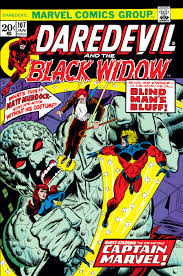 DAREDEVIL #104-107 (October 1973 to January 1974)
“Prey of the Hunter!” / “Menace From the Moons of Saturn!” / “Life Be Not Proud!” / “Blind Man’s Bluff!”
Writer: Steve Gerber
Penciller: Don Heck (#104-106), Jim Starlin (#105 Titan sequence), Bob Brown (#107)
Inker: Sal Trapani (#104, #106), Don Perlin (#105), Sal Buscema (#107)
Letterer: Charlotte Jetter (#104, #107), June Braverman (#105), Shelly Leferman (#106)
Colourist: Petra Goldberg (#104, #107), Janice Cohen (#105), George Roussos (#106)
Editor: Roy Thomas
Throughout Steve Gerber’s run, a mysterious shadowy figure has been giving super powers to oddballs like Angar and the Dark Messiah. Now, it’s time for Daredevil to meet this arch villain. It’s Kerwin J Broderick, the senior partner of the law firm of Broderick, Sloan and Murdock.
Until now, Broderick hasn’t been seen on panel, but Gerber has been building him up in a subplot. Matt is hired to defend a group of kids who are charged with robbery, and Jason Sloan keeps telling Matt that Broderick wants him to enter a guilty plea. The expectation seems to be that Matt Murdock, of all people, won’t merely persuade his clients to plead guilty, but will actually ignore their instructions. It’s a strange arc, since Gerber seems to think that this sort of thing would be classed as “slightly questionable” rather than “completely beyond the pale”, meaning that Matt reacts to it as simply a troublesome work problem.
Daredevil Villains #39: Ramrod
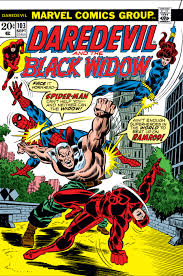 DAREDEVIL #103 (September 1973)
“…Then Came Ramrod!”
Writer: Steve Gerber
Penciller: Don Heck
Inker: Sal Trapani
Letterer: Artie Simek
Colourist: George Roussos
Editor: Roy Thomas
We’ve skipped issue #102: it’s a fill-in by Chris Claremont and Syd Shores, and the villain is Stilt-Man. And now, back to the storyline in progress.
Daredevil has been working his way through a series of new supervillains, all created as henchmen by a mystery archvillain. Daredevil has already faced the nebulously religion-themed Dark Messiah, and psychedelic oddball Angar the Screamer. Ramrod is the next in the series.
What is a ramrod, anyway? Good question! Well, it’s a stick for ramming things into a gun barrel. You probably have one at home for your own musket. But in America, it also means a foreman who’s a strict disciplinarian. That’s presumably the sense that Steve Gerber had in mind, since Ramrod’s extremely token origin story has him as an obnoxious foreman on an oil rig. When he gets crushed by an oil drum, he’s taken to the same hospital where Mordecai Jones became the Dark Messiah a few issues back. The same shadowy villain carts him off, gives him superpowers, and tells him to kill Daredevil.
Daredevil Villains #38: Angar the Screamer
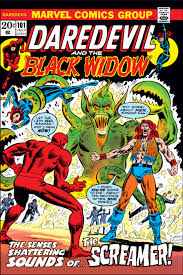 DAREDEVIL #100-101 (June-July 1973)
“Mind Storm!” / “Vengeance in the Sky with Diamonds!”
Writer: Steve Gerber
Pencillers: Gene Colan (layouts #100) & Rich Buckler (#101)
Inkers: John Tartaglione (finishes #100) & Frank Giacoia (#101)
Letterer: Artie Simek
Colourists: Stan Goldberg (#100), George Roussos (#101)
Editor: Roy Thomas
We’ve skipped issue #99, which doesn’t have a villain. Instead, it has Daredevil and Hawkeye literally fighting over the Black Widow as part of a loose crossover with Avengers. Natasha is so unimpressed by this display of 1970s machismo that she sticks around in Avengers for an extra month and skips Daredevil #100 entirely, despite being billed as co-star on the cover. So, in her absence, Daredevil has an anniversary issue all on his own.
In trying to find an approach to the book that works, Steve Gerber’s first thought is to play up the location. If this is Marvel’s only comic set in San Francisco, then surely it’s got to be about the counterculture, right? And so issue #100 guest stars Jann Wenner, the editor of Rolling Stone, who spends a good chunk of the book interviewing our hero. Daredevil endorses Rolling Stone as a quality publication, but “didn’t think the counter-culture was interested in anybody who works with the police.” Wenner assures him otherwise: “Of course they’re interested! You work with the cops, but you’re fair! You want the system to work justly, up-front – and even people who oppose the system can respect that!”
Daredevil Villains #37: The Dark Messiah
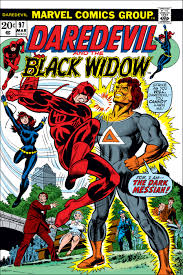 DAREDEVIL #97-98 (March-April 1973)
“He Who Saves” / “Let There Be – Death!”
Plotter: Gerry Conway
Scripter: Steve Gerber
Penciller: Gene Colan
Inker: Ernie Chua
Letterers: John Costanza (#97), Shelly Leferman (#98)
Colourists: not credited (#97), George Roussos (#98)
Editor: Roy Thomas
We’ve skipped issues #95-96, which are a rematch with the Man-Bull. That brings us to the final Gerry Conway story, which is also the first Steve Gerber story. Although he’s only the scripter, these issues kick off a storyline that runs through to issue #107, and so they’re more a part of Gerber’s run than Conway’s. Spoiler: it’s another of those arcs where Daredevil takes on a series of lesser villains before facing the final boss at the end.
Steve Gerber was still fairly new to Marvel at this point. His first comics were cover dated December 1972. But they included Adventure into Fear #11, the start of his Man-Thing run. Later in 1973, he debuts Howard the Duck. So some of his signature work is happening at the same time as his Daredevil run. In comparison, Daredevil is a minor entry in his bibliography. He plays this book fairly straight, at least while it remains set in San Francisco. Things change when the book moves back to New York, but we won’t get to that for a while. At this stage, there’s a bit of weirdness, but for the most part Gerber’s Daredevil remains within normal parameters for 70s Marvel. This is Steve Gerber showing that he can also be a safe pair of hands.
Daredevil Villains #36: Damon Dran, the Indestructible Man
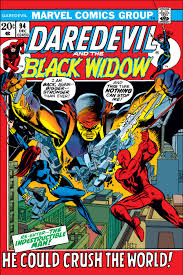 DAREDEVIL #92-94 (October-December 1972)
“On the Eve of the Talon!” / “A Power Corrupt!” / “He Can Crush the World!”
Writer: Gerry Conway
Penciller: Gene Colan
Inker: Tom Palmer
Letterer: John Costanza
Colourist: not credited
Editor: Roy Thomas
I’ve called these issues Daredevil #92-94, but you might have noticed that the cover logo quite clearly says Daredevil and the Black Widow. That starts with issue #92 and continues through to issue #106. During that time, editorial footnotes call the book “DD/BW”.
But according to Marvel, these title of this comic is was still Daredevil during this period. And they have a point. It’s not just a question of checking the copyright warning. The cover design of the time had the title in text just above the cover box, and that still just said Daredevil. The Stan Lee Presents captions on the splash pages still just said Daredevil. And for the most part, despite her equal billing on the cover, the book continued to treat Daredevil as the star and the Black Widow as a supporting character, albeit a prominent one.
The exception is the Project Four storyline, which culminates in these issues. But it’s a major exception. Gerry Conway introduced the subplot back in issue #87, as soon as the book relocated to San Francisco, and it’s been building ever since. In previous issues, we’ve learned that on her very first mission as a Soviet spy, the Black Widow and freelancer Danny French were sent to steal something from the mysterious Project Four. Project Four turned out to be a bunch of scientists working on a mysterious and allegedly powerful artefact. It’s a weird energy globe thing, and it’s the macguffin for the whole arc. Danny French has had it all this time, but he’s never figured out how to use it.
Daredevil Villains #35: Mister Fear III
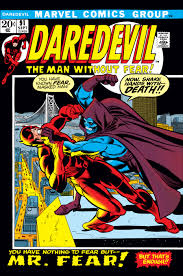 DAREDEVIL #90-91 (August-September 1972)
“The Sinister Secret of Project Four!” / “Fear is the Key!”
Writer: Gerry Conway
Penciller: Gene Colan
Inker: Tom Palmer
Letterers: Sam Rosen (#90), Artie Simek (#91)
Colourist: not credited
Editor: Stan Lee (#90), Roy Thomas (#91)
We’ve skipped five issues with returning villains, so let’s get up to speed.
Issue #85 is a Gladiator story and it doesn’t matter in the slightest. Issue #86 brings back the Ox, but it’s an important issue for other reasons: Matt Murdock and Karen Page briefly reunite, it all goes wrong, and they decide that they were never meant to be together after all. Matt then decides to move to San Francisco and pursue his relationship with the Black Widow which is where the book will stay for a while to come. The existing supporting cast are completely jettisoned. Karen joins the cast of Ghost Rider for a while, but doesn’t return to this book until issue #227. Foggy Nelson won’t appear again until the book returns to New York in issue #108.
In their place are the Black Widow, her sidekick Ivan Petrovich (who comes with Natasha as a package deal), and a bunch of new Californian characters mostly forgotten by posterity, such as irascible police commissioner Ironguts O’Hara.
Clearly either Conway or his editors decided that the book wasn’t working and that drastic steps were needed. After all, Daredevil had been on the verge of merging with Iron Man. So far, Conway has struggled to find a hook on Daredevil himself; moving to San Francisco doesn’t change that, but it does make Daredevil into Marvel’s token west coast book, and it means that the Black Widow can be mined for story ideas.
Daredevil Villains #34: Mr Kline
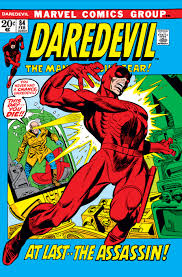 DAREDEVIL #84 (February 1972)
“Night of the Assassin!”
Writer: Gerry Conway
Artist: Gene Colan
Inker: Syd Shores
Letterer: Artie Simek
Colourist: not credited
Editor: Stan Lee
We’ve skipped issues #80-81, which feature the Owl, acting at the behest of Mr Kline. That story also introduces the Black Widow to the cast, which will shortly lead to a radical retooling of the whole series. We’ve also skipped issues #82-83, where Daredevil and the Widow fight android duplicates of the Scorpion and Mr Hyde, built by, you guessed it, Mr Kline.
That brings us to this issue, where Daredevil finally meets Mr Kline after some six months of build-up. And defeats him in one issue.
Context, then. At this point, Gerry Conway was writing both Daredevil and Iron Man. Both titles gave Mr Kline an extended build up over the course of several months, with Kline sending an assortment of seemingly random villains to carry out missions with little or no discernible link between them. In Daredevil, he’s also a blackmailer, extorting money from Foggy Nelson for some vague and unspecified mistake. Eventually, after the whole arc is over, we do get an answer to this question: it’s something to do with papers that Crime-Wave prepared when he was working in the DA’s office circa issue #59, and that Foggy signed without reading them.
Daredevil Villains #33: The Man-Bull
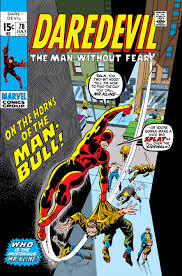 DAREDEVIL #78-79 (July & August 1971)
“The Horns of the Bull!” / “‘Murder!’ Cries the Man-Bull”
Plot: Gerry Conway
Script: Gerry Conway (#78), Gary Friedrich (#79)
Penciller: Gene Colan
Inker: Tom Palmer
Letterer: Sam Rosen
Colourist: not credited
Editor: Stan Lee
We’ve skipped issue #77, which is the comic that the Teardrop Explodes got their name from. It’s another random crossover – a prologue to Sub-Mariner #40, where Daredevil doesn’t appear. And it doesn’t have a villain anyway.
That brings us to the Man-Bull. It’s been a while since we had a new villain with any staying power whatsoever. He may be a Z-lister, but the Man-Bull does still show up from time to time. Why, he was in Miles Morales, Spider-Man just this year! Admittedly, he was teaming up with the likes of Mr Fish and Lady Stilt-Man. But hey, at least he was still in print in 2024. It’s more than you can say for most Daredevil villains of the early 1970s.
These two issues are part of the Mr Kline storyline, which was running through both Daredevil and Iron Man at the time. Kline is a complicated matter, and I’ll come to him properly next time. Fortunately, the details of Kline’s much-maligned arc don’t really matter for the Man-Bull. For present purposes, all you need to know is that Mr Kline kept showing up as a shadowy manipulator who got people to do seemingly arbitrary things with no apparent connection, all in service of a mysterious masterplan. In fact, for present purposes, you don’t even need to know that. All that really matters is that the future Man-Bull is a hapless henchman who’s been dragged into a larger scheme that he hasn’t got a clue about.
Daredevil Villains #32: El Condor
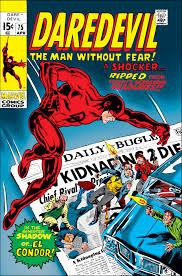 DAREDEVIL #75-76 (April & May 1971)
“Now Rides the Ghost of El Condor!” / “The Deathmarch of El Condor!”
Writer: Gerry Conway
Penciller: Gene Colan
Inker: Syd Shores (#75) and Tom Palmer (#76)
Letterer: Sam Rosen (#75) and Artie Simek (#76)
Colourist: not credited
Editor: Stan Lee
In certain parts of South America, January 1971 was an exciting time to be a diplomat, particularly if you fancied leaving the house. In Brazil, guerillas kidnapped four diplomats, and ransomed them to secure the release of 130 prisoners. At around the same time, in Uruguay, the Marxist-Leninist group Tupamaros kidnapped the British ambassador.
What, you might ask, does any of this have to do with Daredevil? And… well, yes, that’s a good question.
What it has to do with Daredevil is this two part story, billed on the cover of issue #75 as “A shocker… ripped from today’s screaming headlines!” Just to prove the point, it includes a Daily Bugle front page story about a kidnapping in Buenos Aires (or a “kidnaping”, as the cover says in three separate places). But this being the Marvel Universe, the story is not set in Argentina. We’re in the previously unheralded nation of Delvadia.
Daredevil Villains #31: The Committee
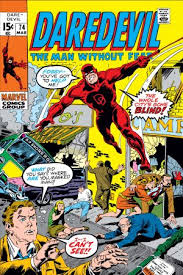 DAREDEVIL #74 (March 1971)
“In the Country of the Blind!”
Writer: Gerry Conway
Artist: Gene Colan
Inker: Syd Shores
Letterer: Sam Rosen
Colourist: not credited
Editor: Stan Lee
We’ve skipped issue #73, which is a crossover with Iron Man. The villains are Zodiac and Spymaster, but they’re not getting an entry because it’s not a Daredevil story. It’s an Iron Man story, and there’s absolutely no reason for Daredevil to be in it, other than (presumably) a vague hope of boosting sales. Daredevil’s contribution is to join in some fight scenes and to stand around listening patiently to pages of exposition about the origin of the Zodiac Key. Two issues in, Conway has yet to write anything for Daredevil which isn’t a complete dud.
Issue #74 is better, though it’s still not exactly good. It’s the second of Conway’s two stories about blindness. We open with Daredevil fighting some random thugs, getting clocked over the head, and miraculously regaining his sight. But alas, it was all a dream. This takes up a quarter of the book, because Daredevil‘s eccentric pacing decisions are unaffected by the change of writer. We still have languid opening scenes, and a desperate rush to finish the plot at the end.
