Daredevil Villains #48: Bullseye
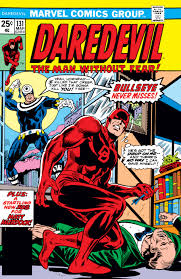 DAREDEVIL #131-132 (March & April 1976)
“Watch Out for Bullseye, He Never Misses!” / “Bullseye Rules Supreme”
Writer, editor: Marv Wolfman
Penciller: Bob Brown
Inker: Klaus Janson
Colourist: Michele Wolfman
Letterer: Joe Rosen
Well, it took us 48 goes and over a decade of comics, but we’ve finally reached one of the really big names. We’ve had enduring second-tier villains like the Gladiator, the Jester and the Owl. We’ve had some villains who were big deal for a short time, like the Masked Marauder and the Death-Stalker. And we’ve had a whole bunch of one-off villains. But truly A-list villains? There’s the Purple Man, perhaps, but his claim to that status rests largely on stories published long after he stopped appearing in Daredevil.
Bullseye is in a different position. He still appears in Daredevil today. He’ll get his own minis. He’s a recognisable figure around the Marvel Universe. He’ll even make it to the Dark Avengers. But it’ll take him a little time. He made it into the first Official Handbook of the Marvel Universe but didn’t make the cut for the Deluxe Edition – which means he was ranked below the likes of the Death-Throws, a team of evil jugglers. He didn’t get back in until Update ’89. So why didn’t he click immediately?
In a sense, he did. He immediately enters Daredevil’s rogue’s gallery and starts making repeat appearances. As you surely know, Bullseye’s gimmick is that he has a perfect aim and can turn anything into a deadly weapon. In his first story, Bullseye’s plan is remarkably sensible. Using his skills, he’s going to make a name for himself as an unstoppable murderer, and then extort money from the rich. So in his very first scene, he shows up in the office of wealthy Mr Hunnicutt, and kills him by hurling a fountain pen into his throat. Bullseye follows that by spraypainting a target design over the corpse, along with a message saying “This is an example to all who refuse to pay Bullseye.”
An origin flashback tells us that Bullseye was an unusually bloodthirsty soldier in the Vietnam War. He’d always had a perfect aim. When his gun jammed, he killed an enemy soldier by simply throwing the gun as a spear instead. After the war, he became a mercenary, using his uncanny aim to master throwing weapons. It’s not a million miles from Garth Ennis’s version of the Punisher’s origin: homicidal sociopath finds his niche in wartime. Bullseye claims that he only kills for the intimidation factor and says that he’d rather just be paid. But he certainly seems to be enjoying himself.
As part of his brand-building efforts, Bullseye lures Daredevil into a public fight at a circus. Daredevil holds his own, but Bullseye gets to look impressive, and having made that point, he simply leaves. Then he shows up at the home of another wealthy couple to extort them. When they call the police, he tries to kill them. Fortunately, Daredevil is on hand; unfortunately, the story has run out of space, and ends with Daredevil defeating Bullseye in a rather routine three-page fight.
Still, Bullseye’s core elements are present and correct from the outset. He’s scary because he can kill you with anything. He’s a sadist who enjoys toying with people. That’s Bullseye, isn’t it? That’s the character that became a hit?
But at first, Marv Wolfman won’t quite commit to the purity of the concept. Like Captain America or Hawkeye, Bullseye is notionally not a superhuman. He’s just extremely skilled. This is, of course, absurd. He does things that are completely impossible. But they have to be things that at least feel like they could be done by a suitably talented genius, at least if you don’t think too hard.
So it’s not ideal that the very first thing Bullseye does is to shatter a skyscraper window by throwing a paper plane at it from the other side of the street. That’s the wrong side of the line. It doesn’t matter how good your aim is, you’re not throwing an ordinary paper plane with enough force to go through a pane of glass. At best, it’s a Karnak stunt, not a Bullseye one. It’s the next page that gets Bullseye right, when he kills with a fountain pen.
On top of that, Wolfman gives Bullseye with a sonic gun. This is truly bizarre. The last thing Bullseye needs is a gun. He can already turn anything that he finds lying around into a ranged weapon. That’s his whole gimmick! So if you’re going to give him a weapon, it should be something that he can fall back on in close combat. The dynamic of his fights with Daredevil is that Bullseye has the upper hand at a distance, but Daredevil can win if he manages to get close. So that’s where Bullseye could sensibly have been shored up. But a ray gun? Why?
There’s another issue, which reads even more strangely with hindsight. Despite being a creation of the mid 1970s, early Bullseye has a foot squarely in the Silver Age. Eventually, he’ll work as a smirking killer, much like the Joker. And that element is absolutely present from the outset. But in his first incarnation, Bullseye is also prancing around circuses and doing wacky stunts with paper planes.
The fact that Wolfman sees Bullseye that way becomes even clearer in his second story. In issues #141-142, Bullseye actually defeats Daredevil in combat, and has our hero unconscious. Bullseye doesn’t just kill the helpless hero, or even unmask him, but opts for the classic death trap. Fair enough, that’s the genre convention. But what a death trap. We’re not talking a bomb on a timer here, oh no. Bullseye ties Daredevil to a giant arrow, and then fires it at a cliff using a giant rooftop-mounted crossbow. This isn’t even Silver Age Marvel – it’s Adam West Batman. And here’s Bullseye doing it in 1976, the era of Wolverine and the Punisher.
In his earliest appearances, Bullseye is a genuine hybrid: a gimmicky throwback with a darker 70s edge. As it turns out, Bullseye works better when he’s played straight, or at least deadpan. He’s a killer who gets a kick out of his outrageous defiance of the normal limits of human skill, mocking everyone else who has to play by the normal laws of physics.
The core idea of Bullseye is strong, and he’s a natural opponent for Daredevil as another skill-based fighter. There are endless possibilities for his improvised weapons routine, and everything that makes him work is there to some degree from the outset. It was just mixed up with throwback elements that needed trimming away.

Bullseye’s gimmick in Wolfman’s first story isn’t fully solidified yet in another way. Wolfman writes him as a guy who turns any common object into a deadly weapon, but this goes beyond his aim. He also manages to nearly kill Daredevil by commandeering a human cannonball’s launcher at that circus, and int heir final battle he wields an umbrella as a hand-to-hand weapon (speaking of Adam West Batman-style stuff…)
It also takes Bullseye quite a while to fully ditch that gimmicky sonic pistol with the special ammo cartridges. He uses some of the cartridges as late as issue #160, his first Frank Miller0drawn storyline (written by Roger McKenzie).
I tend to think of his one Jim Shooter-penned appearance, Daredevil v.1 #146, as the point at which the character really gels. There, he sticks to thrown objects, steals a perfectly ordinary pistol early on for later use, and has an utterly psychotic level of ego, forcing Daredevil to fight him on live TV just to try to win back his rep as the deadliest man alive.
Frank Miller seems to have liked that story; he returns to it in both issue #159 and in the final Daredevil story he pencilled, #191, wherein a videotape of the fight from #146 plays a central role in a rather depressing, surprisingly mature plot. (For my money, it may be the best thing Miller’s ever written.)
It’s also interesting that Bullseye goes back into dormancy after Denny O’Neil’s attempt to revive the character, mainly so Daredevil can have a big fight with him in issue #200. While that story ended up being quite consequential for Wolverine, it’s not especially memorable, gives Bullseye an odd gimmick of being able to psychically home in on Daredevil, and is mostly just a buildup for him to be humiliatingly defeated.
After that, he vanished from the Daredevil book for years, and his next appearance is in, of all places, the “Streets of Poison” storyline in Captain America, almost seven years later.
Also, a slight correction: Bullseye did receive an entry in issue #2 of the 1983 original version of the Handbook, complete with a Frank Millar portrait. He was left out of the Deluxe Edition for some reason.
This may have been related to the early plans for Miller to kill Bullseye off in the much-delayed Elektra Lives Again graphic novel. Perhaps they figured he’d get a Book of the Dead entry? (Notably, Elektra does get a one-page entry in the Deluxe Edition among the living characters.)
Bullseye has been described as a former pitcher. He shares this background with Boomerang. In fact, the similarities between Boomerang and Bullseye have been pointed out more than once, with Fred feeling overshadowed by Bullseye.
This isn’t the only time we’ve seen windows broken with ridiculous ease in the Marvel Universe- Redwing also broke through a window during a Kingpin storyline in Captain America. What are windows made of in the Marvel Universe?
Bullseye tying Daredevil to a giant arrow wasn’t really that out of place for the Silver and Bronze Ages- Captain Boomerang tried to kill both the Flash and Batman by tying them to giant boomerangs. And Boomerang’s battle with Iron Fist involved a giant boomerang.
Where Bullseye really takes off is during the Miller era. He essentially becomes Matt’s second foe after the Kingpin- he kills Elektra before getting dropped by Matt and nearly killed. And after that he appears at the start of O’Neil’s run in the Lord Dark Wind arc.
However. after Daredevil 200. in 1983, Bullseye wouldn’t be seen until the Streets of Poison arc in Captain America in 1990. The reason has to do with the Elektra Lives Again Graphic Novel. It was supposed to come out in 1984 and feature a resurrected Elektra killing Bullseye before dying herself. But Matt is practicing law in that story, so it has to take place before Born Again. But it took forever for Miller to finish the Graphic Novel and as a result Bullseye was absent from the comics. Finally. Mark Gruenwald, who was the number two at Marvel, got tired of this and decided to use Bullseye in the Streets of Poison arc. The Elketra Lives Again Graphic Novel finally came out a few months later and was declared out of continuity.
All of this had a couple of interesting effects. Miller intended the Graphic Novel to be Elektra’s final appearance. But since it was out of continuity, Chichester decided that he could bring Elektra back in 1993 since it was ambiguous in Daredevil 190 whether she was resurrected.
The other effect it had involved Lady Deathstrike. Originally, in Alpha Flight. the reason she went after Wolverine was because she was trying to recreate her father’s adamantium bonding process and needed a previous subject to experiment on. But she couldn’t find Bullseye so she went after Wolverine. But after Bullseye was brought back. writers later claimed she was after Wolverine because it was a dishonor that her father’s process was used on Wolverine against his will. which is ridiculous.
Lady Deathstirke, by the way, joins Hallow’s Eve in the category of Women Who Killed Their Abusive Fathers And Were Treated Sympathetically By Their Creators But Turned Into Psychos By Later Writers.
These early Bullseye appearances are great, and it’s easy to see why he became a regular fixture. But by the end of Miller’s first run I was bored of the guy, and no stories since then have made him compelling as an arch-nemesis.
At the end of the day, he’s just a bad guy who kills people; he doesn’t challenge Matt Murdock’s worldview in the same way as the likes of Kingpin, Punisher, Bullet, Typhoid Mary, or even the Jester.
Thanks – I’ll fix the point about the Handbook when I get a chance.
Marv Wolfman clearly needed an editor who wasn’t Marv Wolfman. The cover is too wordy. Bullseye’s spray-painted warning is too wordy. He has a sonic gun but uses a paper airplane to break the window? I mean, come on — a second pair of eyes could have easily trimmed a lot of the fat off these stories.
After Streets of Poison, Bullseye appeared in Nocenti’s Daredevil in Daredevil 284-290. He then disappears for a few years after that until Punisher 101 in 1995.
Bullseye cemented his position as Daredevil’s number two villain by killing Karen Page in Kevin Smith’s Daredevil.
@Omar- Something similar happened with Iron Fist in the Deluxe Edition. He was killed off. then there plans to resurrect him in Avengers, then those plans got quashed when Roger Stern was fired in Avengers. But the result of all this was that Iron Fist would up not getting any entry at all because they weren’t sure whether to put him in the living section or the dead section. First they were going to put in the deceased section then they decided he might be alive. He finally got an entry in the 1989 Update.
But Bullseye wasn’t the only villain who didn’t appear in the Deluxe Edition. Chameleon and Hammerhead didn’t appear in the 1983 edition or the Deluxe Edition, although Hammerhead was mentioned in the Maggia section of the Deluxe Edition. (Both got entries in the 1989 Update.) In Chameleon’s case, that was because he wasn’t used for a decade after Amazing Spider-Man 186. In that issue, he was portrayed as a pawn of Spencer Smythe and after that no one wanted to use him for a decade. Finally, in 1988, David Michelinie gave him actual shape-changing powers and a few months later Gerry Conway had him try to take over the underworld in partnership with Hammerhead.
“What are windows made of in the Marvel Universe?”
Something nice and soft to let heroes without handy protective powers jump through them and not get lots of gashes.
What is the current status of bullseye spinal injury, he is not being used as an adamantium user/thrall in Wolverine is the because he has had it removed or it not a weapon as in the others or just that the writer either does not know or is not allowed to use him?
Also the Owl is an A lister from the moment he was revealed at the end of the first X-factor arc he was their top villain the horse men of the owl in fall of the mutants, age of owl in the 90s, his role on krakoa and the recent heir of the owl mini. He was one of the most popular characters in the biggest comics at the peak of the comic book.
> What is the current status of bullseye spinal injury,…
Who knows. He’s been killed and resurrected at least once.
I think he’s missing an arm now.
There’s another way key factor as to why Bullseye is a nice counterpoint to Daredevil, and I don’t see it often made. That’s how a chaotic, amoral Bullseye plays well against the strict and Catholic Daredevil.
Also, I imagine that Bullseye’s real name of Ben Poindexter was intentionally an attempt to be ironic. When did he get the name in the comics? In the postmodern age we live it, where creators hate to use codenames, I laughed out loud that Marvel’s Daredevil: Born Again live action series used his name in the courtroom scene– it was truly a funny juxtaposition.
@dannythewall: The “Ben Poindexter” name shows up for the first time in Daredevil v.1 #146, but it’s strongly implied to be an alias when first presented.
Bullseye, in civilian clothes, gives that name to a police officer after a non-costumed Matt Murdock gets in an altercation with him. Matt’s radar sense tells him Bullseye is about to bean a store clerk with a golf ball; but to the clerk and the cop, it just looks like a blind man attacking a stranger. The officer lets Bullseye walk, failing to recognize him.
How soon we forget one of 2016’s biggest movies, X-Men: The Owl.
Omar> The “Ben Poindexter” name shows up for the first time in Daredevil v.1 #146, but it’s strongly implied to be an alias when first presented.
Yeah. His “real name” is usually given as Lester, no indication if it’s a forename or surname.
@SanityOrMadness: “Lester” seems to be from the Bendis/Maleev era, where Daredevil, while pummeling and mutilating Bullseye, tells the him that he’s dug into the latter’s past and learned his name and found out about his “prostitute of a mommy” and so forth while beating him to a pulp. The scene is more about how unhinged Matt is with anger than it is about Bullseye.
The name “Lester” has stuck to some extent, but later stories have never followed up on the idea that Daredevil knows about Bullseye’s past. Other writers, such as Daniel Way, have complicated the matter by showing other origin elements.
As with the Joker, I think most writers (and fans) see Bullseye as the kind of impossibly malign character who’s simply become “Bullseye,” to the point that there’s no way to do a full origin that doesn’t diminish the sense of threat. That as certainly Miller’s take on Bullseye, which has remained defining.
@dannythewall: Since Bendis’s use of Bullseye in the “Hardcore” arc of the Marvel Knights Daredevil series, the villain is also played as a moral challenge to Matt in that his bottomless evil and sadism tempts Matt to give in to his own anger and love of violence. Shadowlands has Matt’s murder of Bullseye signifying his full corruption by the Hand, for instance. Even in the Miller era, Bullseye was the guy Matt let fall to the street and break his back, who he later admitted that he desperately wished he could kill without losing himself in the process.
True to his codename, Bullseye’s behavior and endless provocations make him a target for Matt’s worst impulses. It’s another way that Bullseye has come to resemble the Joker,
@Michael: It occurs to me that writers go back and forth a bit on whether Bullseye is an especially dangerous physical threat, a dangerous schemer, or mostly a moral threat for Daredevil. Sometimes, as in Kevin Smith’s stories, Bullseye can run rings around Matt. And he’s usually shown as even matched or even slightly better than Deadpool, even with Wade’s healing factor.
But other times, as in the Denny O’Neil and Brian Michael Bendis eras, Bullseye is someone that Matt can take out brutally and definitively when he stops holding back.
And some writers, such as Bendis, O’Neil, and Ann Nocenti, write Bullseye as a sadist who kills folks but is mostly just a smug smirk barely hiding the mad dog underneath. Others, such as Daniel Way and Mark Waid, write him as a fairly intelligent planner and strategist.
In between, there’re the writers who treat Bullseye as an expert at killing people, down to having fairly advanced anatomical and weapons knowledge, an even (to some extent) witty and eloquent, but, again, restricted entirely to thinking about how to kill and hurt people. Warren Ellis and Frank Miller spring to mind for this take. (Miller even riffs on the infamous 1981 Tom Snyder interview with Charles Manson in Daredevil v.1 #181.)
@dannythewall, SanityOrMadness: I’d forgotten that in the interview scene in Daredevil v.1 #181, Bullseye explicitly disavows the “Ben Pondexter” name:
“Call me Bullseye. Pondexter’s just a name I’ve used. One of many.”
“What’s your real name?”
“Bullseye.”
I liked how Warren Ellis used Bullseye in his Thunderbolts run: a psychopath held in reserve for when the team was on the ropes. A little Bullseye goes a long way.
He was paralyzed in that run, too. You’d think all the paralysis and missing limbs would throw off his aim, but no.
Wasn’t Deadpool’s real name also originally meant to be a jokey alias, but it became stuck as his actual name?
In a similar vein, I know War Machine became called that because so many fans misinterpreted some cover art.
I say give him the name. Real people named Poindexter deserve something nice for a change.
RIP David Johannson.
Si> In a similar vein, I know War Machine became called that because so many fans misinterpreted some cover art.
It’s a little bit more complicated than that, although it’s kinda the gist.
Basically, Iron Man #282-283 had a story called “War Machine”, where a “speciality” (temporary) armour debuted, and they marked the story by scribbling “War Machine” over the logo. Consequently, the armour became associated with the name.
Concurrently, they had a story upcoming where Rhodey was going to become Iron Man again for a bit, and because of the response they changed their original plans for a blue & gold armour to him using a slightly-tweaked version of the “War Machine” armour. But it wasn’t until that story was done, months later, and Stark came back that he actually started calling himself War Machine. Which was ultimately because of that logo-scribble on the cover, but it wasn’t even Rhodey in the original story.
@Si: My understanding is that “Wade Wilson” started out as Fabian Nicieza’s in-joke to Rob Liefeld about the character’s close resemblance to DC’s Deathstroke the Terminator, Slade Wilson in name, design, and initial concept.
I suppose it’s appropriate that Deadpool’s civilian name started out as a bit of metahumor commentary.
Bullseye’s “Benjamin Pondexter” name, which has since morphed into Poindexter, wasn’t presented with the same kind of tongue-in-cheek attitude, and wasn’t much used after its initial appearance until it started popping up in the first Ultimate Universe and then the Netflix Daredevil series. Both of those do a it more with who this guy is beyond being an assassin and serial/spree killer.
But in the comics, neither the Benjamin Pondexter name nor the “Lester” name have fully stuck. Pretty much everyone calls him Bullseye in-universe, including Bullseye himself.
I think it’s largely because comics Bullseye is defined almost entirely as a sadistic, egotistical killer, pretty much living entirely in his “Bullseye” persona.
@Si: There’s also the persistent efforts to the fandom to get Marvel to canonize the Vanisher’s real name as “Telford Porter,” despite years of the Handbooks trying to make it an alias. Some stories over the years have treated it as his actual name, which seems to have been the original intent.
There’s also the Earth-1610/Original Ultimate Universe version of the Rhino, who ended up actually being some guy named “Alex O’Hirn,” which was previously just a jokey alias the Rhino used in a Peter David issue of Incredible Hulk.
Surely the most triumphant example of “in-joke becomes lasting character element” is Gwenpool, a variant cover image that ended up becoming a continuing character with an entirely distinct identity.
@Omar: I’d say it’s a toss-up between Gwenpool (most frivolous origins) or John Constantine (most lasting impact). As the story goes, Steve Bissette and John Totleben kept drawing Sting background cameos in Swamp Thing issues, and eventually Alan Moore turned him into a distinct character.
The name “Benjamin Pondexter” was always positioned as an alias. That wasn’t stated outright when the name first appeared in issue #146, but the story does say very clearly that Bullseye rented his apartment under that name – at a time when he’s supposed to be “one of the most wanted men in the country”.
As for the Vanisher, “Telford Porter” comes from the 1983 Official Handbook, which listed it as his real name without any suggestion that it was an alias, despite the obvious pun. It was officially retconned into an alias in the 1990s X-Men Index.
That explains why the 1983 Handbook states that Bullseye’s real name is “Unknown” and lists “Ben Pondexter” as an alias. The ’89 Update follows suit.
It makes me wonder why the Handbook writers felt the need to invent a name like “Telford Porter” for the Vanisher. Later versions of the Handbook treated “Telford Porter” as an alias The Deluxe Edition Handbook alos lists the Vanisher’s real name as “Unknown” and treats “Telford Porter” as an alias, which is hilarious given that the only time the “alias” had appeared was in the previous Handbook.
I know that some of the 21st-century versions’ writers were told by editorial that the “Porter” name was just an alias.
But then, I think the Handbooks also invented the “Angelo Unuscione” birth name for Unus the Untouchable, and they also did things like giving Avalanche and Pyro backstories.
As Brian Cronin has shown, it was also the Handbooks that changed Pyro from English to Australian:
https://www.cbr.com/x-men-pyro-brotherhood-evil-mutants-british-australian/
I’ve read claims that the Handbooks got some of the Pyro and Avalanche backstory material from Chris Claremont, but I don’t know that I’ve seen anything on the record. It’d suggest that Claremont revised Pyro’s origins following his co-creation of the character. (And apparently John Byrne’s idea for Pyro never made it onto the page.)
Bah. There’s a sentence in my last comment that ended up merged with another one, and should read:
The Deluxe Edition Handbook also lists the Vanisher’s real name as “Unknown” and treats “Telford Porter” as an alias, which is hilarious given that the only time the “alias” had appeared was in the previous Handbook.
As far as I’m concerned, the Riddler’s name is Edward Nygma and not an alias for Eddie Nash.
Telford Porter and Ed Nygma are great names. Comics should stop being embarrassed about being comics. One of my favourites is Al Ewing’s American Kaiju character, real name Todd Ziller.
On a similar subject, I saw that they made a Penguin TV show, and changed his name from the best name in comics, Oswald Cobblepott, to Oz Potts. How very dare they.
What is the difference between Oz pots and Yank pots? That’s a much stupider name than Oswald Cobblepott. It sort of misses the entire point of the Penguin character to try to give him some “hip” name.
It’s exactly right that comic creators need to stop being ashamed that they are adults writing for comic books. They try to make it seem less embarrassing that they are adults writing comic books. It misses the entire point of comics. Even if mainly adults are reading these things now, the sense of “anything can happen” is what always made superhero comics so fun. While both writers have written serious literature in the form, it’s something that Alan Moore and Grant Morrison never forgot. These stories are supposed to be crazy and mind-expanding. Al Ewing is one current creator who isn’t embarrassed that he is an adult writing comic books.
The Penguin’s named Oswald ‘Oz’ Cobb in the show.
The show is actually very good, but other than showing the Batman in the news at one time and the Bat-signal in the sky at another time, it could be any gritty crime thriller set in any American city (that’s New Jersey, I guess?)
The MCU is also bad for having to make fun of old school comic book names and identities. One of the things that soured me on a lot of the more recent stuff
And here’s Bullseye doing it in 1976, the era of Wolverine and the Punisher.
In 1976, the resident leprechauns of Cassidy Keep revealed to Wolverine his origin… as a mutated Wolverine! I’m not sure this “era” of Wolverine is all that different from this era of Bullseye.
@Omar- Sometimes the Handbooks were just revealing what the writers intended. For example, in New Mutants 5-6 and Uncanny X-Men 172-174, nowhere is it stated that the Silver Samurai is a mutant. It’s stated that he’s Sunfire’s cousin. so most readers assumed that his ability to surround his sword with energy was his mutant power. But that’s not explicitly stated in the comics until Wolverine 2-3, five years later. It’s the Handbooks that first stated that the Samurai was a mutant. What happened apparently was that he was intended to be a mutant but Claremont who wrote those issues and Simonson and Shooter, who edited them, never realized that nowhere in the script was it specifically stated.
Other times, though, the Official Handbook just made up information that was never referenced in the stories. The Handbooks claimed that Juggernaut and Black Tom met when Juggernaut was in jail before he got his powers for working ss a mercenary. That’s something that’s never been referenced in the comics and later stories suggested that they met when Siryn was a teenager, which would be after Juggernaut got his powers.
The MCU is a bit scattershot with its source material. Spider-Man made fun of names a few times, but The Marvels was almost too comicbooky. Doctor Strange had Xavier in his big yellow wheelchair.
Is anybody here watching Born Again? I’m kind of loving it, although they need to get Matt back in costume soon.
“Frank Miller seems to have liked that story; he returns to it in both issue #159 and in the final Daredevil story he pencilled, #191.”
The televised fight from DD #146 is also referenced in ELEKTRA LIVES AGAIN, the final FINAL Daredevil story that Frank Miller drew.
I’m watching Born Again, and yes, I think it’s very good so far. After three episodes it doesn’t have a lot of momentum, but each episode is a solid stand alone story.
I’ve only now watched season three of Netflix’s Daredevil, which was spectacular (I turned off the Netflix stuff after Defenders; more fool me).
Except now I’m Daredeviled out so I’ll probably wait until the season finale to watch it.
Currently on my own season 3 rewatch of the Netflix Daredevil ahead of getting into Born Again.
Tangentially, how is the Marvel Unlimited reading experience on a tablet? I’m considering getting it in place of physical books and Comixology-at-Amazon, and I’m curious if anyone here has any recommendations one way or the other.
Re: Marvel Unlimited. There are a few interface elements that take some time to get used to (it’s often a bit of a hassle to go from within the comic to the digital page listing the credits, for example) but it’s been my preferred comics reading app for years.
And despite its shortcomings, it’s still much more easy to manage than the DC version.
Fairly similar opinion. A standard iPad is very nearly the same size as a comics page, and if you’re dealing with a smaller screen you can use zooms or panel view.
Marvel Unlimited still has some pre-digital gaps (for instance, they’re just adding a bunch of Web of Spider-Man which was poorly represented), but it’s extremely good on the flagship series and often very good elsewhere.
Among the many things that the Official Handbook appears to have made up is that Sean Cassidy has a Bachelor of Science degree from Trinity College, Dublin. Trinity offers very few B.Sc. degrees (the normal degree for most things, including sciences, is bachelor of arts), only in things like nursing. This aspect of the character’s “official” backstory has fascinated me since I learned about it.
I quit buying comics last year and sold off like 80% of my 45+ year collection recently (no place for all that stuff in my new house). I got a recent 13” iPad to read comics on through Unlimited.
The UI is terrible. Navigation within the app is pretty janky. I figured out how to “follow” ongoing series, but can’t find a way to be notified when there’s a new issue in a series I follow.
Once you get into a comic, the experience is fine. Easy to read, looks good, pages turn with swipes or taps on the edges of the screen.
I have found the 3-month delay pretty off-putting. It just feels different from the weekly trip to the comic store. Up until last summer, I owned basically every X-book ever published. Now I can’t really even be bothered to read the new X-stuff. (Might also be disinterest brought on by the Krakoa stuff, which I didn’t enjoy, and the fact that the new stuff sounds awful in Paul’s reviews.)
Regarding Marvel Unlimited: I think navigation is a bit frustrating, especially when moving back from a specific page in an issue to a more general menu.
I also don’t understand why (how, even) it doesn’t have an inbuilt option to skip directly to the previous or following issue, something which most piracy-based comic book readers (i.e., CDisplay) get right immediately.
Nor, for that matter, why tradepaperbacks aren’t compiled. That I find especially strange: I understand trades are a format best suited for bookshoops/buying story arcs in bulk.
But if you don’t have an efficient interface to move easily between issues of the same series or the same time period (thinking of crossovers, for instance, or storylines spilling across various issues), why exactly prevent readers from the easiest way to follow through on a given storyline or event?
It’s one of those things where you can’t really complain about the relationship between price and sheer abundance of material you get access too, but that also seems limited (maybe because of that) in terms of some very basic functions and features.
Regarding Daredevil:
This is still, by and large, offtopic. But precisely because of Marvel Unlimited, and one of its “recommended reading” lits by specific authors (in this case, Al Ewing), I ended up reading a random issue of Ann Nocenti’s “Daredevil” run.
I’ve never been into Daredevil comics, apart from being kind of stunned by some of the Miller visuals, reproduced in some very shoddy Portuguese-language reprints adjusted to A5.
But I think I’m starting to get something of Nocenti’s sensibility – there’s an odd, anti-naturalist energy to it that I find myself appreciating, actually.
I’m wondering what folks find of her run, and if you’d reccomend it to someone who is by and large ignorant about Daredevil himself.
@Michael, Voord99: The Handbooks have an interesting place in Marvel continuity. They were always allowed to introduce background information on characters, which was meant to be canon.
So, for instance, the 1980s X-Men and Avengers Marvel Index series both treat new information from the Handbook entries the same ay they treat other stories. When, for instance, the Toad is introduced in “Uncanny” X-Men v.1 #4, the X-Men Index states that his “chronologically last previous appearance [is] in the origin narrative in the OFFICIAL HANDBOOK OF THE MARVEL UNIVERSE #11.” Much the same is done for characters like Unus and Mastermind.
Any new info for the Handbooks always has to be okayed by an editor of the book that’s most relevant, but it’s not always consistent how much involvement monthly comic writers and character co-creators have on any given profile (at least the, writers, ones contemporaneously working at Marvel). In the Gruenwald/Sanderson era, it’s also not clear how much leeway Gruenwald provided.
This does lead to oddities when the writers — either the Handbook folks or the books;’ own writers — lack some relevant real-world background knolwedge. The Banshee background thing about a BsC from Trinity College that Voord99 mentions, plus a lot of embarrassing mistakes about how inherited titles work fro characters like Ka-Zar, the Plunderer, and Baron Blood that got reader corrections in the back pages of later editions.
Incidentally, the X-Men Index issues from the 1980s also cleared up the Unus the Untouchable thing for me. Both of his civilian names — Gunther Bain and Angelo Unuscione — come from the Handbook. “Gunther Bain” was added under Unus’s headshoot ina Brotherhood of Evil Mutants entry in issue #2 of the 1983 Marvel Handbook, but then issue #11’s full-page Unus entry adds “Angelo Unuscione” as a birth name, making “Gunther Bain: something he legally changed to after emigrating to the U.S. from Italy. All of this was brand-new information in the Handbooks.
So the Handbook actually retconned itself! And then Scott Lobdell used this as a reference for the Acolyte called Unuscione, implied to be Unus’s daughter, in Uncanny X-Men v.1 #298.
@Salomé H.: I think you’d like Nocenti’s run, especially if you’re already vibing with it. Her characters in this run all speak in a kind of stream-of-consciousness style. It’s as if they’re reflecting on the themes and archetypes they’re meant to communicate. The stories and characters are politically themed, but often a bit surreal in he process.
Once the John Romita, Jr. art starts up, I think the book really gels. His more expressionist style and design sense pair well with Nocenti’s scripting style. The result is more than the sum of its parts.
I’d definitely recommend Nocenti’s DD. It’s my favourite run on the DD comic. I’d say Omar sums it up nicely.
As far as how accessible the issues are, I’d say it works well as a self-contained run. The Miller issues were the only DD comics I had read at the time I read Nocenti, and I never felt I needed to know anything except the basics about the DD character.
“Is anybody here watching Born Again? I’m kind of loving it, although they need to get Matt back in costume soon.”
No, they don’t. The show is cooking nicely. Don’t ask for the microwave.
Why is the name “Poindexter” laugh-out-loud funny, by the way?
I’m not sure if this question is rhetorical. The name Poindexter has taken up the slang meaning of a nerd. It became synonymous with a nerdy person due to its being given to a Felix the Cat cartoon character in the 1950s. It’s one of those instances where pop culture has informed the way we interpret a simple name, most likely without even knowing the context any longer.