Daredevil Villains #56: Elektra
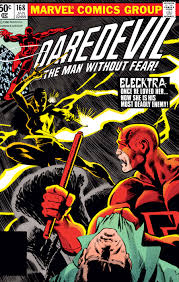 DAREDEVIL #168 (January 1981)
“Elektra”
Writer, penciller: Frank Miller
Inker, embellisher: Klaus Janson
Colourist: “Dr Martin”.
Letterer: Joe Rosen
Editor: Denny O’Neil
This feature began with me wondering why there were so few major Daredevil villains, despite the book having been around since the early sixties. Back in the first post, I wrote: “There’s the Kingpin, the Hand, Bullseye, um, Typhoid… um… does Elektra count…?”
Over fifty posts in, we’ve only met one character from that list: Bullseye. Typhoid won’t show up until 1988. But the other three are about to join the book in rapid succession, because we’ve now reached Frank Miller’s run – initially as writer / artist, with Klaus Janson as his finisher and inker, though Janson takes over on art entirely towards the end.
It’s a statement of the obvious, but Miller’s run genuinely is a quantum leap in quality. It’s not that the plots are that much deeper than before, so much as that the storytelling really kicks up a gear. Miller turned Daredevil into a book that people were talking about, and the sales increase got it back onto a monthly schedule again. And this run is the template for Daredevil going forward.
Elektra isn’t around for very long, not in her first run. She debuts in issue #168, and dies in issue #181. She remains something of a presence, since the next few issues have Matt going off the rails in response to her death. She gets resurrected in issue #190, Miller’s penultimate issue, but only to write her out; she doesn’t return until 1993. Then things change. She becomes a Marvel Universe mainstay. She gets her own book. Eventually, she gets to be Daredevil.
So, does she count as a villain? For most of her history, she’s been an antihero or a supporting character. But yes, the premise of her original arc is 100% that she’s a villain. It says so right there on the cover of issue #168: “Elecktra [sic] – Once he loved her… now she is his most deadly enemy!”
Except… well, let’s look at what happens.
Issue #168 begins with Daredevil beating up Turk for information, as is usual in Frank Miller stories. Daredevil is after Alarich Wallenquist, a criminal who can exonerate a man who’s wrongly accused of murder. Wallenquist has hired Turk’s boss, Eric Slaughter, for protection. But there’s also a price on Wallenquist’s head, and Elektra is here to collect it. She beats up Daredevil and goes after Wallenquist herself.
This leads into an extensive flashback to Matt’s college days. He bumps into Elektra, who is new on campus, and has an overprotective bodyguard. Matt impulsively tells her about his powers and the two spend a year happily in love. (This gets a one-panel montage.) When she and her ambassador father are taken hostage by terrorists, Matt tries to rescue them, but isn’t quite good enough yet: he accidentally knocks one of the bad guys out of the window, which leads the police to panic and open fire, and so Elektra’s father is killed. Traumatised and disillusioned, she quits college and goes home to Europe.
So Elektra has resurfaced as a “bounty hunter” – it’s fairly obvious that she’s an assassin, but the script tries to avoid saying so in terms. Daredevil goes after her, planning to bring her to justice, and they wind up teaming up against Slaughter and his men. Daredevil and Elektra kiss, and Daredevil leaves with Wallenquist, with Elektra left behind crying. That’s the first issue.
The whole dynamic is that Elektra is a villain who’s treated like a supporting character. She has a love/hate relationship with Daredevil, whom she blames for her father’s death. They ought to be fighting, but they choose to coexist. Over time, she becomes the Kingpin’s main assassin, which means she has to intimidate Matt’s witnesses and threaten Foggy, all leading to the inevitable conflict. But finally, Matt is spared the task of having to defeat Elektra because Bullseye gets there first, and kills her in revenge for stealing his spot with the Kingpin.
It’s a tragedy, then. Matt and Elektra would have been the perfect couple; she even dresses in his signature colour and looks much of the time like a natural partner for him (which of course is how she effectively winds up in 2025). But her father’s death sends her on the wrong course, and everything falls apart when she finally crosses paths with Matt again and has to deal with those choices.
Somewhere in there is her former association with the Hand. We’ll come to the Hand in a future post, but aside from her resurrection, Elektra’s basic story wouldn’t have been fundamentally changed if she’d been trained by someone else instead. The explain her martial arts prowess and, I suppose, they make her red colouring more ambiguous. And because she’s on the outs with the Hand, they provide another villain that she and Matt can join forces against.
It’s striking with hindsight is how focussed and straightforward Elektra’s character used to be. For most of the Miller run, there’s no mysticism in her stories, just a lost love turned assassin. By the time magic does come into play, she’s no longer an active participant, because she’s dead. The concept is clear and simple; the execution is focussed. Magic only comes into play via the likes of Stick, and as a vehicle for giving Elektra a fresh start – but as an active character, she’s kept away from it.
The name “Elektra” is odd. Readers were presumably expected to associate it with Carl Jung’s long-discredited Electra complex idea. But even allowing for Code limitations, Elektra’s relationship with her father doesn’t seem all that unhealthy. He’s overprotective of her and has a bodyguard trying to keep her away from everyone else, but she doesn’t go along with that – right from the start, she’s trying to get around that. Besides, to be fair to her father, there really is a terrorist threat, so apparently she genuinely does need a bodyguard.
What happens is really that she can’t deal with the loss of her father; in issue #190, her sensei suggests that she was left seeing the world as a dark and chaotic place. That issue also plays this as a mental block that she could never get past on her own; the point of her resurrection is that Daredevil’s failed effort to resurrect her somehow removes that darkness from her and gives her the chance to move on. There’s a suggestion that he’s taken on some of it himself, atoning for his failure in her origin story, and setting her free.
And move on she does – despite the seminal importance of this run, it takes a decade plus before DG Chichester brings her back into circulation. Her story is clearly finished, and it ends with her moving on without Matt. In the logic of the Miller run, this is no bad thing. Notionally, Matt’s love interest throughout this run is still Heather Glenn, but his behaviour towards her gets increasingly awful as the run goes on. Eventually, Foggy and the Black Widow sabotage their engagement and trick Heather into leaving the cast – and this is unequivocally played as saving her from an appallingly toxic relationship. Elektra’s happy ending is to be without him. Miller’s final issue is an epilogue in which Daredevil takes out his frustrations by torturing Bullseye, and ends on Daredevil lamenting that he’s “stuck” in an endless cycle.
The story hardly cries out for Elektra to be brought back, at any rate outside a prequel. Despite her popularity, that seems to have been the accepted position for a decade – perhaps because she was seen as Miller’s signature character and there wasn’t perceived to be much demand for Elektra stories by anyone else.
Still, her return was certainly no failure on its own terms. She’s been very popular in her current role. But it’s made her a muddier character – still a pretty good one, but the purity of the original has been lost somewhere. Her first storyline seems to position her as a Gwen Stacy with a happier ending, a character whose long term role is to be remembered, not to appear.

I guess Miller just named her Elektra based in broad strokes from the Electra myths. Electra’s father is murdered and Electra vows revenge. The brother character is missing and it wasn’t Elektra’s mother who she wanted revenge against though.
I seem to remember reading that Miller made a (non-binding) deal with editor Ralph Macchio (I think it was him) at Marvel that he wouldn’t allow anyone else to write the Elektra character as long as said editor worked at Marvel. Macchio then came up with the idea to bring Elektra back as an event story-arc to increase sales during the Chichester run, which Miller felt was a betrayal.
Back when Kurt Busiek was writing Avengers, I asked him about Mantis and if there was a possibility we could see her turn up at some point during his run. His response to me was that Mantis was one of those characters whom he felt was too tied into the sensibilities of her creator for any other writer to do her justice. He then went on to say that he’d never read a good non-Gerber Howard the Duck story, or a good non-Miller Elektra story, and he didn’t want to add to the pile.
So, I guess from that we can take that had Busiek been writing Daredevil, he wouldn’t have touched Elektra either.
It’s really the Epic Comics prequel Elektra: Assassin where Miller and Bill Sienkiewicz give Elektra both mystical talents and a much more literal version of the Freudian Elektra complex.
But that whole mini is aiming for a deliberately absurd tone and style. Miller is writing to Sienkiewicz’s gonzo art, letting him draw heavily stylized cyborgs, semi-human genetically engineered dwarves, Nick Fury sitting on top of a giant revolver, and a demonically possessed Presidential candidate whose face is depicted as a crude black-and-white photostat pasted on top of his body.
I think the real mistake was not only in bringing Elektra back, but doing so by also bringing in elements of her Epic miniseries.
Keep in mind that Elektra does wound Ben Urich pretty badly in Miller’s original run- and he’s shown to be traumatized by it in Spectacular Spider-Man when he talks with a hospitalized Robbie about Robbie’s fear of Tombstone. (Of course, that sequence is odd- in issue 179, Elektra appears to have killed Ben and in issue 180 Ben’s walking around talking about how he spent two weeks breathing through a tube. )
“The name “Elektra” is odd. Readers were presumably expected to associate it with Carl Jung’s long-discredited Electra complex idea. But even allowing for Code limitations, Elektra’s relationship with her father doesn’t seem all that unhealthy. ”
Elektra: Assassin is ambiguous about this. After drinking demonic milk, Elektra recalls being molested by her father but it’s not clear whether the memory is real or a side-effect of the milk. Further confusing this issue, when Marvel brought Elektra: Assassin into continuity, it decided that much of what happened was actually hallucinations by Elektra and Garrett.
Elektra’s resurrection in issue 190 is ambiguous- Elektra is climbing a mountain but it’s not clear whether Elektra is climbing a mountain in the afterlife or Elektra is climbing a mountain in the real world.
Elektra’s next appearance after Daredevil 190 was supposed to be Elektra Lives Again, which was teased in 1984. However, that story never came out until 1990. In the meantime, Bullseye was initially not allowed to appear in any story .In Elektra Lives Again, Elektra is seemingly killed again and Bulseye also seemingly dies. The problem is that this story takes place prior to Born Again and by the time Elektra Lives Again came out Marvel got tired of not being able to use Bullseye and he reappeared in the Streets of Poison story in Captain America, alive and well. So Elektra Lives Again was ruled out of continuity.
Supposedly, DeFalco had a gentlemen’s agreement with Miller not to use Elektra but D.G. Chichester, who was writing Daredevil at the time, convinced DeFalco to allow him to use Elektra. (Daredevil’s sales were declining at the time.)
This was after Busiek was writing Avengers, and I hate to say anything positive about other writers writing Gerber creations, but Chip Zdarksy’s run on Howard the Duck was quite good, especially the “After Beverly” story. Lethem’s Omega the Unknown was also genius. Which even Gerber admitted, eventually, that he enjoyed Lethem’s Omega.
Having said that, yeah, there haven’t been any good Elektra stories after Miller.
One correction- according to this website, Chris V was right- it was Macchio who had the gentlemen’s agreement with Miller, not DeFalco:
https://www.polygon.com/2016/3/9/11181058/elektra-punisher-explained/
Is the Millar/JRjr Tje Man Without Fear mini from the 90s comsidered cannon or is Eletra’s history during this run canon? The general plot is the same, it’s just the details that differ.
As I was reading the post, I did immediately think “I wish Paul could someone include Elektra Assassin” in this series.
Didn’t Rucka an Elektra book at one point? I would think it’s probably good, given his propensity for writing strong women. I seem to remember also liking the Elektra book that Scott Morse did.
@Chris V – It was probably like 1999 or 2000 when I asked that of Busiek, so yeah, his opinion was based on just what had been published up to that point.
And Chip Zdarsky? Really? That’s his name? I’ve never known a real person named Chip so I was beginning to think that guys named Chip only existed in the movies. I don’t have kids, but I couldn’t imagine naming my son “Chip”.
Unless maybe if I had twins. If I had twins, then I might’ve been inclined to name one “Chip” and the other “Fish” purely for the entertainment value I’d get in traumatizing them for life with those names.
This is tricky. Man Without Fear was originally supposed to be a movie script before being reworked into a comic. The problem is that Man Without Fear depicts Matt’s father being killed and Matt pushing a prostitute out a window while trying to avenge him before Matt goes to college and meets Foggy. Every other story depicts Matt going to college and meeting Foggy before Matt’s father dies. But the prostitute Matt pushed out the window is eventually revealed to be Typhoid Mary. So it’s basically a big mess.
This was not the first time making a Miller project that was supposed to be out of continuity canon has caused problems.
Batman: Year One was supposed to be an out-of-continuity graphic novel. But when Denny O’Neil took over as Batman editor, he found out that the title was at its nadir in sales- he was told that Batman and Detective were selling at levels so low they’d be cancelled at Marvel. So in an effort to revive sales, he decided to run Batman: Year One in Batman 404-407. and make it Batman’s official post-Crisis origin. This succeeded in reviving sales but it caused continuity problems. Batman: Year One features a Batman who is just starting out as a crimefighter and revolves around the brith of Gordon’s first child. The problem was that Batgirl was Jim Gordon’s daughter and was usually depicted as less than a decade younger than Bruce. Bob Greenberger and Barbara Kesel pointed this out to Denny O’Neil and in an issue of Secret Origins, they established that Barbara was Jim Gordon’s niece post-Crisis.
Mark-Rucka did write Elektra in the early-2000s, a few times actually. He took over the ongoing series from Bendis, but Bendis run was so bad I think it made me scrub the entire series from my mind because I have no recollection of anything from Rucka’s Elektra. I can only remember the horror of Bendis’ trash. Elektra gets an assignment from SHIELD to go to “Iraq” to kill Sodaminsane…or some horrible stand-in for real world personage. I am 100% certain it was a work of monumental genius compared to Bendis’.
He also wrote a Wolverine & Elektra mini-series, but that was about the art. I think it was an illustrated prose comic though.
Then, he wrote the Ultimate Daredevil & Elektra comic, but that was the Ultimate-version.
Sorry to break kayfabe, but Chip Zdarsky is not his real name.
“Sorry to break kayfabe, but Chip Zdarsky is not his real name.”
I knew it!!
Well, no, I actually didn’t, but that makes sense.
There are people who go by “Chip” (e.g., science fiction author Samuel R. Delany) but it’s pretty much always a nickname, not a legal name that a parent gives a child.
Of course it’s not his real name. His real name is Dale Zcharsky.
I see what you did there.
I just looked at at an image of Chip Zdarsky in Google. He looks exactly like someone who’d think Chip would be a cool nickname.
Oh, God. Turns out Chip Zdarsky and I were born in the same city. I hope we never lived on the same block. That would make him a Chip off my old block.
This just keeps getting worse. Can someone please steer the conversation back to Elektra and/or Frank Miller? Sorry for all the Chip talk. I blame Chris V.
There is one good Elektra story post-Miller, and it’s the prose part of Wolverine 102. Larry Hama wrote a series of captions in which Elektra recalls an event from her past. Adam Kubert drew a silent Wolverine comic, and Elektra’s words are reflected in Logan’s actions. It’s one of the best Wolverine comics of its era.
There was a Daredevil parody I read long ago, probably in What The. Elektra was dating Electro, mostly because they liked saying each other’s names.
Probably 1988’s “What The-?” #3. A story by Fred Hembeck.
However, they are named Electra and Elektro.
Miller recycled the Wallenquist name for a Kingpin-like crime boss in Sin City.
I knew two Chips in high school, and both were nicknames.
“I knew two Chips in high school, and both were nicknames.”
You did? Were you at all tempted to get them both up in an airplane somehow and then toss them out at a high altitude just so you could say, “Let the Chips fall where they may!”?
Okay, I think I shouldn’t be allowed to post here anymore. I’m even annoying myself.
Don’t forget to tell, “Chips ahoy!” after tossing them out.
Back in college, one of my freshman year roommates was a “the Third.” Eventually I learned that his dad was nicknamed “Chip,” and that it’s often used (among rich people) as a nickname for juniors, as in “chip off the old block.” (And less frequently, their sons are then nicknamed “Trip,” as in the third, though my roommate wasn’t.)
Y’all are so focused on “Chip” that you’re sleeping on “Zdarsky.”
Could it be an homage to Robert Z’Dar of the Maniac Cop film series and the MST3K-riffed Future War?
“Robert Z’Dar? Oh Z’No!”
I’ve always wondered if Chichester bringing Elektra back was a response – at least in part – to Miller’s work becoming increasingly and overtly misogynistic. Sin City had been going on for a while by that point, and even before that was the Karen Page of it all…
No. There’s an interview with Chichester somewhere online discussing “Fall From Grace”. Basically, he kept pestering Macchio to let him bring back Elektra, but Macchio was honouring his agreement with Miller. Then, DD’s sales were slipping and they needed a big event story-arc. So, they went back to the well, wanting to copy Frank Miller’s Daredevil (John Garrett is brought back and into continuity), as that when DD was one of Marvel’s top-selling titles. Chichester was coming up with ideas they should throw into “Fall From Grace”, and it was Macchio who told Chichester that they should bring back Elektra, as that would really help sales.
Also, Chichester’s work generally doesn’t have lots of strong feminist themes. I wouldn’t call any of it misogynistic, either, just that his stories don’t typically address feminist topics.
If you wanted a feminist response to Miller in the pages of Daredevil, you’d need look no further than Nocenti’s run (although it predates Sin City, but followed “Born Again”), with both Typhoid Mary and Number Nine, the Perfect Housewife.
I wouldn’t say it was any sort of direct response to Miller, as Nocenti is simply a feminist, but if you wanted to read some sort of feminist response to Miller on Daredevil…
It’s also actually readable (more than that, kind of brilliant), unlike the muddled mess of “Fall From Grace” (which definitely reads like it was written for marketing reasons). That’s the start of the absolute nadir for Daredevil (the armour costume).
Oh, yeah. I wasn’t reading the book any longer by this point, but I remember that awful costume (stupid ’90s). IIRC, that’s also the same time he faked Matt Murdock’s death and began using a new name. Chip Batlin, I think.
“Jack Battlin,” but I’m sure he went by “Chip,” given how it’s obviously the best nickname…
@Omar Karindu: “Also, Chichester’s work generally doesn’t have lots of strong feminist themes. I wouldn’t call any of it misogynistic, either, just that his stories don’t typically address feminist topics.”
I don’t remember all the specifics, but the way he treated Typhoid Mary in “Last Rites” left a sour taste in my mouth. Matt has sex with her first, then she’s defeated… and that’s it. One of the best and most complex Daredevil characters is used and disposed of in one issue. It’s the worst part of a storyline I mostly enjoyed.
Also, I like the black costume, and wouldn’t mind it appearing more often, minus the metal shoulder pads. Those are dumb looking, and ruin the aesthetic.
@Omar: Zdarsky is a real eastern European name – the anglicised version is “Starsky”.
Ah, as in “Starsky & Hutch”. My second-favorite TV show from the ’70s. The first being “CHiPs”.
I never understood the logic of putting the guy with radar senses in a metal suit.
But did “Chip” Zdarsky have a VIC-20?
@Mike Loughlin: The part where Matt forged a judge and 2 doctors’ signatures to get Mary Walker committed for psychiatric evaluation was the bit that left a bad taste in my mouth.
Yeah, Typhoid’s dangerous and Mary could use some help, but he sleeps with Typhoid because his accepting her advances somehow throws her off enough for Mary to emerge. Meaning Mary wakes up alone and confused when a bunch of people bust in and tell her she’s getting an evaluation, and if she doesn’t calm down, they’re going to put her in a straitjacket. Which they do 2 panels later anyway.
Plus, whatever Chichester’s narration says about Matt wanting Mary to get help, it’s really more about hurting the Kingpin. Taking away someone Fisk cared about, the way Fisk had Typhoid turn Matt’s head from Karen Page.
I won’t exactly disagree with you about Matt’s handling of Typhoid in Chichester’s “Regicide” arc.
But I don’t know that I see a better way of dealing with her. You may question Matt’s motivations and methods, but ultimately there are only so many courses of action regarding Mary and Typhoid.
You may leave her free, but that means both denying Mary some sort of help and allowing Typhoid to endanger people.
You may arrest her, but I don’t know that it helps Mary much.
Or you may put her under observation for psychological evaluation… preferably with a straitjacket or some comparable measure to avoid the danger of Typhoid coming to the surface when you are not ready to deal with her.
From there you can hopefully go to a better place – although this far her known history isn’t encouraging – but containment and observation is the optimal immediate course to go for.
It would be better if that could be done with some sort of consent from Typhoid _and_ Mary and without the risks of emotional harm from the sexual involvement, sure. But if we learned one thing about Typhoid, it is that this is a very tall order indeed.
Or, perhaps, is that healing her would mean no longer having her as a major plot factor. Come to think of it, she somewhat reminds me of the well-known “Joker Dilemma”.
Elektra recommendations:
Dark Reign: Elektra, a Zeb Wells/Clay Mann mini that has great, straightforward action
the Michael del Mundo run as artist, beautiful stuff
@Luis- I think the problem most people have is Matt sleeping with Mary when he knows Typhoid is mentally unstable. If he’d just tied her up and handed her over to the mental institution, it would be something else.
Of course, that wasn’t the only time during Last Rites that Matt did something morally reprehensible. When he learns that Hydra is trying to scam the Kingpin, he leaks the information knowing it will spark a conflict between the Kingpin and Hydra. He does this because he needs a way to destroy the Kingpin’s legitimate businesses. Hydra does attack the Kingpin’s legitimate businesses but Strucker chooses to spare the lives of the civilians working there. Matt’s actions were horrible. He endangered the lives of hundreds of innocent people working at the Kingpin’s legitimate businesses and probably traumatized some of them- and there’s no way to argue that secretaries, janitors and clerks at the Kingpin’s legitimate businesses deserved this. But the story contrives to avoid having Matt suffer any real consequences. Strucker decides to be merciful this time and spare the lives of the innocent employees- why? And luckily no one is caught in the crossfire.
@CalvinPitt: thanks, I couldn’t remember how Chichester got from point A (Matt soeeeps w/ Typhoid Mary) to point B (Mary is no longer a threat). I don’t mind Daredevil committing morally questionable acts, but his actions crossed the line into morally repugnant.
@Luis Dantas: how else could Matt have dealt with TM? By not sleeping with her first. You’re right that there is no “good” way to stop a supervillain with a severe mental health condition, but he could have reasserted the Mary persona some other way (e.g. luring Mary to a place or object she connects to strongly enough to get her benign persona to reassert herself).
@Michael: I forgot about that part. It could have led to an interesting story- innocents get hurt, and Matt has to deal with the consequences. Can he forgive himself? What happens when his friends or fellow super-heroes find out? Can he make things right? It would have been a more coherent plot than what saw print in “Fall From Grace.”
I do like the idea that DD would end up crossing the line because he’s so obsessed with this vendetta with the Kingpin. I’m wondering if it was a direction that Marvel did not want to go because it would have been too similar to Iron Man in the recent “Armor Wars” story-arc (on the other hand, being the early-‘90s, it’s more likely that no one thought about any longer-term complications of any of it). Which definitely would have ended up being conspicuous with Matt deciding to wear armour during “Fall From Grace”. There’s little doubt that Marvel was set on Matt faking his own death (again) and getting a new “cool” costume by the end of “Fall From Grace” to shake up the title, as sales were getting dangerously close to cancellation figures on DD at that point, and Macchio needed to be able to show a huge bump in sales to Marvel executives for the sake of justifying continuing to publish the character. So, for that purpose, why not throw in a mindless grab-bag of characters and ideas directly from Miller and try to drum up interest in characters written by Chichester’s buddy, Gregory Wright?
I’m really not insisting on disagreeing with you folks – I am not sure I disagree at all, even – but I just don’t know that sleeping with Mary was more abusive than beating her up with a stick or even forcibly restraining her.
It is probably a good thing I am not in the business of containing violent psychopaths. Mom will be so disappointed.
As for Chichester writing a Matt Murdock that decided that he had enough of the Kingpin… I can’t say I disliked that.
One of the most frustrating things of Daredevil since the first Frank Miller run is the frequency with which he ends up accepting people such as Kingpin and Bullet as just parts of the status quo that he must learn to live with instead of attempt to overthrow. At times it veered dangerously close to friendly rivalry.
It occurs to me that Elektra was really the first femme fatale villain Daredevil ever got, especially since her debut issue is loosely based on Will Eisner’s Sand Saref from The Spirit (especially Sand’s first story).
Like Sand Saref, Elektra debuts and eventually dies as the embittered adventuress who nonetheless remembers her innocent love for the hero, a ruthless killer guarding a sentimental heart. Prior to Elektra: Assassin, she’s actually a big softy.
She really only acts as the villain in issue #179, where she fails to ill her target, and despite wounding Matt, it hardly stops him rom undermining the Kingpin’s plot an issue later. Her only other job for the Kingpin — to kill Foggy Nelson — is a failure because he recognizes her as Matt’s ex, and she can’t go through with it. And then Bullseye kills her.
Most of her more ruthless persona comes from the Epic miniseries, and even there she has a bit of a kind streak given Garret’s apparent fate (later retconned away by Chichester, of course).
Typhoid is in part a commentary on that archetype, with the “femme” and “fatale” aspects as two separate, extreme personae to the point that they aren’t even recognizable as the same person. There’s more in Nocenti’;s conception of Typhoid than this, of course.
The returned Elektra, however, is hard to write for. She seems like a character whose arc finished up back under Miller’s pen, and she keeps rehashing it or simply being used as a PG-13 version of the gonzo Miller/Sienkiewicz version. Occasionally a writer has a take on how to move the character forward, like Rucka or, to a lesser extent, Peter Milligan, but it’s always a development that’s undone in favor of bringing her back to her original internal conflict from the Miller era.
It doesn’t help that the Hand just never go away, and that they keep losing more and more of their sense of eerie menace the more times they appear. But I suspect we’ll get more opportunity to discuss the Hand in the not-so-distant future.
That’s kind of the trappings of the genre. It’s something that the Punisher comic had to continually grapple to sustain suspension of disbelief. “Why was Punisher going around killing all these low-level street criminals, instead of going after Kingpin, who was amassing so much power and wealth from the crime?”. Was Frank Castle secretly working for Fisk? The Punisher comic had to settle on the explanation that Kingpin was so big and powerful in the world of organized crime that taking Fisk from power would create a massive power vacuum leading to far more innocents dying than leaving Fisk in charge.
Daredevil had to deal with the issue that in the eyes of most people in society, Fisk really was simply a wealthy business owner, not a criminal. “Born Again” established that Fisk even had ties within the US government. That creates a dilemma for someone like Matt who is supposed to trust in the legal system, instead of a character like Punisher or Wolverine.
I don’t mind that Chichester wrote “Final Rites” or the idea that Matt would have to “break a few eggs” in order to bring down Fisk (it would have been better had Marvel acknowledged this fact instead of treating it as another early-‘90s example of superheroes acting “badass”).
The idea that there was too long a gap between “Born Again” and Daredevil #300 completely misses the point that Fisk had to be built up as nearly unstoppable in between the two story-arcs. Nocenti did a great job with that, even having Fisk start his own legitimate FOX News network to influence public perception and politics in his interests.
Of course, that opens up the the problem that most writers post-Miller don’t seem to know what to do with DD without Kingpin. So, having Kingpin fall will be followed by the Kingpin rising up again.
I agree that Elektra is a somewhat borderline inclusion in this feature because for the most part she’s used as a supporting character rather than an antagonist. But she is a professional murderer and the basic story arc is that the inevitable clash between her and Daredevil can only be put off for so long. In other words, she IS a villain, but the story is that both she and Matt persistly try to act as if she’s not.
Oh, yes, Elektra is certainly played as a villain. My apologies if I seemed to suggest otherwise. I just find it interesting how much work Miller does to forestall the inevitable.
As suggested, this can be read as a story about Matt’s troubled morality. His romanticization of Elektra erodes his morals even before the mystical atonement element at the end. His decision to let Bullseye take a near-fatal fall and his ever-worsening treatment of Heather Glenn play into this.
Arguably, the final issue of Miller’s first run is the resolution to all this: Daredevil ultimately demonstrates to himself and to the paralyzed Bullseye he hasn’t got it in him to kill even his most irredeemable enemy. But he’s also left meditating on the ways in which his vigilante violence might be corrupting even if he’s not a killer.
None of that was an issue for Eisner, whose Sand Saref was more of an amoral adventuress with a habit of stealing loot the Spirit had recovered. It was also less of an issue for the early Catwoman stories, the ones in which Batman is always finding some flimsy excuse to let her get away because he’s infatuated with her. “Professional killer,” as opposed to thieving rogue, is really where the tension becomes unsustainable.
But then “Born Again,” Miller’s final regular series Daredevil storyline has Matt quite deliberately killing a couple of people, albeit in the context of Hell’s Kitchen being attacked by an actual rogue soldier who’s causing mass deaths.
But it’s also written as a culmination of the character in a different way, portraying Matt abandoning of the law and his old life after the Kingpin has demonstrated how easily it, the people in it, and the institutions surrounding it can be corrupted. And there’s the redemption of another love interest along the way, although the initial plot idea there looks pretty bad in retrospect.
@Omar- That’s the thing about Born Again, though- Karen doesn’t really “redeem” herself. She stop doing drugs, yes, but she doesn’t do anything to try to make up for the harm her actions caused. Her “redemption” is basically sleeping with Matt. It isn’t until Ann Nocenti that she tries to stop other women from going down the same path she did.
People sometimes complain that Busiek’s alcoholism storyline with Carol Danvers tainted the character long term. But at least in that story, Carol tries to make amends for her actions. After nearly causing a plane crash while on a drunken rampage, she turns herself into the authorities and joins the Avengers as penance. We can argue about whether it was handled well but at least we saw that Carol was trying to atone. We saw none of that with Karen under Miller.
How was Miller supposed to write a satisfying redemption arc for Karen Page *during* the Born Again storyline?