Daredevil Villains #59: The Hand
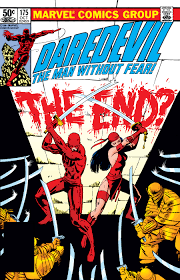 DAREDEVIL #174-176 (September to November 1981)
“The Assassination of Matt Murdock” / “Gantlet” (sic) / “Hunters”
Writer, penciller: Frank Miller
Finisher: Klaus Janson
Colourists: Glynis Wein & Klaus Janson (#174), Christie Scheele & Bob Sharen (#175), Glynis Wein (#176)
Letterer: Joe Rosen
Editor: Denny O’Neil
We’ve already had Elektra and the Kingpin, and now we complete the trinity of enduring creations from Frank Miller’s Daredevil.
Ah, the ninja! Historically, an expert in stealth, spycraft and infiltration. Over time, a part of Japanese folklore, with quasi-magical abilities. And in the Marvel Universe, a bunch of anonymous guys in bright red who attack in large groups and die. Or at least, that’s how they come across if you first encounter them in later stories. They’re the ultimate redshirts.
But what about their first incarnation? After all, recurring villains tend to rack up a string of defeats over the years – that’s the nature of the beast. Surely it was different when they started? Right?
The Hand make their debut in issue #174, when they assassinate one of Elektra’s targets before she reaches him. The narrator tells us that they’re “the same order of master assassins that taught her the many ways of murder before she broke training to operate on her own.” We’re told that the Hand want to kill Elektra because she left. But that’s not why they’re here – instead, the Hand have been hired to kill Matt Murdock.
Four anonymous ninjas do indeed attack Matt in his apartment. You might think that this was overkill when dealing with a blind lawyer – the random target in the prologue was taken out by a single ninja with a crossbow – but it sets the tone for the Hand right from the off. Why bother with stealth when you can just chuck expendable swordsmen at the problem? Now, these particular ninjas don’t know that Matt is Daredevil, and so they have an excuse for being taken by surprise when he fights back. And Matt duly beats them, almost singlehandedly – Elektra helps him out with the last one. In the aftermath, we learn that the ninjas always commit suicide and into gas when they’re defeated.
Later in the issue, the Hand have another go at killing Matt, but Elektra stops them. They do at least manage to chuck a bomb through Matt’s office window – not exactly a classic ninja weapon, but the explosion somehow causes Matt to lose his radar sense for a bit. And the issue builds to a fight scene where Daredevil thinks that he and Gladiator are fighting off a horde of Ninja, when in fact Elektra is helping him out unnoticed. And they win.
So the rank and file Hand may look great, but they’re slotted as cannon fodder right from the word go. The end of the issue sees the introduction of a Hand jonin – a smug guy in a suit, apparently not so caught up in the cult aspects as the dissolving bozos – and his giant magically-powered ninja, Kirigi. Now, Kirigi is presented as the one Hand ninja you really need to take seriously – but he doesn’t have a personality either. As a character, he’s basically a boss fight.
In issue #175, Kirigi is despatched to kill Elektra. Meanwhile, the Hand rank and file try to kill Foggy Nelson… and get beaten up by Matt in a comedy sequence. This leads to Elektra and Daredevil both finding their way to the Hand’s base for an extended fight scene. During this, the jonin implies that his real issue with Elektra is that she refused to sleep with him; this creep is a bit at odds with the Hand’s general cult vibe, and Miller’s later Hand stories will tend to use priest figures in a similar role. And in issue #176, Daredevil is mostly preoccupied with the story about losing his powers, leaving Elektra to deal with Kirigi.
The individual Hand members are an anonymous bunch – conspicuously so. They remain masked, there’s little to tell them apart, and they never stick around to talk once captured. Sure, they’re henchmen, but the book has plenty of recognisable low-rent thugs – not just Turk, but recurring characters like Pike who hang around with him. The Hand, by comparison, are literally interchangeable; their identities are subsumed into the Hand.
We’re not given much reason to take the individual Hand members seriously. Sure, you wouldn’t want to meet them in a dark alley. But they’re completely out of their league against Matt and Elektra – who didn’t even finish her training! The idea might be that Elektra was a prodigy who ran into sexism (all the Hand members we see appear to be men), but even so, she’s vastly better than them. What are they teaching these guys?
Doing ninjas in 1981 was not a great inventive leap. There was a ninja craze going on at the time. There’s a lot of exoticism and mysticism going on with the Hand. But in plot terms, their function is to be a threat from Elektra’s past, and to give her and Daredevil a reason to team up. Why did they stick around beyond that?
It took a while for the Hand to become a standard feature of the Marvel Universe. Like Elektra, other creators seem to have treated them as Miller signature characters best left to him. They show up in the 1982 Wolverine miniseries, but that’s another Miller story. They’re in Elektra: Assassin. But they don’t turn up in another Marvel Universe title until X-Men started using them in 1989 – after which, they were a little less tied to Elektra’s specific story, and a little more available for generic ninja duty.
They do have something going on beyond the bare fact of being ninjas. They’ve got the death cult thing, which becomes more obvious in later stories where the rank and file are laying down their lives to bring more important Hand members back from the dead. Miller hints at a whole mythology with these guys, and sets up Stick and his group as the Hand’s opposite number, but largely leaves the details to our imagination. Is it a genuine religious order? Do the guys in charge actually believe any of it, or are they just sniggering at the cannon fodder? The Hand’s magical abilities are significant – they can raise the dead. But at the same time, they’re low-level, in the sense that they’re not going to make much difference in a fight.
So there’s a degree of mystery to the Hand, at least when they first debut. Time hasn’t been especially kind to them in that regard. We now have a demon for them to worship, we have stories about their inner workings, and ultimately I’m not sure any of it was an improvement on just leaving it vague, as a part of Elektra’s hinted past. They’ve become a Hydra-style agglomeration of factions, some of them mystic cults, some just guys with swords. In all that time, they’ve achieved very little.
And yet their cachet remains. Maybe it’s association with a classic run, maybe it’s the strength of a simple yet memorable design, and maybe it’s simply that they’re flexible enough that the Marvel Universe doesn’t need any more ninjas. The Hand look the part so much that they don’t need to actually back it up.

The Hand are kind of like Arcade. Useful when killing normal people, not that useful when killing people in costumes.
Issue 176 is notable for the first appearance of Stick.
Issue 176 is also the issue where Turk uses the Mauler armor to try to kill a Daredevil who’s lost his rader sense and still manages to screw it up. Turk would later steal the Stilt-Man armor and screw that up too.
The Hand are notable for corrupting Elektra by tricking her into killing her own teacher. So they did that right at least.
They’re also famous for turning Psylocke into a half-naked Asian ninja.
it should be noted that writers were making fun of the Hand’s incompetence early on. In X-Men 258, in 1989, Jubilee. who’s hardly had any experience fighting super-villains at this point, makes it past the Hand’s ninjas. She thinks to herself “For an ancient guild’s master assassins, these guys aren’t so tough”.
What if their greatest evil power was making female characters’ backstories problematic?
The Hand aren’t een the first ninja villains at Marvel, or even the first “magical ninja” archetypes. One of the central elements of the pre-Claremont Iron Fist was the mysterious ninja who’d framed Iron Fist for murder, and turned out to be under some kind of magical curse linked to a grimoire. He was creatively given the supervillain name…the Ninja.
As to the Hand, I always got the sense that they worked in Miller’s Daredevil stories as an exoticized menace, the Asian hordes with their strange and pre-modern ways. There’s some setting up for the idea that Matt had opted out of a secret, ancient conflict between Stick’s order and the Hand, only to find that the conflict was coming to him anyway.
The other big role for the Hand in this run is as another way to emphasize the Kingpin’s power and cunning. In this first arc, the Kingpin works to set the Hand and Daredevil against each other to keep them both from encroaching on his interests. In Miller’s second Hand arc at the end of his first DD run, Daredevil is forced to bring the Kingpin in to defeat the Hand.
That second arc makes the Hand much more menacing, more what you’d have expected of them in their introduction. They pick off most of Stick’s order and require all but one of the survivors, Stick among them, to sacrifice themselves just to hold off the Hand’s hordes for a little while longer. They very nearly kill the Black Widow. And, s noted, it takes the Kingpin and Daredevil making a deal, with Matt sacrificing some idealism in the name of pragmatism, to stop them.
Even then, the real victory is that Matt somehow cleanses Elektra’s soul and Stone, the last of Stick’s order, gets to retire instead of having to spend his life in an eternal struggle.
That also has some problems, from a certain perspective: there’s an idea of the modern, urbanized characters being the ones who can get out of the constraints of the old blood feud from Asia and thereby end it. The two greatest warriors Stick ever trained turn out to be an Irish-American lawyer and the daughter of a Greek diplomat. All that’s missing is Danny Rand-K’ai, and even he got his shot at the Hand later on.
When Miller next uses the Hand (although it’s set chronologically earlier) in Elektra: Assassin, the demon element is emphasized, and there’s more of a sense that the Hand are a disturbing, corrupting force, since they manage to turn SHIELD into part of their plan, have no trouble with the products of bizarre super-science along with magical means of corruption, and get pretty close to putting a demon-possessed thrall in the White House. They’re used less as ninja warriors there than as an insidious demon cult who work on corrupting souls more than getting all stabby-stabby.
Of course, that story is so gonzo in art style and so laden with absurd and satirical elements that it’s hard to build on it the Hand effectively. A lot of the effect was style, and even then, Sienkiewicz couldn’t make the glimpse we get of the Beast’s true form look like anything besides a slightly goofy, generic, green ogre.
Since then, we seem to get one of two versions of the Hand: generic East Asian crime syndicate, or oddly pedestrian evil ninja wizard cult that announces their quite ordinary motives out load at every opportunity. Both versions exist mainly to be mowed down by heroes en masse.
Miller was riding the crest of the wave with ninjas though. 1981 was early in the ‘80s “craze”. Neuromancer and Karate Kid both came around in 1984 (which wasn’t the start of the “craze”, granted). Plus, Miller’s work was an influence on the TMNT, whose Foot was a jokey nod to Miller’s DD, and it might be questionable if Hama’s ninjas in GI Joe would have become the break-out stars if not for Miller’s DD and Wolverine. I’m sure that Hama would have featured ninja characters, regardless, but the GI Joe comic eventually started to be all about Snake Eyes and Storm Shadow.
Which is another example of the trope that the greatest ninja warrior trained is a white Vietnam veteran. At least Hama also had Storm Shadow, who was Japanese-American. Of course, the backstory was that the two originally developed enmity due to Storm Shadow’s family clan choosing Snake Eyes over him.
Then, Storm Shadow is killed but brought back from the dead, although by Cobra rather than mysticism. Still, parallels with Miller’s Hand.
As foils for Daredevil, the Hand suck. They have nothing to say about the law or blindness or fatherhood or any of the usual DD themes. They are better for characters like Wolverine or Elektra who want hordes of faceless goons to slaughter. Nearly all of the worst DD stories prominently feature the Hand.
The crumbling to dust is played by Miller as a suicide pill mechanism built into the costumes, but later writers justify it as something supernatural, sometimes even going as far as to claim that Hand ninjas are zombies. This has occasionally meant that Matt does in fact use lethal force against them. Ninjas Don’t Count.
Stick also sucks. It was way more interesting when Matt learned to fight from a father who didn’t want him to.
The “stage hand pyjamas” look for ninjas has become the standard in Western media since the 1980s. Was Miller the first to use that look, or was he riffing on something else?
ENTER THE NINJA, the Cannon film that mainstreamed that ninja look, came out in October 1981. Are the dates the publication dates or the date on the cover?
Is it possible that Miller saw trailers or posters for ENTER THE NINJA, or just parallel influences?
Those are the cover dates. DD #174 would have been on sale during July.
According to the link Paul left in the article, an Eric Von Lustbader novel (The Ninja) seems to be the earliest instance of the ninja theme starting up in the ‘80s. I have no way to know, but I could imagine Miller reading Lustbader novels.
@Omar- It’s ambiguous what happens to Stone in Daredevil 190. The Hand are trying to revive Elektra as one of them. But Matt tries to revive her as a hero. Matt fails but Stone notices that Matt has purged her of her corruption. Then Elektra’s body is gone. The Black Widow sees Stone’s empty costume and tosses it into the fire so Matt won’t see it. Then the story ends with Elektra climbing a mountain.
There’s two ways to interpret it. The first is that Stone succeeded in reviving Elektra but the effort killed him. And Natasha hid the evidence because she didn’t want Matt to know about it. The second is that the scene with Elektra climbing a mountain takes place in the afterlife. Which raises the question of what happened to Stone.
The really weird thing is that later in D.G. Chichester’s run Stone and Elektra both turn up alive. So I guess he just walked away from the battle naked and Natasha tossed his clothes into the fire for no real reason.
It should be noted that even in the second Hand story where they’re arguably as dangerous as they ever would be multiple Hand members are killed by the Kingpin’s goons with ordinary guns.
@Mr.K There is no way that he could have missed all of the trailers and pre-release publications, but I doubt that was his inspiration. Miller claims to have been a fan of Lone Wolf and Club during it’s original release (72-74 trade/73-76 tv). The artwork reflects this. As much as I dislike Miller’s work (weirdly Sin City is an exception) I don’t there is a reason to doubt him here. Never noticed anything that made me think that he was directly inspired by movie pop culture like Claremont was. Still, I am sure that you are pointing to the correct zeitgeist.
Mostly holding my breath until the Nocenti run.
There was also the novel Shogun by James Clavell, which was adapted into a made-for-TV movie mini-series in 1980. That seemed to be very influential on a lot pop culture ideas with ninjas which would come along, as the novel and TV-movie were extremely popular. I know of people who were of the right age to have experienced Clavell’s book and the TV-movie who loved it when they don’t seem like the type of person be interested in the topics. Miller would have had to have been influenced by that to some extent, living through the popularity of both, regardless of it was a main influence on him or not.
@Chris V- I don’t remember any ninja craze in the ’80s. The Karate Kid owes its existence to the success of Rocky (Columbia Pictures asked screenwriter Robert Kamen to write them a Rocky-like film), and I had to Google “Neuromancer” as I’ve never heard of it.
@Skippy: I think the Hand’s supernatural suicide is a result of later writers blurring together the Hand dissolving themselves and Stick and company supernaturally disintegrating the Hand ninjas by absorbing their life forces in the second Hand arc under Miller.
I’d say there is a way to set the Hand up as a foil to Matt, by having them represent the kinds of clannish social organization and blood-and-honor vengeance you’d have in the absence of a legal system, but it’s a big stretch and they’ve pretty much never been used that way.
I think the Netflix Daredevil show did manage to use Stick for this sort of purpose. There, Stick is a much more morally ambiguous character, and he pushes Matt to abandon his civilian identity and attachments in order to fight in an ancient war outside the bounds of legality and modern mores. They couldn’t make the Hand any more interesting, though.
@Michael: I guess it depends what we read into Stone’s lines about being tired. Is he finally resting, or is he…putting himself to rest? It probably was meant to be ambiguous, just like the mountain imagery of Elektra at the very end.
Moo-Karate Kid may owe its existence to Rocky, but the plot of Karate Kid is…a kid learning karate. Trust me, lots of boys in my class wanted to start doing karate all of a sudden in 1984. Kids weren’t going to learn boxing skills after watching Ralph Macchio.
You may have also heard of popular video games that came along later in the ‘80s like Double Dragon or Ninja Gaiden. I wasn’t into the whole “ninja” thing, I didn’t read Neuromancer until I was in my 20s and I started buying TMNT because another kid in my class liked it (I never even thought much about them being ninjas), but I still wanted to play Double Dragon on Nintendo when it was released.
@Chris V- Robert Mark Kamen, the screenwriter of Karate Kid drew from his own life when he came up with the plot for The Katate Kid. He took up karate after getting jumped by a gang of bullies when he was a kid, and he continued to practice it throughout his life.
And I don’t know why you said “trust me” as if you were there and I wasn’t. I was thirteen when The Karate Kid came out. As popular as that film was, I don’t recall a surge of interest in karate among my classmates. Maybe you lived in a rough neighborhood where kids were routinely getting beat up?
Even still, “karate interest surge” is still miles away from “ninja craze”.
And yes, of course I remember those video games you’ve mentioned, but I don’t see those as evidence of any ninja craze either. Video games became sophisticated enough for the side-scrolling fight genre to emerge in the ’80s (which paved the way for Mortal Kombat in the ’90s).
I definitely remember a werewolf craze. The Howling, Wolfen, and An American Werewolf in London all came out in 1981. X-Men writer and human pop-culture sponge Chris Claremont took notice of the werewolf interest and created Wolfsbane in 1982. Michael Jackson hired the director of An American Werewolf to develop the “Thriller” video with him.
But I didn’t see any ninja craze. I remember TMNT mania, of course, but that was a craze unto itself.
I feel like I am watching people debate if Man-thing or Swamp Thing was a rip-off of the other. Both were copies of the Heap.
Miller claims that he studied and honed his entire art style directly inspired by Kazuo Koike and Goseki Kojima.
https://www.benzilla.com/uploads/2024/04/Miller-LW-and-Cub_sm.pdf
If we are talking about indirect inspiration, then how about that his editor created Ra’s al Ghul, and it was O’Neil’s direction that led to Miller using ninjas. I bet of the two of them it was only O’Neil who read Clavel.
https://www.popticnerve.com/2020/06/denny-o-neil-1939-2020.html
There certainly is an element of Asian exoticism to the Hand, although Miller really uses them as a free standing ninja trope – he doesn’t play up other Japanese elements and Elektra and Stick are casually presented as forming part of the Hand’s tradition. At any rate, we’ll come back to exoticising Japan in a few instalments time once Denny O’Neil is writing.
Moo-It doesn’t matter where the creator of Karate Kid got his inspiration. It’s the influence of the creation on pop culture that matters. Karate Kid created an increased interest in karate.
It seems you are interested in arguing semantics with me more than anything else. I wasn’t the first person to use the term “ninja craze” in this entry. I was copying what Paul wrote in his article. I guess your argument is with him, not me. There were a lot of ninja themed elements to pop culture throughout the 1980s in the English-speaking world, call it whatever you want.
If you were 13 in 1984, you also might have been outside of the target demographic for Karate Kid. I was nine years old in ‘84, and I think you were more likely to see boys that age deciding that Macchio was cool for learning karate and standing up to bullies and pester their parents to let them learn karate.
I’d find it pretty pathetic for kids age 13 or over to want to emulate Ralph Macchio.
“If you were 13 in 1984, you also might have been outside of the target demographic for Karate Kid.”
You’re suggesting that as a teenager, I probably wasn’t the target demographic for a PG-13 film whose lead character was a teenager? That it was really intended for younger children? I don’t think that would hold up in court. Especially the bits where it’s revealed that Miyagi’s wife died during childbirth. Not to mention the fact they were in an internment camp.
While sic might be correctly used, in the sense that it indicates it’s what Miller used. But “Gantlet” is, in fact, the original and correct spelling for the “running the gantlet” sense of the word. Gauntlet is, of course, now regarded as also being correct.
My, someone is testy today. I believe Karate Kid was rated PG at the time in the USA. It was only later that the rating was changed in America. Probably because of all the Woke crybabies (I’m just kidding).
Anyway, if Ralph Macchio was your hero when you were 13, more power to you.
@Chris V – I’m not testy. I just don’t understand your argument at all. You’ve pointed to Karate Kid as evidence of some ’80s “ninja craze” on the grounds that it featured karate, and it apparently influenced a bunch of nine-year-olds at your school to take karate lessons. Oh, and the film was intended for children (which, it actually wasn’t).
And I have no idea what you’re getting at it with the Ralph Macchio “your hero” line. What
does that even mean? Yeah, I liked the film as plenty of movie-goers did at the time, but why would that make Macchio my hero?
Besides, it’s a well-known fact that Daniel Larusso (Macchio) was the real bully in The Karate kid. Johnny Lawrence (William Zabka) was the real hero of the story.
Because I said I would find it pathetic if 13-year old kids decided they wanted to take karate lessons after watching the Karate Kid. You apparently took umbrage at that comment. I never said there was anything wrong with someone at any age enjoying Karate Kid. I caught the movie last year on TV and enjoyed it.
As far as the “karate craze”, I’ve given multiple examples as have others, including Paul originally stating it and including a link to Wikipedia.
I said you can call it whatever you want. Gremlins is another seminal movie of the ‘80s, but there weren’t a bunch of examples of slimy little monsters messing with technology, so no one ever made a claim there was a “gremlin craze” in the ‘80s. There were multiple examples from pop culture in the ‘80s featuring ninjas. Paul took it to be a “ninja craze”, Wikipedia wrote up an article on it. Take of it what you will, or don’t.
I can certainly believe Miller had read/seen the original Lw&C. When First began publishing the reprints in the US, Miller did the cover for the first year or so.
Put me in the “ninja craze” camp although we really didn’t see it where I lived in the rural Mid-Atlantic. I can well believe it was taken place in NY, SF, LA and other places with a strong Asian culture.
I should ask my friend Keith who does a lot of ninja (and lucha) pop culture history.
@Chris V – Umbrage? No, no, no. You misunderstood. I didn’t take any umbrage at your comment about teenagers wanting to take up karate after seeing the film. I wouldn’t go so far as to call the idea of that pathetic, but the film certainly didn’t make me want to run out and sign up at the nearest karate dojo. Doing that would have been terrible for my allergies (physical activity and pain).
It was your suggestion that I might’ve been outside the film’s target demographic that I took umbrage at. Well, not umbrage, really. I was just surprised is all. I’ve gotten accustomed to you saying things that actually make sense, so that threw me.
And you only just saw the film last year? How is that possible? Didn’t the kids at school pulling crane kicks on you make you remotely curious to see it back when it came out?
Moo-Oh no. I meant that I watched it again last year. I did not see it at the time it premiered because I lived with my grandparents, and they rarely took me to the theatre. I saw it in the late-‘80s at some point.
I was sort of confused about the whole “crane kick” thing back then, yeah, but I pretended I knew what was going on. It’s what us uncool kids did in elementary school, pretended we were in on what everyone else was talking about.
If I did say you weren’t part of the target demographic, that wasn’t what I intended. I meant you were too old to be part of the demographic that would want to emulate Macchio.
Mark Coale-You mentioning SF reminded me that there was even an episode of Full House where DJ Tanner was taking karate lessons too. Full House was set in SF (well, they claimed it was and at times it at least looked like SF, heh), which is why this is pertinent, if you didn’t watch Full House.
@Skippy “The “stage hand pyjamas” look for ninjas has become the standard in Western media since the 1980s. Was Miller the first to use that look, or was he riffing on something else?”
From the Wikipedia article on ninja, in an image caption: “Two prints depicting kabuki plays. In Japanese theatre, ninja are often dressed as kuroko, stagehands in black suits, to make their attacks seem more surprising. This practice gave rise to their stereotypical black outfits.” Those prints do depict costumes that look like what everyone thinks of as ninja.
—
“They do at least manage to chuck a bomb through Matt’s office window – not exactly a classic ninja weapon”
I do kind of associate hand grenades with ninja, I think because of Usagi Yojimbo. A Google search suggests some historical backing for this.
Weren’t the ninja elements involved with Wolverine at the time the Joe ninjas became the breakout stars (198…5ish) just Yukio and Ogun?
And I’ll say that Snake Eyes & Storm Shadow were part of the definite 80s ninja craze, along with Shinobi and other arcade games (Bad Dudes vs Dragon Ninja).
The video game industry has always been dominated by the Japanese. Nintendo, Sony, Sega, Temco, Konami, Capcom, Technōs, the list goes on. Of course there’s going to be lots of ninjas.
@Dave- No the Hand were involved in Wolverine’s first series, as Paul mentioned.
Keith nicely sent me a link from his website about the explosion of ninja stuff in popular culture
https://vintageninja.net/wp-content/uploads/2020/05/VintageNinjaTimeline-%C2%A9KeithRainville-V1.3opt.pdf
Sam Peckinpah’s 1975 movie The Killer Elite has an entire thing about ninjas trying to assassinate a political leader and James Caan trying to stop them on the CIA’s behalf.
The ninjas do wear the pajamas, but at least they picked a shade meant to blend in with the hull of the decommissioned warship they’re fighting. Not that this helps them, as they’re gunned down pretty easily by Caan and his small team, and Caan (who walks with a cane after getting shot in the knee at the beginning of the film) beats several of them in hand-to-hand.
I can’t see it as a film that would have contributed to any ninja craze – the ninjas come off as the epitome of “brought a knife to a gunfight” – but it’s another early example of their use in U.S. fiction.
This also from Keith in our bluesky convo
“ Miller was way better versed in the 60’s Japanese ninja boom than most, so he had a much more authentic feeling result (save for the red uniforms). Previous ninja in comics leaned on Chinese design tropes, research no deeper than a mail order ad in a magazine, etc…”
@Moo: yes, there was a ninja craze in the ‘80s. I grew up in the ‘80s. We incorporated ninja stuff into a lot of our play. Throwing stars and nunchucks were the freakin’ coolest. Action figure lines had ninja characters. There were ninja b-movies I wasn’t allowed to see, many of which became cable tv staples. TMNT was its own thing, true, but part of the appeal was the ninja aspect.
The Karate Kid wasn’t about ninjas, but there was sufficient content overlap (martial arts, white perceptions of Japan). To my friends and me, it was part of the same cultural moment, and one we could access without restriction.
The funniest thing about all this is that ninjas don’t even practice karate.
“The Karate Kid wasn’t about ninjas, but [yada-yada-yada]… it was part of the same cultural moment, and one we could access without restriction.”
What?
@wwk5d -Right. It’s as though anything Japanese-related is being lumped in with “ninja.”
There is certainly a distance between the cultural elements found in “The Karate Kid” and other well-known works of the late 1970s and very early 1980s and the general idea of “ninjas”, but it is not a particularly large one. Once you give some thought about Kung Fu and Karate, it is natural enough to drift occasionally to curiosity about who learned and used them historically. Learning about Samurai and Ninja is just a matter of time after that.
Born in 1976. There was absolutely a ninja craze in the early -to-mid 80’s, at least where I was growing up (near Washington, DC). We used to rent Revenge of the Ninja, Enter The Ninja, American Ninja, and god knows what other trash at the video store. We had plastic shuriken and nunchucks and sais and used to window-shop the store at the mall that sold the real deal.
We’re all just doing personal anecdotes here, and those don’t negate each other, but I can say work absolutely one billion percent certainty that my childhood included a massive ninja fad.
@Moo: what I meant was we under-10s could access Karate Kid because most of us had permission to watch it. My parents and many of my friends parents would not let us watch many of the ninja-centric b-movies. Karate Kid and cartoons were what we could get our hands on without parents getting mad.
@Matt Teri- Okay, fair enough, and at least you’re sticking to actual examples of ninjas in cinema and not suggesting that karate is close enough to count.
Ninjitsu is an art of warfare that was developed for covert operations. Striking from the shadows and all that. Karate is used mainly for self-defense. They couldn’t be more different.
I do remember and certainly acknowledge a general martial arts craze that began in the 70s and extended through the 80s, sure. But ninja craze is pretty specific. Maybe I was still too caught up in being a Jedi to notice any shurikens flying around me.
In defense of the Hand, I’d like to believe they did some cursory investigation of Matt Murdock, found out that he survived many, many assaults, and that’s the reason they sent 4 ninja to kill him. Though from above it seems that their contract was “make one attempt at killing him and if that doesn’t work, no big deal, leave him alone”?
As for terrible 80s ninja movies, I remember Ninja 3: the Domination as being a particularly bad one. I think there were a lot of these movies on HBO/Showtime and they were frequently aired, along with the Beastmaster.
Shout out to the Ninja Hedge from the original Tick comics.
I can confirm that the ninja craze spread to Australia as well. Lots of movies, video games, comics, toys, etc.
As for early examples of ninja influence in Western media, would the Bond film You Only Live Twice be the earliest at 1967?
@Nathan – That was the first Hollywood film to feature ninjas, so sure.
Martial arts in general, and ninjas in particular, where prominently featured in ads throughout mainstream comics of the time:
https://www.hoganmag.com/blog/the-deadliest-ads-alive
Okay, before someone posting from Green River, Utah, chimes in to confirm that a ninja craze existed there too, please refer to my reply to Matt Teri.
Ninjas showed up in Swedish comics in the 80s as well.
https://fantomenindex.krats.se/1984/17