Storm: Earth’s Mightiest Mutant #4 annotations
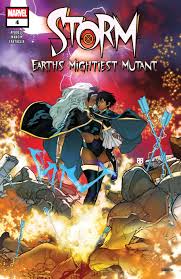 STORM: EARTH’S MIGHTIEST MUTANTS #4
“Mama”
Writer: Murewa Ayodele
Artist: Federica Mancin
Colour artist: Java Tartaglia
Letterer: Travis Lanham
Editor: Tom Brevoort
STORM:
We’re still “two days before Akujin’s invasion of Earth”, as in the previous issue. Storm is still outside the Marvel Universe proper at “the Wall” (the edge of the DC Universe), though in this issue it seems more like an area of metafictional swirl, complete with fan mail floating around. Storm seems to disregard all of the explicitly meta elements.
The alt-N’Daré’s basic pitch to Storm is that she should let Death destroy the Multiverse and then they can go back and restart it. Not surprisingly, Storm isn’t on board with this idea, not least because she’s working from an in-universe perspective and isn’t remotely convinced superhero universes work this way. However, we also get a flashback to the Krakoan era to remind us that, when she was infected by a techno-organic virus, she chose to fight it rather than just take the easy option of resurrection. This was Giant-Size X-Men: Fantomex and Giant-Size X-Men: Storm. The latter issue does indeed have a speech from Storm implying that she thought Krakoan resurrection undermined the value of life.
When Ororo rejects N’Daré as not living up to the real N’Daré’s values (as to which, see below), N’Daré decides to teach her a lesson by “see]ing] what you would do differently in my shoes”. She seems to hope that experiencing the wider Omniverse will force Ororo to recognise the context in which she exists. Traditionally, the “Omniverse” is Marvel’s term for the wider collection of all real and fictional worlds that go beyond the regular Marvel Multiverse, and that’s how Ayodele is using it here. A footnote calls it “the collection of all multiverse clusters to have ever been featured in a narrative”, expressly including the real world. By a “multiverse cluster” he seems to mean superhero multiverses and similarly tangled continuities.
On her way back to the Marvel Multiverse and Earth-61391, Ororo passes through the following worlds:
- “Chaos Womb. Multiverse Cluster of the Blind Idiot God.” This is the Cthulhu mythos, and the “blind idiot god” is Lovecraft’s description of Azathoth.
- “Shibuya, Tokyo, Japan. The Multiverse Cluster of Magic and Death.” This is the world of Jujutsu Kaisen.
- “Mono, the Ground. The Multiverse Cluster of Sentient Trash.” This is a world from Gachiakuta.
- “Desert 1993. The Macho Multiverse Cluster.” I’m not sure what specifically this is referring to, but it seems to be a world of Liefeld-style 90s warriors.
- “Thataway”, the “multiverse cluster of war and lovers”. Search me.
- May Pen, Jamaica, “earth-61391, the One Above All’s Multiverse Cluster”.
Ororo appears in the opening flashback as a six-month-old baby, already with a full head of white hair.
SUPPORTING CAST:
David Munroe and N’Daré Munroe. Storm’s actual parents appear in the opening flashback. Broadly, what Ayodele is getting at here is that the Munroes moved to Africa rather than continue to put up with American racism, believing that Ororo could one day return if she wanted to. The fact that the Munroes moved to Egypt when she was six months old because David had a job offer there comes from X-Men #102, but the idea that they chose to leave America because of racism (and specifically because of N’Daré’s reaction to it) comes from Storm #1 in 2006.
Presumably, the reason why Ayodele is bringing this up is to draw a parallel with the alt-N’Daré trying to persuade Storm to escape the universe for somewhere safety, and to undermine Storm’s claim that her real mother wouldn’t do such a thing.
Furaha. Ororo’s daughter previously appeared in a flash forward from Hellfire Vigil, as the recap page explains. Ultimately, she seems to be just a daughter from an alternate timeline, Earth-61391, who has precisely one line of dialogue interacting with Storm before helping her unconscious mother get back to her home timeline. In theory, the point of this is supposed to be to put Storm in the position of meeting an alternate universe daughter, but that doesn’t really hapen in any meaningful way on the page.
Furaha recognises Ororo as her mother but knows that she’s from another timeline. She first appears standing on an ice cube thing that hovers in mid air.
Her home reality is identified as Earth-61391, and she seems to be from May Pen, Jamaica. What little we see of her timeline here presents it as a rather chaotic place of chunky Sentinels, large white humanoid entities, and biker gangs who seem to be roughly allied with Furaha. This is the alternate future timeline from Ayodele’s own I Am Iron Man #1 (2023), and the character with the guitar is called Tami.
VILLAINS:
N’Daré Munroe. The alt-timeline N’Daré is trying to persuade Storm to abandon the multiverse to Death rather than fight a futile battle, on the basis that once Death has destroyed everything, they can “go back and trigger the creation of a new multiverse”. She doesn’t explain how they’re going to do this. However, she does explain (correctly) that the multiverse has been destroyed and re-created before, and cites Secret Wars, something that she previously mentioned in issue #1. In very meta fashion, she says that it “happens frequently as a natural way of the narrative renewing itself”. That presumably explains what we’re doing out here on the shores of the DC Universe.
On one level, N’Daré seems to have drawn the conclusion that the world isn’t real and that its destruction and recreation don’t matter. Despite that, she seems obsessed about saving Storm, even though it’s not her real daughter – in fact, she said last issue that she didn’t even have a daughter in her world.
In the closing panel, she’s holding a copy of the next issue.
Bogey. Last seen in issue #2, as one of Akujin’s sisters, co-leading their army as it marched on Earth. That army seemed to be aiming to secure the release of Susanoo, but here she implies that her master is someone more demonic and ancient, and that ultimately she regards her people as older and greater than the gods.
In issue #2, she said that she would negotiate with the Olympians to get passage through the Underworld to allow them to invade Earth. She said that she would offer something from Wakanda that would be of interest to Hera, and strongly implied that it was more than just a big pile of vibranium. Turns out, no, it was just a big pile of vibranium. Her argument is that the Olympians don’t need it, but it would be nice to have, and they can’t take it themselves because Wakanda is protected from outside gods by the Orisha. (A footnote directs us to Black Panther: Blood Hunt #2.)
Bogey is rather put out and taken aback to find that Hera doesn’t seem to recognise or respect her – she clearly thinks her people ought to have made more of an impact on Olympian minds. She claims that her master aided the Olympians against “the alliance of Jötnar and Gigantes in the Third Gigantomachy” – i.e., the combined forces of the giants of Norse and Olympian mythology. Hera does remember this incident, but regards it as an unsavory affair, and Bogey’s master as a mere mercenary; in Bogey’s version of events, Zeus begged her master for aid, but she thinks better of pushing the point.
The Olympians reject Bogey’s offer on the eminently sensible basis that if she actually has the power to deliver on it, they don’t want her army anywhere near their domains. This prompts her to unleash a magical attack which suggests that, at least with the benefit of surprise, she is indeed capable of outpowering the Olympians.
OTHER CHARACTERS:
Hera, Hades and Persephone. Zeus is still missing after the Thunder War, which is odd, since various other thunder gods have shown up alive and well since then (including in this series). Nonetheless, the recap page insists that they’re the exceptions. There’s a passing mention of Zeus’s death in Immortal Thor #14, but that precedes “Thunder War”, so he must have got better. Certainly the Olympians refer to Zeus as if he’s simply missing. Hera doesn’t seem especially bothered by his absence, but does mention that she believes he’s changed his ways in terms of his endless infidelity (in Incredible Hercules #140), and that she no longer has any interest in taking revenge for those incidents.
In Zeus’s absence, Hera, Hades and Persephone are ruling Olympus as a triumvirate. This is why Hades and Persephone relinquished the throne of the Underworld to their daughter Macaria, as mentioned last issue. Bogey was unaware of these developments, and was hoping to simply appeal directly Hera.

Zeus wasn’t killed in Thor #14 but he’s not doing too well. He and Athena are stuck in Asgard
Thataway, the universe of war and lovers, could be referring to Saga, but I have no proof other than ‘the vibes match’.
“Thataway”-I don’t know. I didn’t buy the comic, so I’m not looking at the comic, but I’m going to go with an alternate universe of Leo Tolstoy’s fiction being written by L. Frank Baum. Does it totally make sense? No, but now I want to imagine this multiversal mash-up.
Oh hell, I meant to write Dr. Seuss, not L. Frank Baum. I don’t know why I got Oz stuck in my head.
Interestingly, Tolstoy and Baum were contemporaries. Tolstoy was nearly 30 years older, but their literary careers do overlap – Tolstoy wrote until he died in 1910 at age 82.
‘The Wizard of Oz’, Baum’s first book, was published in 1900. I doubt that Tolstoy would have read it, and I’m almost 100% certain he would not have liked it. However, Baum probably did read Tolstoy, and it’s conceivable that he was inspired in some way. I think it’s certain that Dr. Seuss was inspired by L. Frank Baum, so … who’s to say ‘Horton Hears a Who’ isn’t just a Seussiverse version of ‘The Death of Ivan Ilyich?’
This hasn’t anything to do with Storm #4, so I’ll just note that L. Frank Baum and Dr. Seuss both wrote short-lived comic strips, which could occupy the same Multiverse Cluster.
I like to judge the quality of a book by how quickly and completely this comment section goes off the rails. I don’t think I’ve ever read anything by Tolstoy, but I’m assuming I’d find it more fun than Storm the Spelljammer.
Would Tolstoy have enjoyed Baum? Well, Tolstoy did write his share of symbolic fairy tale/fantasy short stories. I think Tolstoy would have found some enjoyment in Baum’s championing of the struggles of the lower classes with Wizard of Oz.
The Tinman-the industrial labourer
The Scarecrow-the farmer
The Cowardly Lion-the ineffectual populist politician
The Great and Powerful Oz-the government, claiming to be all-powerful, but revealed to be weak.
The Yellow Brick Road being trod upon by Dorothy’s silver slippers (not ruby)-opposition to the gold standard
The major question is if Tolstoy would have enjoyed this Storm comic, and I’d say definitely not.
There’s something incredibly bizarre about Storm being the one to confront a threat of this magnitude. I mean, we’re not talking the world, the solar system, the galaxy, the universe, but all of the near-infinite universes which make up Marvel’s Eighth Cosmos. This is the sort of thing around which entire line-encompassing crossover events are centered, and here it’s confined to one tiny already cancelled series.
I think maybe the scope of this comic has gotten way out of hand.
Especially when you just randomly drop into other multiversal clusters–the sort of thing which has been, and should be, just about impossible outside of special occasions. (You know, like inter-company crossovers!)
Also, I’d like to see Tolstoy and Baum swap material. That would be fun. Tolstoy might be able to do all sorts of wild things with some of Baum’s weirder magical lands.
@TheOtherMichael,
Personally I blame Chris Claremont for making Storm the OG Mary Sue even more than any other Marvel heroine he ever wrote before or since tsk tsk tsk and of course she cannot be proportionally depowered anymore or else all of her fanatics and sympathizers , who are much more often than not Gen-Z/Alpha SJW Twitterati , especially if of the USAmerican “Hotep” variety (the same crowd who insist that Egypt’s Cleopatra was Black African) , will have a hissyfit LOL
I can say from experience that I know that Russian writers loved American pop culture.
True story: I visited the dacha (summer house) of an early 20th Century Russian writer named Korney Chukovsky (who died in 1969). The house is now a museum. In the author’s small library, the shelves were full of 19th and early 20th century Russian and American writers. A little splash of color caught my attention on one shelf and I looked closer and it was a tie-in novel for “The Munsters” (yes, the tv show) by Morton Cooper, published in 1964.
Just sitting there in the library of a revered Russian poet and writer.
Tolstoy/Baum seems perfectly reasonable by comparison.
I do so love when Jdsm24’s illiterate ignorance is on full display – *Claremont* made it so Storm couldn’t be depowered, you heard it here first, folks!
I love that Munsters story!
I think at some point in his life Tolstoy would have enjoyed Baum, and he did wrote his share of fairy tales once upon a time. By the end of his life, and around the time that ‘The Wonderful Wizard of Oz’ was published, he had dismissed even his own ‘War and Peace’ as “counterfeit art” and I think had become very uncompromising in his religious and political views. I do wonder what he could have done with a fantasy story in his later years. Might have been fun!
I think multiverse stories used to be reserved for big cross-overs (and back in the ‘Flash of Two Worlds’ days the multiverse was the conceit that made the crossover make sense), but today it’s become such an established trope of superhero stories that I don’t think it’s all that special anymore. It’s just that Storm isn’t usually a meta textual character. If this was a She-Hulk or Howard the Duck story it would seem like a more natural fit. But Ayodele seems to be throwing everything at this book, so sure, why not?
Aro-Tolstoy’s final novel, Resurrection, one of his most political, espousing the economics of Georgism, was published in 1899, one year before Wizard of Oz was published. The novel led to his being excommunicated from the Russian Orthodox Church. Tolstoy would have appreciated the political intent of Baum with Oz.
Maxwell’s Hammer-It’s funny that you mention Chukovsky in this conversation as his writing style in the English-speaking world was compared to a Russian Dr. Seuss. Which is where my derailing of a Storm comic into a Tolstoy conversation started.
It’s not really derailing if you consider that Murewa Ayodele is the Lev Tolstoy of solo ‘Storm’ comic books.
@The Other Michael — This is actually the second time within less than a year that Storm has been directly involved in a Multiverse ending scheme. That was how Jed MacKay’s Avengers wound down; Kang (via cosplaying as a knockoff of Merlin and beating up a version of himself from 5 minutes ago) wanted to use some cosmic doohicky Reed Richards unwittingly created when he and Franklin remade everything after 2015’s SECRET WARS III to end the Multiverse and start another. He literally unleashed hordes from the Marvel Zombies universe as minions. Storm’s role within that final arc was no more or less than most of the other Avengers (aside for Carol Danvers, who ultimately convinces the doohicky not to work properly for Kang at the 11th hour because it was made by a hero and Kang isn’t one). Amusingly, at the end of the volume when Carol disbands the team, her chat with Storm implies that by this point, the Avengers are beneath her (or at least a distraction).
@Maxwell’s Hammer — I can attest from personal fan community experience that one piece of American pop culture very popular in Russia are the Teenage Mutant Ninja Turtles. Some well connected Russian-based fans have crowdfunded and produced major fan works which have included many actual Mirage Studios talents (including Jim Lawson and Chris Allan), even after the franchise was licensed by IDW. Russia’s war with Ukraine delayed some of these efforts due to various sanctions but they have continued.
@Diana,
Ah , but you are misinterpreting what I said , CC made it so that Storm couldn’t be overpowered , not depowered , they’re 2 different concepts , and indeed CC started the tradition that Storm Always Wins (which was ignored by other X-writers in the 1990s after he quit Marvel and the XMen in 1991 , but which was restored when he fully* returned to the XMen in 2000) LOL
* after ghostwriting a number of Alan Davis’ plotted issues , but he already returned to Marvel in 1997, when he began writing Fantastic Four (and made Sue Storm the most adulterous with Namor she had ever been up to that point , see his first full formal FF story tsk tsk tsk)
I have a half-baked theory that Marvel is still trying to turn Storm into a rival for Wonder Woman, except now they’re trying to make her the rivel for magic-wielding, extra-dimensional Absolute Wonder Woman. The timing on that probably doesn’t work out, but they do share a lot of elements.
Anyway, whatever writer takes up Storm next has to completely disregard all this nonsense, right? Or maybe Marvel will just put her back in the toybox for a while.
This whole Baum & Tolstoy discussion is really funny considering how the first 6 Oz books were rewritten into 5 Russian books.
But will Storm replace the One Above All?
[…] EARTH’S MIGHTIEST MUTANT #4. (Annotations here.) Well, this is as berserk as ever. But for the life of me I don’t see how this is going to get […]
@Thom H.: I see a lot of Superman in Ayodele’s take on Storm, myself. The running theme is the usual Superman conflict between being all-powerful and all-good. She absolutely won’t be do something personally wrong, whether to go along with a lie that gives mutants good publicity or mercy kill a suicidal god to prevent a cosmic war. She’s the most powerful, most respected, etc. Though Wonder Woman tends to be all that too.
Do you mean the Magic Land novels? The first one was a plagarization of Wizard of Oz, but it was published after Tolstoy was dead. As far as I’m aware (I haven’t read the novels), the other books in the series were original plots with familiar characters, rather than copies of Baum’s sequels (which I also have never read). I’ve heard the themes of the Magic Land sequels have more in common with the Strugatskis’ earlier novels than Baum.
@Chris V
He’s probably talking about the translation done by Alexander Volkov. It’s a loose translation, as he changed most of the names (Dorothy Gale becomes ‘Ellie Smith’), excised some bits, re-jiggered some others, but it’s close enough that people still recognize and credit it to Baum as the original author. In Russian, it was titled “Волшебник Изумрудного Города”, which translates as “The Wizard of the Emerald City”.
Volkov then went on to write four sequel books which were essentially original works (though they featured a few Baum characters and elements from Baum’s other books).
@MasterMahan: Good point. Maybe that’s why I’m enjoying Absolute Wonder Woman so much. She’s doing my favorite version of Superman: all-powerful and all-compassionate, a superhero who isn’t just a teenage fantasy but an actual adult.
Maybe the direction for Storm is just increasingly bizarre short stories. I like the idea of the Ice Cream Man team getting ahold of her at some point.
Is there a name for writing something so pretentiously that it becomes an all-out sublimation into satire (albeit apparently oblivious satire)? If there isn’t, this series now has the duty to create that name.
@The Other Michael: Yeah, it just _might be_ that this Storm plot got way out of hand. In the same sense that I might notice if an Elephant sat on my head.
@Thom H: Are you sure that they are not aiming to make Storm Marvel’s answer for Lobo? I would suggest Valiant’s Solar instead a few months back, but I feel that we have crossed the ludicrousness line a few times since already. Can Chuck Norris jokes be far behind?
@MasterMahan: both Superman and Wonder Woman tend to be written in a far more nuanced and less ludicrously than this… run.
Heck, I’m not sure Lobo at his most extreme can compare at this point. You could just make her a MAD Magazine feature already with no changes.
@Thom H- Marvel has been looking for a counterpart for Wonder Woman for decades. First they tried to turn Carol into a counterpart for Wonder Woman but they abandoned that after the Marvels flopped and her solo series flopped. Then they tried to turn Storm into a counterpart for Wonder Woman but they seem to be abandoning that now that her series have flopped.
@Michael,
If Marvel wants to have their own direct counterpart to Wonder Woman , they first have to have their heroines (not anti-heroines or villainesses) show much more skin tnan they do now , WW is nothing minus her bathing suit LOL
I would say that attempts at having a Marvel take on Wonder Woman go back to Spider-Woman in the 1970s – and arguably later She-Hulk and Dazzler as well as Carol, indeed.
Then again, I think that WW is a difficult character to deal with at the best of times – not least because her “classic” look is indeed a bathing suit with an entirely absurd patriotic theme that is rationally in defiance to her own nature and origin.
Making a pastiche out of Storm and glossing over the incoherence of it defiantly is not the answer, though. Unless the end goal is indeed to make her into a comedy character. She is halfway there already. All that is missing now… is probably a symbiote. Everyone else has one.
@LuisDantas
Cosmic Coincidence , Marvel Rivals already also had a Storm Symbiote (Venom) skin around 10 (“X”!!!) months ago LOL
Marvel Multiverse Synergy GO!
https://www.youtube.com/watch?v=AQGl2BvXzHY
The irony is DC flailed around with what to do with Wonder Woman for decades before settling on making her their equivalent to Marvel’s Thor by playing up the mythology angle.
Goodness, I felt the weirdest sense of nostaliga on actually seeing the phrase “SJW Twitteratti” in 2026. It’s like hearing someone in 1943 describing the decadant avant-gard as the sort of people you get in Berlin nightclubs, and just being like “Sorry, did you miss the part where that place got taken over by Nazis?”
@yrzhe
I strongly suspect that National and later DC liked the _idea_ of Wonder Woman quite a lot, but did not really know what to do with it for most of the time since the very start.
It is bad optics (and more than a bit defeatist) to actually cancel such a symbolic book as that of the best known female superhero of all. No group, at any time period, has the habit of telling itself that it is not giving women (or any other group) unfair or unrepresentative treatment. It is the perception of what would be fair that changes. Indeed, it has changed quite a lot, sometimes back and forth even.
Wonder Woman is anything but an inherently strong character, and in both concept and implementation it has some very serious contradictions and flaws, _particularly_ in its early forms. It very much tries to be all things at all times, at once a monarch-in-waiting of a closed borders slaver nation and an American immigrant wearing USA colors in her costume. A costume which is somehow supposed to show strength and initiative despite being obvious bait for submission fetishes. While its wearer operates under a false, illegally acquired identity in order to somehow be an ambassador of peace by punching armed people and monsters left and right. It is an horrible mess, all over the place and with no discernible point.
Which apparently made her quite the antifragile construct; she can’t be broken because she never made any sense to begin with. So she is Steve Trevor’s guardian angel and lapdog for a few decades, some form of liberated woman for a few years, occasionally some sort of independent, slightly rebellious daughter, then a naive yet strong immigrant under George Perez, then an obedient extension of Batman’s and Superman’s designs as Volume 3 begins after Infinite Crisis. It takes decades for the character to even be officially written or drawn by a woman in the first place.
I fully believe that her book would have been cancelled at least once at every decade since the 1950s if it was not perceived as a bad public image move to do so. She was probably often what is called a “loss leader” – not much of a success, but removing her book would harm more than help. Keeping her around could potentially lead to some good run (IMO that only happened under Messner-Loebs and some later runs).
In the meantime there were lots of indications that DC did not really know what to do with her, including at least three different periods of going back to the golden age (at one point redoing plots from decades prior with new art); a year-long period of having other Justice League members coaching her in her own book so that we could know for a fact that she deserved to rejoin; and an extended period of being in effect a split book with Huntress as a second feature.
Marvel may have trouble handling woman superheroes, but there is no comparison with the trouble at handling Wonder Woman.
@LuisDantas,
It was all in her name from the very beginning : Wonder Woman , because the audience always wonders what editiorial is going to do next with her , nominative determinism LOL
And at this point , 616-Storm is the same situation because of the decades of stories caused by her having such a fortuitous demographic profile hehehe after all if the USA Establishment is supposed to be CisHet WASP Male Human , then she is obviously the Counter-Culture being LGBT BIPOC Female Mutant
“It is bad optics (and more than a bit defeatist) to actually cancel such a symbolic book as that of the best known female superhero of all.”
If I’m not mistaken, DC is legally required to continuously publish Wonder Woman comics or else ownership of the character reverts to the Marston estate. Or at least that was true until relatively recently.
I won’t argue that Wonder Woman has been mishandled many times over the course of her existence, but I don’t think it’s because the characters is unworkable. I think of her as like a Rubik’s cube, always solvable but you have to put each piece in its place carefully.
Greg Rucka seemed to have a firm handle on “female warrior tied to mythology and ancient traditions who leads with compassion” before his run was derailed by whatever nonsense DC was peddling at the time. More recently, Kelly Thompson has arranged all the pieces in a row again. With some thoughtfulness, writers can even integrate the sexual aspects of the character.
But otherwise, you’re right — lots of bad takes over the last 85 years, mostly because of institutional misogyny.
@Luis- Thom H is right. The only reason DC kept publishing Wonder Woman during the Silver and Bronze Ages is because it had to publish a certain number of issues per year or the rights would would revert to the Marston estate.
Wonder Woman’s sales were horrible during the Silver and Bronze Ages. with the exception being the period when there was a Wonder Woman TV show. (Oddly, the Hulk’s sales also improved when there was a Hulk TV show but Superman’s sales declined when the Superman movies came out.)
I think that Wonder Woman is one of the few titles that had both an unmemorable Silver Age and an unmemorable Bronze Age. Superman’s Silver Age produced characters such as Brainaic and Supergirl. Batman’s Silver and Bronze Ages produced Barbara Gordon, Poison Ivy and Ra’s Al Ghul. Captain America’s Silver and Bronze Ages produced Sharon Carter. the Falcon and Helmut Zemo. Wonder Woman’s Silver and Bronze Ages? Well, there was Donna but that was due to an error and mostly in Teen Titans. Also, Wonder Woman had her first encounter with Circe in the Bronze Age but Circe had appeared in DC Comics before that.
One thing though- the Huntress back-up stories in Wonder Woman were not unusual. It was common for unrelated characters to appear in backup stories in DC comics during the 70s and 80s. Dr. Fate, for example. appeared in backup stories in the Flash. Superman was the star in Action Comics but everyone from Aquaman to Air Wave appeared in backup stories.
@Thom H- I wouldn’t say that Wonder Woman’s problems were mostly due to institutional misogyny. A lot of it was due to decisions that seemed sensible at the time but weren’t thought through.
For example, Denny O’Neil’s decision to strip Diana of her powers was meant to be a Storm-like story where she loses her powers but finds a way to be a hero anyway. Of course, the result was to offend actual feminists.
Or take Perez’s decision to portray Diana as new to Man’s World. I understand why Perez thought writing Diana as a rookie hero would be fun. But after a decade you can’t write her as a rookie hero any more. Plus, Diana appearing after Donna made Donna’s origin completely nonsensical. And whenever Perez wasn’t writing, a writer would have Diana say things like “Poison Ivy smiling is always a bad sign” when Diana hadn’t met Ivy yet in post-Crisis continuity! Plus, the League retained much of its continuity after Crisis- Ivo still became immortal after his encounters with the League, Dr. Destiny still blamed the League for losing his ability to dream and turning him into a monster., etc. That meant that Black Canary had to replace Diana in any early Justice League story that had a female member.
in addition, it was difficult to see why Diana was considered the premier female hero in the DC Universe. Pre-Crisis, Diana was the first major female superhero of the modern era and one of the founders of the Justice League. Post-Crisis, Diana debuted after Booster Gold! Black Canary, Zatanna, Vixen and Gyspy were already members of the League when she appeared and that’s not even mentioning the female Titans.
And then there’s the mess Steve Trevor turned into pre-Crisis. It was arguably a mistake for Denny O’Neil to kill him off in the first place but that doesn’t explain the mess that he turned into after O’Neil was gone. And Hippolyte’s behavior regarding Steve was so nuts that even Marvel’s Odin would consider her too controlling a parent.
Luis: Don’t forget Wonder Woman’s depowered super spy years.
I would not necessarily say that there was mysoginy operating in WW’s publication history, but there are certainly signs of struggle with the character concept. To be fair, much of that comes from the struggle of larger society to decide what would be proper treatment of women.
Take for instance how difficult it is for Diana Prince to even _have_ a civil identity at all. For the longest time she alternated between her military uniform, her Wonder Woman costume, and apparently nothing else. That may have been one reason for the 1970s attempt at non-powered “Mod” Diana Prince, but that had its own flaws and challenges.
But hey, at least they were trying something new. Even if it gave us Diana saying in #203 (not by Denny O’Neill) that she “does not like women”. I don’t even know what to make of that.
I am aware that the Marston State’s demand for continuous publication. I don’t know how much of a difference it makes here, though; DC could have chosen to let the licensing lapse if it felt that there was no point in keeping it, after all. They could have attempted to promote anyone from Lois Lane to Black Canary to Black Orchid to Thorn to Supergirl to Big Barda as their main woman superhero instead. Sometimes I feel that they should do it.
Then again… is there even a point to having a specific “main” female superhero? Beyond knowing who to feature in “Trinity”-styled stories?
From Marston’s death until Perez’s series Wonder Woman, rarely received a top-notch writer. O’Neil was one of the only exceptions, and his run was divisive. Bob Kanigher was DC’s most important war comics writer, but not a top super-hero writer. She rarely received top artists, either, post Andru and Sekowsky. Jose Delbo and Don Heck didn’t have the cache of Perez, Aparo, Rogers, Neal Adams, LSH-era Giffen, etc. I haven’t read much Bronze Age WW, but the solicits from the era make it seem like an afterthought.
Also: in the Silver & Bronze Age’s, most comic book writers were terrible at writing women. That didn’t help matters.
@Mike Loughlin- Gerry Conway wrote about 35 issues of Wonder Woman during the Bronze Age. Roy Thomas also wrote Wonder Woman for about a year.
@Michael: yep. Conway wrote a bunch of DC books. WW was one of them. Thomas, too. Neither one of them were who you’d call to shake things up or bring attention to a title, even then. Both of them have written good comics, but they’re dependable utility players.
Roy Thomas’s work on WW was a surprisingly strong influence on Neil Gaiman’s _Sandman_. I wrote a paper about Sandman and DC continuity some years ago (before Gaiman’s cancellation). In researching it, Thomas came up a LOT.
@Alexx Kay: wow, really? I know the Fury and Silver Scarab were characters from All Star Squadron or Infinity, Inc, but I’ve never heard of Thomas’s WW being an influence on Sandman. Despite being a huge Gene Colan fan, I’ve avoided reading Thomas’s WW because I don’t like about 80% of his writing. He writes most characters as jerks, and his dialogue and narration are often stilted and pretentious. Those traits worked in Conan, and art by BWS, John , et al elevates the material. I just don’t like how he writes super-heroes. I try not to think about Sandman now, but it used to be an all-time favorite and I’m wondering what could have come from Thomas besides the use of Hippolyta and Hector Hall.
@Mike Loughlin- In Wonder Woman, Roy Thomas brought the Bronze Age Sandman into mainstream DC continuity.
@Michael: cool, never heard that, thanks for the info!
Admittedly this series sounds a whole lot less coherent, but I wonder if people reacted to the metatextual elements in Animal Man the same way.
@Michael: By “Bronze Age Sandman” do you mean the guy with the gas mask and sleep gun or is there another Sandman out there?
@Taibak- Yes, there was another Sandman created by Simon and Kirby:
https://en.wikipedia.org/wiki/Sandman_(DC_Comics)#Garrett_Sanford
And his enemy, who later appeared in Wonder Woman, was called General Electric, believe it or not.
@Michael: In a fictional universe with the Nuclear Family and the Force of July, a character called “General Electric” sounds just about right.
Also, that may be the most Kirby cover I’ve ever seen.