Sabretooth #1 annotations
As always, this post contains spoilers, and page numbers go by the digital edition.
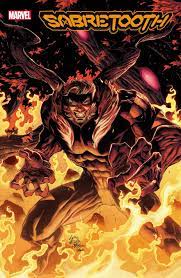 SABRETOOTH vol 4 #1
“The Adversary”
by Victor LaValle, Leonard Kirk & Rain Beredo
SABRETOOTH. If you’re wondering, volume 1 was the 1993 miniseries, vol 2 was a 1998 one-shot, and vol 3 was a 2004 miniseries. This is another five-issue miniseries.
COVER / PAGE 1. A grinning Sabretooth in hell, with Krakoa visible behind him.
PAGES 2-5. Sabretooth is consigned to the Pit.
This is a reprise of Sabretooth’s “trial” and banishment at the hands of the Quiet Council in House of X #6. Sabretooth’s narration is new and replaces most of the spoken dialogue. But what remains is taken directly from that issue, except for Sabretooth’s final line: “No prison can hold me. I’ll be free before you even notice.” In fact, that issue came out in October 2019 and we haven’t seen him since.
Xavier’s line “It’s distasteful, I know…” originally continued “…this business of running a nation.” The emphasis here is much more on the personal treatment of Sabretooth.
We do get Sabretooth’s almost universally contemptuous views on the members of the Quiet Council. He has a point about Magneto’s hypocrisy, and Apocalypse is the only one he actually respects. He sees the three outright heroes as children, and dismisses Emma and Sebastian as costume drama (which is more a reflection of his style than hers).
If “the Rainbow Gang” refers to anything specific, I don’t recognise it.
Sabretooth refers to Mystique as “Leni”; Leni Zauber was the cover identity she was using during the brief relationship that led to their son Graydon Creed.
PAGE 6. Data page. Someone reflects on what the Pit actually is. The obvious candidate is Sabretooth, but it doesn’t really sound like his voice. Could it be Cypher (imagining how he would answer the questions in italics)?
The wildlife factoids are accurate.
PAGE 7. Recap and credits. The small print reads “Destiny of X”, “The Pit” and “Cast into Exile on X”.
The recap covers Sabretooth’s involvement in the plot of House of X. I’m not sure it was previously stated that he had been resurrected on Krakoa, but it was strongly implied, since he was one of the many characters to get killed on panel during Matthew Rosenberg’s run – specifically, he was beheaded by Magik in War of the Realms: Uncanny X-Men #3.
PAGES 8-13. Creed imagines himself killing the X-Men who have come to recapture him.
Like apparently almost all of this issue, this scene is in Sabretooth’s mind, so there’s not much continuity to be explained here. Much like Wolverine, Sabretooth imagines himself retreating to the wilderness to hunt. Unlike Wolverine, he imagines himself sadistically killing the X-Men.
PAGES 14-18. Cypher strikes a deal with Sabretooth.
We established during Inferno that Cypher and Warlock know much, much more about what’s going on on Krakoa than previously thought; we’ve also seen in X-Men Unlimited Infinity Comic #12 that they’re prepared to ignore directions to put people in the Pit. Clearly, it’s Krakoa (rather than the Quiet Council) who feel that this punishment is too harsh; that’s consistent with Krakoa’s refusal to countenance putting Nature Girl in the Pit for murder. Note that Cypher insists that “nothing like this will happen to another mutant again” – he implies this is Professor X’s decision, but it may well be Krakoa’s. It may also mean that Krakoa’s attitude to Nature Girl wasn’t based on her own actions, but on a general objection to the Pit. And it begs the question of what happened to the Toad after he was taken into the Pit in X-Men: Trial of Magneto #5.
Plainly, even before Sabretooth accepts Krakoa’s deal, he is not experiencing what Xavier told him to expect – “alive but immobile… aware but unable to act upon it”.
PAGE 19. Another data page about the nature of prisons – and again, this doesn’t sound much like Sabretooth’s voice.
PAGE 20. Sabretooth indulges his dreams of slaughter.
Obviously, the first victim is Professor X. Next is Iron Fist, billed as an “old acquaintance” because Sabretooth started off as an Iron Fist villain. And the next panel is a bunch of wolf-type rivals – Feral is clearly recognisable, and that looks like Wolfsbane near the front. Wild Child is on the right, with an echo of the collar worn by his Age of Apocalypse version. The others might be Wolf Cub or some of the wolf-themed Dominant Species mutants from Chuck Austen’s Uncanny X-Men.
PAGE 21. Sabretooth reflects.
Imagining killing people gets boring after a while. Might this experience actually force him to… do something else?
PAGES 22-23. The Feral Council meet.
This is Creed’s parody of the Quiet Council, obviously. Sabretooth appears here in his traditional costume, in a suit which he sometimes wore in the 90s, and as the bloody child from some origin flashbacks. Note that there’s a fourth seat which remains unoccupied.
The multiple Sabretooths decide that the solution to being bored with murder is to increase the scale.
PAGE 24. Sabretooth as “Creed the King”.
This is a Conan parody, obviously.
PAGE 25. Sabretooth as the Starjammers. All of them.
Sabretooth is playing the roles of Corsair, Hepzibah, LIlandra, Ch’od (with Cr’reee), Raza and Binary – it’s a late 80s Starjammers line-up, basically. In Sabretooth’s version, they bring down entire civilisations. Note that “Corsair” is wearing the same “Mark of Creed” that was used as a brand by “Creed the King” on the last page.
The races Sabretooth mentions are all established in the Marvel Universe. The Acanti are space whales who were enslaved by the Brood; the Shi’ar are longtime X-Men fixtures; the Centaurians’ best known citizen is Yondu from the original Guardians of the Galaxy; and the Kymellians are the horse-like aliens who feature in Power Pack’s origin story.
PAGES 26-27. Sabretooth starts to manifest on Krakoa.
Krakoa seems well aware of what’s happening, and not to have an issue with it. That’s worrying.
The blue violinist on page 27 is Rhapsody, a minor character from Peter David’s X-Factor run. The barman in the Green Lagoon is the Blob, as usual. The guy being threatened by Corsair seems to be Mole, a minor Morlock from the Simonsons’ X-Factor run who also appears in their issue of X-Men Legends this week. He was killed by Sabretooth in X-Factor vol 1 #53.
PAGES 28-32. Some outsiders arrive in Sabretooth’s Hell.
Probably? Or maybe they’re illusions. We’ll find out next time. Anyway, Sabretooth is blissfully torturing an imaginary Quiet Council when this unusual selection of characters shows up on his doorstep:
- Nekra Sinclair is a mutant, but I’m not sure she’s ever appeared in the X-books before. She gets more powerful when she has violent and hateful emotions. So she should be at home here. She debuted in Shanna the She-Devil #5 back in 1973 but she’s been all over the Marvel Universe. Basically she’s a kind of cult leader. She has a weird high concept back story that hasn’t really been a factor since the 1970s, so we’ll cross that bridge if we come to it. (Her origin story can be found in Daredevil #110, which is on Unlimited, but it’s the sort of thing that will have you wonder what on earth they were thinking even by the standards of 1974. Suffice to say it’s meant to be making a statement about race, and it involves the Mandrill.)
- Madison Jeffries was a member of Alpha Flight and X-Club. His control over machinery doesn’t seem like it’d do him much good down here.
- Oya was a member of Generation Hope, and later a regular in Wolverine and the X-Men and All-New X-Men (the version with the time-travelling Silver Age X-Men on a road trip).
- Melter is a character from Dark Reign: Young Avengers, who’s appeared sporadically since in minor roles. He was the leader of the Young Masters, but seemed not to be too bad a guy. He appears to have killed people, including his parents, through a lack of control over his powers.
- Third Eye seems to be new.
PAGE 33. Trailers. The Krakoan reads NEXT: NEW FISH.

I very much enjoyed this comic.
It ended abruptly, but otherwise, I found LaValle’s writing strong.
I thought that was Daddy-Long-Legs at the end, not Third Eye (yeah, I had never heard of him either).
So I really liked this and put it high on the list of Krakoan era first issues.
Sharp writing with a good sense of character, nice art, and some actual fun if you find horrific fake murder entertaining.
But oh boy I’m worried this is somehow going to turn into a Sabertooth redemption story via restorative justice.
He’s probably killed what 10,000 people?
I’d much rather he continue on as Krakoan Satan.
If not for several people online having a high opinion of Victor LaValle’s writing (never heard of him; I’m not very knowledgeable of current prose authors), I might have skipped this book. Sabretooth is not the most compelling villain. I’m glad I did, as the horror elements, social commentary, and art were all well-executed. I’ve never disliked Leonard Kirk’s art, but I was surprised at how good it looked in this book.
I don’t think we’ll see a demotion arc in this story. The opportunity for Sabretooth to change his ways came after he got tired of killing. He didn’t. I think we’ll see the failings of the Krakoan criminal justice system through the stories of the characters who appear on the last couple pages, and probably a prison break. Whatever direction this story goes, I’m eager to read the rest.
You know it’s going to be a weird week when Mole, one of the most obscure Morlocks ever, appears twice in two different storylines.
I do wonder about the collection of mutants we see at the end. Were they sentenced for actual crimes, dragged in through Sabretooth’s doing somehow, or something else? Nekra at least has a history of murder (and a weird history in general.) Oya has always been on a “I’m cursed and going to Hell kick since she first appeared. Madison Jefferies was brainwashed by the Zodiac into becoming a supervillain terrorist, and by Weapon X into helping run a concentration camp for mutants. Melter has also murdered people with his powers. It’s still a remarkably weird selection.
Oddly, there was a mutant named Third Eye, but he was a white guy with a literal third eye in his forehead, who was depowered on M-Day and subsequently murdered.
The Other Michael-I still think that was Daddy-Long-Legs from Nocenti’s Spider Woman. I wonder if there was some miscommunication.
@The Chris V –
Except Daddy Longlegs wasn’t a mutant, his powers came from drinking a bad batch of Bill Foster’s growth serum. And this dude just doesn’t have the distinctive elongated limbs of the other.
Third Eye is clearly an original for the story with plot-convenient, most likely psychic, abilities, if not a secret identity for someone checking in on Sabretooth.
I’m wondering if the fourth chair of the Feral Council is the more controlled, probably older version of himself, which only came out when Birdy (his sidekick telepath) was calming him. Creed’s active mind doesn’t want to accept that version of himself, hence the empty chair.
The gang of newbies is so random that I feel like they have to be real – does Creed have any idea who any of these people are? Nekra seems like a natural apprentice to Creed given how her powers work. Melter’s powers have horrific potential to kill, which he’s thus far not gone all-in on, but Sabretooth-as-devil will push him to do so. No idea what we’re in for with Madison Jeffries or Oya.
The additional question is why these five were presumably put in the Hole. Nekra’s easy since she kills people a lot. Melter’s powers can easily kill. Jeffries and Oya are the question marks, and Third Eye is new so hey, we’ll see.
“I’ve never disliked Leonard Kirk’s art, but I was surprised at how good it looked in this book.”
Apparently he’s inking himself, which . . . I think he used to be inked by Robin Riggs? There are plenty of instances where I really don’t prefer when pencillers do their own inking (Doug Mahnke and Pat Gleason come to mind), but this is indeed a step up. Feels a bit like Mark Buckingham/Steve Leialoha.
Josie- yeah the Mark Buckingham comparison is a good one.
If “the Rainbow Gang” refers to anything specific, I don’t recognise it.
It’s the League of Queer-Coded Villains !
Exodus had a close relationship with the 12th century Black Knight, Mystique is outright bi and in a longtime lesbian relationship (and there’s all the genderqueer subtext, of course), and, well, just look at Mr Sinister.
In other words, it’s Sabretooth being a queerphobic “smartass”, which fits with his usual shtick of toxic ultra-masculinity.
I just assumed it was because one is white, one is red, and one is blue.
Victor LaValle seems to be mainly a prose writer with very limited experience in comics.
I have to assume that assigning him to a Sabretooth miniseries is no accident; either him or Marvel believe that he has something to say by way of the character.
I read this one on a lark myself and was also surprised at how much I enjoyed it. Sabertooth seems dangerous again, and the possibility of his escape feels like a big deal.
Cheers to LaValle, who I’m surprised isn’t a native of the medium.
LaValle has been on my “to read” list for a while, but the strength of this issue definitely moved him up the pile.
— Nekra briefly turned up in Matt Fraction’s run during the Dark Avengers crossover, as one of the many mutants in San Francisco fighting Norman Osborn’s registration scheme. That said, she’ an extremely minor part of it, and her dialogue and behavior there is pretty unrecognizable as any prior version of Nekra. There’s also the issue that the Dark Reign: Lethal Legion series has a standard-model Nekra in a very different plot set in a super-prison, playing off her history with Avengers villain the Grim Reaper.
— The Chris Colchiss Melter went full villain in Fraction’s Invincible Iron Man, joining up with the Mandarin, getting some kind of physical upgrades from Zeke Stane, and behaving like a standard part of a villain team-up. But pretty much all the minor characters in that run were there as a sort of indistinguishable lump, mainly so the story could feature versions of most of the recurring Iron Man villains. Kind of a running thing with Fraction’s use of minor characters, really.
Ah, thanks for that, Omar. That’s the guy who took up the name of Melter in Iron Man. I didn’t realize he was a mutant. I thought this was another character who happened to have the same codename as another, more famous Marvel character.
This wasn’t what I expected. Good. I have no idea where this is going, but I’m very excited to find out.
Another kind of surprise was the motley crew at the end – I think most of us expected Nanny, Orphan Maker and Toad, the characters we’ve known have been sent to the Pit. Maybe they’ll still appear later and this bunch is some kind of the Council’s dirty secret being revealed.
I think the data pages is just Creed. He’s quite intelligent when he wants to (is being written as such). And I much prefer smart Creed to the snarling moron of the cartoons… and quite a few comics as well.
The Warlock briefcase was a fun bit.
As for LaValle’s prose, I read his Ballad of Black Tom and Changeling and can recommend both. Especially the Changeling – it’s not quite horror, not quite modern fairy tale, a bit of both and more besides. Good stuff.
Sabretooth isn’t his first comic book – he’s written them before, though I think maybe just one or two other miniseries.
Yes, “Ballad of Black Tom” is a very interesting story (it’s a novella) if you are a fan of Lovecraft. It’s a deconstruction of racialist themes from one of Lovecraft’s most overtly racist stories, “The Horror at Red Hook”.
The novel Lovecraft Country was influenced by LaValle’s story. I know that book became popular. There are also some similarities of theme with David F. Walker’s Bitter Root comic.
I’m kind of shocked Mandrill isn’t in the Pit. Has he even been SHOWN as being on Krakoa?
I mean, given his power to control females and his tendency to take full advantage of them, there’s almost NO chance he WOULDN’T end up there.
The rainbow gang line is just a joke about their skin colors, not everything is a reference to continuity
Aaron Elijah Thall: does that violate any of the Krakoan laws though?
No, it isn’t a Pittable offence. At most, there would be a reprimand. He’s just using his mutant gifts though, so it’d be the same as Empath.
To get thrown in the Pit, one must murder a human.
Yeah, but when Mandrill uses his powers, it generally leads to, well…
y’know. THAT. I’d say doing that serially would probably be pittable.
I wondered if the fourth seat was for the cat. There’s room for interpretation there, right?
Does Krakoa actually have any protections from offences against the person? Punishments? Laws, even?
No.
It’s somehow an utopian anarchist society, a lawless Social Darwinist experiment, and an authoritarian oligarchy. All at the same time.
Krakoan laws are applied ex post facto-if a mutant committed an offense before it is declared a crime, then they can still be punished for it. It’s one of the human rights violations they do that’s probably unintentional on the part of the writers.
So we have no evidence that offenses against the person are illegal, but if the Quiet Council so chose, they could be made so retroactively, and punishment applied immediately.
I’m not sure exactly how you punish someone on Krakoa outside of the Pit, which is supposed to be reserved for only those who violate the Law (murder a man).
Mutants are immortal.
It’s a moneyless society, so you can’t fine someone.
It’s a communal society, with no private property.
Exile would seem to be contrary to Krakoa’s promise as a “land for all mutants”.
Using outright violence on the part of the State would be anathema to the Quiet Council’s original raison d’être for creating the Pit (to prove their justice system was superior to humankind, even though Hickman wrote the scene with irony).
We saw when Shaw murdered Kate, it was basically left to the wronged party to seek retributive justice, if she so chose.
Xavier and Magneto’s ideology seems to be based around the idea that a mutant would never harm a fellow mutant. I’d have to assume that Apocalypse had a large hand in shaping most of Krakoa’s legal system outside of the Law. “Mutants can defend themselves. The strong are in the right. Those who cannot defend themselves are the weak and deserve no justice.”
Kate’s murder wasn’t left to Kate to avenge – nobody made that decision, Emma didn’t reveal his guilt to the Council or the Krakoan people. We didn’t see what would happen if the Council was to rule on it.
Given Mandrill’s powers, tendencies, and DEEPLY offensive origin, my best guess is that he is, at best, WAY down the list for resurrection (he apparently died in a Spider-Man arc a while back at the hands of Kraven) and that the writers don’t intend to use him.
I mean, his origin is BEYOND racist (black kid turns into a monkey), the character’s the very definition of misogynist, and rapey as hell. If I was in charge of Marvel, I’d absolutely dictate that he NEVER be used again.
That’s my theory. Because him just being ALIVE on Krakoa would open cans of worms no one should even WANT to touch.
His origin was that he was born to two white people but looked like a black kid…but then he grew up looking like a monkey. It’s still quite problematic, although not quite as racist.
I can only assume that Steve Gerber was writing that story as a satire of racist ideas. I’d like to blame it on drugs, but I know that Gerber never used drugs.
Leah Williams is claiming that eryone who was in the queue before trial of Magneto has been resurrected, and only the mutants that Wanda added are there. Of course, that doesn’t go with the math HoX/PoX had of it taking 10 years even if the Five could increase to 30,000 per week.
My prediction is that at the end of the series, the inhumane Pit punishment will be abolished in favor of a superior mutant alternative, showing Krakoa is better than human culture.
Mandrill *is* white by family background, but the premise of him and Nekra is that they’re race-swapped (apparently due to their parents being caught in the same lab accident) and both were cast out of their respective communities. She’s the albino daughter of black parents; he’s… well, he’s indefensible. A *very* charitable reading would be that they’re each meant to be parodies of their respective communities’ perceptions of the other, but it’s not obvious how Nekra fits into that.
I’m not totally sure. Nekra is a vampire-like woman who feeds on hate. There might be something there. It’s certainly not as obvious. Then again, Gerber might have had less to say about the issue of black bigotry as pertains to white folk, and the satire is mainly aimed at racism by whites.
Mandrill is born to white parents, grows up looking like a monkey. He is sexually irresistible to women. He founds a subversive organization called Black SPECTRE (the name certainly sounds satirical), with the intent to torment a race war leading to him taking over the government. It seems like a satire of the worst and most paranoid ideas about African-American males at the time.
I knew Steve Gerber well enough to know he was certainly not a racist. I never heard him outright address the Daredevil storyline though.
*foment a race war, not “torment”.
Also, I forgot to mention Nekra isn’t an albino woman. It’s pointed out she is born a white woman and not simply albino.
And Nekra, born of Black parents, is chalk-white and literally gains strength by hating others. So it’s as if each character is meant to satirize a racial stereotype….but the story of American racism makes it super-lopsided, since the whole “hypersexual person of color” thing is literalized in Mandrill, and “White people are hateful” isn’t a stereotype, exactly. Nekra’s not fueled by, like, a sense of her own superiority; she just gets stronger the more she hates people, like the Hulk with more focus.
And, worse, she’s Mandrill’s muscle, so visually, it’s a ewhite-coded woman serving a hypersexual Black man who already controls women. while Nekra is still his muscle and has a pretty generic, non-racially charged powerset.
And in terms of plot technicalities, Nekra is…a Black woman who looks like an inhuman monster, acts as a pagan priestess, and gets super-strong by getting hateful and angry.
I have no doubt Gerber was trying to make some double-reverse ironic statement about prejudice — the Daredevil storyline that reveals their origins ends with the hero doing one of those “They were victims of a world that wouldn’t accept them, why didn’t the authorities understand that?” bits.
But the story that resulted, and, honestly, the character concepts in general, very much do the opposite of attacking prejudice in terms of both the high concept and the execution.
I’m not sure it’s worth the effort. For one thing, it relies on creating hurtful stereotypes “ironically.” For another, it would mean having to create a hurtful stereotype of a White American that somehow has the same impact on American readers as the racist imagery being played with for the Mandrill character.
And, especially circa 1974, that may literally just not be possible to do because the hurt is so tied up with history and with social power differentials.
It was just a super-bad idea coming from a lot of unexamined assumptions on Gerber’s part, and it’s kind of depressing — but not, sadly, very shocking — that neither he nor anyone else around him spotted it and slammed on the brakes.
As a full society, Krakoa *should* have some policies in place around things like sexual assault, but I don’t think the writers want to think about that. I don’t blame them. The closest we got was the datapage about Empath’s mutant gift affecting his worldview, but that fell under the whole mutant identity thing. I’m not sure I want to know how the writers would handle someone who harms others without the explanation of their power predisposing them to do so.
Steve Gerber is one of the best and most interesting writers in comics history, but he could be terrible when writing about race. Besides Nekra and the Mandrill, he wrote a story in Defenders about the Sons of the Serpent. They are a white supremecist hate group trying to drive minorities out of New York City. They were obvious bad guys, and the Defenders were rightly appalled by their actions. It was revealed that they were being funded by someone embezzling funds from Nighthawk. That someone was… Nighthawk’s black butler (or chauffeur, I forget) who was profiting from the group. Ugh. Because money trumps racism, or maybe it was “both sides” blather? Either way, it was an awful ending.
This was also the era in which Steve Englehart (another one of Marvel’s best writers) revealed Sam Wilson used to be “Snap” Wilson, a criminal the Red Skull had brainwashed into being an upstanding citizen and later Captain America’s partner. I don’t think Gerber or Englehart were racist, but they stumbled pretty hard in these stories.
I won’t make excuses for how the Mandrill story ended up on paper.
However, I have a soft spot for the Sons of the Serpent storyline. It’s about a bunch of white supremacists who think they’re superior to the black man because of their race, except their leader is revealed to be an African-American man. They’re shown to be complete morons.
You could go the realism route and reveal their leader to be a white man, with the message of “racism is bad”. I much preferred Gerber’s message that these people are utter and complete deluded idiots.
Also, it was actually a financier who had invested in Richmond Enterprises.
They’ve already pretty clearly established the “Respect this sacred land” law is just nonsense that lets them justify anything the QC wants to do.
Chris V said: However, I have a soft spot for the [Gerber Defenders Sons of the Serpent storyline. It’s about a bunch of white supremacists who think they’re superior to the black man because of their race, except their leader is revealed to be an African-American man. They’re shown to be complete morons.
In fact, he’s a spoof of Alfred Pennyworth and (maybe ahead of the fact) of Lucius Fox, since he works for Kyle Richmond, running his investments.
There’s a genuinely clever bit, when he’s revealed, Gerber has him say that he doesn’t see himself as in solidarity with poor Black people, because he’s in with the wealthy:
As the dialogue has it in Defenders v.1 #25:
“How could you do what you did to…your own people?!?”
[…]
“The cold, unadorned truth is…I spent most of my life trying to escape my own people. Do you think me despicable, sir — for turning on my ‘brothers’ and ‘sisters?’ Before you answer, ask yourself — Is every white man your ‘brother?’ Do you feel kinship with him — because your skins are the same color? Of course you don’t! Why should you? Why should I?”
“B-but I don’t go out and murder people because they’re white, either!”
“Ah. But you hold stock in companies which gouge the public of millions each year — and in firms that pollute the air and water — and in — but need I go on, sir? You never objected to those investments. Never even asked where the money was. On that basis, I assumed — ”
“That I wouldn’t object to plunging the nation into civil war?!?”
“Yessir — If it would help increase your fortune.”
It helps that Luke Cage is there to kick the crap out of him at the end of the story, and that the dialogue emphasizes that Pennyworth has internalized racism and classism, indicting the systems that led him to those ideas.
And the story then makes very explicit that the Serpents themselves are genuinely just White bigots, and that they are still dangerous and must be stopped even after Pennyworth has been exposed and defeated.
Thanks for the clarification on Pennyworth’s name and job, Chris V & Omar. It’s been awhile since I’ve read the issues. I still remember how good early Klaus Jason inking looked on Sal Buscema’s pencils, though.
Anyway,I see why you guys have a better opinion of the story than I do. Your points about white Supreme costs being fooled by a black man and Gerber portraying Pennyworth as internalizing racism & classism give me food for thought.
I can’t get past the fact that secretly funding a race war makes a black man just as complicit as the disgusting racists. Maybe more, as the Sons of the Serpent might have disbanded without his financing. Gerber could have had the person who is using Nighthawk’s money to bankroll the Sons of the Serpent be a white employee, and the twist would still work. Nighthawk’s irresponsible, unchecked capitalism led to evil people causing death and destruction. To me, making Pennyworth black reads more like “people of color can be racist, too!” I’m white, and I’ve heard other white people say, “but black people can be racist” to justify their own bigotry. I don’t think that was Gerber’s intent but Penny worth being black derails the story for me.
He was somewhat self-hating though. When white people say that they usually don’t mean that a black man can be racist against other black people.
As Omar said it’s more about class than race for Pennyworth. While for the Sons of the Serpent it’s solely about race, and they’re the ones who come off looking the worst.
I like it because Gerber’s stories are usually deeper and more philosophical than the norm for superhero comics of that time period. Stan Lee (and other Marvel writers) had already addressed the “good and evil” issues of racism.
*“Good versus evil” issues of racism. I didn’t mean to imply there are any Good aspects to address with racism!
@ Chris V
*“Good versus evil” issues of racism. I didn’t mean to imply there are any Good aspects to address with racism.”
Understood, and I wouldn’t think otherwise.
Steve Gerber is one of my favorite writers in the medium. He was like the later British invasion writers, but in a field by himself at the time. It’s too bad his time at Marvel ended badly, and I wonder what he would have done had he continued to write Howard the Duck. It’s a shame Destroyer Duck is so hard to find. I’m glad he returned to comics in the late ’80s. Hard Time, his last major work before his untimely death, was very good.
I’ve seen both Mandrill and Nekra before, but knew nothing about their origins or relationship. That sounds…bad.
It’s sadly not surprising how often attempts by comic writers to address real-world issues turn into tone-deaf misfires. I suppose working in a homogenous industry like comics will do that.
Also, what a wealth of comics knowledge this community is. I appreciate every explanation of a terrible/weird/awesome story I haven’t read before.
Well considering the last time they tried to do a redemption arc for Creed, he had fooled Xavier and nearly killed Psylocke (Elisabeth Braddock). I just thought that they would have to do something similar to what they had to do in order to deprogram Wolverine after he was turned into a brainwashed assassin for the Gorgon.
Nah, the last time they (Marvel editorial) tried to do a redemption arc for Creed was the Axis magic wand solution. He became an Avenger for five seconds and later an X-Man for a year and a half. Albeit on Magneto’s team on a book that might as well have been called X-Force.
I was on board for magic wand Sabertooth, but that’s kind of my point.
They had to magically shove empathy into him like Angel’s soul.
No not that Angel, the better one.