Legion of X #1 annotations
As always, this post contains spoilers, and page numbers to by the digital edition.
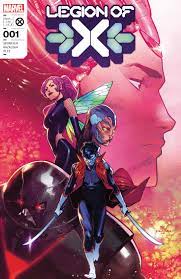 LEGION OF X #1
“Do What Thou Wilt”
Writer: Si Spurrier
Artist: Jan Bazaldua
Colourist: Federico Blee
Letterer: Clayton Cowles
Editor: Sarah Brunstad
LEGION OF X is the relaunch of Way of X (or, if you prefer, Way of X was the prequel which did the set-up for this book).
COVER / PAGE 1: Well, that’s Legion and Juggernaut in the background, Nightcrawler at the front, and Pixie with the wings (who isn’t really in this issue, but was a recurring character in Way of X). The woman with the techno-stuff on her head is Weaponless Zsen, who’s introduced in this issue.
PAGE 2. Legion’s opening monologue.
Legion is addressing Blindfold, but we’ll come back to that. He’s also helpfully recapping Way of X for anyone new (like Blindfold). The opening panel seems like a meta nod to the season break since the last arc, too.
The Altar was introduced in Way of X and Legion’s explanation of it here is about as clear as anything else we’ve had in the past. Legion talks it up as a mutant dimension and then kind of backs off from that – we don’t entirely have a sense yet of how many mutants are using the Altar, or what kind of people they are. Broadly speaking, it seems to function as a hub of mutant culture with therapeutic overtones. Using it as the base for the Legion of X is slightly at odds with that – or maybe not, given that Kurt sees it as an essential part of a nation-building project, and as rehabilitative to boot.
The Station is new, but it was set up in X-Men: The Onslaught Revelation (which was effectively the final issue of Way of X). In the epilogue of that issue, Legion describes them as “mutant cops, with my brain as the precinct”. Nightcrawler replies that “it’s not police. We must defend what unites us, not punish the growing pains.” One of the themes here is whether the Legionaries are an alternative to a police force, or simply a different kind of police force – the book is plainly drawing on police procedural tropes – and generally how Krakoan society deals with criminals and troublemakers. Legion describes the Station as “what Nightcrawler needed [the Altar] to be”, and maybe there’s an element here of Kurt wanting to impose order on chaos. It certainly looks a bit non-psychedelic by the Altar’s standards.
In Revelation, Nightcrawler was expecting his Legion to be poorly received by the Quiet Council, but they seem to have some quasi-official status here – certainly Ora Serrata recognises Kurt as Krakoa’s chief policeman.
PAGE 3. Nightcrawler briefs the Legionaries.
Nightcrawler is doing his station commander routine. We’ll see the first three assignments that he mentions later in the issue, so we’ll come back to them. “Possession with intent” is a genre trope pun, as we’ll see.
Fabian Cortez is now standing as Nightcrawler’s right-hand man; he only gets one line of dialogue in this issue, but clearly his turn into a productive citizen in Way of X has stuck.
Xabi is ForgetMeNot, who debuted in X-Men: Legacy #300, and has the rather unwelcome power to be instantly forgotten by anyone who isn’t directly looking at him at the time. Originally he was a joke character – the idea being that he had been in the X-Men all along and you don’t remember. You can decide for yourself how literally you want to take that as part of his back story. Forge has apparently created some devices to shield people from the effects of this power, which would make it possible for the poor guy to finally develop some ongoing relationships with people. His real name, “Xabi”, is given for the first time here. It’s probably short for “Xabier”, which is a Basque form of “Xavier”. Hmm.
The Omega House. One of the collective homes in the Akademos Habitat. Nightcrawler talks about it here as being the home of some generic kids. Back in New Mutants vol 4 #3, the occupants of Omega House were listed simply as “redacted”.
The Legionaries in the audience are mostly recognisable. From left to right in panel 1:
- On the very far left we can see the helmet of Zorn.
- The elongated woman with the black and red hair is Lost, a major character from Way of X.
- In the bottom left is Maggott, with either Eeny or Meeny in hand.
- Gorgon is leaning against a wall. Remember, he was mentally rebooted after “X of Swords”, so he’s not a Satanist Nazi any more.
- Pixie, another major character from Way of X.
- Chamber, with the strapping around his mouth.
- Dr Nemesis, with the strange fungal hair.
- Xorn, the other one, with his head on fire.
- And a couple of unrecognisable people with their backs to us in shadow.
It’s maybe worth pointing out that Legion himself is not apparently part of the Legion.
PAGES 4-6. Legion and Blindfold are reunited.
Blindfold was Legion’s girlfriend in Spurrier’s X-Men Legacy run. She died by suicide in Uncanny X-Men vol 5 #11. She’s only just been resurrected because of the ban on resurrecting precogs, which was in place until Inferno, at Moira MacTaggert’s insistence (but also apparently because of a fear on Xavier and Magneto’s part of what a precog might see in the future of Krakoa). Blindfold says that the Five told her that the ban has just been lifted; the ban wasn’t public knowledge on Krakoa and it’s not clear whether the Five actually knew about it at the time, or whether they were just working through the list in the order it was given to them.
The Qortex Complex, as a home for Legion’s other personalities, comes from X-Men Legacy vol 2 #2-3.
PAGE 7. Recap and credits. The title, “Do What Thou Wilt”, and the recap headline “The whole of the law”, are part of the credo of the mystic Alastair Crowley (1875-1947).
The small print just reads “Legion of X – The Altar X”.
PAGE 8. Data page – the three laws with Nightcrawler’s interpretation, plus a bit on Nightcrawler’s philosophy of semi-reckless experimentation. Much of this is recapping the views Nightcrawler reached about the laws in Way of X. In particular, “respect this sacred land” is very broadly construed by making the “land” a political rather than geographical concept, allowing the rule to become a very broad edict of social responsibility.
The obvious issue with these laws is that (aside from the one about murder) they’re really more in the nature of underlying principles. Basic jurisprudence would say that good laws strike a balance between flexibility and predictability – and Krakoa’s three laws fail spectacularly on that account. Kurt might well respond that it’s a country which has only been around for a few months and practice will be become clearer over time.
PAGES 9-11. Nightcrawler is introduced to Ora Serrata.
Storm’s comments about Arakko’s “surprisingly nuanced culture” fit in with the work being down in X-Men Red to flesh them out a bit. Since Legion is generally based on Mars, Arakko is apparently going to play a part in this book too.
Storm’s costume places this before X-Men Red #1.
Ora Serrata has been mentioned before, as has her role in the “chair of law”, but this is the first time we’ve actually seen her. (She was conspicuously absent from the Great Ring meeting seen in S.W.O.R.D. #8, and she’s just plain missing in X-Men Red #1.) Basically, Arakko’s justice system boils down to a system of challenges (usually but not necessarily combat), with refusal to participate being punishable by death. In the real world, the supposed logic of trial by combat was meant to be that God would intervene to dictate the winner, but that doesn’t seem to be the thinking here, given the Arakkii attitude to gods.
PAGES 12-15. ForgetMeNot and Juggernaut deal with Paulie DiCosta.
Pretty straightforward, though the wisdom of sending ForgetMeNot to have a conversation with someone who keeps forgetting he’s there must be a bit debatable. Krakoa doesn’t do extradition – we’ve seen repeatedly that they regard themselves as above human justice whatever the charge. ForgetMeNot is duly following the Legion of X philosophy here: rehabilitation rather than punishment, but it’s going to be compulsory. The alternative on Krakoa, of course, is just to stick the guy in the Pit. Interesting that Spurrier chooses to start us off with such a signally unsympathetic character, though.
Seems a bit odd that Juggernaut knew to follow ForgetMeNot’s order but doesn’t recognise him at the end of the scene. Maybe he was given something to keep reading so that he’d remember what was going on.
We’ll come back to what Cain is doing here.
PAGES 16-18. Lost and Pixie in the Healing Gardens.
Spike. This guy is a minor background character from the Morrison run. His big moment is in New X-Men vol 1 #134, when he actually gets a few lines of dialogue and talks to Quentin Quire.
Lost seems to have got control of her powers now, and is no longer causing everyone around her to feel nauseous due to the gravity distortions.
Rockslide died in Otherworld in “X of Swords” and was resurrected as a blank slate; his storyline was a subplot in X-Factor and got lost in the shuffle when that book was cancelled. Apparently we’re picking it up here. Note that the opening scene set up the kids as “graffitiing” Rockslide, but Spike seems pretty emphatic that they were cheering him up.
The others who are accompanying Spike in his flashback are Glob Herman and two minor characters from New Mutants, Brutha Nature and (I think) Cam Long.
PAGES 19-24. The Arakkii summon up a god to fight.
All these arena characters are new, though Zsen is obviously going to be a major character in the series.
Ora Serrata’s explanation of the history is a bit confusing: she claims that since anarchy is inconsistent with effective war, “[a]t such times, all Arakkii defer to the Chair of Law”. But… how can there be anarchy and deference to the Chair of Law at the same time? At any rate, her predecessor’s solution was to summon up god-like beings to try and create social unity, and they were useless. Apparently there are some religious groups on Arakko, but it’s regarded as a crime – or rather, worship is regarded as a crime, rather than simply acknowledging the existence of a god, which appears to be okay. There are weird echoes in all this of Kurt’s attempts to find a quasi-religious hook for social unity in Way of X.
For reasons which are not entirely clear, the Arakkii have had a big upsurge in godly manifestations since arriving on Earth / Mars – the suggestion seems to be that these are low-end deities casting about for potential worshippers. Anyway, Nightcrawler’s job is to locate a stray trickster god who has escaped all this.
PAGES 25-27. Legion crashes the Quiet Council.
If Legion’s been at the top of Olympus Mons for “six months” then we’re apparently running in publication time.
For some reason only about half the Quiet Council are present. Hope is there, so it’s after Immortal X-Men #1-2.
Magus. Warlock’s father was last seen in All-New X-Factor, I think. We haven’t seen him in a while. In Blindfold’s vision, he seems to be surrounded by other technarchs. Quite why Nimrod would want to kill him is less clear, since they’re both machine life – but if we’ve sticking with Hickman’s cosmology, the technarch are part of the evolution of machine life, and presumably this is something to do with Nimrod aiming to ascend himself.
Legion is obviously right to want to tell Warlock in person what he’s seen, but it’s not so obvious that he couldn’t wait until the end of the meeting – he’s doing this at least in part to make a dig at Xavier, which of course helps to establish the relationship for newcomers.
PAGES 28-30. Nightcrawler and Zsen talk.
Nightcrawler. A nightcrawler is indeed a worm. The bit about Nightcrawler’s priestly training being a “crazy illusion” refers to a notoriously inane storyline from Chuck Austen’s run on Uncanny X-Men in which the Church of Humanity were going to install Nightcrawler as Pope and stage a false Rapture in order to topple the Catholic Church. As part of this, Nightcrawler’s priestly training wound up being retconned into some sort of fake in Uncanny #423-424.
Zsen. Zsen has no “weapons” because her mutant powers have no military use. She says that her apparently cybernetic enhancements were given to her by the Vile – the group associated with Tarn, who we still don’t know much about. I think this is the first time we’ve seen it suggested that the Vile did something constructive for someone. But presumably they made some sort of contribution during all those years of war.
PAGES 31-32. The Legion gather back at the Station.
Switch is a seriously obscure character who was a member of the New Hellions, a minor revival of the Hellions team who appeared in X-Force #87-90 back in 1998. I don’t think he’s been seen since.
Juggernaut thinks he was assigned to the team by Professor X, and clearly attaches some pride to that; we don’t get to see how he reacts to the news that it was Nightcrawler who wanted him here. Professor X did invite Juggernaut to come to Krakoa – in X-Men Unlimited Infinity Comic #20 – though that story ended with Juggernaut saying that he wanted to bring down the Warden’s backers first. Either he’s dealt with that off panel, or he’s parked that mission for now.
PAGES 33-34. Mother Righteous debuts.
This is a new character – she could of course be the escaped trickster god.
PAGE 35. Trailers.

There is a Switch in the Legion TV series, but it’s a new character with the same codename, so it’s probably just a coincidence that (a) Switch and Legion are being brought together here too, although I wouldn’t put it past Spurrier to be making a meta-reference.
So in Marvel there’s meat gods like Thor and Hercules, intercessionist spirit gods like Bast and Khonshu, metacontextual gods like the Celestials and the Beyonder, apotheosis pseudogods like Molecule Man and Genis Vell, Lovecraftian gods like Shuma Gorath and Set, and demon gods like Mephisto and Satan.
The ones in this comic would appear to be somewhere between a meat god and a spirit god, but with a bit of Discworld logic thrown in, where they crave worshippers? It all gets very confusing.
As an aside, I kind of wish there was a proper opposite to the likes of Mephisto. For example, Mephisto’s there mentally torturing, let’s say Dazzler, and the Archangel Michael just manifests and beats the living crap out of him before high fiving Dazzler and vanishing again without explanation. That would be the best story ever.
And no, angel-Ghost rider, angel-Punisher and angel-Angela don’t count. Neither does Jack Kirby.
As far as ways to oppress your own people for daring to worship the wrong god, this is definitely up there. You get your public humiliation, your social shaming for daring to believe in a higher power that’s been demonstrated to be “unfit,” and a side of murder. I suppose Spurrier felt the Arakkoans were getting a bit too sympathetic, so he felt the need to add religious oppression?
The most obvious candidate for the trickster god of mischief is Loki but he’s too obvious.
Great coloring on this book, especially the psychedelic-looking sequences.
I was impressed by the breadth of Spurrier’s set-up. The A-plot seems to be Nightcrawler investigating the trickster god on Arakko, but we also have separate subplots for Lost & Pixie, Legion & Blindfold, and Forgetmenot & Juggernaut. I look forward to seeing how Spurrier & co keep the plates spinning.
I also hope to see the comic explore concepts of Justice and alternatives to strict punishment. Given that Cortez’s face-turn was a subplot in Way of X and the characters talk about finding new ways to define and administer Justice, I’ll be happy if redemption is a theme of the series going forward.
Spurrier is rapidly becoming my favorite Krakora-era writer. As an ignostic I am loving the Arakki take on gods. And these feel like real characters with interesting personalities. Good, good writing.
(Paul, what do you mean when you say that Pixie is not part of this issue? You even describe a couple of her scenes later.)
Boy this was really kinda over stuffed.
This follows along from Way of X in that I can’t tell if we’re supposed to view this as horrifying or not?
I’m supposed to be rooting for the religious police who are only partially endorsed by the undemocratic oligarchy that runs the place?
Enforcing three ludicrous laws as interpreted by a German swashbuckling elf?
I’m supposed to be happy multiple murderer Fabian Cortez gets to be a church cop instead of… going to jail?
Refusing to extradite a suspected wife wife murderer because he has an X-Factor is… awesome?
I can’t even tell if we’re supposed to think the Arakki are crazy brutal monsters.
Also the Altar is continuing the fine Krakoan tradition of not explaining how anything in their society actually works.
@Ceries:
“As far as ways to oppress your own people for daring to worship the wrong god, this is definitely up there. You get your public humiliation, your social shaming for daring to believe in a higher power that’s been demonstrated to be “unfit,” and a side of murder. I suppose Spurrier felt the Arakkoans were getting a bit too sympathetic, so he felt the need to add religious oppression?”
Wow. Talk about divergent readings.
Are you sure you read the actual issue? Because you seem to have taken it all quite backwards.
As a matter of fact, this is the one issue that finally makes the Arakki feel sympathetic… and funny!
It does?
Their justice system is based on fighting and murder, they have no religious freedom, and giant dry eyeballs are gross.
Painting the truth is viewed as a useless power.
They’re assholes.
Their lifestyle is based on fighting. Their justice system is rather more anarchic really, which quite fits if you think about it.
I have no idea of what you mean by lack of religious freedom here. What I saw on page is something else entirely – being though on worship requests, I suppose. Very, very funny and an excellent use of the weirdness of a society where people have unusual powers left and right.
As for Zsen’s power, I suppose I have to wait until it is actually shown. But I love her poetic streak. I also notice that her right hand seems to shape shift into a blade at a moment’s notice.
I know it was only one dialogue box, but was that really an indentured servitude/slavery reference in Zsen’s introduction scene?
And that possession scene sounds like a sexual assault metaphor. I don’t like it.
The godlaw thing is… at least it’s different? I’m sure it’ll be important in Judgment Day. And in a universe with Thors and Mephistos, it makes sense that a warrior culture would approach religion as a challenge. I’m kind of sick of everything on Arakko being a challenge though.
I’ll give Spurrier credit for trying to portray Krakoa as an imperfect nation, but I don’t think he’s skillful enough to be writing half the things he’s writing here.
You can really see the gears shifting as Spurrier tries to cobble the Three Laws into something sane. These are some very particular interpretations. Deciding that Make More Mutants just means Do Resurrections is probably the best way you can interpret it – but then, why would that need to be a law? Kurt should discarding this law, but why did he even propose it in the first place?
It’s awkward. Necessary, but awkward.
The way I see it, Kurt is learning better. It is character growth. After foolishly proposing that Krakoa should “make more mutants” just because in HoXPoX, he achieved a better understanding of the responsibilities that come with such a goal. Love that after so much panel time it is still possible to make our man Kurt a more rounded character.
Similarly, I loved that he now realizes that having the laws is of little use until and unless one accepts the responsibility of interpreting then and the decurrent consequentes.
This and the prequel book are pretty good at pointing out why dogmaticism is not to be accepted. Worthy enough in itself, but there is also a lot of entertainment and characterization thrown in there for good measure.
Here is hoping that he gets to write the main book sometime soon. Scott and company deserve better than the milquetoast take that Gerry Duggan has been writing for them.
@Luis Dantas: It’s the line “these mutants stand accused of worship” that makes it clear-this is as much about punishing religious deviation as it is having a good scrap. No Arakki mutant is permitted their own faith. It has to be all or nothing.
This was pretty interesting. But the Arakko parts were nonsensical. Most descriptions of Arakko customs and society has been nonsensical though so it’s perhaps an editorial mandate intended to make Krakoa look better.
I liked this one a lot. Not quite at the level of the Immortal and Red opening issues but very close behind. And one thing I appreciate about all three is how packed each one felt.
Apparently, the god who was killed this issue, Teshup, is from real world mythology. Worshipped by the Hurrians, who I think I might never even have heard of, according to Google.
>Ora Serrata’s explanation of the history is a bit confusing: she claims that since anarchy is inconsistent with effective war, “[a]t such times, all Arakkii defer to the Chair of Law”. But… how can there be anarchy and deference to the Chair of Law at the same time?
During the war with the demons, social unrest among the people rose so the Chair of Law was put in charge. The chair at the time tried to use Gods to fix it but they failed and Serrata took over installed the god law, and ended the deferment.
Each member of the Great Ring can be deferred to when their expertise comes up
Ceries,
I can see why the “stand accused of worship” line/ character stance would come across as being against religious freedom. Unless we’re shown another facet of this law (e.g. worshipping tangible gods for personal gain is forbidden, not the concept of worship itself), it pretty much is.
The way I interpreted it was that the gods who had been summoned were lesser deities trying to use the Arakki for their own ends and offering nothing else. In their case, contact with an assortment of galactic con artists and leeches would result in the view that gods were detrimental to society, and therefore aiding and empowering said gods through worship is akin to treason.
I remember reading the Official Handbooks to the MU and coming across the claim that “the majority of people do not believe that [character] is an actual god” and think the character is delusional or it’s part of their shtick. I thought that was funny, but people believing Thor & Co were actually gods would result in a lot of new religions and cults. It’s probably better Marvel didn’t go in that direction.
I think Asgard floating above Oklahoma probably would have changed a few minds about Thor’s godhood.
I still want to see more of the mutant-worshipping cults. There’s a lot more to organized religion than the deity at the center of it. Trying to “prove” divinity just feels like a surface level go at the concept.
Wasn’t there a story where some civilians were praying to Thor for deliverance, but Thor couldn’t help so Loki saved them and let them think it was Thor?
Devin> I know it was only one dialogue box, but was that really an indentured servitude/slavery reference in Zsen’s introduction scene?
Sounds akin to signing up to the US Army as someone’s only way to pay for college.
MasterMahan> You can really see the gears shifting as Spurrier tries to cobble the Three Laws into something sane. These are some very particular interpretations. Deciding that Make More Mutants just means Do Resurrections is probably the best way you can interpret it – but then, why would that need to be a law? Kurt should discarding this law, but why did he even propose it in the first place?
The “interpretations” are basically a recap of “Way of X” issues. The “Make More Mutants” reinterpretation was Stacy X’s, after she shoved the orphanage of abandoned kids in Kurt’s face.
Scott B> I think Asgard floating above Oklahoma probably would have changed a few minds about Thor’s godhood.
If you’re taking that route, you’d think the time it floated over NYC would be a better example. But, hell, Cable had a floating island for a while, and he didn’t claim godhood.
“Refusing to extradite a suspected wife wife murderer because he has an X-Factor is… awesome?”
That’s pretty much been the issue with the amnesty all along. But arguably, the same issue comes up with the redemption of villains like Emma and Marrow. Although, I like how the writers seem to choose the wrong villains to redeem considering what happens in the real world. (There was a lot of anger over Russian war crimes and at the moment an X-Force storyline is published about the redemption of Omega Red, a Russian war criminal. This issue came out a day after a school shooting, so naturally one of the redeemed villains is Fabian Cortez, who had a nurse killed as part of a plot to massacre schoolchildren.)
Regarding the reluctance of the public to accept Thor’s and Hercules’s claims to divinity, keep in mind that both Storm and Apocalypse were worshipped as gods in the past but they freely admit that they’re just powerful mutants.
It must be so confusing to live in the Marvel universe, not knowing who’s a god and who’s just a really powerful…something.
I would be surprised if there weren’t regular people who worshipped everyone just to be on the safe side. They’d have a little altar with their Storm action figure and their Galactus Funko Pop and their Thor Blu-ray discs, etc.
Establishing what counts as “real” god in the Real World(TM) is no less confusing nor less ambiguous than it would be in Earth-616. It just happens that we have a lot more taboo in addressing the matter head on than Storm and Nightcrawler do.
And again, it does not make sense to call the rather upfront stance of Krakoa towards worship as a lack of religious freedom. Maybe it is because I am so critical of the Abrahamics, but I am just not following the claims in that direction.
What does exist in Arakko that is considerably more questionable is the insistence for political unity no matter what. While Krakoa is an oligarchy with some ambition of being perceived as a democracy, Arakko is the ultimate military junta with little tolerance for dissidence or (surviving) divergence.
Horrible in its own (and far more concrete) way, sure, but hardly in the religious sense.
I guess I don’t see where the difference is. Enforced political unity in religion seems to be the definition of a lack of religious freedom, no? Is there something I’m not considering here?
I hope future issues show that Arakko isn’t as monolithic as it seems right now. The USA has a prominent religion — if you’ll allow me to use the example — that everyone is at least familiar with. But not everyone follows it, and even the people who do have differing views on it. Or perhaps France’s attempts at enforced secularism may be a better example. Targeting certain expressions of faith doesn’t make the citizens atheists.
And then there are the religions that don’t worship a deity. If the godlaw is specifically for entities that would claim dominion by demanding worship, does that mean there are other forms of religion that are common or at least accepted? Do any of the Arakkii keep ancestor altars or give offerings to spirits? Are they going to look skeptically at Nightcrawler‘s Spark?
YMMV, but I hate the “ancient gods are aliens” workaround/cop-out, be it in the comics or MCU.
Say what you want about Arakkoa but I like their approach to gods and worship.
“I AM A GOD. WORSHIP ME.”
“Big deal. Look, we have standards around here. We’re not going to worship any old clown who tosses off a couple miracles even our children could replicate.”
“BUT I AM A GOD.”
“Okay, let’s see about that. Just be warned, we only worship gods stronger than we are.”
“Oh. Um. Take it on faith, maybe?”
*Arakkoans summon the god and proceed to beat them up*
“Give up?”
“NO.”
*Arakkoans kill the god.*
*other gods back away slowly…*
“Worship” is largely an Abrahamic category to begin with. Any reasonably ritualized expression of respect could be “worship.” A July the 4th parade could be “worship” of the United States of America. What makes it not “worship” is that it’s not directed to this special entity, God, who is the only entity that you’re supposed to worship if you’re a Christian, Muslim, or Jew.
But it’s entirely a matter of how you think about what you’re doing — there is no fixed act that constitutes “worship” except insofar as it’s conventionally recognized as such by a given culture. A slaughterhouse can kill animals without it being sacrifice. I can ask someone important to help me without it being a “prayer.”
Conversely, if you decide in your head that you’re “worshipping” the USA by attending a July the 4th parade, that this is what the ritual means, you suddenly violated a central Christian/Muslim/Jewish precept, even though you didn’t actually change what you were doing.
Religions that don’t have the Abrahamic religions idiosyncratically strict worries in this area don’t have these particular hang-ups. Hercules, I suspect, might find the Arakkoans to be talking nonsense if they have any ritualized expressions of respect at all. These things were more of a continuum for ancient Greeks and Romans.
(Although it’s notoriously difficult to define religion at all without importing Christian ideas. E.g., you might start by trying to define a god, but — leaving aside the question of cultural practices that we call religions that don’t address themselves to gods, which Devin raises above — what’s a god? Many Western people will reach for the word “supernatural” as part of their answers, but lots of cultures don’t recognize the concept of the supernatural.)
Of course, within a Western (largely Christian) framework, freedom to practise your religion is normally considered part of an essential part of freedom of religion, and thanks to history, this perspective has become thoroughly enshrined in international law:
Article 18 of the UN Declaration of Human Rights (emphasis added):
Everyone has the right to freedom of thought, conscience and religion; this right includes freedom to change his religion or belief, and freedom, either alone or in community with others and in public or private, to manifest his religion or belief in teaching, practice, worship and observance.
One might agree that this is a freedom that should not be respected, of course, and that expressions of religion should be suppressed by force by the state.
Given that the Arakki are a sci-fi civilization that is not analogous to any human civilization (at least as far as I can tell), I’m okay with Sportier using “worship” as shorthand. He also includes an example of gods interacting with Arakki to drive home the point.
Which Raises another question: can we the readers or the Krakoan mutants judge their society by our standards? Obviously, we can condemn practices that are clearly evil, but what about their government, justice, education, and health care systems? As has been pointed out by many, the Arakki are still underdeveloped, so we haven’t seen much about their society beyond combat, challenges, honor, etc. X-Men Red is off to a strong start, so I’m willing to see where the new attention to Arakko is going.
Any ideas on what would have happened to that unfortunate deity had he accepted the offer to surrender instead of insisting in fighting to the death?
Voord 99’s worship post reminds me of something about Storm. For a long time, it was very embarrassing that Marvel had depicted Storm as being worshipped as a god, though it’s back in vogue now, maybe because of Ta-Nehisi Coates writing her in Black Panther.
I think the idea is that Storm is considered an orisha, one of numberless divine spirits that some faiths believe manifest in humans.
Orisha aren’t worshipped in Kenya or anywhere a thousand kilometers from Kenya, in the real world. But in the comics they are worshipped in Wakanda, which (sometimes) borders Kenya, so why not? Maybe the religion spread across the border in days of yore, and Marvel Kenya’s protestants have tolerated it.
Those villagers (who presumably live like that for the tourist dollars) probably knew full well that she was a mutant with ordinary super powers, but that doesn’t stop her from also being divine to them. It’s worth exploring, with the right writer.
This was actually covered in Pak’s Storm solo series, issue 3, where she goes to Kenya and meets someone who “worshipped” her as a goddess. Who says: “It was a strange time. Years of drought. Cattle were dying. We were just starting to farm. We all knew you were just a crazy girl. But we needed the rain.” So we do have a canon acknowledgement that not everyone actually thought she was a goddess but rolled with it for pragmatic reasons.
Si-I always had the same thought. I felt the story where Storm found out they were humouring her because they thought she was crazy went too far in the opposite direction.
I thought that the village where Ororo lived was very isolated? If so, there’s no reason they would realize she was a mutant.
An important aspect for many people in Kenya who still do follow traditional religion is ancestor veneration.
I think a better out for the original interpretation of Storm is that the village was suffering. The people had been petitioning their ancestors to send them help. Storm shows up.
Since Storm is an outsider, she misunderstands the culture. She thinks that they are worshipping her, but they are thanking their ancestors for sending them help in the form of a very powerful woman.
Instead of Storm returning to the village and finding out that they were playing along with a madwoman, they could laugh at her thinking they thought she was a goddess and explain that their beliefs are monotheistic and they never thought she was any kind of deity.
It would take the proper writer, but I think it could show that there is more complexity.
@Si
Orishas are, in fact, worshipped here in Brazil where I live. Mostly in animistic rituals in Umbanda and Candomblé.
I don’t think that Ororo would be considered an Orisha, though; it is my understanding that there are relatively few of those and the list is not very easy to revise. Besides, they tend to communicate through mediums.
There’s different beliefs about orisha. Some have a short list of entities, some have infinite orisha, or 400+1. Some believe they are spirits who get born as humans, some think they’re spirits that possess humans, some believe they’re humans who become divine after death. It’s a widespread religion in an area that’s suffered a lot of upheaval over the centuries, so there’s a lot of variation.
The beliefs that came to the New World with the African slaves often, understandably, became a bit mixed up, for example what became voodoo. I don’t know much about the belief in Brazil, it sounds like it’s closer to the original faith than what grew around Haiti etc.
I’m not an expert on African religions. I’m eager to be corrected if I’m wrong. Likewise, I’m pretty sure Kenya is a pretty advanced country, with even isolated villages having access to education, mass media, and so-on, so they should know at least a bit about something as globally important as mutants and super powers. But I might be way off.
I thought this was all right. Not as good as Immortal or Red, but a step up from Marauders.
@Allan M
It makes sense once one takes a step back, doesn’t it?
You may believe Superman is nuts because he claims to be an otherworldly alien. But if he wants to go through the trouble of facing dangerous threats to society and is not really asking for anything in return, odds are that you will indulge him.
I think that all of us have done worse in our everyday lives.
Si-How well was the existence mutants known when Storm was living in Kenya anyway? It seems Ororo, herself, was unaware of mutants.
I mean, when Nightcrawler was born a village in Bavaria thought Mystique’s baby was a demon and chased her with pitchforks and torches…during the 1990s, apparently.
To deal with the unbelievability of that scenario, they ret-conned that Nightcrawler’s father really was a demon.
Imagine how hard it must be to teach about mutants at schools in the Marvel Universe.
“Now, at one time, ignorant people thought mutants were the work of the devil, but today we know…”
Little Billy raises hand, “Teacher, my dad told me that Nightcrawler really is the child of an extradimensional demon.”
“OK. Yes. It is true that maybe a few mutants have demonic lineage, but the vast majority of mutants…”
Is Azazel actually demonic or is he just a mutant? Everything in The Draco made my brain hurt.
You know…
when we get into the whole “there were actual tribes of demon-like and angel-like mutants” and “there’s a lineage of lupine/feral mutants…”
I wonder if it’s all going to tie in with the revelation of stuff like Arakkoa and whatever “first mutants” storyline is going on over in Marauders. And with the “prehistoric 1,000,000 BC mutants” as seen in Jason Aaron’s Avengers.
In other words, a grand unified history of mutants that has them appearing in large numbers at periodic points throughout history, only to be wiped out or otherwise removed from Earth in a cyclical fashion. Because we saw the Eternals wipe out the first tribe of “thinkie monkees” and we know there was an entire community of mutants at the same time and…
Eh, I dunno. I don’t want to legitimize the Draco or any more of Austen’s work than can be helped.
But then again, an entire tribe of demon mutants is no weirder than the Inhumans spawning an entire sub-race of winged people.
“The Draco” tries to imply that angels and demons *are* mutants and always were. But there’s no way to fit that into wider Marvel cosmology, and in that context it falls into the category of “people who claim to be Satan tell a lot of lies”.
There are apparently groups in the MU that attempt to present themselves as angels and/or demons – mostly demons. Which is probably fair enough; they exist to some degree in our own Earth despite a remarkably lower level of paranormal powers, after all.
Warlord Kro of the Deviants, for instance, made such an attempt early into the original Eternals series and strongly hinted that it wasn’t the first time. Granted, that was not meant to be Earth-616 at the time.
But we also have Mephisto and other demons who sure seem to be supernatural in nature – and also fuzzier cases such as Illyanna and even S’yn, Bellasco, Nastirth. I guess it can go either way.
Just to push back on this notion that Krakoan amnesty is somehow the same as Emma and Marrow (and Rogue) – absolutely not. Those characters had to earn their redemption and acceptance; Krakoan amnesty/amnesia is given arbitrarily, whether the subject in question is contrite or not.
As for Arrako… I’m operating on the assumption that this is just Claremont’s Neo come back around again – I’ll wait them out.
Well… did they, though? Sure, Rogue absolutely did, and she was the least villanous of the three.
But Emma basically earned her redemption via coma? She came out of the coma and was given Generation X.
And Marrow was a serial killer who relished her outcast status among the X-Men. And again, it’s sort of like having (one of) her heart(s) ripped out was the punishment she was ‘due’, and soon after that she joined the X-Men.
Unless we take that those years on the x-team was them ‘earning their redemption and acceptance’, in which case… The Krakoan amnesty is sort of like that? The villains get amnesty and now they work for Krakoa to earn their redemption and acceptance?
Emma’s turning point is the death of the Hellions under her charge, rather than the coma as such, I think.
Way of X could be called a prologue but not a prequel to Legion of X. A prequel is released after the work it proceeds in story.
@Krzysiek- Even Rogue joined the X-Men for help with her personality problem, not out of any real sense of contrition. She started showing heroic traits very quickly, though, risking her life to save Mariko two issues after she joined.
In Marrow’s case, the X-Men let her join after she helped Bobby against Operation: Zero Tolerance. That wasn’t exactly an act of great heroism though, since OZT was after her, as well.
Changing the subject – how weird is it that they’re finally doing the ‘what happens when someone we resurrected didn’t actually die in the first place?’ plot… and it’s a story about one of Maggot’s stomach-slugs?
Because I think it’s very weird.
Where is that happening? Here in Legion of X #1?