Daredevil Villains #56: Elektra
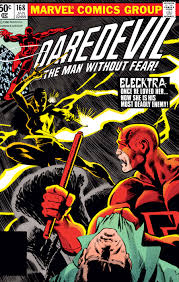 DAREDEVIL #168 (January 1981)
“Elektra”
Writer, penciller: Frank Miller
Inker, embellisher: Klaus Janson
Colourist: “Dr Martin”.
Letterer: Joe Rosen
Editor: Denny O’Neil
This feature began with me wondering why there were so few major Daredevil villains, despite the book having been around since the early sixties. Back in the first post, I wrote: “There’s the Kingpin, the Hand, Bullseye, um, Typhoid… um… does Elektra count…?”
Over fifty posts in, we’ve only met one character from that list: Bullseye. Typhoid won’t show up until 1988. But the other three are about to join the book in rapid succession, because we’ve now reached Frank Miller’s run – initially as writer / artist, with Klaus Janson as his finisher and inker, though Janson takes over on art entirely towards the end.
It’s a statement of the obvious, but Miller’s run genuinely is a quantum leap in quality. It’s not that the plots are that much deeper than before, so much as that the storytelling really kicks up a gear. Miller turned Daredevil into a book that people were talking about, and the sales increase got it back onto a monthly schedule again. And this run is the template for Daredevil going forward.
Elektra isn’t around for very long, not in her first run. She debuts in issue #168, and dies in issue #181. She remains something of a presence, since the next few issues have Matt going off the rails in response to her death. She gets resurrected in issue #190, Miller’s penultimate issue, but only to write her out; she doesn’t return until 1993. Then things change. She becomes a Marvel Universe mainstay. She gets her own book. Eventually, she gets to be Daredevil.
So, does she count as a villain? For most of her history, she’s been an antihero or a supporting character. But yes, the premise of her original arc is 100% that she’s a villain. It says so right there on the cover of issue #168: “Elecktra [sic] – Once he loved her… now she is his most deadly enemy!”
Except… well, let’s look at what happens.
Issue #168 begins with Daredevil beating up Turk for information, as is usual in Frank Miller stories. Daredevil is after Alarich Wallenquist, a criminal who can exonerate a man who’s wrongly accused of murder. Wallenquist has hired Turk’s boss, Eric Slaughter, for protection. But there’s also a price on Wallenquist’s head, and Elektra is here to collect it. She beats up Daredevil and goes after Wallenquist herself.
This leads into an extensive flashback to Matt’s college days. He bumps into Elektra, who is new on campus, and has an overprotective bodyguard. Matt impulsively tells her about his powers and the two spend a year happily in love. (This gets a one-panel montage.) When she and her ambassador father are taken hostage by terrorists, Matt tries to rescue them, but isn’t quite good enough yet: he accidentally knocks one of the bad guys out of the window, which leads the police to panic and open fire, and so Elektra’s father is killed. Traumatised and disillusioned, she quits college and goes home to Europe.
So Elektra has resurfaced as a “bounty hunter” – it’s fairly obvious that she’s an assassin, but the script tries to avoid saying so in terms. Daredevil goes after her, planning to bring her to justice, and they wind up teaming up against Slaughter and his men. Daredevil and Elektra kiss, and Daredevil leaves with Wallenquist, with Elektra left behind crying. That’s the first issue.
The whole dynamic is that Elektra is a villain who’s treated like a supporting character. She has a love/hate relationship with Daredevil, whom she blames for her father’s death. They ought to be fighting, but they choose to coexist. Over time, she becomes the Kingpin’s main assassin, which means she has to intimidate Matt’s witnesses and threaten Foggy, all leading to the inevitable conflict. But finally, Matt is spared the task of having to defeat Elektra because Bullseye gets there first, and kills her in revenge for stealing his spot with the Kingpin.
It’s a tragedy, then. Matt and Elektra would have been the perfect couple; she even dresses in his signature colour and looks much of the time like a natural partner for him (which of course is how she effectively winds up in 2025). But her father’s death sends her on the wrong course, and everything falls apart when she finally crosses paths with Matt again and has to deal with those choices.
Somewhere in there is her former association with the Hand. We’ll come to the Hand in a future post, but aside from her resurrection, Elektra’s basic story wouldn’t have been fundamentally changed if she’d been trained by someone else instead. The explain her martial arts prowess and, I suppose, they make her red colouring more ambiguous. And because she’s on the outs with the Hand, they provide another villain that she and Matt can join forces against.
It’s striking with hindsight is how focussed and straightforward Elektra’s character used to be. For most of the Miller run, there’s no mysticism in her stories, just a lost love turned assassin. By the time magic does come into play, she’s no longer an active participant, because she’s dead. The concept is clear and simple; the execution is focussed. Magic only comes into play via the likes of Stick, and as a vehicle for giving Elektra a fresh start – but as an active character, she’s kept away from it.
The name “Elektra” is odd. Readers were presumably expected to associate it with Carl Jung’s long-discredited Electra complex idea. But even allowing for Code limitations, Elektra’s relationship with her father doesn’t seem all that unhealthy. He’s overprotective of her and has a bodyguard trying to keep her away from everyone else, but she doesn’t go along with that – right from the start, she’s trying to get around that. Besides, to be fair to her father, there really is a terrorist threat, so apparently she genuinely does need a bodyguard.
What happens is really that she can’t deal with the loss of her father; in issue #190, her sensei suggests that she was left seeing the world as a dark and chaotic place. That issue also plays this as a mental block that she could never get past on her own; the point of her resurrection is that Daredevil’s failed effort to resurrect her somehow removes that darkness from her and gives her the chance to move on. There’s a suggestion that he’s taken on some of it himself, atoning for his failure in her origin story, and setting her free.
And move on she does – despite the seminal importance of this run, it takes a decade plus before DG Chichester brings her back into circulation. Her story is clearly finished, and it ends with her moving on without Matt. In the logic of the Miller run, this is no bad thing. Notionally, Matt’s love interest throughout this run is still Heather Glenn, but his behaviour towards her gets increasingly awful as the run goes on. Eventually, Foggy and the Black Widow sabotage their engagement and trick Heather into leaving the cast – and this is unequivocally played as saving her from an appallingly toxic relationship. Elektra’s happy ending is to be without him. Miller’s final issue is an epilogue in which Daredevil takes out his frustrations by torturing Bullseye, and ends on Daredevil lamenting that he’s “stuck” in an endless cycle.
The story hardly cries out for Elektra to be brought back, at any rate outside a prequel. Despite her popularity, that seems to have been the accepted position for a decade – perhaps because she was seen as Miller’s signature character and there wasn’t perceived to be much demand for Elektra stories by anyone else.
Still, her return was certainly no failure on its own terms. She’s been very popular in her current role. But it’s made her a muddier character – still a pretty good one, but the purity of the original has been lost somewhere. Her first storyline seems to position her as a Gwen Stacy with a happier ending, a character whose long term role is to be remembered, not to appear.

That’s what I was wondering also. Page overcoming her addiction was the start of her redemption. I think everyone associates Karen Page with the excellent work Nocenti did with her directly after “Born Again”.
…Then, she gets killed as a result of a plot by…Mysterio…? Wait, that can’t be tight, can it? Yeah, ok, sure, Mysterio. Throw the dart at the supervillain board.
Yet, Miller is taking all the heat here with Karen Page.
@Chris V
Exactly. Makes no sense to me either. Born Again began with Karen selling Matt’s identity for a single fix of heroin, and Miller’s taking flak because she wasn’t counseling other addicts by story’s conclusion? “Hello, I’m Karen, and I once sold a superhero’s secret identity to a crime lord for a heroin fix. But that was on Tuesday. Today, I’m here to help you overcome your addiction.”
I’d be like, “Screw that, lady. Get me another counselor. Anybody else. Preferably not someone named Chip either.”
@Chris V: The last 2 pages of the “Last Rites” story (issue #300), Matt’s in his brand-new office with his freshly restored license to practice law, and he’s confronted by a vision of the Kingpin, essentially accusing Murdock of doing all the kinds of stuff Fisk did.
Which is something I appreciate, the arc of the Murdock v. Fisk conflict across Miller, Nocenti, and Chichester’s stories. Miller has Fisk try to destroy Matt by taking tangible things; Money, his home, his license to practice law. Comes close, but no donut. Matt and Karen find each other and pull themselves out of their respective hells together.
Nocenti, when she has Matt decide to reenter the legal realm (after he worked as a diner cook in the first year of her run), has Fisk attack intangible things. Matt’s faith in the legal system, via the Kelco case (a failure). Matt’s love with Karen, via Typhoid (direct hit.)
Except Fisk, who probably used Typhoid at least partly because he resents Murdock for having a woman he loves in his life, while Vanessa’s in Europe convalescing(?), then falls for Typhoid too. Which, once Chichester comes along, gives Matt a way to do both of Fisk’s plans in one swoop. Strike at something intangible to Fisk (his relationship with Typhoid), while using HYDRA to hit him in the tangible realm (his fortune, his news network, his real estate holdings.) The latter also hurts Fisk’s image and prestige (the bit where he’s at a fancy restaurant and the waiter insists Fisk can no longer just run up a tab and has to actually pay his bill. Humiliating to a guy like Fisk.)
Chichester doesn’t really delve into the implications of the fact Matt used own Fisk’s playbook against him, beyond having Matt acknowledge he’s responsible, and justify it as NYC’s people not needing, ‘an unshakeable graven image to sin dominating their better halves.’ Which seems like, “ends justify the means,” but Matt also vows to protect the good in those people, which sounds like he feels a need to atone, or at least make his questionable actions mean something, that he’s gotten a opportunity to help people as a lawyer again, and he’s not going to waste it.
I don’t know if Chichester really did anything with the idea (could Matt Murdock even be more motivated by guilt?), but it’s as close as I could find to acknowledgement of the dicey nature of his actions in that storyline.
@Moo, Chris V- I agree that Miller didn’t have much time to do a redemption arc for Karen. But Karen’s arc is still pretty weird. At the end of issue 231, Karen’s about to kill herself but Matt stops her and they hug. In issue 232, she goes through withdrawal with Matt watching and hugs Matt. Later the Kingpin blows up the building they’re in and Karen is holding his costume and says she saved it for him. And at the end of issue 233, she and Matt are walking together, holding hands. The whole thing is just bizarre.
@Michael- Could you clarify what it is specifically that you find bizarre? Is it something about the events or the sequence of the events? Something to do with Matt’s behavior? Something to do with Karen’s behavior? I mean, she’s an opioid addict. It’s not like sleeping off a hangover. Karen’s still a long way off from being okay at this point.
@Moo- I guess it’s the way she just seems to magically get better after being reunited with Matt. I agree. she should be a long way off from being okay at the end of Born Again but it’s not like Miller acknowledges it. There’s just a scene of her walking with Matt at the end and it’s portrayed as a happy ending.
But then again, Karen’s drug problem also came out of nowhere. Admittedly, we hadn’t seen her in seven years but the last time we saw her in Marvel Two-in-One 46 she seemed to be a successful actress. Karen’s drug problem seemed to just be there for the first five chapters of Born Again as opposed to developing naturally or resolving naturally.
In that sense, it fits well with the Iron Man “Demon in a Bottle” story, where Tony Stark is recovered after going one night without drinking. Denny O’Neil came along to save that “Hollywood”-version of alcoholism. Granted, there was a lot more evidence to use as set-up that Stark had been a functioning alcoholic until it got to the point of “Demon in a Bottle”, it was just the pat ending that was a problem.
In the same sense (although purposely in the case of Karen), I think Miller was leaving the heavy lifting for Karen Page’s recovery to the next writer. The setup wasn’t there, but we hadn’t seen Karen for seven years. If Karen Page was a popular actress in Hollywood at that time, there’s a good chance she was involved in a lot of partying. The only thing missing is her fall from stardom, but if she did end up seriously addicted, it would explain her career going downhill. She’s not going to get the parts if she’s constantly strung out (OK, maybe a young Drew Barrymore might ruin that theory).
Michael – Karen already being an addict was the catalyst for the whole storyline. Was Miller supposed to precede it with a year-long, slow-burn prologue depicting Karen’s descent into addiction just to kick off the story that he actually wanted to tell?
Like you said, we hadn’t seen her in years, so it didn’t really come out of nowhere. Had she still been a regular cast member and developed the addiction between issues 226 and 227, yeah that would have come put of nowhere.
As for the happy ending. Yeah, it was upbeat, but I didn’t take it as Miller trying to say that Karen was all better. She’s on the road to recovery which was certainly a better place than she was at the start of the storyline, but earlier you were critical of the fact that Miller didn’t depict Karen attempting to make amends for what she’d done. Don’t you think that would have taken her a great deal more competency and functionality than it takes to be able to stroll down a beach?
And what does Chip Zdarsky have to say about all of this?
Maybe the issue is that Page was a longstanding character in a serial story shared with other writers. I don’t know if Page was anyone’s favourite, but there were no doubt people who liked her. Then she’s brought back just to be a junkie and further another character’s story. The least Miller could have done was put the toys back in the box when he was done. I don’t know how that would have been accomplished, but maybe if there was no room for her redemption, she shouldn’t have been in the story at all.
Note that I like the Born Again story. In fact it’s the only Daredevil story I actually care about.
Well, Born Again and the time he fought a vacuum cleaner. Please tell me Paul’s going to do the vacuum cleaner story.
I was thinking less in terms of Karen being written not only as an addict willing to sell Matt’s secret for a fix, and more about the way the story treats her sex work as a sign of how far she’s fallen and how wretched she’s become. There’s a reason Deborah Ann Woll was fine with playing Karen as a former addict and dealer, and even as a killer, but not with sexualizing the character’s moral weakness.
But I do think Miller writes it as a redemption arc. Karen goes to great lengths and puts herself in danger to try to reach Matt and warn him, even if she’s too late. And her guilt, desperation, and recovery are played somewhat in parallel to Matt’s fall into brutal violence and paranoia and then his reasserted heroism. They both get a “fall and rise” arc, with both characters going through hell and doing foolish and self-destructive things, but ultimately showing who they really are.
Nocenti certainly puts in the work to show Karen working towards more, and that material for Karen Page has certainly aged better.
Miller has a much more reductive view of gender in “Born Again” by comparison. Karen has “fallen” into porn movies and heroine addiction; Matt’s lowest point is when he can’t even stand. up to Turk in a fight.
This shows up through the foil characters as well: compare the arc’s portrayal of Glorianna O’Breen to its take on Karen Page, for instance; and its presentation of Foggy Nelson with its vision of Matt Murdock.
Si-The vacuum issue was part of the “Inferno” crossover and features Typhoid as the villain, so he could work it into the overview of Nocenti’s use of Typhoid, if he so chose.
I’m certainly glad that Miller did bring Karen back with the addiction angle as it gave Nocenti a lot of great material to work with, as otherwise, there’s no way to know if Nocenti would have brought back Karen. Probably not since outside Kingpin and Foggy (who both had outstanding plots to deal with after “Born Again”), she wasn’t looking backwards on the character.
Then, look at Kevin Smith…whoops, no one gets to use Karen Page anymore because obviously Mysterio is to Daredevil as Green Goblin is to Spider-Man.
I don’t agree that creators should always “put all the toys back in the box”, as sometimes leaving a challenge open for a new creative team can stimulate them. On the other hand, it was simply luck that Nocenti was the next writer on DD. I can imagine a less creative writer like Chichester taking over immediately after Miller would have us looking at Miller’s use of Karen Page completely differently today.
@Si – Karen Page hadn’t been a Daredevil series regular since 1972. That’s not a longstanding character. That’s just an old character. You can’t describe an old character as a longstanding character when they’ve spent most of their published existence sitting down.
I’d been reading comics for seven years by the time Born Again saw print, and the only reason I had any previous familiarity with Karen Page was because of some Giant-Size Spider-Man comic I read that carried a reprint of some early Spider-Man/Daredevil team-up story.
I’m sure she had her fans, but that’s true of any character, and Miller didn’t publish Born Again all on his own. Editorial had to sign off on it, which they did. What does that tell you about how significant the hardcore Karen Page fanbase was when against the popularity of Miller’s previous work on Daredevil and the popularity of Miller in general back in 1985?
And I’m not sure how one puts the toys neatly back in the box when one of those toys is an addict. Addiction isn’t something that gets resolved. At best, it can only be managed.
I mean it can be “resolved” for plot purposes, as Denny O’Neil did with Iron Man, but he used the majority of his entire run for the purpose, while Miller only had five issues, and Karen’s addiction certainly wasn’t the main focus of the story.
Hey! Maybe Mysterio just tricked Karen into thinking she was using heroin, but it was really just herbs, then she can be killed. Oh wait, Frank Miller isn’t Kevin Smith.
Also, did anyone really care about Karen Page before the Nocenti run? Really? I mean, some fans might have liked the idea that she was Matt Murdoch’s love interest, but she wasn’t exactly a compelling character when we last saw her in DD. Their relationship was also incredibly toxic at that point (even if that was unintentional on the part of the Silver Age writers).
“Also, did anyone really care about Karen Page before the Nocenti run? Really?”
Doubtful. I mean, like I said, every character has their fans, but the hardcore fans of Karen Page back in 1985 probably could’ve fit within the space of a phone booth. Nocenti hadn’t touched the character yet, and Deborah Ann Wohl was only eight months old.
“Born Again” is one of my favorite comic book stories- the art, dialogue, and story beats are excellent- but Karen is definitely sacrificed to move the story along. Miller is terrible at writing female/ non-tough-guy characters. Karen is weakness and corruption personified, Maggie couldn’t handle motherhood, Heather is there to be Foggy’s girlfriend,… the best female character in the story is the Nurse Ratched rip-off.
I’m glad that we as a culture have moved beyond always treating sex workers in fiction as disposable, evil, or victims to be saved. I think problematic “of-it’s-time” material should be examined and analyzed with modern eyes, and the audience can make their own decisions whether or not to accept or abandon it. I think Karen’s treatment in “Born Again” is rough, but it doesn’t derail the comic.
The problem is that Miller decided to make Karen a sex worker as the only way to make money. I don’t see anyone defending that aspect of Karen’s treatment in the story. It was unnecessary shock value. The drug addiction angle could have been played up without any need for the sex worker material. Last we saw Karen, she was a somewhat successful actor, which is a good paying job. So, she was bleeding through her savings buying drugs after being unable to get any gigs after getting addicted, and she eventually turn to the Kingpin for money to pay for her habit. Simple. There was no need for the sex worker angle being thrown in on top. The heroin addiction idea gave Nocenti a lot of mileage to make Karen Page a living, breathing character where (before Miller) she was Matt’s love interest.
I also disagree that Miller cannot write female characters; although, yes, he struggles to write “non-tough” characters. Look at Martha Washington who Miller wrote after “Born Again”. Now, maybe Miller has gotten much worse with time, which I could certainly believe after the Batman idiocy he was churning out in the early-2000s. I’m not totally sure because I have read very little Miller after the second Martha Washington series (i.e. Martha Washington reads Atlas Shrugged), but I can believe it.
“I think Karen’s treatment in “Born Again” is rough, but it doesn’t derail the comic.”
Give it time. The culture is eventually going to arrive at a point where Karen’s depiction in Born Again will be looked upon by modern readers (perhaps readers haven’t even been born yet) as so appalling and unforgivable that nothing else about the story will even matter.
Look at Marvel at that time. They had a policy to never feature a gay character. The only way Marvel would have allowed Miller to write Karen as a sex worker is if there was some sort of morality angle that showed that sex work is immoral and leads to damnation. I’m not defending Miller’s treatment of Karen as a sex worker, and Miller should have just dropped that part, but it’s not like Miller could have went to a Marvel editor at that time and said, “I want to present Karen choosing to become a sex worker in a positive light, but then she gets addicted to heroin because Hollywood, and drugs are bad, right?”. Marvel editorial would have flipped out, “Sex outside of marriage is sin, Frank Miller! What will the parents think?”
@Chris V – I think those decisions were more about what Marvel figured would get Code-approved. Even if Miller had pitched a story portraying a sex trade worker in a positive light, the CCA would never have gone for that. Marvel would’ve had to feel very strongly about such a story in order to be willing to publish it without Code approval.
@Chris V
Denny O’Neill certainly used a better pacing to show recovery from alcoholism in his later run, but “Demon in a Bottle” stated that it took weeks under Bethany Cabe’s watch for Tony to recover. Unfortunately there were very few panels showing that recovery, so it does feel like it could have been a single night.
@Si
Putting the toys back in the box is certainly good etiquette for hired writers writing characters that they do not own. But good stories can and have been told that ruined supporting characters for further use.
If “Sin City” – which is apparently the focused totality of what Miller likes to write – is any indication, that is just up to his alley. Much of the strength of his writing comes from imposing non-reversible changes on his characters.
One of downsides of shared universes from mainstream publishers is that they do not match that sort of writing very well.
Re: Karen Page. At that point she was no longer a regular character, and her last few appearances were not even connected to Daredevil, but instead to Ghost Rider. And even _that_ was several years prior. Clearly she and Matt had not been keeping in touch since, and the implication (very clear to me) was that she had been figuratively eaten alive by the pressures and dangers of the show business. In her very first scene written by Frank Miller we see her sell Matt’s secret in order to get money, with dialogue that all but tells us outright that she is now addicted to drugs and can’t even think straight about the consequences of her current action and that she already has some story as a performer of porn movies. The clear implication is that at some point she entered a serious downward spiral and shaped her life to accomodate the addiction and its financial costs.
The way I see it, at that point Karen is not even properly a sex worker; she just happened to have attempted to live off her body at some stage before resorting to selling Matt’s secret identity. Her arc in “Born Again” is very much one of giving Matt a second chance to show that he does not have to be toxic to his exes, at a time when he is barely functional out of guilty feelings about Heather Glenn’s fate and an even more recent bout of suicidal depression from Foggy.
Think of this time period of Daredevil comics as a Sin City prototype and it will become much easier to understand and accept. It is all about the despair seeping out of each character’s skin.
“The way I see it, at that point Karen is not even properly a sex worker”
What’s “properly” a sex worker?
@Moo: I remember when the main complaint about “Born Again” was how the last chapter didn’t fit with the rest of the story. I also remember when “The Killing Joke” was up there with “Dark Knight Returns” and “Year One” in lists of best Batman stories. Now, “TKJ” is seen as a misfire, mostly due to Barbara being shot, tortured, and disabled in order to provoke a reaction from the male characters. I could see “BA” getting a similar reputation due to Karen’s treatment.
@Chris V: Martha Washington is one of Miller’s tough characters. He struggles to write characters of any gender well unless they are good at fighting and/or some other “manly” skill. The female characters who get respect in Sin City are femme fatales, sex workers who are willing to kill to protect their own, ninjas, former victims who fight back, and/or good with a gun. The only female character in 300 who gets a significant line of dialogue is the Spartan queen, who gets a tough-guy line. Carrie Kelly is the only notable semi-exception I can think of- she’s resourceful and good at fighting in a mischievous manner in DKR, but doesn’t act stereotypically tough.
“Elektra recommendations:
Dark Reign: Elektra, a Zeb Wells/Clay Mann mini that has great, straightforward action
the Michael del Mundo run as artist, beautiful stuff”
These were what I thought of as good later Elektra stories.
@Mike Loughlin- Alan Moore has cited TKJ as one of the worst things he’d ever written. His reasoning for that had little to do with Barbara Gordon, though he wasn’t proud of that either. I read an interview with him years ago (which I’ve been furiously trying to dig up again, but I can’t find it) where he described getting the approval to cripple her. I don’t recall whether it was a phone conversation or if he was physically at the DC offices, but the editor to whom he was speaking was skeptical that he’d be allowed to cripple Barbara, so he excused himself from the conversation to speak to whoever his boss was. When he returned, he said to Moore, “Okay, cripple the bitch!” Moore later reflected that, “It was one of those times that they (the editors) probably should have reined me in.”
@Moo-The editor was Len Wein, according to Moore. I’m not sure if anyone ever got Wein’s side of the story.
(Killing Joke started under Wein and finished under Denny O’Neil. Everyone remembers that the decision to cripple Barbara was made under Wein. And Bullock appears in one of the scenes with a crippled Barbara, so those pages were almost certainly plotted when Wein was editor. Shortly after taking over the Bat-Books, Denny ordered Bullock to be written out and didn’t change his mind until 1992.)
@Michael- Okay, so Wein must’ve been the editor to whom he spoke directly, and I’m guessing it was Dick Giordano whom Wein went to for the approval.
Found out that the interview I read was published in a 2006 issue of Wizard (strange, I thought I read it much earlier than that) but I don’t know which issue.
@Dave: thanks for the recommendations! I didn’t know delMundo had done an Elektra series, so I’ll have to track that down.
@Moo: I remember reading an interview in which Moore thought TKJ wasn’t that great because it was only about Batman and the Joker and didn’t (or couldn’t) be about anything deeper. I know Barbara had been out of circulation for a few years prior to Killing Joke, but it’s wild that Moore was so insistent on crippling her. It’s like making Karen a sex worker in “Born Again;” the story would have been fine without taking things that far.
And Jeanette Kahn was in charge of everybody, meaning that the crippling of Barbara Gordon happened while a woman was running DC.
@Micheal Loughlin- Are you sure he was insistent? I thought he was in disbelief when he was given the go ahead to cripple her.
@Moo: I reread your above comment:
“… [Moore] described getting the approval to cripple her. I don’t recall whether it was a phone conversation or if he was physically at the DC offices, but the editor to whom he was speaking was skeptical that he’d be allowed to cripple Barbara, so he excused himself from the conversation to speak to whoever his boss was. When he returned, he said to Moore, ‘Okay, cripple the bitch!’”
I read the “he” in “he excused himself…” as being Moore, not the editor, which is why I thought that meant Moore was bound and determined to cripple Barbara. In fairness to me, all the other “hes” in the sentence refer to Moore. I didn’t square that with your next sentence, though, in which “he” definitely refers to the editor, so I misread the initial post. Oops!
@Mike Loughlin- Sorry about that. I could’ve worded that a little better. I keep trying to think of ways to work the name “Chip” into my posts as I write them and it’s distracting me from paying close attention to my grammar.
@Moo: no problem, Sometimes I ask other people to help me edit my sentences, and I’m thankful when they Chip in.
@Mike Loughlin- Damn. That was good. Wish I’d thought of it.
Moore isn’t wrong about The Killing Joke being one of his worst comics. I never understood the acclaim of that comic. I’d throw it up there with the “menstruating werewolf” and the misogynist hunter issues of Swamp Thing as comics by Moore I found very disappointing.
Everything else Moore wrote may have been pure genius though.
I forget who it was that was making fun of the ending of The Killing Joke, but it’s spot on.
Joker tells a joke.
Batman get serious, “A woman was crippled…Oh wait, now I get it. Damn, that is one funny joke.”
It’s not at the level of Frank Miller’s “I’m the god damn Batman!”, but has to rank as one of the worst scenes in a critically lauded Batman comic.
@Moo
The way I see it, a sex worker sees that activity as a job, a bread earner.
Karen Page as portrayed in Daredevil #227 strikes me as not fully aware of what she is doing, acting far more out of instictive craving than of any sort of career path.
Maybe it is just me, but I felt that there was a strong implication that she was well on her way to losing so much self-control that she had an overdose death in her not too distant future.
@Moo: thanks! I’m done with the puns, though, and can leave the topic. In other words, I’m going to stop with the Chips, & dip.
@Chris V: I swear, we were all so mesmerized by the amazing Brian Bolland art that we thought The Killing Joke must be a masterpiece. Alan Moore’s reputation played a part in it too, and the Joker’s (possible)origin sequences are pretty good. Of course, they feature a woman dying to further a man’s story, so maybe those scenes are a mess?
Good point about the ending, too. I actually like the panels before the joke, in which the Joker acts sane for a few seconds, but it’s not enough to save the scene.
“The way I see it, a sex worker sees that activity as a job, a bread earner.”
I don’t think it matters how one sees it. She got paid (not enough to keep her in heroin, evidently) to perform sexual acts in films to be sold commercially. That’s a sex worker.
The art’s the only good thing. If only Moore could have put together a plot that would have done justice to the band.
I’m def in the camp that Miller and Moore did ground breaking work that, 40 years on, may have done more harm than good for the business and art form of comics.
Miller’s work, particularly the first “The Dark Knight Returns” series, “Born Again” and “Batman: Year One”, has always been questionable for its ideological content and left a rather stingy legacy.
The only clear exceptions that I see are his first Daredevil run and “Sin City”, in the later case because it is very explicitly a nightmarish setting that no one really wants.
The Killing Joke was a relatively rare misfire from Alan Moore.
I’m not sure what you mean about Daredevil: Born Again’s “questionable ideological content”? That it questions if the role of the US in world affairs is usually to the positive? If you blame “Born Again” for this type of “ideological content”, then I say that’s all the more reason to praise “Born Again”.
I’m not sure if you feel that in “Born Again” someone, somewhere wants the scenario being presented (other than Wilson Fisk?), but it’s pretty apparent that the ties between an influential businessman, the US military, and secret ops programs are not something that characters like Matt, Captain America, or Ben Urich (the protagonists) “want”.
The three comics you mention stand alongside Watchmen as changing the legacy of comic books. They are part of the same shift in perceiving superheroes.
“ The three comics you mention stand alongside Watchmen as changing the legacy of comic books. They are part of the same shift in perceiving superheroes.”
They are comics Dr Oppenheimer and Dr Frankenstein.
Lol. I really don’t see what’s so terrible about those works at all. There’s no way of knowing what the industry and the art form would be like today if they hadn’t come along. Nor is there any way of knowing whether or not someone else would have come along and produced similar works because such approaches hadn’t been tried before.
I mean, you can say its not their they set stage for grim n gritty and hyperviolence just like it wasn’t Tarantino’s fault he spawned so many imitators who did what he did but badly.
But, for me, the bloom was off with those roses years ago.
I think it’s undeniable that DC, Marvel, and later Image learned the wrong lessons from DKR and Watchmen. Too much armor, hyper-violence as a stand in for actually adult themes, etc.
But we certainly wouldn’t have gotten the 5YL Legion of Super-Heroes without them. And you can fight me, but the first year of that book was amazing.
Tom King’s whole schtick is a riff on the formal constraints and “mature” themes of those books. And I know he’s not everyone’s cup of tea these days, but Omega Men, The Vision, and Mister Miracle were all generally well regarded when they first came out.
Honestly, would we have gotten the Death of Superman story without Moore and Miller? That’s not highbrow literature, but it has become something of a ’90s classic.
Gillen and Wijngaard’s The Power Fantasy, all these years later, owes something to Watchmen in particular.
All this to say that entertainment companies frequently take the wrong parts of big hits and run them into the ground as long as fans are happy to shell out their money. That doesn’t mean that great stuff doesn’t get made by the people who truly understand what’s of value in the original texts.
I also love the 5YL Legion (although not as much as the Levitz/Giffen Legion).
Im also still hoping to one day to do a pod with Kieron about his Pete Cannon and all the meta involved. (Hi KG, if you’re lurking.) It took two years to get Morrison on the pod. I can pay the long game.
It’s also possible my opinion of those books may have soured by osmosis from a lot of Moore and Miller’s later work. Which is probably hypocritical since Family Plot and frenzy dont tarnish Shadow of a Doubt or Notorious.
I’ve always enjoyed and taken the mid-80s Miller/Moore work on their own terms. Blaming them for the worse stuff that followed is silly to me because they have no responsibility for that stuff.
It’s been decades since I read Elektra Lives Again but my memory of it was that she dies at the end and is apparently resurrected again (I recall the last page being a shot of her standing in snow again in full costume). Or maybe that’s just how I interpreted it at the time given she was already alive again in the comics by that point.
I remember reading the Bendis run in the early 2000s and the Rucka period was quite good but I couldn’t tell you much about either at this point (Chuck Austen maybe drew the Bendis run?)
Ah what the heck. May as well bump this up to 100 comments.