Daredevil Villains #59: The Hand
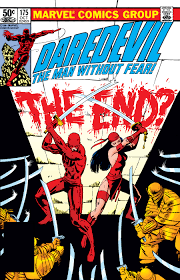 DAREDEVIL #174-176 (September to November 1981)
“The Assassination of Matt Murdock” / “Gantlet” (sic) / “Hunters”
Writer, penciller: Frank Miller
Finisher: Klaus Janson
Colourists: Glynis Wein & Klaus Janson (#174), Christie Scheele & Bob Sharen (#175), Glynis Wein (#176)
Letterer: Joe Rosen
Editor: Denny O’Neil
We’ve already had Elektra and the Kingpin, and now we complete the trinity of enduring creations from Frank Miller’s Daredevil.
Ah, the ninja! Historically, an expert in stealth, spycraft and infiltration. Over time, a part of Japanese folklore, with quasi-magical abilities. And in the Marvel Universe, a bunch of anonymous guys in bright red who attack in large groups and die. Or at least, that’s how they come across if you first encounter them in later stories. They’re the ultimate redshirts.
But what about their first incarnation? After all, recurring villains tend to rack up a string of defeats over the years – that’s the nature of the beast. Surely it was different when they started? Right?
The Hand make their debut in issue #174, when they assassinate one of Elektra’s targets before she reaches him. The narrator tells us that they’re “the same order of master assassins that taught her the many ways of murder before she broke training to operate on her own.” We’re told that the Hand want to kill Elektra because she left. But that’s not why they’re here – instead, the Hand have been hired to kill Matt Murdock.
Four anonymous ninjas do indeed attack Matt in his apartment. You might think that this was overkill when dealing with a blind lawyer – the random target in the prologue was taken out by a single ninja with a crossbow – but it sets the tone for the Hand right from the off. Why bother with stealth when you can just chuck expendable swordsmen at the problem? Now, these particular ninjas don’t know that Matt is Daredevil, and so they have an excuse for being taken by surprise when he fights back. And Matt duly beats them, almost singlehandedly – Elektra helps him out with the last one. In the aftermath, we learn that the ninjas always commit suicide and into gas when they’re defeated.
Later in the issue, the Hand have another go at killing Matt, but Elektra stops them. They do at least manage to chuck a bomb through Matt’s office window – not exactly a classic ninja weapon, but the explosion somehow causes Matt to lose his radar sense for a bit. And the issue builds to a fight scene where Daredevil thinks that he and Gladiator are fighting off a horde of Ninja, when in fact Elektra is helping him out unnoticed. And they win.
So the rank and file Hand may look great, but they’re slotted as cannon fodder right from the word go. The end of the issue sees the introduction of a Hand jonin – a smug guy in a suit, apparently not so caught up in the cult aspects as the dissolving bozos – and his giant magically-powered ninja, Kirigi. Now, Kirigi is presented as the one Hand ninja you really need to take seriously – but he doesn’t have a personality either. As a character, he’s basically a boss fight.
In issue #175, Kirigi is despatched to kill Elektra. Meanwhile, the Hand rank and file try to kill Foggy Nelson… and get beaten up by Matt in a comedy sequence. This leads to Elektra and Daredevil both finding their way to the Hand’s base for an extended fight scene. During this, the jonin implies that his real issue with Elektra is that she refused to sleep with him; this creep is a bit at odds with the Hand’s general cult vibe, and Miller’s later Hand stories will tend to use priest figures in a similar role. And in issue #176, Daredevil is mostly preoccupied with the story about losing his powers, leaving Elektra to deal with Kirigi.
The individual Hand members are an anonymous bunch – conspicuously so. They remain masked, there’s little to tell them apart, and they never stick around to talk once captured. Sure, they’re henchmen, but the book has plenty of recognisable low-rent thugs – not just Turk, but recurring characters like Pike who hang around with him. The Hand, by comparison, are literally interchangeable; their identities are subsumed into the Hand.
We’re not given much reason to take the individual Hand members seriously. Sure, you wouldn’t want to meet them in a dark alley. But they’re completely out of their league against Matt and Elektra – who didn’t even finish her training! The idea might be that Elektra was a prodigy who ran into sexism (all the Hand members we see appear to be men), but even so, she’s vastly better than them. What are they teaching these guys?
Doing ninjas in 1981 was not a great inventive leap. There was a ninja craze going on at the time. There’s a lot of exoticism and mysticism going on with the Hand. But in plot terms, their function is to be a threat from Elektra’s past, and to give her and Daredevil a reason to team up. Why did they stick around beyond that?
It took a while for the Hand to become a standard feature of the Marvel Universe. Like Elektra, other creators seem to have treated them as Miller signature characters best left to him. They show up in the 1982 Wolverine miniseries, but that’s another Miller story. They’re in Elektra: Assassin. But they don’t turn up in another Marvel Universe title until X-Men started using them in 1989 – after which, they were a little less tied to Elektra’s specific story, and a little more available for generic ninja duty.
They do have something going on beyond the bare fact of being ninjas. They’ve got the death cult thing, which becomes more obvious in later stories where the rank and file are laying down their lives to bring more important Hand members back from the dead. Miller hints at a whole mythology with these guys, and sets up Stick and his group as the Hand’s opposite number, but largely leaves the details to our imagination. Is it a genuine religious order? Do the guys in charge actually believe any of it, or are they just sniggering at the cannon fodder? The Hand’s magical abilities are significant – they can raise the dead. But at the same time, they’re low-level, in the sense that they’re not going to make much difference in a fight.
So there’s a degree of mystery to the Hand, at least when they first debut. Time hasn’t been especially kind to them in that regard. We now have a demon for them to worship, we have stories about their inner workings, and ultimately I’m not sure any of it was an improvement on just leaving it vague, as a part of Elektra’s hinted past. They’ve become a Hydra-style agglomeration of factions, some of them mystic cults, some just guys with swords. In all that time, they’ve achieved very little.
And yet their cachet remains. Maybe it’s association with a classic run, maybe it’s the strength of a simple yet memorable design, and maybe it’s simply that they’re flexible enough that the Marvel Universe doesn’t need any more ninjas. The Hand look the part so much that they don’t need to actually back it up.

@Moo
I think you’re just getting hung up on the semantics. If anyone had been interested in being accurate, they would have called it the a ‘Martial Arts Craze’, but being Americans, everyone just lumped all martial arts stuff together and called it a ‘Ninja Craze’ instead. To be fair, Ninjas specifically did own a lot of the market share during that period.
But the explosion in interest in Karate was definitely connected to the pop culture prominence of ninjas. Tons of the little kids who signed up for karate lessons did so because they were hoping to get to play with throwing stars and nun-chucks.
You can see this in the Teenage Mutant Ninja Turtles, who were called ninja even though the sai and nun-chucks aren’t really traditional ninja weapons. American kids weren’t really interested in such distinctions.
@Maxwell’s Hammer – Point taken, but look, I ended up in a lengthy argument about The Karate Kid. That film barely qualifies as a martial arts movie, let alone a ninja movie.
And just for the record, I’d like to point out to everyone that I never said “There was no ninja craze.” I said that I didn’t remember a ninja craze. I was allowing for the possibility that I simply wasn’t aware of any ninja craze. Mark Teri’s post convinced me there was. I conceded the argument. That almost never happens on the Internet and still people are chiming in to point that there was a ninja craze in whichever country they’re from.
@JCG But is that a licenced original Swedish Phantom comic, or a translation?
By the way, for everyone else, Thing’s catchphrase in Swedish translations of Fantastic Four is amazing. It essentially translates directly to “it’s clobberin time”, but it just sounds so cool.
“Det är dunkardags!”
Hell, you could hide “dunkardags” in an otherwise untranslated original Stan Lee script, and Mole Man would definitely know he doesn’t want a dunkar.
@Si It’s an original Swedish comic. Team Fantomen do publish the American daily and Sunday strips of the Phantom in their Fantomen comic, but they also make their own Phantom comics to fulfill the demand. Many more than the strips in fact, as Fantomen is published every second week.
Maxwell’s Hammer-You’re right about that. My one friend in elementary school, who was taking karate classes, managed to get his hands on some shuriken and brought them in to class. There was no distinction made between ninjas and the art of karate by the class. He tried to convince us that his dojo used throwing stars. When you’re nine years old, you have no idea that ninjutsu is distinct from karate. It seemed like all the cool ninjas in pop culture were using karate and that Ralph Macchio was probably going to be soon dressed in yoroi.
Anyway, to move away from personal reminiscence and turn this back to DD and Paul’s comment, as the point I was trying to make before I became the one accused of first using the term “ninja craze”, Miller was something of an innovator considering he was using ninjas in 1981, which was early and before Karate Kid came along which ended up lumping karate in with ninjas. He might not have been the first, but I think the peak was in 1984, when you had Neuromancer, Teenage Mutant Ninja Turtles, Snake Eyes & Storm Shadow, then Karate Kid came along to add karate to the mix. Miller predated all of that in DD and Wolverine, and I’ll continue to state was influential on TMNT (which isn’t even arguable) and the direction of GI Joe. So, I give Miller some credit.
Of course, as pointed out, You Only Live Twice, both the movie and book, pre-date Miller.
Yes. Japan predates Miller. A movie from 1967 isn’t exactly part of riding the cusp for popular culture. Shogun also predates Miller also, and the TV-movie was from 1980. I’m saying Miller wasn’t just jumping on a bandwagon, and his work was influential on the CRAZE.
-From now on, it must be all capitalized.
“I became the one accused of first using the term “ninja craze”
Hey, now that’s not true. I didn’t accuse you of that. But by the time I came along, you were already discussing the ninja craze Paul spoke of and cited The Karate Kid as an example. I was just killing two birds with one stone is all.
@Chris V
That 1967 movie was probably seen by more people than have read these Miller issues of DD.
It’s all Cannon Films and Sho Kosugi’s fault.
I again refer people to the PDF link I posted from my friend Keith about history of Kung fu/ninja/…. Stuff in pop culture.
The Turtles were just one of many independent books that were homage/parodies to what Miller was doing, in DD, but also Ronin and even TDKR. Anyone else remember Radioactive Adolescent black belt hamsters? Arguably, Usagi was also part of that zeitgeist.
@Mark Coale
Yeah, I remember Adolescent Radioactive Blackbelt Hamsters. From Eclipse Comics, I believe. That wasn’t a intended as a direct parody of Miller’s work, however. That was just one of a plethora of “critter books” published in an attempt to capitalize on the success of TMNT during the B&W boom (glut, really) of ’87. Power Pachyderms is another one that I recall, but there was plenty more.
It got so ridiculous that a series called Boris by Bear (Dark Horse Comics) came out in which the main character (Boris) went on a killing spree, slaughtering the Turtles and all of their copycats.
From the Boris the Bear Wikipedia page…
“The series began as a response to the popularity of the wave of anthropomorphic animal titles that began with the publishing of Teenage Mutant Ninja Turtles in 1984. That title, itself a parody of popular comic books at the time such as Daredevil, inspired numerous knock-offs and parodies like Adolescent Radioactive Black Belt Hamsters, Pre-Teen Dirty-Gene Kung-Fu Kangaroos, Mildy Microwaved Pre-Pubescent Kung Fu Gophers and Geriatric Gangrene Jujitsu Gerbils which led to what many refer to as the Black-and-White Boom of the mid-1980s.”
Interest in oriental martial arts – and specifically that interest in comic books – goes back at least to the mid 1970s. Bruce Lee and his role in “Green Hornet”, Shang Chi, “Deadly Hands of Kung Fu” Iron Fist, even the Count Dante advertisements.
On hindsight it is a bit of a surprise that it took so long for a convenient recyclable Ninja clan to arise in the Marvel Universe.
@Luis Dantas- And of course. there was Richard Dragon: Kung Fu Fighter at DC, which was odd because the title character’s companions- Bronze Tiger and Lady Shiva- became far more important at DC than the title character.
I think the difference between the martial arts craze that started in the 70s and the later ninja craze is that martial arts are commonly employed today. The real-life ninjas died out before Commodore Perry “opened” Japan in 1853. It wasn’t until the 1980s that the idea that entire clans of ninja survived to the present day took hold in Western fiction. If you look at the earliest uses of ninjas in comics, they’re implied to be the last existing ninjas. In 1974, the ninja appearing in Manhunter was described as the last ninja. Similarly, the ninja that fought Iron Fist was suggested to be centuries old. The idea that large numbers of ninja survived to the present in secret didn’t become common in Western fiction until the 80s and Miller’s Daredevil run was an early example of that.
I didn’t know until years later after I first saw the comics that Richard Dragon first appeared in a 70s pulp novel written by Denny under the pen name of Jim Dennis. This was in the era of the Mark Bolan executioner novels
“I think the difference between the martial arts craze that started in the 70s and the later ninja craze…”
Ah, so you see a distinction between martial arts craze and ninja craze as well. And I was told I was getting hung up on semantics.
One irony about Miller’s Lone Wolf and Cub influence is that, while ninja do appear there, they’re not very prominent foes.
In the most major story that features them, they insist on taking on the protagonist with face-to-face attacks instead of trickery, which goes as you might expect.
My understanding is that therte were several waves of martial arts popularization in U.S. pop culture.
In the 1950s and 1960s, there were a lot of action and adventure stories in various media that invoked “karate” and “judo.” In practice, this meant characters could use standard hand chops to cleave through stuff and typical throws. “Karate” and “judo” were functionally just “super-punches” or “super-throws” in a fight scene.
It’s this era that gave us Bruce Lee’s first significant Hollywood role as Kato on the Green Hornet TV show, various Marvel heroes explaining a knockout blow as “using a little judo,” the Mandarin’s first few appearances mentioning his “deadly super-karate” that could damage Iron Man’s armor (and be thwarted using a slide rule-calculated block!), and the Legion of Super-Heroes character Karate Kid.
Other East Asian fighting traditions might turn up here and there. Samurai swords would show up, as did the occasional samurai warrior (or robot, as in the case of the Flash’s battle with the “Samuroid” warriors). They were often played as irredentist Japanese nationalists, and didn’t have much in the way of bushido or other elements. Sumo might turn up to explain why a particular baddie was a huge strongman, but there wasn’t much awareness of actual sumo wrestling as a sport.
Then, in the 1970s, kung fu and Chinese martial arts cinema got big in U.S. pop culture. This is the bruce Lee era everyone remembers, the period of grindhouse cinemas showing dubs of Shaw Brothers flicks, and so forth. The Americanized “Kung fu” genre was a bit more explicitly Eastern, with some limited effort to present “Eastern” philosophies in the form of monologues alongside the beatdowns.
Fight scenes in this genre usually used some recognizable clichés, such as a tournament or other structure to ensure a series of one-on-one fights, mobs of attackers coming at the hero one by one, and opponents defined by bringing a particular gimmick or weapon to their duel with the protagonist. In comics, this was the era of the aforementioned Iron Fist, Shang-Chi, and Richard Dragon, plus lesser lights such as the Sons of the Tiger and their successor the White Tiger. Karate Kid got his own spinoff series set in the 20th century.
Then, in the early 1980s up through part of the 1990s, ninjas were the latest martial arts craze. Westernized “kung fu” stories with cod-philosophy were replaced with mysterious assassins, ninja clans and cod-mysticism. The odd fear-slash-admiration of Japanese business success in the later 1980s and early 1990s probably extended this wave, and ninjas as corporate espionage types got to be a fixture of comics for a while. This was the era of the Hand, the G.I. Joe ninja characters, the Teenage Mutant Ninja (or, in the UK, Hero) Turtles, Kitty Pryde becoming Shadowcat after a bout of possession by a quasi-demonic martial arts master, and Valiant Comics’s Ninjak with its early-career Joe Quesada art.
Samurai got to be more of a distinct, well-defined presence in this era, often as a counterpart to ninjas, and terms like “ronin” came in. Wolverine is explicitly framed this way by the end of his first miniseries, the Silver Samurai gradually goes from a big armored hench-guy of the Viper to a villain with motives of his own tied up with the Yakuza and the Yashida clan, and the Yakuza more generally play a role.
We might here contrast the James Bond film You Only Live Twice. Sure, there are elements in it we;’d think of as ninjas today. But in the film, the word “ninja” isn’t really used. Samurai swords turn up as well in a fight scene, but no one calls them that, either. Tanaka’s troops who raid the villains’ lair at the end are presented as commandoes with some Japanese aesthetics, such as the occasional throwing star turning up amid the gunfire and grenades. But there’s not much really effort put into defining samurai as opposed to ninjas, or even the sense that these characters use specific fighting or other martial disciplines.
These shifting waves of broadly culturally translated martial arts elements settles down a lot by the end of the 1990s. The emergence of translated manga and anime as a major pop culture force in U.S. culture likely had a lot to do with it, as did the success of the wuxia genre in Western markets, most notably Crouching Tiger, Hidden Dragon. Now there was less of a tendency to faddishly bring in U.S. understandings of these things, and more interest in the products of the actual East Asian cultures than in culturally translated takes.
This is my limited memory of how it went down. Others will likely spot tons of errors and unsupportable generalizations, and the stuff that doesn’t fit is likely to be really interesting to learn about.
The real question is, now that the “big three” Frank Miller era villains are covered, will Paul skip right to the next run or grace us with an account of Peter “Hogman” Grunter, a drug dealer infamous for his lie-detector beating pacemaker (and triggering an infamous showdown between DD and the Punisher), and/or Randolph Winston Cherryh, a standard mobbed up local politician who, unlike Lady Killer, actually popped up in two comics outside the 1980s. They’re far apart in time and minor (unless you were a fan of Untold Tales Of Spider-Man), but they’re more than quite a few one-shot DD foes.
@AMRG I hope Paul doesn’t skip those comics, but for a different reason. For my money, Daredevil’s best foe is actually Frank. Their first meeting is really important.
@Skippy — if Electro, Nitehawk, and the Ox were considered Daredevil villains at certain points, then a case certainly can be made for the Punisher. He did start out as an antagonist for Spider-Man who branched out into his own franchise, as one of the title’s most successful spinoffs before Venom. But he has squared off against DD both in Hornhead’s book and his own many times since the Miller run.
To me it was quite obvious that Stone sacrificed himself in order to save Elektra, and that Chichester simply overlooked it when he continued the story. Which I can forgive him for.
I find it more annoying that, although the Hand resurrection technique was clearly shown in the Kirigi story to be a special procedure in order to revive their MVP requiring the life force of several other Hand members, later writers considered every general Hand ninja to be resurrected/undead, which simply doesn’t work.
Definitely hope we get to discuss the Punisher and the PCP stories here.
Too bad about the UPC box on Miller’s cover here. It mars an otherwise really nice design.
@Thom H.: It’s odd, since UPCs had been on Marvel covers since 1976.
You’d figure that editors or production staff would be giving artists solid guidance about how to design around UPC placement.
Instead, UPCs screwing up cover design is a recurring problem some ways into the 1980s, at least as I recall.
@AMRG: Cherryh has at least the distinction of being elected Mayor of NYC (although Daredevil saw to it that he had to resign before even taking office). Somewhat foreshadowing a certain, much later storyline…
Cherryh might be worth considering because he’s a more grounded example of a corrupt politician beyond the reach of the law.
He’s a good contrast to the likes of the Organizer or Crime-Wave.
The name Cherryh is almost certainly taken from the SF author C. J. Cherryh — her real name is Carolyn Janice Cherry, she added the h because her editor thought it sounded too much like a romance writer.
I’m not planning to cover the Punisher. He appears in Daredevil #181-184, but that’s a four issue run at a time when he was already a well established Spider-Man character. After that, he goes back to Spider-Man, then gets his own book. He doesn’t appear in Daredevil again until issue #257, and that was a crossover.
I’m not planning to do Cherryh either – it’s basically a Kingpin story.
So…maybe the King of the Sewers is next? He does come back for a totally unnecessary return arc over a decade later.
Possibly? With hindsight, DD #180 features almost a first draft of what Miller would do with the Mutant Gang Leader during that infamous mudhole fight in DARK KNIGHT RETURNS. Like him, the King is a huge gross albino monster-man who rules over a subgroup with sheer savagery. Daredevil’s defeat of him was also pretty violent for the Comics Code era.
And, yes, considering that the King of the Sewers does return for 4 issues of Gregory Wright’s run in the mid-90s, that puts him above a slew of one-issue-wonder DD villains.
As others have noted, ninjas were on the margins of the ‘70s “kung-fu” fad but didn’t catch on in a big way until the 1980s. Having been a lad in the ‘80s, I recall martial arts were often presented in 80s pop culture as “noble” and even nonviolent or reluctantly violent t, while ninjas were darker, dangerous, evil, and part of the grim-n-gritty turn in entertainment. I hesitate to say martial arts in general came to be perceived as “weak” while ninjas alone were “strong” or badass, but there was something of a trend in that direction. Note that before Marvel’s Master of King-Fu title ended around ‘83, Jim Shooter pressured Doug Moench to rebrand it as “Master of Ninja,” which Moench thought was unrealistic and stupid. But ninjas had kid cachet at a time when martial arts generally seemed like a fad that had passed. (Karate Kid revived it for a time.)
@Walter Lawson- Or at least that’s how Moench remembered it. Kurt Busiek and Roger Stern have contradicted some of Moench’s claims about Shooter, so it’s possible Moench was misremembering this. (Or Shooter was being sarcastic and Moench took it literally.)
‘The Law of Diminishing Ninja’ states that the threat level of ninja(s) is inversely proportional to the amount of ninjas.