X-Men #22 annotations
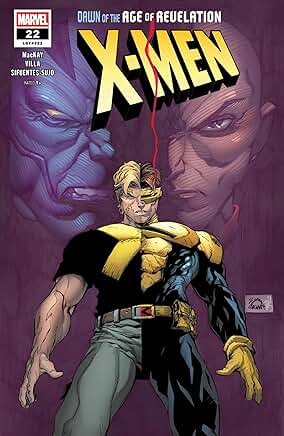 X-MEN vol 7 #22
“Dawning of an Age”
Writer: Jed MacKay
Artist: C F Villa
Colour artist: Fer Sifuentes-Sujo
Letterer: Clayton Cowles
Editor: Tom Brevoort
COVER. A split image of Cypher and Cyclops, with their symbolic predecessors Apocalypse and Professor X in the background.
This is the final issue of X-Men before it goes on hiatus for “Age of Revelation”; the story continues into the stand-in mini Amazing X-Men.
PAGES 1-2. Magik collects Cyclops from the Merle town jail.
Chief Robbins arrested both Cyclops and Agent Lundqvist in issue #20 when they got into a fight in a diner. She tells us here that she was putting on a show to demonstrate that the authorities will treat mutants (and Lundqvist) just like anyone else. She’s well aware that Cyclops could have left at any time, and once Lundqvist is out of the way, she’s willing to say so openly.
Hopefully Robbins doesn’t really deal with regular bar fights in the way she did in isuse #20, which was to give one warning and then take out both combatants with a taser. But she would probably argue that shooting first and asking questions later was the only way she was ever believably going to arrest them both – and while Cyclops might have been willing to play along, Lundqvist certainly wouldn’t have been.
Lundqvist’s claim in issue #20 was that he didn’t hate mutants, but merely resented the ones that regarded themselves as above the law. Robbins clearly doesn’t share that view, but does seem to regard it as important that Scott at least plays along with her authority. Magik a big show of not respecting Robbins – in similar terms to Kid Omega in issue #20 – so there’s a lurking issue there.
In line with the Magik solo series, Magik is effectively in persona here, and Cyclops calls her on it, asking what she’s done in his absence that she’s trying to distract from. In fact, last issue, Magik took it upon herself to lead half the team against the Upstarts in his absence – and seemed to regard it as quite convenient that Scott wasn’t around to stop her.
PAGES 3-4. Psylocke and Temper talk to Trevor Fitzroy.
Magik’s crew – consisting only of herself, Jen Starkey, Kid Omega and Juggernaut – defeated Trevor Fitzroy and his Upstarts last issue, with Juggernaut killing Ocelot. It’s not clear what happened to the other two Upstarts, Orbit and Orifice – presumably they were also brought back to the Factory as prisoners, but Psylocke and Temper talk as if Fitzroy was their only prisoner. Even if Fitzroy was their top priority (for reasons we’ll come to), they surely wouldn’t just leave the other two Upstarts to make a break for it.
Fitzroy is remarkably confident that Psylocke’s threats are bluffs, considering that Ocelot was killed in front of him last issue. But he’s basically correct when it comes to Psylocke in particular, as she reminds us on the next page that she regrets her assassin-era body count. Temper is also positioned at the moderate end of the team spectrum, fretting about possibilities for rehabilitation.
Psylocke tells us that Fitzroy is the payment that the X-Men owe to King Bedlam for “services rendered”. This refers back to issue #10, where King Bedlam and his Hellions attacked O*N*E facilities on the X-Men’s behalf; there was mention in that issue of Bedlam wanting “a very specific head”. Psylocke’s very compressed explanation is that “Years ago, Trevor Fitzroy murdered Marie-Ange Colbert, a crime that [Bedlam] has been very interested in repaying.”
Marie-Ange Colbert is Tarot of the original Hellions, and she was murdered by Fitzroy in Uncanny X-Men #282. She later showed up alive and well in X-Force #87-90 as part of Bedlam’s new Hellions. A flashback in X-Force #87 established that the two had been in love as teenagers before she joined the original Hellions, and it was strongly implied that this had something to do with her return from the dead, but the plotline was never resolved.
PAGES 5-8. Beast and Juggernaut argue.
There’s an obvious irony here in Glob Herman sticking doggedly to his vegetarian principles while regarding Juggernaut’s murder of Ocelot as a minor bit of social awkwardness.
Beast is the most willing to challenge Juggernaut about this, partly because he sees it as threatening the well-being of Jennifer Starkey (who he clearly is interested in, despite her worries on that front), and partly because this version of the Beast was restored from a back-up that predated Juggernaut’s face turn. Of course, this version of the Beast only exists because the previous version went mad and did assorted awful things – Juggernaut resists the temptation to point that out.
Juggernaut’s initial reaction to being confronted on this is to ignore the killing bit and engage with the argument about whether Jen needed to confront her fears (on which he has a reasonable point). His argument for killing Ocelot is decidedly unconvincing, though – he claims that the guy had it coming, and argues that he would have carried on killing. But Ocelot had already been defeated, and besides, he didn’t kill the other Upstarts – he did it because Ocelot didn’t take his threats seriously and clearly thought that he’d gone soft. His machismo was threatened, but he’s evidently rationalising it to himself as reasonably combatant behaviour.
PAGE 9. Ben and Jennifer.
Jen claims to be completely unbothered by seeing Juggernaut murder someone; she attributes this to the violent instincts that come with her predatory animal form.
Jen reminds Ben that he was originally brought to the Factory in issue #2 after the X-Men had faked his death, that he’s been required to stay on base to prevent the truth from coming out, and that there’s no need to keep up the pretence now that Lundqvist has revealed (in issue #20) that they know he’s alive. Ben brushes it off – he wants to stay, claiming that he can’t go back to San Francisco after being such a threat to the city in issue #2, but seeming rather more interested in getting control of his (rather intimidating) power.
PAGES 10-12. Cyclops and Magik arrive back at the Factory.
Kid Omega knows the rules of chess but can’t play it very well without cheating. Unfortunately for him, he can’t read Magneto’s mind because of his telepathy-blocking helmet.
Magik accuses Cyclops of being “too busy” to deal with the Upstarts because he was playing by the rules, and invokes her former status as a Great Captain on Krakoa. As in her solo book, Magik tends to reach for the best arguments she can think of to score points on people whether she necessarily believes them or not. She has an image to maintain.
For some reason, Magik also ignores the other two Upstarts even when recapping for Cyclops. Kid Omega is completely correct to say that his injuries were vastly more serious than she’s letting on – she’s avoiding telling Scott how badly wrong the mission nearly went.
Psylocke is the official second in command but seems to have no problem with Magik going off like this.
The “second Iron Night” that Cyclops refers to is presumably the events of issues #14-18, with Magneto piloting the Sentinel to fight a kaiju.
PAGE 13. Revelation, Bei and Warlock arrive at the Factory.
We saw them set off in this direction in issue #19.
PAGES 14-17. Revelation asks for his group to join the X-Men.
Cyclops is clearly sceptical about this (as is Psylocke), partly because he’s aware in general terms of what happened in X-Men: Heir of Apocalypse, and partly because Revelation is clearly acting differently – although he seems to greet Scott warmly, he’s clearly presenting himself as more of an authority figure here. The art shows him as rather smug, though I’m not sure how far the script really intended that.
Revelation acknowledges himself as the heir of Apocalypse, but compares it to Cyclops’ status as the heir to Professor X – a neat way of reframing the role in a way that Cyclops may be more sympathetic to. He argues for building on both mentors’ ideas and people seem somewhat receptive to that. Cyclops calls a vote…
PAGES 18-20. Revelation is admitted to the X-Men.
We established in issue #19 that Revelation can now control people with language, but in that issue he did it with direct commands (which were shown in a different coloured speech balloon). In the absence of anything similar here, it seems that he doesn’t directly compel the X-Men’s vote. In the Age of Revelation one-shot, Xorn said that Revelation only seized control at a later point in time. Besides, while nobody votes against, two abstain and some hesitate.
Kid Omega is particularly enthusiastic, which fit with his role as one of Revelation’s enforcers as shown in Age of Revelation (to be followed up in the Omega Kids mini). Psylocke, Magik and Juggernaut simply agree. Temper doesn’t seem to understand why there might be an argument for not admitting literally any mutant who showed up at their door. Jennifer and Ben don’t understand the context but can’t see a problem either. Glob Herman seems to go with the flow. Magneto hesitates but agrees before the vote is clear – he’s always been written in this book as having an open door policy for mutants. Cyclops rather implies that he might have voted against but he isn’t going to go against such a clear consensus.
The two abstainers are the Beast, who isn’t confident that he knows what’s going on, and Xorn. In Age of Revelation, Xorn claimed to be uniquely immune to Doug’s powers, which is presumably why he has doubts about what he’s seeing. However, he said in that flashback that he had agreed with Cyclops’ decision to let Revelation and co join – in the context of this scene, it seems he agreed with Cyclops’ decision to accept the consensus.
Cyclops is interrupted before shaking hands with Revelation. The flashback to this moment in the Age of Revelation one-shot showed the handshake, so this is a point of divergence in the timeline. It looks like we’re doing a “Days of Futures Past” routine, with the future Cyclops swapping places with the current one. We saw this future Cyclops briefly at the end of in Age of Revelation.

Isn’t Mutant X considered a high point for Havok’s portrayal by his fans?
I’m going to speak up for Matthew Rosenberg again – he took over Charles Soule’s Astonishing X-Men for it’s final arc, a whole whopping five issues, but I liked his take on Alex there, as a complete screw-up still trying to make it as a team leader.
Rosenberg was stuck with Greg Land, though, so. Hard to recommend.
Writing this, I’m reminded that I’ve liked a lot of Rosenberg books. A lot of them were about screw-ups, whether singular or teams of. “Hawkeye: Freefall” was an interesting, completely ignored take on Clint. His “King in Black: Thunderbolts” mini was probably my favourite T-Bolts revival (again, a whopping three issues). His “Secret Warriors” made me care about Inhumans (well, some Inhumans).
And I’ve already said in another thread that I enjoyed his Uncanny run, as well as the preceding “New Mutants: Dead Souls” mini. The only mutant misifire he wrote was, for me, his basically incomprehensible “Multiple Man” mini that brought Madrox (a Madrox) back after “Death of X”.
Also “Phoenix Resurrection: The Return of Jean Grey” could have been better. It could have been a lot worse, too.
I wish Marvel would get him back. He’s been writing good stuff for DC for the last couple of years.
I’ve never had a problem with Rosenberg. I enjoyed his work at Marvel, although I never found it to be above “worth a read”. I didn’t follow his work at DC. I did pick up his recent creator-owned series We’re Taking Everyone Down With Us, and I was very impressed. The writing is so smooth and clever. I recommend it, and it makes me want to reread his work at Marvel and see if I underestimated him, or if he saves his ability for his own creations.
I like Rosenberg’s indie work. What’s the Furthest Place From Here, 4 Kids Walk into a Bank, and the aforementioned We’re Taking Everyone Down With Us are all enjoyable reads with a good balance of humor and tragedy. It doesn’t hurt that 4 Kids & Furthest Place collaborator, artist and co-plotter Tyler Boss, is very good. His work reminds me a little of Matt Wagner’s.
Anyway, I liked the character interactions this issue. The disagreements between Cyclops, Psylocke, and Magik made sense. I think a similar conflict between Rogue and Cyclops could have worked (“You screwed up & someone died!” “Oh yeah? We needed you, and you were off indulging some pointless feud!” Oh well, too late for that). The ending was a bit confusing. AoR is up next, hope it doesn’t suck.
[…] #22. (Annotations here.) Okay, now this is good. I was saying last week that most of the line wasn’t doing a great […]
@Chris V: Scott must have felt even more inadequate that his younger brother, who was quite average, was already graduating university while older brother, Scott, had only graduated high school.
Did Havok graduate university? I know the running gag in Jay and Miles X-Plain the X-Men about him never finishing his dissertation is, well, a gag, but I’m not sure it’s actually wrong.
Speaking of Jay and Miles, whenever I think of how Alex has been written over the years, I remember them X-plaining X-Factor vol. 1 #71. Miles describes Havok thinking the whole mutant government enforcement team sounds like a bad idea and he’d rather rebuild post-apartheid Genosha, and Jay says “Remember when Havok had ethics?”
Miles then describes Havok signing up anyway as soon as he’s told he’ll be working with his ex, and Jay says “Remember when Havok had ethics for like ten seconds?”
I should not be trusted with html tags without a preview button…
If I’m not mistaken, that was specifically why Scott went to visit Alex in Alex’ first appearance. Regardless, poor Scott who has only barely gotten out of high school is thinking about his younger brother, “I’m proudest about him graduating third highest in his class.”
To expound further: It was his PhD he never completed.
I think what happened with Alex is that his adoptive parents screwed him up by trying to make him into their dead son, Todd. Alex wanted to prove that he was deserving of being loved for himself and worked extremely hard to prove he was better than Todd, but all he accomplished was burning himself out by the age of 19. I am guessing that Todd was a very average child. Adult Alex then decided that he strove so hard to prove he was worthy of love and still he could never equal his adoptive family’s love for Todd, so he decided he should try to emulate average Todd as much as possible. Hence, we ended up with very average, screw-up, living in Scott’s shadow Alex. He’s begging the memory of his adoptive parents to love him like they did Todd, “See? I am just as average as Todd.”
Alex graduates in his first appearance, which is a continuity headache because his older brother was in high school just a few years earlier. It makes sense in a world where the sliding timeline hasn’t been established yet but it’s very difficult to rationalise now. Even back in the 1980s, Marvel Index resorted to claiming that Alex must have been a child prodigy, but that’s obviously letting the tail wag the dog, given the way Alex is actually written.
@Paul- this apparently caused problems at the time- an answer to a letter in X-Men 56 suggested the child prodigy explanation.
“Ending up being handled by Howard Mackie and Chuck Austen? There is no greater judgment upon a character. Even the Siege Perilous treated him kinder.”
No words were more viciously spoken
Too bad Austen and Mackie got their greasy mitts on Spidey and so many others here and there