Daredevil Villains #56: Elektra
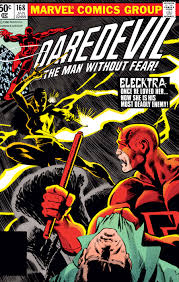 DAREDEVIL #168 (January 1981)
“Elektra”
Writer, penciller: Frank Miller
Inker, embellisher: Klaus Janson
Colourist: “Dr Martin”.
Letterer: Joe Rosen
Editor: Denny O’Neil
This feature began with me wondering why there were so few major Daredevil villains, despite the book having been around since the early sixties. Back in the first post, I wrote: “There’s the Kingpin, the Hand, Bullseye, um, Typhoid… um… does Elektra count…?”
Over fifty posts in, we’ve only met one character from that list: Bullseye. Typhoid won’t show up until 1988. But the other three are about to join the book in rapid succession, because we’ve now reached Frank Miller’s run – initially as writer / artist, with Klaus Janson as his finisher and inker, though Janson takes over on art entirely towards the end.
It’s a statement of the obvious, but Miller’s run genuinely is a quantum leap in quality. It’s not that the plots are that much deeper than before, so much as that the storytelling really kicks up a gear. Miller turned Daredevil into a book that people were talking about, and the sales increase got it back onto a monthly schedule again. And this run is the template for Daredevil going forward.
Elektra isn’t around for very long, not in her first run. She debuts in issue #168, and dies in issue #181. She remains something of a presence, since the next few issues have Matt going off the rails in response to her death. She gets resurrected in issue #190, Miller’s penultimate issue, but only to write her out; she doesn’t return until 1993. Then things change. She becomes a Marvel Universe mainstay. She gets her own book. Eventually, she gets to be Daredevil.
So, does she count as a villain? For most of her history, she’s been an antihero or a supporting character. But yes, the premise of her original arc is 100% that she’s a villain. It says so right there on the cover of issue #168: “Elecktra [sic] – Once he loved her… now she is his most deadly enemy!”
Except… well, let’s look at what happens.
Issue #168 begins with Daredevil beating up Turk for information, as is usual in Frank Miller stories. Daredevil is after Alarich Wallenquist, a criminal who can exonerate a man who’s wrongly accused of murder. Wallenquist has hired Turk’s boss, Eric Slaughter, for protection. But there’s also a price on Wallenquist’s head, and Elektra is here to collect it. She beats up Daredevil and goes after Wallenquist herself.
This leads into an extensive flashback to Matt’s college days. He bumps into Elektra, who is new on campus, and has an overprotective bodyguard. Matt impulsively tells her about his powers and the two spend a year happily in love. (This gets a one-panel montage.) When she and her ambassador father are taken hostage by terrorists, Matt tries to rescue them, but isn’t quite good enough yet: he accidentally knocks one of the bad guys out of the window, which leads the police to panic and open fire, and so Elektra’s father is killed. Traumatised and disillusioned, she quits college and goes home to Europe.
So Elektra has resurfaced as a “bounty hunter” – it’s fairly obvious that she’s an assassin, but the script tries to avoid saying so in terms. Daredevil goes after her, planning to bring her to justice, and they wind up teaming up against Slaughter and his men. Daredevil and Elektra kiss, and Daredevil leaves with Wallenquist, with Elektra left behind crying. That’s the first issue.
The whole dynamic is that Elektra is a villain who’s treated like a supporting character. She has a love/hate relationship with Daredevil, whom she blames for her father’s death. They ought to be fighting, but they choose to coexist. Over time, she becomes the Kingpin’s main assassin, which means she has to intimidate Matt’s witnesses and threaten Foggy, all leading to the inevitable conflict. But finally, Matt is spared the task of having to defeat Elektra because Bullseye gets there first, and kills her in revenge for stealing his spot with the Kingpin.
It’s a tragedy, then. Matt and Elektra would have been the perfect couple; she even dresses in his signature colour and looks much of the time like a natural partner for him (which of course is how she effectively winds up in 2025). But her father’s death sends her on the wrong course, and everything falls apart when she finally crosses paths with Matt again and has to deal with those choices.
Somewhere in there is her former association with the Hand. We’ll come to the Hand in a future post, but aside from her resurrection, Elektra’s basic story wouldn’t have been fundamentally changed if she’d been trained by someone else instead. The explain her martial arts prowess and, I suppose, they make her red colouring more ambiguous. And because she’s on the outs with the Hand, they provide another villain that she and Matt can join forces against.
It’s striking with hindsight is how focussed and straightforward Elektra’s character used to be. For most of the Miller run, there’s no mysticism in her stories, just a lost love turned assassin. By the time magic does come into play, she’s no longer an active participant, because she’s dead. The concept is clear and simple; the execution is focussed. Magic only comes into play via the likes of Stick, and as a vehicle for giving Elektra a fresh start – but as an active character, she’s kept away from it.
The name “Elektra” is odd. Readers were presumably expected to associate it with Carl Jung’s long-discredited Electra complex idea. But even allowing for Code limitations, Elektra’s relationship with her father doesn’t seem all that unhealthy. He’s overprotective of her and has a bodyguard trying to keep her away from everyone else, but she doesn’t go along with that – right from the start, she’s trying to get around that. Besides, to be fair to her father, there really is a terrorist threat, so apparently she genuinely does need a bodyguard.
What happens is really that she can’t deal with the loss of her father; in issue #190, her sensei suggests that she was left seeing the world as a dark and chaotic place. That issue also plays this as a mental block that she could never get past on her own; the point of her resurrection is that Daredevil’s failed effort to resurrect her somehow removes that darkness from her and gives her the chance to move on. There’s a suggestion that he’s taken on some of it himself, atoning for his failure in her origin story, and setting her free.
And move on she does – despite the seminal importance of this run, it takes a decade plus before DG Chichester brings her back into circulation. Her story is clearly finished, and it ends with her moving on without Matt. In the logic of the Miller run, this is no bad thing. Notionally, Matt’s love interest throughout this run is still Heather Glenn, but his behaviour towards her gets increasingly awful as the run goes on. Eventually, Foggy and the Black Widow sabotage their engagement and trick Heather into leaving the cast – and this is unequivocally played as saving her from an appallingly toxic relationship. Elektra’s happy ending is to be without him. Miller’s final issue is an epilogue in which Daredevil takes out his frustrations by torturing Bullseye, and ends on Daredevil lamenting that he’s “stuck” in an endless cycle.
The story hardly cries out for Elektra to be brought back, at any rate outside a prequel. Despite her popularity, that seems to have been the accepted position for a decade – perhaps because she was seen as Miller’s signature character and there wasn’t perceived to be much demand for Elektra stories by anyone else.
Still, her return was certainly no failure on its own terms. She’s been very popular in her current role. But it’s made her a muddier character – still a pretty good one, but the purity of the original has been lost somewhere. Her first storyline seems to position her as a Gwen Stacy with a happier ending, a character whose long term role is to be remembered, not to appear.

@wwk5d: Maybe House o Astonish will be interviewed by the editor-in-chief of Rolling Stone?
More seriously, I wonder if everthing with Elektra’s initial storyline could be read as Miller learning and then pushing the censorship limits.
So in Elektra’s first appearance, as Paul notes, she has to be called a “bounty hunter” and not an assassin. When she comes back five or six issues later, she gets a storyline in which she quite viciously kills some members of the Hand, including a decapitation.
Then she’s explicitly defined as an assassin, and kills a bunch of Kingpin goons as an audition. After that, she gets some pretty explicit stabbing scenes, with Miller’s well-known “blade makes thew back/front of the shirt bulge out” panels. And then Bullseye gets to rather graphically kill her. (Everyone remembers the sai pushing against the back of her clothes, but there’s also the visible bleeding from the throat.)
And when he comes back for a short run on the title with “Born Again,” it seems like he can show just about anything short of cursing or nudity, thus Karen Page’s new profession, Paolo Scorcese clearly being a violent pimp who demands sex from Karen as payment for a ride to NYC, some fairly direct captions regarding the deaths from Nuke’s rampage, and finally Daredevil killing some guys by blowing up their helicopter with Nuke’s gun.
It’s almost like a little chronicle of the Comics Code becoming less and less enforceable and relevant, even without a “Mature Readers” label.
There’s that famous story about Marvel simply ceasing to send books to the comic code after the whole thing with Peter Milligan’s X-Force in 2001. Then someone from DC went over to check why they hadn’t been hearing from it a few months later only to find it has shut down and there was a stack of undelivered books sitting outside.
If I remember right, DC had been sending cheques to the CCA for quite a while before they learned they shut down.