Betsy Braddock: Captain Britain #1 annotations
As always, this post contains spoilers, and page numbers go by the digital edition.
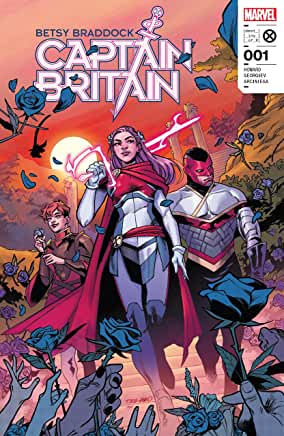 BETSY BRADDOCK: CAPTAIN BRITAIN #1
“Returns Home, Having Changed”
Writer: Tini Howard
Arist: Vasco Georgiev
Colourist: Erick Arciniega
Letterer: Ariana Maher
Design: Tom Muller with Jay Bowen
Editor: Sarah Brunstad
BETSY BRADDOCK: CAPTAIN BRITAIN. This series is the continuation of Excalibur and Knights of X, both also written by Tini Howard. It’s solicited as an ongoing, but Amazon has it listed as a five-issue miniseries. That may just be to do with the season break for Fall of X.
COVER / PAGE 1. Betsy, Rachel and Brian in (presumably) Avalon.
PAGE 2. Betsy appears on television.
Reginald Cross appears to be a new character, obviously representing the likes of GB News. The name of his show is obviously a play on “X of Swords”, though since “X of Swords” has no actual relevance, I’m not sure that invoking it is a particularly good idea.
“You’ve been a supermodel…” Betsy’s modelling career originally comes from the Captain Britain story in Super Spider-Man & Captain Britain #243 (1977). I think the idea of her being actually famous as a model comes from X-Treme X-Men vol 1 #3.
“…a charter pilot…” No, seriously, she was. That’s her job when she first appears in Captain Britain #8.
“…a ninja, a body snatcher…” Both referring to her lengthy period when she was body-swapped with Kwannon, though “body snatcher” implies she had any choice in the matter.
“…a mutant…” Well, obviously.
“…and a twin.” With Brian.
“[M]ad Wiccans and teenagers at Glasto trying to upset their parents…” The Glastonbury Festival does traditionally attract a Wiccan contingent, but it doesn’t particularly have a reputation as somewhere to find rebellious teenagers. It’s more a classic rock kind of place.
Micromax is a character from the Alan Davis run on Excalibur in 1991, who was indeed a DJ – the name “Scott Wright” clearly positioned him as a thinly-disguised Steve Wright, though he didn’t really have much to do with Wright’s on-air persona. He was (very) briefly a member of Excalibur. He’s generally written as vaguely clueless and irritating. (Making him a long-established Radio 1 DJ in 1991 was basically a shorthand for implying that he was a self-important has-been – there was a massive clearout of dead wood a couple of years after that, though Wright was one of the survivors.)
“Without Britain, what are you even a captain of?” Giving this question to Cross is obviously intended to delegitimise it, but it is a fundamental point raised by Howard’s whole set-up. It’s never been at all clear what she thinks the concept of representing Britain actually means in practice. Or rather, the villains in this series have a pretty clear and defined, if highly traditionalist, idea of what they understand by Britain. The heroes don’t offer any alternative vision of Britain so much as a repeated appeal to progressive values, but a single universal value is not a national identity .
To be fair, this inability to articulate any competing vision of Britishness or even Englishness – and vague disdain for the idea that it might be worth attempting – plagues the English centre and left generally. But it’s not as easily dodged when you’re writing, well, Captain Britain.
PAGE 3. Data page. “The Reflector” is presumably meant to be a stand-in for the Daily Mirror, though that would be odd choice since although it’s a tabloid, it’s generally considered to be left-wing.
The first three paragraphs are an unsympathetic but basically accurate recap. Faiza Hussain, who’ll show up later, is the currently holder of Excalibur, introduced in the 2008 series Captain Britain & MI-13 #1.
The suggestion in this article that Betsy’s ascent as Captain Britain is both a subject of great national controversy and completely unnoticed by 82% of the population is obviously incoherent, but it’s probably meant to be.
PAGES 4-8. Captain Britain and Askani help Britannica Rex fight a Fury.
Britannica Rex first appeared in X of Swords: Destruction #1, along with the rest of the new Betsy-themed Captain Britain Corps. For fairly obvious reasons, she’s one of the more recognisable background Captains who’ve appeared in subsequent issues as part of the pack.
“When I left to join the rest of the Captain Britain Corps to fight in Otherworld…” Since the footnote is to Excalibur, this is presumably referring to the Corps being gathered to help fight Merlyn’s forces towards the end of that series, and continuing through Knights of X.
Askani is now being used as a codename by Rachel Summers; it was originally the name of the quasi-religious philosophy founded by an alternate Rachel in the future timeline where Cable grew up. “Earth-811” is the Days of Future Past timeline.
The Furies. In the current Otherworld cosmology, a whole load of Furies live in the “Everforge” domain. In Knights of X the Furies had been remodelled as stand-ins for the Sentinels, making them much bigger. Brian theorises later that this was the main reason why they got weaker. This version is a callback to the original Fury from Captain Britain stories in the early 1980s, which travelled between worlds slaughtering superheroes (and specifically Captain Britains).
PAGE 9. Recap and credits. The title, “Returns Home, Having Changed”, is positioning Knights of X as a transformative hero’s journey.
PAGE 10. Data page – the Mothermind comments on the Fury.
The Mothermind is presumably a new and improved version of Mastermind, the sentient computer in Braddock Manor (which eventually became a supervillain).
Fury-238 is the original Fury, from Earth-238 – the “Crooked World” ruled by Jim Jaspers.
A little unusually, this page doesn’t just quote directly from a previous data page, but actually references the earlier comic itself within the text. So don’t take it too literally as an in-universe object. At any rate, we’re told that the Fury overthrew the previous inhabitants of the Everforge and obtained its “Celestial heart”, allowing it to create an entire nation of duplicate Furies. For whatever reason, these duplicate Furies turned out to be rather more stable and predictable than the original, which wound up being subsumed in the hivemind.
PAGES 11-12. Betsy, Rachel and Brian discuss the Furies.
“Yes, I remember that, Brian.” Betsy was in the original Fury arc as a supporting character; she didn’t fight the thing, but she did get run away from it.
Reasonably enough, Betsy concludes that if the Fury who attacked Britannica Rex wasn’t traceable as coming from any particular timeline, it must be one of the Furies created outside time in the Everforge.
PAGES 13-14. Jamie Braddock moves Braddock Manor to Braddock Isle.
Braddock Isle was created by Rictor in Excalibur #21 when he split the part of the land with Braddock Lighthouse on it away from the mainland. There was an initial suggestion that this somehow made it not part of Britain, but evidently someone has figured out that territorial waters don’t work that way. Curiously, there’s no sign here of the lighthouse; page 23 confirms that it’s gone.
Jamie is still wearing his crown, despite control of Avalon having presumably been returned to Arthur at the end of Knights of X.
The two unnamed characters are Brian’s wife Meggan and their daughter Maggie.
PAGE 15. Betsy and Rachel discuss the plot and head to Otherworld.
Betsy clarifies that it’s been “months” since the end of Knights of X.
PAGE 16. Micromax is imprisoned by Morgan Le Fey.
Micromax is evidently gullible enough not to notice that Coven Akkaba is an anti-mutant organisation and has been, very openly, for Howard’s whole run. But he is a bit dim.
PAGES 17-18. Morgan Le Fay explains her agenda to Reuben Brousseau.
Morgan Le Fay was the villain of the first arc of Excalibur, but spent most of the time after that as a prisoner of Jamie Braddock before escaping to Earth in Excalibur #21. From the look of it, she’s only just got around to hooking up with Coven Akkaba.
Her plan is apparently to create a competing Captain Britain with greater mass appeal who, in some unclear way, will enable her to restore her vision of Britain. Maybe it’s something to do with popular sentiment being a source of magical power.
Some of this, honestly, comes across as a little defensive.
PAGES 19-22. Betsy and Rachel visit the Everforge.
“With no Starlight Citadel, the provinces of Otherworld have no obligation to even let me in any more.” Betsy rejected the Starlight Citadel and any formal link with Roma or Saturnyne at the end of Knights of X as part of her agenda to act independently.
Merlyn was killed by Betsy in Knights of X #5.
Apparently the flag is supposed to indicate that the Furies are allied with Coven Akkaba (or similar), though that brings us back to the point that we’ve got a Captain Britain book in which all British iconography is used in an exclusively negative way.
PAGES 23-24. Pete Wisdom visits Braddock Manor.
S.T.R.I.K.E. This is a plot from the tail end of Excalibur, where Pete Wisdom and Betsy’s former colleagues in the psychic intelligence unit S.T.R.I.K.E. were resurrected and… then nothing happened, because the story moved exclusively to Otherworld. Now that we’re back on Earth, we’re returning to the S.T.R.I.K.E. plot.
“Well, I’ve been dead lately…” Wisdom was killed in Excalibur #21 and resurrected in the following issue.
“…what’s happened at home in the time since they’ve been dead…” Howard’s Excalibur has set up the current British government as wildly anti-mutant and, for some unclear reason, under the influence of Coven Akkaba. It generally seems to be intended as a Brexit analogy, though not a terribly convincing one.
PAGES 25-26. Betsy and Rachel in bed.
PAGES 27-28. S.T.R.I.K.E. meet Faiza Hussain.
Doctor Destiny. This wasn’t a codename, but the stage name Mulhearn used as a stage magician when he was on the run from Vixen in Daredevils #3.
PAGE 29. Morgan identifies another Captain Britain to attack.
PAGES 30-33. Captain Britain and Askani help Captain Pretani.
Captain Pretani makes her debut here, though presumably she was somewhere among the crowd in some earlier stories. “Pretani” was the Common Brittonic name for Britain (from which “Britain” is derived). Basically, this is a Bronze Age world. Like Britannica Rex earlier, Captain Pretani sees it as a sign of personal failure that she needs Betsy’s help to defend her world.
The Fury offers to leave her world alone in exchange for her agreeing to help Morgan. So Morgan’s plan seems to be to find an alternate Betsy Braddock who is willing to be a more pliable Captain Britain. Which… seems odd, if they’re going to be put forward as a competitor to Betsy, but okay.
Most of the Captain Britains on page 33 are generics, but Britannica Rex is obviously recognisable. The big dragon is another semi-regular, and goes by the name Captain Plumdragon.
PAGE 34. Trailers.

You know, it might just be me, but I could accept Wolverine being bi easily enough. He’s a bear, he’s all about sensation because of his powers, he’s been around a long, long time and has never cared much for societal norms, so he probably at least experimented in those long Canadian logging camp nights.
But Cyclops? He’s the straightest man alive. Most people have a “type”, but very few have a type so specific as “mutant superheroine with powerful telepathy”. The only question is how similar Emma Frost is in powers to daddy Jack o’Diamonds. He’s so straight he’s the main problem I think that most people have with the whole poly thing.
This is in the spirit of fun, mind you. I haven’t put that much thought into it. But it is telling that there’s so much activity in this chat thread while the newer X-Force one just has a few complaints.
This is in the spirit of fun, mind you. I haven’t put that much thought into it. But it is telling that there’s so much activity in this chat thread while the newer X-Force one just has a few complaints.
+1.
I’m also with you on Cyclops, but not really with Logan. I might be persuaded that Logan “experimented in college,” or his equivalent, but a throuple? “Don’t need the hassle,” I would think he’d say while walking away.
” I might be persuaded that Logan ‘experimented in college,’ or his equivalent, but a throuple? ‘Don’t need the hassle,’ I would think he’d say while walking away. ”
To which Jean responds, “I understand. But when you need a place to be, you have one here, with us.” Scott nods stiffly in the background. Logan continues on his way but Jean sees a smile form on his lips as he turns his head.
Again, any Claremont-era character could be in any kind of (consentual adult, non-incestuous) relationship and I’ll believe it.
I’ve decided that Sinister engineered Scott to be attracted by and attractive to telepaths.
Yeah, Scott is a harder sell for me, too. He seems like the jealous type. And even if he did find pleasure in eroticizing his rivalry with Logan, he certainly wouldn’t start being all relaxed and open about it.
Scott’s whole vibe at the beginning of Hickman’s run — casual flirtation with Logan included — was the main reason I thought all of the mutants had been brainwashed or drugged. Happy, satisfied Scott reads all wrong.
We’ve seen Logan be super tender and loving in relationships with special women. Outside of that, I have a feeling he’s pretty sexually adventurous. He’s functionally invulnerable and probably bored with convention after 140 years or however long.
But you can overlay whatever traits you want on Logan at this point — who’s the person on this board who always says that? Luis? I feel like that reading definitely pertains here.
I chalked Scott being happier up to:
– being a military leader rather than a political one. I think he’s more comfortable as field commander than anything else.
– the possibility of a mutant utopia finally being real. Even the villains get along with the heroes, and Cyclops can incorporate some of them into his work. Prof. X and Magneto working together probably helped, especially with Charles working towards what Scott sees as a worthy cause.
– having his weird family around, and being able to advise the younger Cable. Even Vulcan bought into family life for a little while.
– seeing and participating in mutants becoming a world power.
As uncharacteristic as it may be, it made sense to me that Scott would develop a more positive outlook and vibe, at least at the beginning of the Krakoa era.
“He’s a bear”
Just one example, but that usually has no bearing on whether someone will be gay/bi or not.
When considering Claremont’s takes on his characters, I think that it is necessary to acknowledge that he isn’t the most consistent of authors when it comes to characterization. He sure seems to have changed his mind about Piotr and Kate, as I pointed out in the past. They are presented as destined to an unbreakable love in the Days of Future Past timeline, at least according to Kate’s speech.
Claremont as I understand him is an author that likes to create slightly unusual or thematic characters and see where they lead him.
That is fair and certainly had good results, but there were some failures and drawbacks as well. One of those is that he never seemed to have much of a clear direction to more conventional characters that he inherited with a well developed personality, such as Jean and Scott. Also, he sometimes simply changed direction without much of an attempt at explaining why; Wolverine, Kate, Rachel and even Jimaine Szardos / Amanda Sefton are all good examples. He needs flesh character clay to truly feel at ease.
I don’t know how sincere he is about Scott and Jean, but he sure retconned the heck out of both characters in his back-up stories of Classic X-Men book. Then again, he does the same with his own creations fairly regularly. Some, most notably Magik, he never quite explained; she was a sorry mess of unexplainable and clashing components all through his run.
It is probably inevitable to speak of his runs as if they had shaped the characters, but that is arguable at the very best. Most of his clear characterization is in fact daring retcons that run against the grain of previously established characterization. And he left quite a few cyphers hanging as a matter of course.
@Mike Loughlin: I mostly buy that argument. It’s just that Scott is very used to having things taken from him: his parents, his brother(s), his partner, his mentor, his home, etc.
Suddenly having all of those things and feeling secure about it seems like too big a leap. I would think that he would have a period of paranoia and/or overprotectiveness about it. Or at least some friction with Xavier.
Anyway, I’m quibbling. Maybe it was a matter of not having enough of a transition from what went before to instant peace and tranquility on Krakoa. But I agree with you for the most part.
Scott is in a sense underdeveloped to this day. We don’t really have a lot to go on while trying to get inside his head. We know that he is quite capable of self-control and discipline, that he generally takes things seriously, that he does not show too much of a sense of humor, we see lots of hints of a stoic nature or at least a stoic persona, but somehow that doesn’t add up to a very clear personality still.
Logically he should be a bit paranoid after so many losses, so much secrecy and so many desperate battles. But we just don’t really see it often at all.
I feel that there is a story to be told there, a story of how something in his mind is so highly unusual that he ends up attracting the attention of telepaths as a matter of course. Perhaps, much as some women are impressed and attracted to well toned men, he has such an impressively resilient mind that telepaths can’t help but want to connect to it.
It may be interesting to re-read Paul’s piece on the 2020 “X-Men: Marvels Snapshots #1” spotlight on Scott before he became Cyclops.
https://www.housetoastonish.com/?p=5634
Logan has always identified himself as a “loner,” even if his entire story has been about coming to recognize the many deep relationships he has had through his life. Even now, that self-identity still pops up from time to time.
What that means to me is not that Logan doesn’t want or value close relationships. What it means is that he”s not afraid to walk away from a relationship if it becomes too complicated. He’s ok being alone, and it’s not worth all the headache to maintain a relationship that comes with a lot of drama.
Logan’s also 140 years old. A lot of this must be been-there-done-that for him. Does he need another passionate love affair, one that comes with all sorts of complications?
Logan also has a sense of loyalty and duty. You can be pretty sure that a Scott-Jean-Logan throuple would generate a lot of gossip. A cuckold scenario would undermine Scott’s leadership. I don’t see Logan willing to be a part of any of that.
That’s not to say he wouldn’t have an affair with Jean, just that IMO he wouldn’t do it openly, and for a long period. Too much chance for rivalries and jealousy to cause problems in the X-Men.
And FWIW, I think Jean would totally be down for polyamory. But as a telepath she would know that Scott would be broken as a cuckold, especially if it was Logan. Her kindness and empathy would hold her back.
That is one reading. There have been so many stories about Wolverine that there are many possible readings. Whether any is convincing is probably to some extent on the eye of the reader.
For instance, Wolverine under Grant Morrison’s pen rejects Jean and has a casual relationship with Domino. Claremont wrote him as a greying man in the far away year of 2013, and seems to have flip-flopped on how faithful to Mariko he wanted to be.
One of the best aspects of Claremont characterization was how realistic he was about sex and relationships, despite making something of a Marty Stu out of Wolverine.
@Nu-D:
Jean as written by Claremont in Classic X-Men would. Perhaps Dark Phoenix Jean would as well, depending on how you decide Mastermind’s influence marked her. X-Tinction Agenda Jean would, as we saw so clearly in late 1990’s X-Factor #61. X-Men: Red’s Jean would, as she established herself in the one-shot that set up that book.
It really depends on who is writing the books and which storyline they want to tell.
I’d forgotten that we actually had an alternate universe Logan in love with an alternate universe Hercules, and I can totally buy the idea of Logan being bi/pan/whatever, it’s just that he’s historically been attracted to women in the 616 so it’s harder to extrapolate what sort of guys he might be into… probably someone he didn’t feel he needed to protect, an equal on the battlefield, someone he felt safe enough to relax around afterwards, but not too much -like- him. Herc’s a great fit because he knows how to relax, and also knows what it’s like to outlive your loved ones and contemporaries.
And honestly, Scott/Logan just doesn’t work in my mind. Like others have said, Scott reads as extremely straight, extremely controlled, and the two of them in any form of intimate relationship is extremely hard to imagine. Jean dating both of them is slightly more plausible, if still a stretch. Scott dating both Jean and Emma would again stretch plausibility–too many personality conflicts (and history) to imagine both women willing to share.
So in the end, I see Scott and Jean doing their normal couple routine, Emma off doing whatever she wants, and Logan, after yet another extended flirtation with Jean, going off to do his own thing as well.
The Incomplete Scott-Jean Saga with gaps for my reading history:
Phase 1: All the boys like Jean, Warren most of all. Scott: I’m not worthy and should leave the X-Men
Phase 2: Jean picks Scott. Scott: I can’t believe she picked me! I’m totally not worthy.
Phase 3: ANAD X-Men arrive, Jean leaves. Scott: I’m not good enough to go with you to your new life.
Phase 4: Jean appears to die in Antarctica. Scott: I can’t even mourn her. I wasn’t good enough to love her!
Phase 5: Nearly corrupt Phoenix kisses Mastermind. Scott: that’s not like her, but I don’t deserve any better.
Phase 6: Jean is resurrected and Scott dumps Maddie. Scott: I’m a shit person. I don’t deserve either of these women.
Phase 7: Maddie’s gone. Scott: I don’t deserve to love you because of how I treated Maddie.
Phase 8: Scott: wow, Psylocke is hot! Uh, I’m uncomfortable.
Phase 9: Wedding! Scott: I can’t believe she picked meeeee!
Fast forward to just before the GM run, because I don’t remmeber much of the rest of the ’90’s.
Phase 10: Scott: I was possessed by Apocalypse and it revealed how dirty I am. Jean deserves better.
Phase 11: Emma: Jean despises you because you think you don’t deserve her. That’s why she’s gone all frigid. Scott: but I’m horny! Emma: wanna fool around? Scott: well, I guess if we just play pretend.
Phase 12: Scott: Jean totally deserved better than me. I cheated on her. Jean: nah, go get with Emma.
finis
Oops, forgot to close the bold tag on the title.
Anyhow, Scott’s so mired in his own insecurities, I read him as suffering from imposter syndrome even when he has won the battle and got the girl. Opening up his marriage would validate that sense of being an imposter, and he couldn’t live with it.
Granted, I ended with Jean’s second death because I have only passing familiarity with the subsequent stories. But I don’t see that changing about him. He’s going to keep feeling like he’s not good enough, and being a cuckold or in an open marriage would just validate his feeling of inadequacy.
I wonder. Scott has been through some significant situations in the last ten to fifteen years. Enough to change major personality traits several times, which arguably indeed happened on-panel.
Fair enough. Scott and I haven’t hung out much the past few years. As a friend from college, the Scott I knew would not have been able to survive an open marriage. A deeply secure Scott seems like a personality change (inconsistent character) to me, not just personal growth.
And that is a fair opinion if you ask me. Scott has been deeply secure several times since 2008 or so, but he has also been terribly insecure.
I can’t very well argue that he is portrayed consistently, even though I am biased towards excusing his portrayals far more than I would do for Wolverine.
Was he secure or insecure when he killed Xavier?
For what’s it’s worth, Ewing seems to have a… cynical view of Scott. He pointed out that Scott usually has Emma and not Jean resurrect him, with Alex going “Not gonna dissect that one” and had Maddie tell Eddie Brock that Scott wants everyone else to be just as broken as he is.
@Mark Coale: neither, he was Phoenix. I don’t buy that any of the X-Men were fully in control when they were possessed by Phoenix. I also think Avengers vs. X-Men is mediocre at best, so I’ve only read it once and might have missed a scene in which I was declared that the Phoenix 5 were totally themselves all along.
@Thom H: I tend to fill in the gaps in ways that allow the story to makes sense to me, which I could do for happy Cyclops or more than I can for anyone allowing Best to continue to lead X-Force. I get where you’re coming from, though, when one considers Scott’s previous portrayals.
@Nu-D: certainly, Scott has never been presented as interested in men or multiple partners, and seems a bit too repressed to experiment. Honestly, if I had to list which X-characters I thought could be LGBT+, he would be among the last I’d name.
But… maybe there’s a reason he was so repressed in the first place and it has to do with not accepting or acknowledging his own sexuality? That’s how I find the throuple plausible. Hell, maybe that’s why he’s happier in the Krakoan era.
Obviously, all this is my interpretation and no more valid than the next reader’s. I get why others don’t buy the idea that Scott would be onboard with a poly relationship. As with well-adjusted Scott, I like to look for/No-Prize justifications for into-relationships-other-than-strictly-hetero Scott.
@Luis Dantas: interesting point about characterization and Claremont. I’ll add that many people who discuss Claremont’s X-Men discount the artists’ involvement in plotting and character work. It was mostly John Byrne who turned Wolverine from the unpopular annoying punching bag to the tough guy with a heart of gold. Dave Cockrum pushed Nightcrawler to the forefront. Bill Sienkiewicz brought a truly alien Warlock into New Mutants before other artists drew him more humanoid. Jim Lee pushed the series away from Claremont’s plots and made Psylocke popular. I like that Claremont kept the characters recognizable but made them people who could grow and change. You’re absolutely right that he underwrote a lot of the cast, including mainstays like Colossus and Havok, however.
I would not know. And I have yet to convince myself that it is worth learning and guessing.
It is not quite as blatant as with Hal Jordan and Parallax, but that is one of those comics questions which will be forever divisive, @Mark Coale, and unavoidably ignored as well.
Come to think of it, I never even bothered to read that story (and I don’t think I will now either) precisely because there is no point. When I learned of this event at the trailing end of AvX I knew that there would be no point.
Back in 1980 people would wonder if Jean and Phoenix were the same person or not. But now Phoenix, too, is all things for all people – except when it is convenient that it should be perceived in some other way. It is both inhumanly ravenous and heroic, eternal and mortal, boundaryless and all too human, pure instinct and a superhuman intelligence.
Scott was possessed by the Phoenix Force either just before or during the act of killing Xavier. I doubt even the writer (Bendis? I did not even bother to learn) knew or cared whether that was “truly” Scott. It will only be remembered according to plot convenience. That is the rule of the land in X-Men stories, and has been for decades. Same as happens with Onslaught for Xavier and Magneto, or Phoenix for Jean. Or, for that matter, how Phoenix relates to Rachel, Jean and others.
We also ignore lots of known facts that logically we ought not to, mainly because the stories invite us to dwell elsewhere. Things such as how often Wolverine has been a cold killer, or how sadistic and manipulative Emma was as recently as of X-Men: Black.
There is only so much ability in the human brain to be shocked.
@Mike Loughlin: Claremont also had considerably long spells of being, for lack of a better word, experimental.
Your mention of Havok reminds me of the Australian Outbacks period and the time before that when Alex had finally become an active X-Man under Storm’s leadership. That was an odd period, with pretty much everyone acting out of character at least half the time. I doubt even Claremont himself knows how to explain, for instance, the grins at the cover of Uncanny #219. At that time he had IMO overextended himself something fierce, and ended up writing lots of plausible explanations for out-of-character behavior operating at the same time.
There was the Adversary’s corrupting influence; there was Malice; the Brood; Roma toying with Colossus’ perception apparently just for the thrills of it; and eventually some unholy mix of Sinister’s influence, the Shadow King, Legion’s insanity, Syn’s whispering in the shadows, Nastirth, all welded together by a veritable ocean of self-doubt and Longshot’s ever inescapable early random personality.
If Claremont knew where he wanted to go with all that, he sure did a good job of hiding it.
I suspect that he was growing increasingly unconfortable with the constraints that the very existence of X-Factor imposed on his ability to control the characters’ behavior and unconsciously employed delay tactics in the form of overlapping mind control plots while secretly hoping that Marvel would give up on having so many X-books at the same time.
I also think that his own mood was being reflected in the characters, who no longer had any patience towards each other and grew increasingly visceral, intractable and aggressive. Come to think of it, even the name and mysterious nature of the Adversary are clear hints of exhaustion, as was the very eventual plot of Fall of the Mutants. After well over two whole years of ominous hints and longing threats, we end up learning very little about him beyond that he is very evil and devious… and then the X-Men appear to die but are instead granted a sort of respite from all that chaos and a fresh start in a new status quo where they will have better ability to choose the troubles that they will pursue. The metatext seems fairly clear to me.
Much is made of how Scott supposedly behaved terribly during that time by neglecting Maddie’s existence, but people tend to gloss over how (for instance) Wolverine might as well have forgotten that Mariko ever existed during that time. He could have asked Gateway to place him in Japan now and then if he wanted, but I don’t think the possibility is even mentioned at the time. Instead we have him spending time in as Patch, being strongly implied to have taken Storm as a lover, and generally being all over the place as his gratuitous appearances intensified. It is really weird how he supposedly hiding from the public view during the same time.
In terms of Scott’s fluctuating security/insecurity, did Morrison (or anyone) ever explicitly state exactly what it was that being possessed by Apocalypse was like for him, besides the odd throwaway line?
It seems like it should be a massive character moment for him, considering it led to Scott and Emma in some fashion, but I can’t recall it ever being given much focus beyond ‘it made him feel bad’. I wonder what we are supposed to think it forced him to confront?
I suppose he’s been possessed by the Phoenix since, so maybe it’s just another of those everyday superhero events that comics folk learn to put up with.
@Luis Dantas- For what it’s worth, Wolverine: Doombringer retcons that Logan met Marko at least once during the Australian period. But really, Wolverine hardly saw Marko between the Kitty Pryde & Wolverine series and her death, thanks to the idiotic “I can’t marry you until I atone for what Mastermind did to keep us from being married” plot.
@Another Sam- the really weird thing is the idea that being possessed by Apocalypse was more traumatic than being possessed by Ahab in Days of Future Present, since during that story he handed over baby Nathan to Ahab.
IIRC, the Twelve storyline’s aftermath had Scott sporting a biker look and going solo for a while.
Then he teamed up with Wolverine for the Eve of Destruction storyline that preceded Morrison’s run, at which point he seemed to have put himself together quite throughly, despite all the drama with Emma and Jean.
To the best of my knowledge there wasn’t much in the way of exploration or lasting consequences of Apocalypse’s influence on him. It made him brooding for a while, arguably gave him a bit of a sense of humor, and gave people reason to vaguely worry about him. Then it was all apparently forgotten or resolved off-panel.
Also, while it is understandably rarely referenced, Scott was briefly possessed by the Phoenix Force (or whatever it was that Darkseid created that resembled Dark Phoenix) back in the X-Men/New Teen Titans crossover of 1982, written by Claremont and published apparently just the day after Uncanny #175 which featured Scott’s marriage to Madelynne. Of course, that is probably not part of regular continuity. I wonder if it was mentioned at all during AvX?
The bottom line is probably that there are all sorts of traumatic events happening that could be either explored further or used as ready-made explanations for sudden changes of personality and behavior.
Thanks @Luis Dantas, I had a feeling from browsing the thread that you would know! Wasn’t the whole biker more a case of corporate synergy with the film at the time? It seems more like Morrison seized upon the whole Apocalypse possession thing as a mean to help explain shaking up the Scott and Jean dynamic. I do like a writer with a knack for using forgotten continuity to shore up an unfolding narrative.
By the way, this has been a cracking read everyone, always fun to see how this mad, sixty-year soap opera continues to be interpreted by its fans. It’s interesting, just as a fan of serial comics in general, to be reminded of how individual details impact readers in such different ways.
@Luis- no, X-Men/ Teen Titans was published in August of 1982, the same month as Uncanny 164, during the Brood Saga. That’s why there’s no Rogue in the story and Storm is pre-mohawk.
For someone with a reputation for being boring, Scott Summers sure is generating a lot of discussion with a decent variety of interpretations.
@Luis Dantas: I assume writers forgot that Wolverine saddled Mariko with an orphan from the moment he did so in the ‘80s until… the Steve Skroce story around Wolverine 150, I think? I don’t recall her appearing in the Larry Hama run. If she did, it was for no more than an issue here or there.
Anyway, Scott left his wife & infant son to go run around and play super-hero with his ex. To me, that’s more egregiously wrong than Logan abiding by Mariko’s request to stay away. The orphan girl (Amiko?) complicates matters, but his neglect is not on the same level as Scott openly betraying his family. Still really bad, though!
Re Apocalypse possession: for me, that was enough to explain Scott’s behavior in the Morrison run. I think it’s safe to consider X-Men/Teen Titans non-continuity, so that leaves Scott’s possession by Ahab, which… I think it’s safe to assume most people who have read “Days of Future Present” have forgotten it. I know I have. How often is it referenced beyond “it’s the REAL first appearance of Gambit” and “… at least the last chapter had that great Art Adams art?” I’m fine with ignoring old stories unless they’re pertinent to the title as a whole or the writer has a good idea of how to use them. I think putting, “Scott was possessed before and it didn’t seem to affect him” into the story would have muddied the waters.
That said, possessed Scott having to give baby Nathan to Ahab should have reeeeeally messed him up. Come to think of it, giving Nathan up to the Askani should have left more psychic scars. Trauma not sticking is a staple of ongoing super-hero comics, but having Scott back in action against the Shadow King the next Issue is ridiculous.
For the record, I don’t have an opinion about whether Scott might be repressing some gay sexuality.
I just have a hard time seeing Scott being comfortable with any form of polyamory, particularly with Logan.
Not to derail this, but I always thought Colossus was more likely to be repressing his homosexuality.
I bet you can likely find just about any combination of X-Men in some Slash fiction story on the internet in 2023.
I bet you can likely find just about any combination of X-Men in some Slash fiction story on the internet in 2023.
Internet Rule #23 has been around for decades: “If it exists, there is porn of it.”
I wonder how many people genuinely thought that about Colossus before the Ultimate version was introduced.
You know, the whole “Cyclops abandoned his family” thing is really exaggerated. He argued with his wife, and went to New York without her, then met Jean, and then fate contrived from the very start to keep Madelyne and the baby isolated from him. First chance he got, he walked out on X-Factor to track them down, and had a mental breakdown when he thought they were dead.
I mean, he did fly off to New York instead of working out his family issues, and he got over it all really quickly, but still.
Oddly, at the same time, the whole “Jean Grey keeps coming back to life” bit started, and she’d done it exactly once at that point (not counting the mid-story becoming Phoenix thing). I think maybe people just didn’t like X-Factor.
To bring the discussion back to the issue at hand –
Howard’s Excalibur series really needed to do two things, I think. The first is to make the Otherwold/Marvel Uk/Magic world a workable venue for modern mutant stories, which might have been in hindsight a don’t get into a land war in Russia in the winter situation (and this has arguably been the focus of Howard’s run).
The other is to make Betsy a viable lead figure after decades of convoluted mistreatment, especially after resetting the character to her white British for after decades after the Siege Perilous mess. And there have been decent stories with the character since then – I think the Remender Uncanny X-Force run for example is pretty convincing. But does anyone think that Howard has had a convincing take on the character? After all of these issues I have a hard time of thinking who she is here, outside of a fairly abstract RPG avatar.
I don’t think anyone would be having an argument about Betsy/Rachel sexuality for example if the character interactions were allowed to develop with some space and thoughtfulness.
“Internet Rule #23 has been around for decades: “If it exists, there is porn of it.””
That’s Rule 34.
Followed by Rule 35: “If no porn is found of it, it will be created.”
Obviously, they’ve become self-fulfilling rules. 🙂
I agree with nrh in that Betsy as Captain Britain is a perfectly decent idea which just lacks compelling follow-through. What makes her special and different as a totemic representation of Great Britain-616 as compared to Brian, or literally anyone else? What does she bring to the role and what could it say about the country? Does the hero represent the land, or the land reflect the hero or what?
This is why, if you’re gonna make a character who is mystically tied to the land, you need a writer who understands the culture, history, mythology, social attitudes far better than Howard seems to.
“I bet you can likely find just about any combination of X-Men in some Slash fiction story on the internet in 2023.”
Long before 2023, I imagine…
“You know, the whole “Cyclops abandoned his family” thing is really exaggerated. He argued with his wife, and went to New York without her, then met Jean, and then fate contrived from the very start to keep Madelyne and the baby isolated from him.”
Not fate, but bad writing (like only trying to call her on the phone one time, not getting through, and shrugging his shoulders when that happened).
“I think maybe people just didn’t like X-Factor.”
I think people did, it just started on such a bad not that once Louise Siminson took over, it her a long while to rehabilitate the title and some of the characters.
“The other is to make Betsy a viable lead figure after decades of convoluted mistreatment, especially after resetting the character to her white British for after decades after the Siege Perilous mess. And there have been decent stories with the character since then – I think the Remender Uncanny X-Force run for example is pretty convincing.”
I don’t think Betsy being white or Asian has anything to do with it. Good writing is good writing. The Uncanny X-force run you mentioned featured Asian Betsy and ran from 2010 to 2012 and was well received. Since then, I don’t believe any of the other titles she was in were as well received, even though some were better than others. So it all depends on the writer, which leads to…
“But does anyone think that Howard has had a convincing take on the character?”
Nope. Also…
“This is why, if you’re gonna make a character who is mystically tied to the land, you need a writer who understands the culture, history, mythology, social attitudes far better than Howard seems to.”
This also.
I think we’re at the point where it’s time for someone else to take over the character and see what they can do with her (same as with the Beast and other X-Force characters).
I think that it is clear enough that Tini Howard isn’t writing these Otherwold-bound books too well.
There are lots of insufficienly explained ideas and situations, characterization isn’t up to the ambitions of the plot, and the storytelling isn’t really very good. Given that she apparently has a fairly ambitious story to tell and can’t help but want to complete it, at this point giving her more issues may be counterproductive; the end result is a longer, more convoluted and disperse tale.
These may be books demanded by editorial policy. Captain Britain and its connection to Otherworld are an intriguing part of the Marvel Universe, and it is good practice to make some use of them every few years so that their existence has some describable significance, preserving the perception that these are relevant, living things and places. Besides, they are one of not too many access points for Marvel to meddle into the fantasy genre and not become too much of an stranger to it. Krakoa and particularly X of Swords provided good plot justification for increased access to Otherworld, so here we are.
If nothing else, these books will protect Otherworld, Brian and Betsy from a perception of stagnation by keeping the storytelling toys at least a bit away from their former places in the box. To a lesser degree, they do the same for characters such as Arthur, Merlin and Saturnyne. Sometimes a promising source for new stories arises from these fairly random shake-ups, particularly if Alan Moore is available. It is better than allowing them to quietly fade into the background and into irrelevance.
They also offer some opportunity for Editorial and Tini Howard to gain valuable field experience and at the same time to learn how readers react to histories that are not just more of the same. Call it the Pirates of the Caribbean approach: genre appreciation shifts and resurgences aren’t always predictable, but they can be detectable.
As for Scott and Maddie during early X-Factor, I guess I am just too aware of the clashes and tensions behind the stage to care too much about what was shown (and not shown) on panel.
I knew for a fact that Marvel wanted to publish X-Factor and that required some form of distance between the two. I wondered how and to which extent they would attempt to appease Claremont’s obvious resistance to the idea.
At the time I felt that Claremont wanted to let Scott and perhaps all of the O5 fade gently into the background so that he could tell new stories with new characters, and I suppose that I haven’t really changed my mind since.
My curiosity on how the two books would handle their overlapping interest in dealing with Maddie somehow took the better of me and I lost interest when I realized that for the most they were just stalling for time and not even attempting to show a coordinated, convergent treatment of the character. That wasn’t a shared universe experience, but instead an awkwardly crowded universe experience. The stalling tactics were too obvious and heavy-handed, particularly her situation of being in a coma and unidentifiable from Uncanny #206 to #215. If the stories saw no need to allow Maddie and Scott to settle things between themselves for such a long time periods, I would not consider that time’s events relevant to my opinions on them either.
It probably doesn’t help that the stories following put into doubt whether Madelynne even counts as a real person, particularly in the Goblyn Queen persona. Nor that this is precisely the time period when Wolverine gets his first ongoing, something that will always scream “editorial demand” to me.
I couldn’t help but feel that there were people wanting very badly to tell stories that would not convince me no matter what, so I better tune out and let them have their ways since they felt so strongly about it. I had been put into abeyance and ought to accept that.
Interesting to hear about the birth of X-Factor from @Luis as someone who read it as it was being published. I came to it 3-4 years later in back issues, so I read it out of order. X-Factor was usually cheaper, so I probably read most of those first.
I go back and forth on Scott’s choices in those early issues. In issue #1, he gets a call from Warren, and IIRC, Warren doesn’t tell Scott what the call is about. Maddie gives him an ultimatum: mutants or me. He chooses to go to New York.
Maddie’s ultimatum on the one hand seems unfair. The issue never spells out why she can’t let him go to a friend in need for a weekend. Maybe if I’d been reading it in context of recent publication, Scott’s absence at the birth to be in France, Asgard, and the fight with Ororo would have been fresh in mind, and it would feel contextually obvious that this is part of a pattern; but that’s not spelled out.
On the flip side, Warren’s call is vague. He doesn’t know about Jean until he arrives in NY. He can’t ask for an explanation on the phone?
To some degree events after he arrived just spun out of control. But Scott also participated in long-term strategizing for X-Factor. Even while his inner monologue was torturously whining about abandoning Maddie, he was consulting about mutant hunters and whatnot with Hodge and the rest. And all his friends were just plunging on ahead with the plans assuming Scott would participate. They talked about his marriage, but only in the context of what it meant for Scott and Jean (and lying to Jean), never in the context of “are you taking a job on the other side of the continent from your family?”
Scott’s delay in calling was unforgivable. It’s even spelled out on the page. They had a big fight and she gave him an ultimatum. But if he wanted to maintain the marriage, he needed to call in as soon as he landed to tell her. He left her under the impression he was gone for good, so any delay more than absolutely necessary just increased the chance she’d act under those assumptions. And she did. So when he called she was gone.
And let’s be clear: a big part of the reason he didn’t call and stayed in NY as long as he did was because of the Other Woman. That’s spelled out in black letters. It wasn’t just that circumstances got out of hand; it was that he knew he needed to make things right at home, “but Jean…”
Someone upthread perceptively mentioned the genre demands us to just shrug away the trauma these characters suffer all the time. Well, I also think it expects us to justify rather ridiculous choices on the basis of these comic book style traumas. Jean was resurrected, so we can forgive Scott’s lapse in judgement regarding his marriage. The fantastical nature of the trauma allows us a fantastical hedge for character motivations. I think they leaned pretty heavily on that here.
As I think about it, the behind the scenes story of Jean’s resurrection doesn’t really jive all that well with what ended up on page in Inferno.
The stores we hear is CC wanted Scott semi-retired with Maddie in Alaska, and objected to resurrecting Jean. Editorial wanted to reunite the O5 so they went around him and gave the book to someone else, who writes Scott and Jean into the book and leaves Maddie for CC
So CC is left with a spurned mother and child. Simonson takes over X-Factor, and by all accounts they were close collaborators. What do they do? Instead of making Scott face the music, and standing up for Maddie, they turn Maddie into a demon-possessed clone and the baby becomes a MacGiffin. They try to rehabilitate Scott instead of leaving him the morally damaged man he appeared to be.
Why did they go so all-in on rehabbing Scott, when CC never wanted him back in the first place? Couldn’t Maddie and the baby have been written out in a more mundane manner? They could have had her actually killed by Master Mold, which would not have absolved Scott, but would have given him a fresh start with Jean. But for some reason they decided to go the additional step and tried to absolve Scott by corrupting Maddie, to justify a story they never wanted to tell in the first place. I don’t get the creative process that led them there.
I have to assume that someone at Marvel wanted to tell the story of a corrupted Maddie. The natural assumption would be further that Claremont was one of those people, since after all he actually did it and spent a considerable amount of time and pages while at it.
It would be possible to write her and baby Nathan out in many other ways – for instance, writing a story where they visit Asgard again, tap into some prophecy, have her and Scott tearfully separate for the greater good. But that is not the kind of story that they were telling, or even that they wanted to tell. And to some extent that is a good thing: it would be avoiding the difficult questions entirely.
Whether the stories between Uncanny #201 and X-Factor #38 and their consequences were a wiser path to follow is a more nuanced question to answer. They sure seem to have grabbed reader interest better, even if it is to complain endlessly.
Incidentally, apparently X-Factor was proposed without Jean as a member. But of course that would lead to thoughts about ressurrecting Jean.
https://www.cbr.com/when-dazzler-joined-x-factor-then-didnt/
I have to believe that those were times of difficult relations between Claremont and Marvel editorial. Of course Marvel would want to expand the line, and of course that would have an impact on whatever Claremont ended up writing. It is probably worth noting that he opposed giving Wolverine a solo ongoing, and did not write it for too long when overruled. He wrote New Mutants and X-Men in tight coordination with each other, but there was no way he could do the same with X-Factor even if everyone wanted him to write that book as well. The very premise of another team making a big deal of “mutants in our midst” would logically have to impact on the X-Men storylines. If anything, Marvel and Claremont tried hard to minimize that impact. Arguably way too much.
We are left speculating “what if” scenarios. What if Claremont had been one of the Image founders? What if somehow he and Marvel agreed to further split the “mutant team” theme and make it less Claremont-centric? West Coast X-Men, anyone? X-Men For Hire? Alpha X-Men? UK-X-Men? Down and Under X-Men? Utah X-Men?
Yeah, it would not really work.
I think the original Inferno is a good story. It’s exciting, emotionally-charged, and the right kind of weird. The road to Inferno, however, is the convoluted mess you all are describing. It makes a certain amount of sense that Maddie hangs out with the X-Men starting with Fall of the Mutants and accompanies them to Australia- what else did she have going for her? I found her depression, anger, and eventual corruption believable. Keeping Scott and Maddie apart from X-Factor 1 to Inferno instead of having them connect for at least a phone call, however, is stupid. Why not have Scott choose X-Factor by saying something like, “I’m sorry Maddie, I can do more good here. Come join me” and Maddie saying no for either emotional or practical reasons? Scott already looked bad! At least give him the chance to try to make things right instead of just whining about it!
Re Betsy: yes, new writer please! I would like to read her adventures with Rachel, but I bailed after Excalibur and haven’t even considered going back.
Re: Maddie’s “ultimatum”- it’s not just the context of Scott’s previous behavior- it’s also the fact that Scott obviously wasn’t telling the whole story. :
Scott: But.. how can that be? I-it’s IMPOSSIBLE! HOW?!
Maddie: Scott?
Scott: Yes! Yes! I’ll be there! Uh.. bye!
Claremont spells it out explicitly in Uncanny 223 that Maddie could tell Scott was hiding something.
Re: Scott’s not checking on Maddie: Part of the issue is that Layton (and initially Simonson) seem to forgotten that the airline that Scott and Maddie were working for was owned by Scott’s GRANDPARENTS. It should have just taken a call to his grandparents to find out if Maddie quit or mysteriously disappeared and probably find out her forwarding address if she left. (And you’d think he’d call his grandparents anyway to let them know that he was okay and that he was quitting.) And the fact that they were working for Scott’s grandparents had been mentioned as recently as X-Men/Alpha Flight 1, which came out just two months before X-Factor 1, so there was no way the readers would forget it. In issue 13,Simonson came up with the “Sinister tricked Scott’s grandparents into selling the business and going on a cruise before attacking Maddie and Nate” to try to explain why they hadn’t been mentioned. But the fact that Scott doesn’t seem to have contacted them before that issue doesn’t look good for Scott.
I wonder if turning Maddie into the Goblin Queen was Claremont’s attempt at salvaging his original plans for Jean. She was supposed to live after the battle on the moon and eventually morph into a recurring villain, at least according to Byrne. He had the unused plot lying around, and we know that he loved returning to the Phoenix well as often as possible even before Inferno.
Inferno also placed the spotlight squarely on Maddie despite editorial’s new preference for Jean, which must have been satisfying for Claremont. Divorcing her from Scott and giving her a quiet retirement in Alaska would have made her irrelevant. Building a crossover around her maintained Claremont’s role as central X-visionary, at least for a while longer. Not to mention Maddie and Inferno gave him an in-story mouthpiece for his “I’ve been done wrong!” message.
All of this to say, I can see why Maddie’s storyline played out the way it did.
—-
Separately, making Colossus a closeted gay man would at least have given him one workable character trait. Attempts to make him a conflicted Communist and a conflicted killer kind of went nowhere or at least got resolved fairly quickly. And we saw him painting fewer times than we saw Ororo watering her houseplants.
Re: Claremont’s attitude toward Scott and Maddie- it seems that Claremont liked Maddie and didn’t want to turn her into the Goblin Queen. In interview after interview, Claremont has complained about what happened to Maddie and how Scott got off too easy. Simonson, on the other hand, has bashed Maddie and praised the Jean-Scott pairing.
Harras seems to have been the one that forced Claremont to turn Maddie into the Goblin Queen since Maddie’s turn into the Goblin Queen happened immediately after Harras took over as editor in chief and was completely contrary to Maddie’s previous characterization.
In fact, here’s a sketch Silvestri did of a costume for Maddie shortly before Harras took over:
https://twitter.com/chrisarrant/status/1313655586471522306
It seems like she was actually supposed to be an active member of the team.
The reason why Maddie was turned evil was to make people forget just how badly Scott behaved. Everyone’s forgotten about it now, but in X-Factor 18, after Hodge tricks Scott into thinking Jean is Phoenix, Scott fires his optic blasts at Jean with enough force to blow a hole in a wall. And he’s not doing this because he thinks she’s a threat- he’s doing this to prove to Jean that she’s really Phoenix. And he does it in front of Skids, who saw her father beat her mother to death. And the next issue is about how badly SCOTT feels, not about how Jean feels. And this was written by Simonson, not Layton. Turning Maddie evil was an attempt to make readers forget about Scott’s behavior. (And it was partially successful.)
@Mike Loughlin- the problem with the way that Maddie was turned into the Goblin Queen was that Maddie didn’t knowingly choose to be evil. She only accepted S’ym’s offer because she thought she it was a dream and her last words before that are “I love him” (Scott). And she’s turned from a good girl into a slutty dominatrix by a spell cast by a male demon. It’s essentially a form of rape.
Also, not to sound like a broken record. but the other problem is that let’s be clear about this- Maddie is portayed as being turned into a baby killer because she thinks about causing harm in a dream. But let’s be clear about this- many mothers suffer from postpartum OCD, where they’re constantly afraid of harming their children. And their condition worsens when they try to avoid thinking about harming their baby and improves when they think about harming their baby. That doesn’t make them monsters or more likely to harm their baby. To have Maddie turn into a baby-killer because she thought about harm would be, in today’s terms, like Kamala Khan turning evil because she took the COVID-19 vaccine.