Daredevil Villains #74: Rotgut
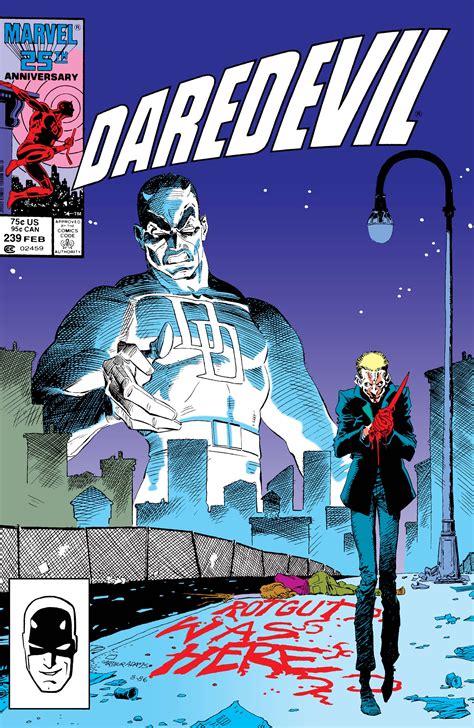 DAREDEVIL #239-240 (February/March 1987)
Writer: Ann Nocenti
Artist:Louis Williams
Inkers: Al Williamson & (#239 only) Geoff Isherwood
Colourists: Christie Scheele (#239), Bob Sharen & Petra Scotese (#240)
Letterer: Joe Rosen
Editor: Ralph Macchio
We’ve skipped another couple of issues. Issue #237, as I mentioned last time, is the one issue that Steve Englehart wrote before quitting, and appears under his “John Harkness” pseudonym. It features Klaw as the guest villain, so it doesn’t concern us. Issue #238 is the official start of Ann Nocenti’s run (since issue #236 was meant to be a fill-in), but it’s a Mutant Massacre tie-in, and the guest villain is Sabretooth.
So that brings us to this two-parter, where Nocenti starts to get into her stride. She’ll be working with rotating artists for the first year or so, until John Romita Jr finally comes aboard with issue #250. The most frequent contributor is Louis Williams, who also drew the Englehart issue, and returns for another two-parter in issues #243-244. Daredevil was his first work at Marvel, and his other credits seem to be fairly limited. I’m not sure why – he was certainly up to the job. He’s a good fit for this story, with plenty of atmospheric detail and suitably seedy and horrific qualities to his work.
To recap, then: with “Born Again”, Frank Miller left Daredevil with a new status quo, free of his middle class professional trappings, and starting a new life in Hell’s Kitchen with Karen Page. Ann Nocenti starts backtracking on Matt and Karen as a happy couple almost immediately, and goes back to the Roy Thomas-era idea that Karen struggles to accept Matt’s life as a vigilante. But otherwise she doubles down on Miller’s direction, and it’s here, more than twenty years into the series, that Daredevil finally becomes the neighbourhood hero of Hell’s Kitchen.
Traditionally, Hell’s Kitchen was a poor and working-class area, particularly associated with Irish Americans. That’s essentially how Nocenti plays it, but how far it represented the reality of Hell’s Kitchen by 1987 is hard to for me to judge. Wikipedia claims that gentrification had started in the early 1980s, but also says that a first wave had petered out by this time, and that the second was a few years into the future. It’s fair to say that Nocenti is not noticeably writing a part-gentrified neighbourhood. But presumably there were parts of Hell’s Kitchen that were still broadly like this in 1987. And besides, the whole point of the new set-up was to reconnect Matt with his roots, and this was the version that made sense for that story.
So if Daredevil is now the hero of Hell’s Kitchen, what sort of villains does he fight there? They have to fit with the stakes of this new setting (which is better suited to Daredevil’s power level anyway). Developers trying to change the nature of the area might work. Crime stories are obviously an option. But this is still a superhero comic, so you also want something heightened. And on top of that, Ann Nocenti likes her stories to be very explicitly about the discussion of ideas, so you want characters who can engage in that.
What this leads to, for the first phase of Nocenti’s run, is a string of characters defined by mental illness. We won’t reach her more enduring creations until after this phase. So Jack Hazzard in issue #236 was hallucinating. Sabretooth in issue #238 was compelled to kill by a throwback hunting instinct he didn’t quite understand. (Nocenti’s take on Sabretooth, comparing him to a house cat with urges no longer suited to his situation, is very weird with hindsight – but this was before Sabretooth had been established as Wolverine’s arch-enemy, and as X-Men editor, she presumably had some idea of how Claremont viewed him at the time.) And with this issue, we have Rotgut.
We first encounter Rotgut in the basement of his apartment building as he makes a random threatening phone call to a pregnant woman. Here’s his opening line.
I was watching you and you’ve got it. Got the gut rot. There are viruses now that are smarter than us. They hide in our bloodstreams and are too smart for the antibodies to detect. No army is fighting them. They are furtive, sneaky deadly. I saw you drunk and drinking, I saw you lean back and enjoy that feeling of brain cells dying. That’s what the high comes from, the sensation of the brain cells screaming and dying. You’re too hot. You’re radioactive. You’ve got to take a bath in ice cubes and drink the coldest thing you have so you drop your temperature and your blood will ooze and freeze and clot. It’s the only thing you can do. I saw you touching everyone and spreading your diseases. I saw you smoking. You’re probably smoking right now, killing that bulge in you, that child in you, filling its lungs with cancer, deforming its fingers, making that innocent baby’s cells creep. You’re a killer keep killing killing your baby and dusting your house it doesn’t matter we’re all covered with dead skin, skin is always dying and flaking away and lying around us calling itself dust. You’re a rotgut I’m a rotgut you’re not living you’re dying.
You get the idea. The general vibe is that he’s a schizophrenic (pop culture version) who is obsessed with the death, rot and corruption in the world, and wants to purge it. He believes that he’s on the same side as Daredevil in trying to cut out disease. But he has no terribly coherent plan about how to do that, beyond just killing things that are in front of him and that register to him as corruption. There’s no real logic to his agenda beyond that. He’s also a racist – “Her eyes slant. Foreign devils are the worst. She came here to infect the gene pool.” Rotgut himself appears to be an African American albino, though no characters mention this.
A couple of panels show the world from Rotgut’s perspective, which is basically Sienkiewicz-style distortion. The idea seems to be to contrast his perspective with Daredevil’s, which sees the beauty in Hell’s Kitchen – perhaps to a rose tinted degree. After all, this isn’t a great neighbourhood, and Rotgut is not entirely wrong in seeing corruption and disease everywhere. His tinfoil hat ravings about the fear hormones of slaughtered cattle are mixed in with complaints about passive smoking and forever plastics. He is, however, completely obsessive. A flashback shows him being lectured about cleanliness by his apparently OCD mother, who’s presented as the main cause of his problems (along with the time when he was forced to kiss his dying grandmother).
When they first cross paths, Daredevil recognises Rotgut as potentially dangerous, but has nothing more than vague suspicions, so he lets the guy go. Rotgut promptly heads off to kill a prostitute, which he regards as a public service. So issue #240 sees Daredevil actually trying to catch the lunatic serial killer, while Rotgut puts his grand plan into action. He’s going to kill everyone in his apartment building by meddling with the plumbing and poisoning the water. He literally has a red tank, like a giant pill, with DANGER: POISON written on the side – it’s like something out of a Road Runner cartoon, but that only makes him seem even more detached from reality, particularly given the visual style of the rest of the story. His beloved mother also lives in the same apartment building, but Rotgut is so addled that he’s simply forgotten that she’ll die too.
Naturally, Daredevil stops him, and we have a bit of philosophical debate along the way. Daredevil insists that he’s not like Rotgut, because he fights for something, while Rotgut only wants to purge things. When Rotgut realises that he’s nearly killed his own mother, he begs forgiveness and tries to kill himself. Finally, he repeats his point that he and Daredevil are both doing the same thing, and Daredevil replies with the rather limp line “I’m sorry. You are… confused.”
A subplot involves the neighbourhood kids trying to warn people in the building about the poison; one of the boys decides to let an annoying man drink the poisoned water and die, and the story ends by implying that the boy has just had the same sort of life-changing moment that set Rotgut on his path. This is a rather similar structure to issue #236, which ends with young Tommy set to follow in Jack Hazzard’s footsteps, but fortunately Nocenti won’t keep repeating it.
It’s an odd way to kick off a run. There’s something effective about the contrast between Daredevil and Rotgut seeing different sides of Hell’s Kitchen – and perhaps in Matt’s view being just as unrealistic in the other direction – but beyond that, the attempt to set up a parallel between them is a strain. Sure, they’re both trying to make the world a better place, and they both act as if they’re above the law while doing it. But Daredevil is a vigilante with a social conscience, and Rotgut is a delusional serial killer. It’s not really comparable, which is why Nocenti struggles to give Daredevil anything much to say in response.
Rotgut never returns, but he doesn’t lend himself to sequels; he’s too erratic to be anything more than a one-off idea, and to make him a workable regular villain, you’d need to tone him down into something closer to a Batman villain. But that’s not really the point here. He’s here mainly to present a competing view of Hell’s Kitchen, in the form of an exaggerated stereotype, and help to establish the new setting. He serves that role well enough.

I don’t think Nocenti’s depiction of Sabretooth is really consistent with Claremont’s thinking at the time. The entire point of Claremont’s depiction of Sabretooth and Wolverine is that Wolverine could change while Sabretooth couldn’t- or wouldn’t. Already in X-Men 212, the first encounter between them on panel, Sabretooth is holding a healer hostage and Wolverine needs him to save some people. But instead of getting into a fight with Sabretooth while the people he’s trying to save die of their wounds Wolverine collapses the tunnel between them so he can get the healer to the people who need to be saved. Sabretooth regards this as an act of cowardice and Wolverine acknowledges that when he was younger he probably would have fought Sabretooth instead of trying to save the injured people but he’s grown since then.
In contrast, Nocenti writes Sabretooth as more like an animal trapped in a man’s body. They’re not really the same thing.
@Michael,
But they are the same in the context of Logan’s character arc. Claremont was writing Logan as someone who used to be like Sabertooth; he was an animal trapped inside a man’s body. But unlike Sabertooth, Logan was able to grow and change and now had somewhat better control over his animal nature.
Also, that cover is some peak Art Adams. Good stuff.
BANG!
This was such a good issue.
I absolutely loved it at the time.
Thinking it holds up very well.
Yes, a very strong start (the Sabretooth issue was part of a cross-over, as mentioned, still a decent issue, but this is where Nocenti gets to do as she wants with the characters). This story-arc reminds me a bit of Thomas Ligotti and also the classic (mostly concurrent overall with Nocenti’s DD, although not quite started yet when these issues were published, I do believe) Alan Grant run on Detective/Batman. That’s my all-time favourite work on the Batman titles too.
Nocenti’s characterization of Karen Page is another absolute highlight of this run. Any possible comparisons with Roy Thomas’ shrill Karen will very quickly dissipate.
Never knew of Rotgut before this article.
He comes across as something of a free sample of a typical Ann Nocenti villain – typical and representative, but not meant for repeated usage. He also reminds me of Batman villain Zsasz, in that both are serial killers that we are meant to have a sliver of sympathy towards.
Of course, that sliver has a very short shelf life. It is difficult to continue to care for a person who keeps trying to kill others out of emotional imbalance alone and can’t be talked into at least trying to have other goals in life.
Visually, he resembles a less impressive Tombstone, and it would not be absurd to believe that he was a partial inspiration for Tombstone.
It is a perfect introduction for Ann Nocenti’s run, and I wish it had been published here in Brazil back in the day (we went from #236’story in April 1988 to #241, #248 and #249 in December. Things like this happened at that time). It would have given me an important clue on how to approach her run (the answer being “without too much of traditional expectations”). In fact, Rotgut resembles what I fear Lance (Bullet’s son) may become quite a lot.
Which I guess shows me a fairly clear theme of Nocenti’s run. The dangers of abusing personal power over others – mostly parental power, but there are other forms too. We see that time and again – Rotgut’s mother, Skip Ash the career fool, Ultron’s previous selves, Mephisto, Bullet, Typhoid, Joe’s boss, the Mambo and Danny, Project Reptile’s handlers and their subjects’ raisers – and, of course, Matt’s own treatment of Karen and Mary.
All of which, of course, remind us of how abusive truly were the demands and expectations of Matt’s beloved father Jack.
Come to think of it, Nocenti’s run is a series of contemplations on the dangers of lack of wisdom and how other people always end up paying for our mistakes. While there are plenty of dangerous governmental conspiracies to dismantle and expose and psycho killers to be opposed and punched down, doing so is never particularly decisive and tends to be futile or even detrimental to the actual well-being of people.
Sabretooth wasn’t a very consistent character until Claremont wrote him regularly, followed by Larry Hama. I remember reading a few issues of a ’90s reprint series called Sabretooth Classics, and being surprised how the early version of the character didn’t match the one I was reading about in the pages of Wolverine.
Nocenti was great at setting up questions readers had to answer themselves. Should Matt have stopped Rotgut earlier based on suspicion? Did that man deserve to be poisoned, and should that child be prosecuted for setting him up like that? Is Daredevil effective, or just a less lethal version of Rotgut? I’m sure a lot of younger readers weren’t used to super-hero comics not having easy answers.
I just re-read Nocenti’s Sabertooth issue, and the contemporaneous Claremont issues. While I stand by my point that the theme of Logan’s growth in contrast to Sabertooth’s animal nature are consistent across both writers, what is different are their understanding of “animal nature.”
Nocenti makes Sabertooth out to be a largely mindless predator. He enjoys the hunt and kill, but he isn’t particularly malicious. The domesticated cat allegory is pretty well fleshed out.
Claremont has him revel in the cruelty a great deal more. He’s more malevolent, less instinctive. He’s more verbose, and therefore more conscious of his own actions.
So yea, the characterization isn’t particularly consistent even though the concepts are complementary.
@Luis Dantas- There’s a very long tradition of albino villains long before Rotgut. The minor Batman villain Snowman was an albino, there was an albino villain in Micronauts, etc. Nowadays, if you see an evil albino like Tombstone, it will be social ostracism that turned them evil.
Remember when Joe R. Lansdale used the real-life Winter Twins in his Vertigo Jonah Hex series? That was after the examples mentioned.
It may land a bit on the ret-con side, but I remember thinking this was Sabertooth that Nocenti was writing, and the contrast was Sabertooth as a Sinister clone that Claremont was writing.
Tobias Whale (DC) was another villainous albino.
Sinister”s clones were a later retcon, but couldn’t apply here anyway. The Mutant Massacre issues written by Claremont and Nocenti’s tie-in were published at the same time. Unless there was a clone and the original running around the Morlock tunnels simultaneously, they have to be the same character.
@Chris V- Apparently DC felt that just having a Confederate soldier as a protagonist wasn’t problematic enough for a Jonah Hex series.
DC has a long tradition of heroic characters fighting for the wrong side. General J.E.B. Stuart’s ghost of the Haunted Tank, Jonah Hex himself, Enemy Ace, plenty of one-occasion opponents that just happened to having been born and raised in the wrong culture.
That wasn’t too difficult in the 1960s and 1970s.
That was Lansdale’s thing. This is the writer who had Elvis and JFK team-up against an Egyptian Mummy (“Bubba Ho-Tep”).
Yeah, but I don’t know why that would be considered insensitive. Making two real-life twin albino musicians into inbred, necrophiliac, rapists who get killed by the Confederate soldier is pretty extreme, even for Lansdale.
“Unless there was a clone and the original running around the Morlock tunnels simultaneously…”
All of the Marauders in the tunnels were clones as intended by Claremont’s comments given in an interview later.
So there were only clones in the tunnels. Oh course, this wasn’t declared on panel… so ret-con-ish.
@Woodswalked- I don’t think that Claremont intended the Marauders in the tunnels to be clones before Inferno. Sabretooth was able to defeat Rogue in issue 213 and nearly defeat Lorna in issue 219. That doesn’t fit with an inferior clone. We don’t see the dead Marauders in issues 221-222, even though we see the other Marauders. Maddie doesn’t seem to have been intended to be a clone. As late as X-Factor 31, when talking about Jean and Maddie, Destiny refers to a displacement of time and place and says to Jean “She had no time and you have all the time in the world”.
If I recall, the Winters did sue over that.
I can certainly believe that part of the DC “make war no more” ethos is that there are good people who fight for “the other side” in a conflict. Not everyone is The Red Skull or Barons Strucker and Zemo.
Yes, they did sue DC, but they lost the case as the Court ruled it was protected by the First Amendment.
It’s certainly true that there are “good people who fight on both sides in wars”, just as there are “bad people who fight on both sides in wars”. It’s simply that most creators tread lightly with ex-Confederate soldiers during the US Civil War, due to connotations of racism. Jonah Hex is never portrayed as a “good guy”, although he’s never outright portrayed as not being exactly heroic due to his supporting the Confederate side either, which I think Fleisher’s personal politics saw as the underdog getting stomped on by “Big Fed Government”. The most recent ongoing Jonah Hex series (by Palmiotti) did make it more ambivalent, where Jonah Hex on multiple occasions did question if the Confederacy did stand for what he thought he was fighting for during the Civil War (state’s rights, not the institution of slavery), showing some regret for fighting for the Confederacy, although not for being a Reb.
As far as Nazism during WWII now…that’s an even stickier subject to attempt to handle. It can be done with a lot of sensitivity, but mainly the types who are saying “there were good people fighting on the side of Nazi Germany during World War II” are people that decent people don’t want to involve themselves.
Other than Colonel Klink and Sgt Schultz, it’s probably a short list.
In the 1970s and 1960s,, it was probably easier to write sympathetic characters from a farther place in history than wars in living memory. Easier to write, for example, a sympathetic British soldier during the Revolutionart War than one from Korea or the ongoing war in Vietnam.
Plus, in that time, the Conferedate battle flag was a lot more ubiquitous in popular culture and didn’t immediately code someone as a bad guy (the Duke Boys) as it would now.
And I say this as someone who lives in a part of the US where you have people who drive around in their pick ups flying the Stars and Bars on MLK Day.
Whenever the retcon of Sabertooth in the Mutant Massacre issues happened, it’s still the same character No enti was writing. The Nocenti issue is a MM tie-in, the story is set in the tunnels, and it strains credulity to claim there were actually *two* Sabertooths in the tunnels at the same time. Either Nocenti and Claremont were both writing the original character, or they both have had their character retconned into a clone. But it can’t be that one is a clone and the other is not.
And I say this as someone who lives in a part of the US where you have people who drive around in their pick ups flying the Stars and Bars on MLK Day.
Me too. I’m not native to the region, so I was astonished and appalled when it dawned on me a few years ago that I have living neighbors who personally participated in lynchings in the ‘60’s and ‘70’s.
I have somehow lived in two different states where the town I was in or nearby were Klan strongholds and had a cross burning in one of those towns in the mid 1980s.
It’s often not easy being blue in very red parts of the country, esp these days.
These days the local Klan anround here are mostly yahoos shooting at beer cans and geezers in beach chairs on the lawn of the county courthouse.
But I will say, for two weeks after election night in 2024 there was an alarming amount of gunfire going on every night in my rural neighborhood. Friday nights are usual, but this was all day, seven days a week. They were clearly sending a message.
Regarding Confederates portrayed as heroes, there re several notable ex-Confederate heroes in older fiction, such as Edgar Rice
Burroughs’s John Carter. Later Westerns sometimes include them, too, such as Rooster Cogburn from the John Wayne movie of that name and Clint Eastwood’s title character from The Outlaw Josey Wales.
Marvel’s Gunhawks characters, who were published contemporaneously with Jonah Hex’s early stories, were arguably even worse, since they were a team of gunfighters comprising the son of a plantation owner and a formerly enslaved person he grew up with, both of whom were portrayed as having fought voluntarily for the Confederacy during the war.
John Ostrander’s gritty Blaze of Glory series much later addresses the problems with the Gunhawks quite brutally, revealing that the original stories were sanitized and that Kid Cassidy was quite racist while the Black character, Reno Jones, never fought for the Confederacy. In Ostrander’s story, Jones ends up killing the Cassidy, who was now a Klansman working for another baddie.
It’s hard to remember these days how prolonged the Dunning School’s influence was in the teaching of U.S. history and in U.S. popular culture. More broadly, he Confederate flag was sometimes seen as the mark of a rebel, and rebels have often been portrayed as cool, heroic figures.
Oddly, Jonah Hex’s 1970s stories took on his Confederate history somewhat directly, although not in ways that align with modern perspectives. On the one hand Hex is explicitly said to be fighting for his home state, and one of his recurring enemies was the Gray Ghost, a lunatic killer trying to avenge the Confederacy by killing the people he felt had betrayed it.
On the other hand, part of Hex’s origin story involves a Union prison camp that mistreats the prisoners horribly, when the most infamous case of this in the actual Civil War was the Confederates’ prison at Andersonville.
Again, it’s of a piece with the Dunning School-influenced teaching of U.S. history that would’ve likely been part of the creators’ childhood education back then.
As to Rotgut, I suppose I’ll make the obvious political joke and suggest that he could return as the Earth-616 Secretary of Health and Human Services.
“Could”?
On second thought, yes, that might well be an improvement.
@Omar Karindu: Blaze of Glory is one of the most underrated Big 2 comics of all time. Ostrander’s story was gripping, and Leonardo Manco’s art was equally gorgeous and gritty. I recommend it, along with The Kents a Western series Ostrander wrote that was drawn by Tim Truman and Tom Mandrake. The Western genre has never been a favorite of mine, but those comics were excellent. I remember liking Apache Skies, the follow-up to Blaze of Glory, too.
I live in Massachusetts, one of the bluest states that happens to be home to plenty of people who are racist and conservative. Far fewer than in red states and more right-leaning countries, though. I recognize how lucky I am in that regard. Anyway, I remember working with a woman who grew up in Kentucky, and she was slightly taken aback by the fact that people around Boston would talk about politics openly and have diverse opinions. She said that back home, everyone just agreed. I think maybe they didn’t and just didn’t speak up (but what do I know?). Either way, I found the difference in social conventions interesting.
Apparently in many places people have a tradition of bonding over certain political stances and having some measure of automatic or presumed despisal towards others.
There are always exceptions, but it is a very common situation.
You only need look at Boston’s sports history to see how intolerant some people can be there. On one hand, the Ted Sox had a racist owner and I think we’re the last team in integrate. But then you have the Celtics and Bruins who were at the forefront of their sports.
I’m not trying to be obnoxious reply guy but Claremont wrote a more verbose version of pretty much everybody.
“I’m not trying to be obnoxious reply guy”
Good, because that’s my job.
@Omar- Historians generally agree that mortality rates in BOTH Union and Confederate prisons were quite high.
Yes, the Red Sox were the last MLB team to integrate when they signed Pumpsie Green in 1959. Tom Yawkey, the then-owner of the team, was an inveterate racist. The Yawkey Trust sold the team in 2002 to Fenway Sports Group, and during the BLM movement the current owners, the team petitioned the city to rename Yawkey Way to its original name “Jersey Street.”
Up into the 2000’s Fenway had a reputation for being inhospitable to black players, more because of the fans than the team. Within the last decade there have been incidents of fans shouting racial epithets at black players. That’s not unique to Boston but it nonetheless continues to happen.
On the other hand, in 2026 the Red Sox have seventeen players on nine different teams in the World Baseball Classic, more than any other MLB team. While African Americans remain underrepresented on the team, it is indisputably the most international team in the majors leagues.
***
And yes, Claremont’s writing is notoriously verbose, though it’s typically more in the narrator than in the characters.
Kentucky, like most states, is different depending on where you are specifically. I grew up in a far suburb of Louisville, where racism was assumed and “agreed upon” by everyone. But the city itself is home to people with quite a variety of opinions, including anti-racist progressives. It’s my experience that the rural/urban divide is pretty similar in other parts of the state, though probably leaning more toward “pro-racist” than other, non-Southern states.
And KY currently has a divided state government with a Republican-led legislature and a Democratic governor who’s fairly popular, so there must be at least some difference of political opinion in the state. Not that Democrats can’t be racist, obviously, but you see what I mean.
@Michael: That’s true. I suppose it’s a mark of history being written by the victors that Elmira gets much less popular attention than Andersonville.
@Mike Loughlin: Ostrander seems to be especially good at Westerns and espionage books.
And spooky books, depending on how you classify his run on The Spectre.
We had him at a store signing years ago and he was a great guy to us and his fans.
And books about aliens on Earth (Hawkworld, Martian Manhunter) and in space (Grimjack, Star Wars). Ostrander’s name on a project pretty much guarantees I’ll check it out.
A few days late and off topic. But as to Paul wondering what Hell’s Kitchen was like in 1987. I worked in the area at that time. It wasn’t an Irish neighborhood anymore, but was still pretty scruffy (it’s adjacent to the Times Square neighborhood which was still pretty seedy then.) The whole area went rapidly upscale in the next ten years.
Nocenti said she used to walk around Hell’s Kitchen while writing Daredevil. A lot of what was in the comic was based on first-hand observation.