X-Men #26 annotations
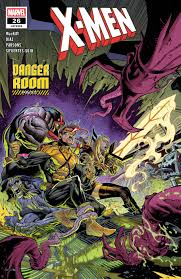 X-MEN vol 7 #26
“Danger Room, part 1”
Writer: Jed MacKay
Penciller: Netho Diaz
Inker: Sean Parsons
Colourist: Fer Sifuentes-Sujo
Letterer: Clayton Cowles
Editor: Tom Brevoort
COVER: The X-Men (Cyclops, Juggernaut, Beast and Magik) are ambushed on the ship.
THE X-MEN:
Cyclops. As usual, he gives entirely pragmatic rather than principled reasons for helping to find Sheriff Robins – she’s a useful ally and her replacement might not be. This isn’t particularly heroic reasoning but he may simply be tailoring his reasons to his audience (Quentin and Cain).
He says that he was a kid when he lived in Alaska, and “grew up” in Westchester – this glosses over his time in the Nebraska orphanage entirely.
His initial reaction to Psylocke prioritising Greycrow is to tell her that she’s needed on the mission, and then to more or less imply that Greycrow had it coming. He backs off, probably more because he realises that he’s being insensitive. However, he does then offer Xorn’s services.
Psylocke. She seems to have a broadly positive view of the locals (it doesn’t seem to occur to her that Glob might get into any trouble running his vegetable stall), but still has no particular interest in being called in to investigate the attack on the police station. She seems to see it as a pointless exercise in soldiers pretending to be detectives for show and rejects the description of the X-Men as super heroes. She claims to like Robbins, but understandably wants to focus on Greycrow when she learns that he’s in hospital.
Kid Omega. He grumbles about the X-Men paying any attention to “a cop”, even though she’s clearly been abducted.
Juggernaut. He’s a big guy who smashes things.
Magik. She uses “sympathetic magic” to track Paula Robbins using her blood, and quotes the old “as above, so below” line, presumably on the reading that things at different scales are essentially similar. For some reason she refers to George Frazer’s The Golden Bough, which was a work of comparative mythology, not a magical text.
Beast. He joins the field team, possibly replacing Psylocke.
SUPPORTING CAST:
John Greycrow. Psylocke’s boyfriend from her solo book (and Hellions before that) has appeared in this book before, and his bank robbing activities were specifically mentioned in issue #5. Adorably, he’s wearing a mask for the purposes of this robbery, even though he’s also in his extremely recognisable costume where he normally appears unmasked. Mind you, he’s hardly a public figure.
Greycrow tells us that the robbery was a trap (or at least that someone tipped off the authorities). When faced with a ton of police, his immediate reaction is to remove his mask and prepare to fight, anticipating death. Either he’s assuming that the cops will try to kill him, or he can’t accept capture – he doesn’t seem to regard surrender as an option. We don’t actually see who shoots first, but he does wind up in hospital.
Amy. Greycrow repeatedly tries to contact an unseen “Amy” to get him away. Based on issue #5, this would be the teleporter Amelia Voght. Something seems to have happened to her.
Glob Herman. He’s setting up a vegetable stand to sell fruit and vegetables to the locals. He’d rather just give the produce away, but Cyclops has persuaded him that people will trust him more if there’s at least a token price. Most of the locals seem to like him just fine, but he apparently gets shot at the end of the issue.
Paula Robbins. She’s been selected as bait to lure the X-Men into a trap, presumably on the view that she’s the closest thing to an outside supporting character that they have.
Deputy Smith. I don’t think we’ve seen this guy before, but Scott seems familiar with him. He’s entirely out of his depth dealing with the attack on the police station, and responds by calling in the X-Men rather than the authorities (either that, or he’s leading the X-Men into a trap). He regards the X-Men as superheroes who saved the town twice.
Rose Ellen Cobb. She seems to have been more or less deradicalised following the discovery that she had a mutant daughter, and is very apologetic to Glob about having believed “all those podcasts”. Understandably, she’s still quite keen to know what happened to the missing daughter, Robin. Glob gives a slightly evasive answer, confirming that the X-Men know that she’s with 3K (which Rose already knows) but dancing around the other reasons why the X-Men are trying to find 3K. Presumably Glob has in mind the fact that the Chairman has turned out to be the original Beast, and that the X-Men’s Beast shared that information with the team after the previous issue.
Piper Cobb. She likes Glob’s strawberries and seems quite happy.
VILLAINS:
Frank Bohannan. He wears his trenchcoat even in his office, and has a mug with the American flag on it. He’s hired Beyond to deal with the X-Men, but regards them as “psychopaths” and cynics who lack his belief in God and country.
Maxine Danger. She was the head of the Beyond Corporation’s New York branch in Amazing Spider-Man and responsible for turning Ben Reilly into a corporate Spider-Man. Originally an absurdist outfit from NextWave, at this point Beyond have basically become mercenaries with assorted wacky technology. She was last seen in Amazing Spider-Man: Blood Hunt, where she certainly wasn’t in jail – so when Bohannan says that he “approved your release requests”, he presumably means that Beyond asked for some people to be released from jail to help.
REFERENCES:
- Deputy Smith refers to “the Iron Night” (the first Sentinel attack on Merle that we saw in flashback in issue #7) and “the Second Iron Night” (presumably Magneto’s Sentinel fighting the attacking monster in issues #14-17).
- Glob is singing “The Move” by the Beastie Boys.

Frazer does discuss magic, even though it’s a work of anthropology rather than a magical text. I think MacKay might be slightly confusing the Golden Bough with the Emerald Tablet, which is the source where that quote comes from. However, Frazer’s definition of magic included the coining of the term “sympathetic magic” which includes the Law of Similarity.
The tentacular Monster on the ship really looks similar to the cosmic parasite in the concorrent issue of Nova: Centurion (also by MacKay)
Annoyingly, the Doug plot from last issue is dropped completely. We never find out if the X-Men found out anything about Doug when they visited the Morlocks or even if they visited the Morlocks. The plot about the X-Men learning that Beast is the Chairman is also mostly dropped- it’s alluded to by Glob if you read carefully but still…
Yes, Quentin, the X-Men shouldn’t try to help a cop. That would be like trying to help a psycho who started a riot just to impress a girl.
I agree with Scott’s initial reaction to Greycrow being shot and captured. He was robbing a bank.Robbing a bank isn’t a “safe” crime like shoplifting, pickpocketing or embezzlement. People get PTSD from bank robberies. If a guard panics, an innocent civilian could get shot. In the scene we saw Greycrow pointed a weapon at police- if they fired on him a civilian behind him could have been killed.
I realize that Kwannon is upset but she doesn’t realize that Scott has entirely justified reasons for disliking Greycrow. Greycrow shot his wife, stole his son and handed him over to a mad scientist. Scott concluded his son was dead and suffered from hallucinations. But we’re supposed to believe that Scott is being judgmental.
Besides, nobody’s rescued Dazzler yet but Kwannon is in a hurry to rescue Greycrow. “We can’t rescue Dazzler. She was arrested singing some horrible lyrics. What will the humans think? Let’s go help Greycrow, a known supervillain who once attacked a hospital who was arrested robbing a bank.”
(And yes, I know that it was implied Maxine Danger had something to do with Greycrow getting arrested. But still…)
So what’s going on with the living ship? We saw some sort of worm crawling in before it came to life. Is this one of Beyond’s creations or the work of one of the villains that Maxine recruited?
“when Bohannan says that he “approved your release requests”, he presumably means that Beyond asked for some people to be released from jail to help.”
Yeah, Bohannan says release requestS- plural. And he refers to Maxine’s “think tank of psychopaths”. Presumably, the people released from jail are established villains.I wonder which ones.
I’m still waiting for the upcoming Baxter Building arc in Fantastic Four, where Mad Dog leads a team of villains agains the Fantastic Four.
Is Glob interacting with locals some of the best scenes we’ve had in X-books in years?
Also LOL’d at this ad copy: “…the New
York Public Library included EXCEPTIONAL X-MEN
Volume 1 on their list of the Best Books for Teens 2025! So it’s never too late to hop on board…” Hop on board to a book that got canceled?
Is Glob interacting with the locals some of the best scenes we’ve had in X-books in years?
Also LOL’s at this ad copy: “…the New
York Public Library included EXCEPTIONAL X-MEN
Volume 1 on their list of the Best Books for Teens 2025! So it’s never too late to hop on board…” To a cancelled book? This is why they need to stand behind at least some of their ongoing past 10 issues. Especially with Eve Ewing, who has a natural fan base but one who are more likely to wait for trade than pick up individual issues. Get with it, Marvel.
Sorry, I received a “duplicate comment” notification and my original comment didn’t seem to be visible until I re-typed it.
Also, thanks Chris, I suspected something like that might be the case but I never finished the Golden Bough and it’s been decades in any case.
Regarding Scott and Greycrow: it has been for some years a recurring topic in the comics how far the regularly cloned Marauders are individuals or just copies of their predecessors, and this has been especially explored with Greycrow, at least since that talk with Nightcrawler during the Utopia era. So while Scott has justified reasons to dislike the original (?) Greycrow, it might be questioned in how far he is justified in transferring this dislike onto the current one. On the other hand, as since Krakoa it has become the X-Men’s philosophy that clones are the same person as the predecessor, he could be expected to.
“Regarding Scott and Greycrow: it has been for some years a recurring topic in the comics how far the regularly cloned Marauders are individuals or just copies of their predecessors, and this has been especially explored with Greycrow”
If I’m remembering right (never a guarantee), the physical, literal Greycrow who participated in the Mutant Massacre and shot Madelyne Pryor has been dead for years — he and all the other Marauders who survived the Massacre were murdered by the X-Men during Inferno.* (Except Sabretooth, who survived that battle only to fall dead in front of the New Mutants in their Inferno wrap-up issue.) So I guess one question is, where do Greycrow’s implanted memories and personality start? Did Sinister take his memories from BEFORE the Massacre and Maddie hunting, or after? (Of course, anyone who’s been tapped by Sinister to lead the Marauders has undoubtedly committed many OTHER atrocities, but that’s another question.)
* Also, as I think of it, they eventually revealed that Greycrow has a healing factor too, so maybe he actually survived Inferno? Like so much to do with Marauders cloning, I can’t keep it all straight anymore.
The original Greycrow served in the US military during World War II. He was apparently involved in many massacres, including against his own side, which led to his being sentenced to death. I guess this is where Greycrow’s healing ability comes into play, as he survived and became a mercenary. It was while working as a mercenary that Sinister found Greycrow.
This contradicts with the revelation about Gambit’s secret. If Sinister already knew Greycrow, why did he need Gambit to recruit him for the Marauders? Maybe Sinister didn’t really need Remy, and it was all manipulation so that Remy would be in Sinister’s debt, which does make more sense. We already saw that the Marauders tracked the Morlocks back to their home, so why did Gambit need to show the Marauders where the Morlocks lived as the other part of Sinister’s deal? It was more manipulation on Sinister’s part.
In his Wolverine series last year, Claremont established that the Marauders from the Mutant Massacre were cloned from the originals. Wolverine killed the former, while the latter escaped.
I love how Marvel’s writers ignored their editors and dragged Nextwave kicking and screaming into continuity.
@Claus: The difference with Krakoa is that minds were being downloaded intact into the replicated bodies – *that* was the reason that continuity of the self was assumed.
With Greycrow and the Marauders, it’s frequently been stated that no such transfer took place (the last Scalphunter before Krakoa claimed he didn’t remember the Massacre, and was presumably the copy Magneto activated during his pre-Secret Wars solo series). So they are, for all practical intents and purposes, not the same people.
The Glob scenes were my favorite part of this issue. It was nice getting something that felt human between the missions.
This book has been decent, but I have no interest in yet another secret organization with nefarious plans like the Beyond corporation (which is unremarkable outside of its original concept). The pacing has blunted the momentum of the 3K plot, which is the only major plot point that I care about.
@neutrino, Diana- But in Hellions Greycrow felt guilt for the deaths of the Morlocks and Storm blamed him for the deaths of the Morlocks.
In any case, Greycrow was resurrected by the Five, so that raises the question of which Greycrow did they resurrect? One of them? All of them combined somehow?
Claremont’s Wolverine series made no sense. Sabretooth has always been written as having his memories from his time with the Marauders. Besides. Scrambler’s powers are wrong in the series, and we already got an explanation of where Wolverine went after Uncanny X-Men 246..
@Michael: It’s hardly unusual for a clone to have feelings about their genetic predecessor’s actions, or for people like Storm to project anger onto them because they have the same face.
Considering that one of Xavier’s roles on Krakoa was periodically updating backups with the latest “versions” of mutant minds, it’s fair to assume the Greycrow they resurrected was the most recent, repentant one.
I suppose we can smooth the inconsistencies over by accepting that Greycrow felt a sense of vicarious guilt, knowing that some recognizable version of himself committed horrible atrocities in the Mutant Massacre; he gets a pass due to not literally being responsible for those acts himself, but the knowledge alone that he is/was capable of becoming that person might well be enough to haunt him. So says my comic book logic, at least.
(Or was he shown having direct memories/flashbacks of the Massacre in Hellions? I can’t remember.)
If indeed this Greycrow does not possess the sum of his predecessor’s memories and experiences, Storm may not be aware of that fact. And it would really be for the best to create as much separation as possible between the two versions of him. A character like this massively stretches the notion of second chances. We’re not talking about a run-of-the-mill reformed villain like, say Rogue. He was a sadistic mass-murderer who gleefully gunned down countless defenseless victims, including children. Even allowing for the possibility of meaningful redemption, it’s asking too much to accept that EVERYONE who witnessed those horrors would just go along with it.
Although I guess during the Krakoan Era, where the likes of Apocalypse, Selene, and Mr. Sinister were all given seats of power, this barely registered on the list of moral transgressions…
Anyway. There’s more potential in Greycrow as a clone of indeterminate origin than as effectively a linear continuation of the guy who participated in the Mutant Massacre. It allows him to operate as something of a sympathetic anti-villain, whose story is concerned with trying to avoid crossing the line into truly irredeemable territory albeit still a generally unsavory character.
@Taibak Nextwave has been the default for Tabby and Machine Man since they came out, Monica has been protected from it’s legacy. But is do feel that Dirk Anger is as much the reason to write out OG Fury as corporate synergy was.
Beyond in Spider-Man though did seen a good distance to the broccoli men of the past.
I’m probably misremembering something here, but I could have sworn that part of the reason it was established the Marauders were being cloned was because, at one point during the Mutant Massacre, Sabretooth kind of gets taken down by the Power Pack, and obviously that can’t have been the real one…
Alastair: I know. It’s just that when it first came out, Quesada was adamant that Nextwave wasn’t in continuity. Then the rest of Marvel’s writers decided that their versions of Aaron, Tabby, and even Elsa were too awesome to pass up and they gradually integrated it into the normal Marvel Universe.
Cyke68, you could be talking about Beast when you say “_____ felt a sense of vicarious guilt, knowing that some recognizable version of himself committed horrible atrocities…; he gets a pass due to not literally being responsible for those acts himself, but the knowledge alone that he is/was capable of becoming that person might well be enough to haunt him.”
Very parallel situation, I think.
@Michael: If you want a N0-prize, you could claim that Sinister altered that clone’s powers.
It wasn’t just that his genetic material was used, but that he made it available to Sinister. Sinister may have betrayed him, but he initially freely joined him.
@Michael definitely a similar dilemma re: Beast. The one difference is that the clone Beast’s memories/life experiences have a clearly defined cut-off point, and it is well before he starts down his dark path. The distinction with Greycrow seems much more ambiguous, which may or may not be by design. We don’t even know to what extent Sinister restored the Marauders’ memories when he was in the habit of simply cranking out clone replacements every time they died in the field.
I suspect, though, Hank as the bigger character will be the subject through which the question of accountability by proxy will be explored. It’s been suggested that the resolution of the two Beasts will see one of them (presumably good Beast/the clone) walking away with the memories of both. Would possession alone of his counterpart’s memories suddenly make good Beast culpable for those crimes? That obviously doesn’t sound right. But how is it functionally all that different from the resurrection protocols, which was essentially a download of memories into a cloned body? Everyone restored in that manner was recognized as the linear continuation of the same being rather than a perfect copy. I guess it will depend on the extent to which good Beast is able to retain his own identity and externalize the infodump of memories, as Jean was eventually able to do with Phoenix and Madelyne after Inferno. That seems like the best compromise in getting us back to an “intact” Beast with complete memories but without straining credulity with some half-baked redemption arc.
@Cyke68- The resurrection protocols are different because (a) of the presence of the Waiting Room, which involved actual souls and (b) the revelation that Jean created Hope when she was basically omnipotent- Jean could have given Hope the ability to resurrect the dead.
I’m reminded of how much I hated the concept of the Waiting Room when it was introduced. To me, the resurrection protocols SHOULD have been difficult, requiring a lot of moving parts, coordination amongst different contributors, and sure, even the presence of a wildcard like Hope. While it gave the characters something of a safety net, it still had limitations, at least in its original form. It was reliant on back-ups existing, which wasn’t possible for every character, and could be corrupted by Otherworld (and possibly other off-world deaths). Then the Waiting Room just opened the door to everyone and made the concept of back-ups obsolete. If resurrection was a narrative conceit to acknowledge the impermanence of death in comics, then the Waiting Room truly drove home how meaningless it was. Where the former was a clever in-universe cheat, the latter felt lazy and uninteresting, a form of power creep in its own way.
Regardless, it is telling the hoops that were jumped through creatively to drive the point home: “These aren’t just clones! Really!” It was a long-established “rule” since the original Clone Saga of the ’70s (and possibly earlier?) that a clone was identical to the original, even possessing the same memories, up to the point at which they were sourced. In the absence of any evidence to the contrary, they fully believed themselves to be the original. Yet that’s never been good enough for readers, particularly in the realm of character resurrections. We’ve always regarded a clone as an inferior copy at worst, or completely separate character at best, depending on the extent to which they deviate and develop a distinct personality from the original. Even amongst the most secular of readers, there’s a curious, intrinsic need for something akin to a “soul” to be preserved in order for any resurrection to be viewed as legitimate. Even if no one can say what that constitutes or how it’s defined.
Long story short: as it relates to Beast, I’m likewise not sure if having a conventional clone of Hank as he existed up until the ’80s in order to fulfill the need for a reset to a traditionally heroic depiction of the character really cuts it. That’s why I feel like there’s got to be some reckoning with the OG Beast, resulting in a consolidation of the two if not a fully gestalt mind/identity (since that would defeat the purpose of the reset). It’s a fine line that will have to be walked creatively in order to be successful.
@Cyke68: Alternatively – that’s really only true of the Jackal’s cloning process, which clearly involves some level of memory transfer. The same doesn’t necessarily hold true for clones created by others like Sinister or the Facility.
@Diana, Cyke68- Maelstorm’s and Arnim Zola’s clones were treated as the originals. Of course, both seemed to allow some mind-transfer technology. In Maelstorm’s cloning process, Deathurge confirmed that the clones were the original people. And Zola’s cloning technology required energizing the subject’s brain to transfer their “mind essence” into a new body.
When Jean absorbed Maddie’s memories it was supposed to set up a situation where Maddie’s life just became the missing chapter in Jean’s life between the death of Phoenix and Inferno. And She also got Phoenix’s memories to fill in the gap from her death on Starcore up to Phoenix’ death.
But Louise Simonson made a long-running story about Jean trying to integrate those memories and in he end they became “like faded copies.” I suspect this was to give Jean some moral distance from the villainy while also allowing future writers to streamline the history into one character’s story.