Daredevil Villains #73: Project Reptile
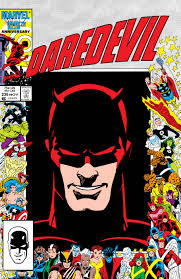 DAREDEVIL #236 (November 1986)
“American Dreamer”
Writer: Ann Nocenti
Penciller, co-inker: Barry Windsor-Smith
Co-inker: Bob Wiacek
Colourist: Max Scheele
Letterer: Joe Rosen
Editor: Ralph Macchio
“Born Again” completely upended the series. By the end, Matt has lost his licence to practice law and started a new life in Hell’s Kitchen as a diner chef, happily reunited with Karen Page for a fresh start. Oh, and the star name creators from “Born Again” have left. So how do you follow that?
Well, this is Daredevil, so the short-term answer is “with fill-in stories”. The first two don’t concern us. Issue #234, by the improbable creative team of Mark Gruenwald, Steve Ditko and Klaus Janson, features Madcap (from Captain America) and the Rose (from Amazing Spider-Man). Issue #235 is a Mr Hyde story by Danny Fingeroth, Steve Ditko and Danny Bulandi. Both acknowledge the new status quo, but don’t really attempt to do anything with it.
That brings us to issue #236, by the book’s new regular writer Ann Nocenti and guest artist Barry Windsor-Smith. Nocenti was the editor of Uncanny X-Men and New Mutants at this point, and would remain so for another couple of years. As well as various fill-ins and anthology contributions, she’d written the final four issues of Spider-Woman, the Dazzler/Beast miniseries Beauty and the Beast and one of her signature works, the Longshot miniseries. Daredevil was her first substantial run on an ongoing title, and turned out to be by far her longest run on any book.
But she wasn’t the regular writer yet. Issue #236 was supposed to be a third fill-in issue, after which Steve Englehart would take over. Instead, he wrote just issue #237 – under the “John Harkness” pen name that he used when he wanted to take his name off something – and then Nocenti took over for real with issue #238. Englehart’s plan was for Daredevil to make a fresh start in California and join the West Coast Avengers, and the Black Widow was going to rejoin the supporting cast. Englehart’s version of events is that Nocenti’s fill-in story clashed with his plans by bringing back the Widow in a different way, and when Marvel refused to have it changed, he quit. So Nocenti became the regular writer instead, and instead of going back to California, she doubled down on the new Hell’s Kitchen setting.
That’s for the future, though. Her first issue, being a fill-in, doesn’t really engage with the new status quo.
Even so, there is no mistaking an Ann Nocenti comic. She’s a writer of ideas and arguments, and tends to write stories in which characters draw attention to the themes in ways that are simultaneously explicit and elliptical. For example, issue #236 opens with a government scientist giving a briefing to Black Widow. One main purpose of this scene is to explain the plot. A government super soldier project suppresses the memories and emotions of their agents to make them more effective. Agent Jack Hazzard’s suppressed personality has started to re-emerge, which is driving him mad. Hazzard is hallucinating and dangerous, and Black Widow’s mission is to kill him before he kills someone else.
Another main purpose is to make clear that the doctor is oblivious to how creepy the whole thing is. Even as he’s explaining how it went wrong with Hazzard, he’s trying to sell Natasha on signing up for the same treatment herself.
None of this is especially complicated. But here’s the doctor’s opening speech – the first line of dialogue in the first scene in the first Ann Nocenti issue:
…the brain is the blind spot between the eyes. This gray sponge buzzes with the white noise of synapses, which most humans mistake for the sound of themselves thinking. The heart beats on doors it should never open. We simply disconnect it. Psychologically, of course. Somewhere inbetween [sic], they say there rests the elusive soul. I have yet to locate one. Perhaps it is really located below the belt. The only thing we leave intact are those vitals that women call beastly and men call their guts. Anyway, the rest is just a twisting mass of nerves, muscles and bones – all working off the violent sparks of the brain. Man flails about in this sea of impulses, memories, phobias… and is ultimately rendered impotent. I take the reins in my fists and twist them into a coil that I can direct as I please.
Obviously, your tolerance for this sort of thing may vary, and the scientist is meant to be bizarrely pleased with himself. Also, in amongst this flurry of thematic discussion, the briefing loses sight of a major plot point: Hazzard has the power to stop people’s hearts, which is why he might kill people during his hallucinations. But you can’t you can’t say it sounds like anything else in Marvel’s superhero line in 1986.
Hazzard’s tailspin was triggered by seeing Daredevil’s fight with Nuke. Having gone through similar procedures, Hazzard is naturally alarmed to see Nuke’s mental state. But Nuke was a deliberately one-note character and a pure symbol. Hazzard is normal by comparison. He loves his country. He loves his mom. But he’s also alarmed at what he’s become, feels unable to return to a normal life, and resents the ordinary people who have no respect for his sacrifices. He lashes out at people who make him angry, but he regrets it and seems to be making a genuine effort to exercise self-control despite his disturbed state. He’s a danger to those around him because of his instant-kill power and his mental instability, but he doesn’t seem so bad.
Hazzard is also a Vietnam veteran who joined the secret service instead of returning to civilian life. All this stuff about the government suppressing his emotions seems to be a literal version of the trauma of his career. The story takes place on the Fourth of July, by the way, for added patriotic irony. Hazzard’s elderly mother is delighted to see him back, and she’s looking after a boy called Tommy, who idolises Hazzard. So Hazzard gives Tommy a rambling speech about patriotism and America, and gets Tommy to point a loaded gun at him. He seems to be trying to revert to normal civilian behaviour without having a clear idea of how to do so.
Black Widow enlists Daredevil to help with Hazzard, because she secretly hopes that Daredevil’s demonic iconography will trigger Hazzard’s religious beliefs and freak him out. After she stops Hazzard from killing Daredevil with his heart-stopping power, Hazzard asks her to kill him. Then he produces a home insurance advert, which he apparently believes to be a photograph of his wife and child. Finally, he grabs the Widow’s hand and forces her to shoot him in the head. And the story ends with the Fourth of July fireworks and Tommy playing patriotically with the loaded gun that Hazzard left him. Ann Nocenti likes a metaphor.
In principle, Hazzard is Nuke played as a character rather than a symbol, albeit presented in a very fractured way. Windsor-Smith draws him as a fairly normal looking soldier and he comes across as a broadly sympathetic figure. He knows he’s a danger to those around him and ultimately he chooses to die before he hurts someone else. But instead of a coherent personality, we get a mass of conflicting impulses which shift almost from panel to panel. You could say this is a Picasso-esque approach to conveying Hazzard’s personality; you might also see it as making Hazzard as abstract as Nuke, just in a different way. At root, Hazzard is simply a good soldier who’s devoted his life to his country in perfect good faith, only to be ruined and cast aside by the authority figures who exploited him.
Nocenti returns to this plotline in issue #247. That issue implies that Hazzard actually survived being shot in the head (though he never appears again), but focusses on an “Agent Crock”. Crock has escaped Project Reptile with wires still stuck in his head that allow him to relive certain memories by jiggling them a bit. Much of the story involves Black Widow being traumatised at having killed Hazzard and being psychologically unable to fight Crock until the last minute, all of which reads very oddly for any modern interpretation of the Widow.
These stories seem to set up a showdown with Project Reptile in due course, but in fact the plot seems to be dropped. Nocenti seems more interested in making points about how the personality is formed by memory – and how the Widow herself might have suffered similar trauma in a less literal way – than in the mechanics of Project Reptile itself. The obvious irony is that the doctor seems to have the same lack of emotion as his victims, and might even have been through the same process himself, making it a vicious cycle. From a plot perspective, though, the main problem with Project Reptile as recurring villains is that we never see it actually work. As best we can tell, all it’s ever achieved is to give some people major psychological problems and lose control of them. The key idea of a “reptilian” agent being effective at, well, anything, is never borne out on the page.
Perhaps that’s the idea – it’s not just an attempt at exploitation but an exercise in utter futility. But it feels more like a story that jumped straight to the final act where it all goes wrong. There’s certainly something in the idea of a government project trying to do by surgical mutilation what would otherwise be done by command structures and by trauma, but it feels like Nocenti finishes saying what she wants to say about those themes in two issues of set-up and leaves it at that.

We’ll have plenty of opportunity to discuss Typhoid down the road when Paul writes his commentary about her, but my sense is that as used originally and as a potential perennial villain, there’s a lot of mileage in making her a foil for Matt because she reflects some of his (and society’s) very screwed-up ideas about women back at him.
Even the way Matt deals with her in Chichester’s “Last Rites” story should be fuel for this, since he takes advantage of her mental illness and has her committed in a way that would make psychological progress impossible. Why and how could she trust the doctors or Daredevil after that, in any of her personae?
The way I see it, that ship had sailed a long time ago, Omar.
Maybe there is some reason why Matt caused significant psychological damage to Mary at that point, but it is just not obvious to me that it is so, nor why.
Perhaps there is some nuance to Mary’s behavior up until that point that clarifies the matter and eluded me. It is very possible, but I am sincerely not seeing it. By that point Mary was a walking pile of dangerous contradictions already – dangerous both for those nearby and herself. Any path forward would be either uncertain or risky, or both.
“…as a potential perennial villain, there’s a lot of mileage in making her a foil for Matt because she reflects some of his (and society’s) very screwed-up ideas about women back at him.”
Wouldn’t this also call for Matt to always have screwed-up ideas about women? I know that probably appears to be the case already, but I’m not sure that it’s a good idea to depict Matt this way intentionally.
Since Frank Miller’s initial run, Matt’s been consistently portrayed as having issues with fidelity, trust, and slotting women into archetypes.
Kevin Smith had Natasha flat-out tell him as much at the end of “Guardian Devil,” Bendis had Matt rush into a marriage with Milla Donovan because he was falling apart mentally only to have it fail, and Brubaker had him cheat on the institutionalized Milla with Dakota North, who gave Matt an earful about it.
It’s not just an appearance, but something creators have flagged up and that other characters have commented on repeatedly over the years.
In any case, Typhoid Mary also reflects broader social ideas about women, since all of her classic personae play out specific stereotypes of women (the meek helpless victim, the wild and dangerous bad girl, the violent misandrist).
Of course, Paul will likely have a more interesting and informed analysis of Typhoid when the time comes.
I wonder if I should be worried by my desire to see characters such as Bullet, Typhoid, Venom and Punisher earn a resolution instead of remaining available for new or repeated plots.
Sure, they illustrate various points and there is value in that. In some cases a lot of value.
But in-universe, I don’t really see how even a very flawed hero would want to keep such a status quo.
I can’t say I’m familiar with Bullet or even all that familiar with Typhoid, but the whole tragedy of the Punisher is that he can’t get a satisfactory resolution. There will always be criminals, so the only ways his story can end are if he dies or if everybody else dies.
I also think Typhoid Mary should’ve been a storyline character (beginning, middle, end and then never seen again) rather than a recurring character.
Mind you, I’ve always felt similarly about Rogue, despite how much I like her.
As for Matt’s love life, yes, it is a serious mess and IMO there were red flags for a very long time, although it was somewhat glossed over for a very long time.
To be fair, to some extent that is an artifact of changing social expectations and perceptions as applied to over sixty years of Marvel Time aging and continuity acting over the same character.
Natasha is arguably the former romantic interest that best weathered Matt’s challenges as a significant other. IIRC the set-up back in the 1970s was that she was Matt Murdock’s girlfriend and at the same time Daredevil’s crimefighting partner. Despite already being an established crimefighter when she first partnered with Matt, even her had to deal with an odd belief that she carried a “widow’s curse” and other issues.
So not to derail this, but how was Nocenti’s Kid Eternity run? That sounds like it could have been interesting.
Yes, it’s clearly Magik on the cover of New Mutants #45 (Nov ’86). She has long straight hair and bangs, and she looks unsettling. It would be quite a bad picture of Magma, but I think it’s a pretty good picture of Magik. The hair decorations are from New Mutants #39 (May ’86).
It was interesting to have Magik as cover portrait at that time, because she didn’t appear on the cover corner box with the rest of the team until NM #64.(June ’88) despite joining in NM #14 (April ’84). (Coincidentally, this covers almost all of the period Nocenti was editing the book, which was issues #17-66).
Yet, in 1986 Magik was becoming the Wolverine of the New Mutants. She had the most interesting powers, internal conflicts and intriguing back story. She was also grossly overpowered compared to the rest of the team. All of that led to a narrative asymmetry, which I suspect is why her storyline ended in Inferno (NM #73, March 1989).
In retrospect, this was probably a mistake (true of many X-Men editorial choices in the late ’80s).
To bring this back to Nocenti, I have to say that both X-Men and New Mutants had an unpredictable streak when she was editor. This issue of New Mutants is an interesting companion issue to Daredevil #236, since they came out in the same month, and both are stories about male archetypes committing suicide – in NM45 that character is Larry Bodine, a closeted teenage mutant who kitty has a crush on until he makes an insensitive “mutie” joke. We see him get bullied into thinking the mutant-hunting X-Factor are coming to get him until he takes his own life.
(The corresponding X-Men issue that month was the Mutant Massacre issue where Colossus kills riptide, and Colossus, Kitty and Nightcrawler are wounded enough to elave the team. A dark month for Marvel’s 25th anniversary!)
@Aro – The fact that she got confused for Amara in the first place speaks to how crap that picture is. Next to Logan, Illyana has one of the most easily recognizable hairstyles in the X-Men universe. It should be impossible to confuse her for another character, but BWS didn’t draw Illyana’s hair. He drew a blonde mop head with bangs.
@Aro- According to most accounts, Illyana was reverted to a child in New Mutants 73 because Bob Harras hated magical characters.
@Moo – look, I don’t know if there’s any other way to nuance this apparently divisive debate, but it looks indisputably like Magik to me. Amara had a wavy/curly bob and did not have bangs. Give that she was hardly more than an auxiliary character in New Mutants at that time, it’s understandable that fans might have forgotten what she looked like, but that’s not BWS’s fault.
@Michael – I was trying to not blame Harras, but as someone who is only going through this era of x-books many years later, a lot of questionable choices sure do seem to happen after he becomes editor. Lots of weird stuff happens which Nocenti is editing, but it generally expanded what the X-Men could be. Under Harris a lot of that gets contracted – or contradicted.
Incidentally, in trying to understand his work beyond editing, I checked out Nick Fury vs Shield, a prestige 1988 comic that Harras wrote, which is well-regarded. One thing that stood out is that there’s a fight scene in issue 4 with a character wearing essentially Psylocke’s Jim Lee costume from 1989, leg bands, sword and everything. I wonder if there was any connection, or if it’s just the standard issue 80s sexy ninja outfit …
I really dislike that SHIELD mini. Another late 1980s attempt to serious/adult up a story and of course full of government conspiracies and the like.
@Aro – There wasn’t any divisive debate. There was just some confusion earlier which probably wouldn’t have occurred had she been drawn by another artist entirely. It’s also not necessarily a matter of forgetting what Amara looks like. It’s just that Illyana is usually unmistakable. So, when a picture of Illyana doesn’t appear to look like Illyana to someone, there’s only one other blonde girl in the group.
BWS should’ve drawn Warlock instead. Even he couldn’t make him look vegan.
@Aro: it’s perfectly fine to blame Harras. I’m not saying every decision he made was bad (Claremont’s late-’80s/early ’90s plans weren’t his best, Jim Lee was a sure bet that other people at Marvel messed up), but I don’t like what the X-books became under his editorship. Then there’s the Nu52…
Warlock was killed off during X-Tinction Agenda because Harras didn’t want aliens in the book. Later on, Shatterstar joined the cast. Apparently Harras was fine with aliens as long as they weren’t too weird looking.
@Moo- Is there a source for Warlock being killed because Harras didn’t want aliens in the book? Because there were multiple rumors about why Warlock died. First, there was a rumor that he died because Liefeld didn’t like drawing him but that turn out to be Doug dying because Blevins didn’t like drawing him. Then there was a rumor that Warlock was killed off because Adam Warlock was being brought back but that’s been called into question. At this point I’m not willing to believe any claims about why Warlock was killed off without solid proof.
“At this point I’m not willing to believe any claims about why Warlock was killed off without solid proof.”
Ok.
Best I can do. Harras is speaking of X-Men here, not specifically the New Mutants title, but it’s basically the same thing.
This isn’t what I originally read (whatever it was mentioned Warlock specifically as I recall), but that was probably in some Wizard magazine I read thirty years ago. I have no idea now.
https://uncannyxmen.net/secrets-behind-the-x-men/the-final-days-of-the-x-men
But the book was becoming more like Avengers. The X-Men now had aliens and magically-powered characters on the team. I felt like we had to go back to what X-Men was all about, and to me X-Men was Xavier and Scott and Jean and all the other classic characters. But Chris didn’t want to do that kind of stuff any more. He felt that he had done it already. My point was, “Sure, but THAT’s the X-Men!” It was getting so we were speaking the same language, but we couldn’t understand each other.”
And this is how Liefeld regarded Warlock…
https://robliefeldcreations.com/x-marks-the-spot-the-lost-new-mutants-pages-pt-2/
“Much of the focus was on Warlock, whom I loved and had an absolute blast playing with.”
Incidentally, I’ve heard the “Warlock died because Adam Warlock” rumor before, and I can’t believe it got enough traction to even become a rumor. If Warlock’s name was the issue, they could’ve simply changed it to something else. The idea that the X-Office’s reaction to this would’ve been “Well, I guess we have to kill him then” is ridiculous. They didn’t kill off Monica Rambeau just because Genis became Captain Marvel.
@Moo: And Cable, of course, also had the techno-organic virus, so presumably Harras didn;t have a problem with that bit of Warlock-related alienness either.
I also suspect that Warlock was killed off not only because he represented Claremont’s space opera and fantasy elements, but also because he was still something of a surreal, sometimes lighthearted character when the titles were going for the Wolverine and Cable fans.
Shatterstar fit right in to X-Force and its “big guns and antiheroes” style. Warlock arguably didn’t.
@Omar- But Rahne also arguably didn’t fit in with the “big guns and antiheroes” style. And she was merely written out, not killed off. (As I understand it, Rahne was not supposed to be a part of X-Factor originally but added on at a later date.) There’s no reason Warlock couldn’t have been written out also. I don’t think that we’ll ever know the full story behind Warlock’s death.
Regarding Shatterstar, I think that Harras might have been uncomfortable with him being from the Mojoverse, since he approved Loeb’s plot to retcon him into Benjamin Russell. (Then again, Harras or one of his subordinates apparently had second thoughts, since the final issue of Loeb’s Shatterstar origin was rewritten into an incomprehensible mess.)
@Michael – Rahne may not have been a 90s badass, but she was still a mutant proper (not the Warlock alien variety) and she wasn’t “written out”. She made a lateral move to X-Factor, which was also overseen by Harras.
And yes, Warlock could have been sent packing to space or something, but if you’re Harras and you already don’t care for the character, and you’ve got a big, dramatic crossover coming up (X-tinction Agenda), then you might be willing to trade Warlock’s life for shock value, which is precisely what he did and why he did it.
I always thought that “Larry Bodine” one-off issue was the highpoint of New Mutants besides the Sink artwork.
It was relatable and emotional in an era of gay men struggling in the closet as the previous commenter stated, I’m really surprised nobody brought him back in the Krakoa era. And his power of constructing things out of light kind of makes him a Green Lantern proxy, they could have had him learn to strengthen his willpower or something so the constructs aren’t so fragile, lot of unexplored territory there but at the time he just would have been a worse version of Doug.
These days he could be Apocalypse 2.0 apparently
@Moo- There was at least one proposal for X-Factor that didn’t involve Rahne:
http://julianperezconquerstheuniverse.blogspot.com/2010/10/fabian-nicieza-and-erik-larsens-unused.html
@Michael – 1. That looks awful. 2. I think you’re trying to make a point of some kind with Rahne not being included in a pitch, but I’m not sure what it is. Or I suppose you could be just sharing an anecdote, in which case, never mind.
@Moo- I should have been more clear. That proposal almost certainly POSTDATES Rahne being written out of New Mutants. Rahne was written out in X-Factor 62, which came out in November 1990. Commando was injured in a backup story in an Annual that came out in the summer of 1991- and that story references events that happened in real life in January of 1991. Commando was injured in order to set him up becoming a cyborg. So the backup story where Commando was injured had to be written AFTER Rahne was written out of New Mutants. So apparently Marvel was seriously considering the proposal after Rahne was written out of New Mutants.
@Michael – Okay. So your point is that a possibility existed where Rahne might not have been cast in a book? So what? She *was* cast in a book, and that was my point. Unlike Warlock, Harras clearly didn’t have an issue with Rahne being on an X-team since she was featured in X-Factor.
@Michael- Or, if this is about my saying earlier than Rahne wasn’t written out but merely transferred, okay, then I can see why you’re pointing out that after New Mutants there was a period where she may or may not have landed a new gig. So, okay. She wasn’t immediately transferred.
@Moo: Rahne also got grittified during “X-Tinction Agenda” with the whole “Genoshan brainwashing, stuck in werewolf form” thing, making her yet another X-person with claws who was the victim of cruel scientific experimentation on mutants.
“Mutant mutant angst angst!” indeed.
@Aro: I feel you. I never had any confusion over who was on the cover either.
@Aro & Jason – Are you guys both done trying your level best to make the commentor who first mentioned the cover and who misidentified her as Amara feel like an idiot now?
FWIW, I never suffered any confusion that it was Illyana on that cover, not back in 1986 or now.
But I’m bemused to find the “vegan face” crack at BWS oddly resonant. How is it possible that there is an archetypal “vegan face?”
@Moo: We can’t all be as kind, positive, supportive, and un-condescending as you.
“Okay. So your point is that a possibility existed where Rahne might not have been cast in a book? So what?”
— the guy who never tries to make other people feel like idiots, two days ago
I thought for sure this was going to tie into the Mad Dog Ward stories Nocenti did with Spider-Man. Those also had a professor tinkering with people’s brains to revert them to a reptilian state (although his test subject there actually turned into a dinosaur-man).
I’m not surprised Englehart’s plans were vetoed – coming off “Born Again,” it would have probably been a disastrous tonal change. Plus I’m trying to picture the Daredevil of this era being drawn by Milgrom over in WCA.