Daredevil Villains #72: Nuke
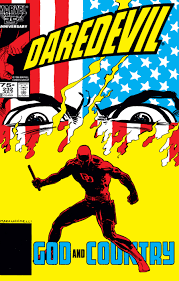 DAREDEVIL #232-233 (July & August 1986)
“God and Country” / “Armageddon”
Writer: Frank Miller
Artist: David Mazzuchelli
Colourist: Max Scheele
Letterer: Joe Rosen
Editor: Ralph Macchio
We’ve skipped a few more issues here, including the tail end of Denny O’Neil’s run. The villain in issue #225 is the Vulture, on loan from Amazing Spider-Man. Issue #226, O’Neil’s final issue, is a Gladiator story. And that brings us to issues #227-233: a seven-issue return for Frank Miller as writer, and the end of David Mazzuchelli’s run as artist. This is “Born Again”, one of the best known stories in Daredevil‘s history. The main villain is the Kingpin, and we’ve covered him before. But he brings in a hired gun for the final two issues, and Nuke is absolutely within our remit.
Before we get to Nuke, though, we need to take a look at what’s already happened. In part, that’s because “Born Again” is important – not just in the sense that it’s an acknowledged classic, but because it makes sweeping changes to the character and to the book’s status quo that will be important going forward. But we also need to look at it simply to figure out what Nuke is doing in this story at all.
The basic idea of “Born Again” is very simple. Although it’s only seven issues long, the story covers an unusually long time frame. By modern standards it’s extremely compressed, but it’s for the best, since the plot calls for long stretches of Matt doing very little and being wholly ineffective – told at a modern pace, it would be glacially depressing.
The story brings back Karen Page, Matt’s Silver Age love interest who left to become an actress. She hasn’t been a regular character since issue #86. Her career has collapsed, and she’s now making porn and addicted to heroin. When she trades Daredevil’s secret identity for drugs, the information makes its way to the Kingpin, who sets about destroying Matt’s life. Matt and Foggy’s law firm had already collapsed by this point. Now the IRS freeze his bank account, the bank repossess his house, he’s falsely accused of bribing a witness, Glorianna dumps him (we won’t be needing her any more), and he loses his licence to practice law. The plan is meant to end up with Matt going to jail, but Foggy manages to stop that. So the Kingpin blows up Matt’s house instead.
Matt winds up homeless and has a nervous breakdown. He fights the Kingpin and loses. Kingpin tries to have him drowned, but Matt escapes, and he’s nursed back to health by nuns who improbably include his long-missing mother Maggie. This is the turning point. Later writers have tended to lose sight of this, but Matt wasn’t noticeably religious up to this point. He finds religion as an adult when at rock bottom and it becomes a much bigger part of his character from this point onwards. Hence “Born Again”.
Meanwhile, the Kingpin is trying to kill everyone else who might have learned Daredevil’s identity along the way, which includes Karen herself. She returns to New York hoping that Matt will protect her. In part four, an out-of-costume Matt rescues her from a Daredevil impostor working for the Kingpin – his first actual win of the storyline. He forgives her and, by the start of issue #5, the two are reunited and starting to rebuild, with Matt working as a diner chef. Infuriated, the Kingpin becomes obsessed with finishing the job, and this is where he brings in Nuke.
Nuke is a bare-chested blond soldier with bullets draped over his shoulders, a massive gun, and an American flag apparently tattooed on his face. The flag is done purely in colouring; there are no lines, at least in the finished art. He takes red pills before going into action – he also has white and blue ones, which seem to keep him under control. We first see him in Nicaragua, on a mission to blow up some military installation. But despite his handler gently reminding him that he’s in Nicaragua, Nuke is utterly convinced that he’s in Vietnam, attacking a POW camp to liberate “our boys”. In other words, he thinks he’s in Rambo, which came out the previous year.
He’s an American government super-soldier, ostensibly in the tradition of Captain America, but the Kingpin has obtained his services by blackmailing a general. The Kingpin briefs Nuke in an office bedecked with American flags. It’s the usual right-wing stuff about true patriots being under siege, with some nonsense thrown in about how the poor Kingpin has simply been forced to break the law just in order to keep the American dream of free enterprise alive in the face of “endless, corrosive legislation”. Nuke listens to all this attentively – well, as attentively as he can, given that the can barely contain himself at the mention of “our boys” – and seems to be clearly on board with this paranoid worldview of liberals.
Nuke dutifully attacks Hell’s Kitchen with ordnance, prompting Matt to finally return to action as Daredevil. The ensuing fight causes so much chaos that even the Kingpin won’t be able to cover up. Daredevil manages to beat Nuke, only for the Avengers to turn up and take him into federal custody – presumably at the behest of the corrupt general who supplied Nuke’s services in the first place. But Daredevil doesn’t find Nuke all that interesting, and turns his attentions back to the Kingpin. Instead, it’s Captain America who investigates Nuke. He learns that Nuke is Frank Simpson, and that he is indeed the final survivor of a botched attempt to create new super-soldiers.
Unfortunately for the military, now that he’s been released onto American streets, Nuke has become convinced that he needs to fight the vaguely-defined enemy at home. So he breaks out of custody in order to return to his mission. Captain America defeats him, and Daredevil winds up taking him to the Daily Bugle as evidence. The strong indication in Miller’s story is that Nuke is mortally injured – he consciously chooses not to take Nuke to hospital, on the grounds that there’s “one purpose he can still serve”.
In the context of “Born Again”, Nuke is an odd character. The rest of the story is a psychological melodrama which tears down the book’s status quo and leaves a clean slate for the next writer to rebuild. In trying to destroy Matt, the Kingpin ends up simply freeing him from the shackles of his dual identity, and giving him the impetus he needed to start a new life, truer to himself. Matt could have had a rematch with the Kingpin for the final act, but that had been done before, and so it makes some sense to bring in a proxy in order to raise the stakes. But the proxy in question is an intentionally broad Rambo parody who isn’t even sure what continent he’s in. What’s he doing here, in this story?
Well… it’s a story about the fragility of the system in which Matt has placed its faith, with the whole thing collapsing in the face of corruption. Even though only one senior military officer actually seems to be outright compromised by the Kingpin, everyone else is willing to go along with his orders anyway. And in a story about the emptiness of the structures that Matt’s life relied upon, Nuke, a literal embodiment of government force, is the final distillation of that. He’s barely a functioning character at all; instead, he’s an intentionally empty symbol, driven completely mad by the same blind faith in the system that had trapped Matt.
Captain America, of course, is here to represent a more decent side of patriotism. But he also lacks the blind faith in the institutions that claim to embody that patriotism; he has no hesitation about distrusting the army and pressing his investigation. More to the point, he finds Nuke offensive. Perhaps the key scene here comes when Cap tries to ask Daredevil about Nuke. Daredevil clearly doesn’t think Nuke is a very interesting topic of conversation, and asks why Cap cares about him. Cap answers that “He wears the flag”, to which Matt replies “I hadn’t noticed.”
For Matt, of course, this is literally true – he can’t perceive colour, so he has no idea that Nuke has a flag tattooed on his face. He just registers a cartoon soldier. But Cap doesn’t know that, and he takes it as a statement that the flag no longer means anything to Matt. Perhaps he’s right there too. The flag means an awful lot to Nuke, of course, but the wrong things.
In some ways, Nuke is almost sympathetic. He’s paranoid and insane, but he’s sincere. He’s not out for himself. He really, honestly believes he’s defending his country. He just believed too much that the system represented the greater good, and this is what it did to him. His patriotism has been exploited by cynics – not just the Kingpin, but the Pentagon. But at the same time, they overestimate their ability to control his deranged nationalistic fervour, and he winds up contributing to the Kingpin’s downfall without realising it. If he was smart enough to understand the plot, he might even approve.
Nuke doesn’t appear in Daredevil again. Miller strongly implied that he was dead, and while that’s hardly conclusive in superhero comics, you can see why it would put people off bringing him back. He finally showed up alive and well in Wolverine: Origins in 2006, in a story that actually had a use for a damaged super-soldier. Since then, he’s wandered around the Marvel Universe and even had a stint in the Thunderbolts.
But Miller’s Nuke was relentlessly one note by design. In theory you could develop him beyond that, but in the context of Daredevil, it would miss the point. Not only would the resulting character would be a more natural fit for Captain America or Wolverine, both of whom have rather stronger feelings about Nuke’s symbolism or his back story, but the “reborn” Daredevil just doesn’t find Nuke very interesting. He represents the forces that Daredevil is moving past, and the book doesn’t have any use for a second Nuke story.

@Moo: No offense intended. I just like New Brunswick and wish I could move there.
@Taibak – Oh, really? I take it you’ve been there then. Never been to the Maritimes myself. In fact, I’m a little bit embarrassed by the fact that Mark has seen more of Canada than I have. He’s been to nine provinces. I’ve only been to four. I’ve visited countries across five different continents, but I haven’t seen all that much of my own homeland.
If I didn’t live on the east coast and went to school in the Midwest, I easily could have been to more provinces than states. Plenty of historical places within an hour (Colonial/Rev War and Civil War sitesI’ve not been to in 50+ years of living here.
Also, I likely have junior hockey sweaters from some of those provinces I’ve not been to in Canada, like the awesome Brandon Wheat Kings jersey.
After “extensive” research, I have discovered several Alpha Flight affiliated characters from previously unclaimed provinces/territories.
Manitoba: Flashback. First appearance: Alpha Flight #1, 13 total appearances.
Nova Scotia: Feedback. First appearance: Alpha Flight #118, 12 total appearances.
Northwest Territories: Diamond Lil (Snowbird is from Nunavut). First appearance: Alpha Flight #1, 67 total appearances.
Yukon Jack is maybe from Yukon.
PEI and New Brunswick apparently have no Marvel characters of any kind associated with them. To any writers, I suggest naming any character from those provinces Fallback, Flyback, Fightback, Fullback, or similar so that at some point in the future they can end up on a team with Flashback and Feedback and someone can make a Roughriders joke.
Damn, Mark. You’re more Canadian than I am.
@Moo: I have, actually. I did a road trip through the Maritimes a few years ago and absolutely fell in love with Saint John.
And I’ve got you beat too: I’m up to five provinces. Granted one of those was PEI, but still….
St. John was cool. IiRC, the big hotel was a Fairmont then, which is mostly where I stayed in Canada (Banff, Quebec,…).
Speaking of Flashback, have any of his future selves shown up anywhere randomly in the last few years?
“And I’ve got you beat too: I’m up to five provinces.”
$%@#!!!
“Speaking of Flashback, have any of his future selves shown up anywhere randomly in the last few years?”
Don’t think so. I believe he was last seen towards the end of Scott Lobdell’s Alpha Flight (volume 3). I assume this was because Bill Jemas had just departed from Marvel and his “No flashbacks. No exceptions.” policy got thrown out.
Wait! Taibak, we’re tied. I’ve been to five provinces, not four. I wasn’t counting Quebec. I was returning home from an overseas trip many years ago and had to change flights in Montreal. At the time, Montreal had two airports and I had to take a shuttle bus from one airport to the other to reach my connecting flight.
So, yeah, I was in Quebec for like an hour or two, but I set foot on Quebec soil (well, pavement), so I believe that counts.
I’m not sure I’d count that. I mean, I’ve changed planes at Heathrow but that doesn’t mean I’ve been to London.
And my grandparents used to live in Vermont about an hour south of Montreal so I used to go up there a lot. I’ve also been to Quebec City and Trois-Rivières.
Fair, since parts of Quebec dont want to be Canada either. Including Northstar IIRC.
@Taibak – I wouldn’t count a stop-over in any one airport as a visit either, but like I said, I didn’t just change flights, I had to change airports too. I took a bus through Montreal.
Please give it to me. Being Canadian is all I have. I can’t suck at this too.
Well, it looks like I’ve been out-Canadianed by two Americans. Talk about embarrassing.
I suppose it’s possible you might even identify as Canadians. If you do, it’s fine. I have no problem with transnationals. It’s your life. You do you.
Currently wearing a 2010 Olympics Team Canada hoodie I bought at The Bay. However, I am not eating poutine or drinking Tim Horton’s coffee.
@Moo: Then a five province tie it is!
And I don’t identify as Canadian, but I just found out that I’m apparently eligible for Canadian citizenship now so I’m pretty psyched about that. I still won’t cheer for the Habs and even Timmy’s won’t get me to drink coffee, but good news is good news.
I’ve been to all ten provinces and all three territories, for a minimum of a week apiece, and lived in ON, QC, BC and NS full-time.
“even Timmy’s won’t get me to drink coffee”
Red flag.
I wouldn’t put that on your application form, or mention it to anyone when you’re up here. In fact, if anyone ever offers you a Timmy’s, I suggest you politely accept and just suck it up and drink it.
@Allan M – Oh, sure. Kick me while I’m down. That’s nice.
I’ll gladly go to Timmy’s for the cocoa and donuts.
Yeah, good luck with that.
Happy 30th anniversary today to the Toonie, which they apparaently wanted to named the Naruq (a native word for Polar Bear).
I have only been to 4 provinces.
Say, are loonies still currency? It has been a while. Fond memories. My aunt grew up in Ottawa, and her brother is a priest in Vancouver, but I have only been a visitor. The two weeks camping along the St. Laurence seaway was my favorite. Pierce Rock was cold enough that I put my feet into a campfire, and didn’t get burned. Good times.
Oh, PEI is a separate provice. So only a few hours, but technically 5.
As a born-and-bred life-long New Brunswicker, I’m disappointed I missed all these comments when they were happening!