Daredevil Villains #78: Wheeler
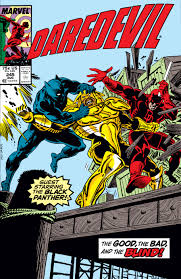 DAREDEVIL #245 (August 1987)
“Burn!”
Writer: Ann Nocenti
Penciller: Chuck Patton
Inker: Tony DeZuniga
Letterer: Joe Rosen
Colourists: Christie Scheele & George Roussos
Editor: Ralph Macchio
(Note: I’ve skipped a story and posted this out of order by mistake; we’ll come back to #77 next time.)
The 1980s was not a great time to be a Black Panther fan.
His last solo series ended in 1980. He made a few other appearances later that year (including the Marvel Team-Up back-up strip that would later be used to justify pairing him up with Storm), but in 1981, he didn’t appear at all. He made a single appearance in 1982, and that was in Marvel Graphic Novel #1, which had everyone in it. In 1983, he didn’t appear at all. In 1984, he was in the Assistant Editors Month issue of Avengers and had a back-up strip in the Marvel Team-Up Annual. In 1985, he didn’t appear at all. In 1986, he was in West Coast Avengers Annual #1. And in 1987 he was in this issue of Daredevil.
Things picked up for him in 1988, when he got a four-issue miniseries. But as of Daredevil #245, his Marvel Knights series was still over a decade away, and the shift towards a more Afrocentric interpretation was further away still.
Aside from the Panther, though, the focus of this story is Wheeler, a Hell’s Kitchen resident heavily in debt through his gambling habit. At one point, he worked for the government of Wakanda as one of a group of guys in flying suits of armour, who were heroes of some sort. Wheeler isn’t Wakandan himself. “What a rich little African empire that was,” he muses. “I sure got paid well to protect that place.” There’s no explanation of how he ended up there, but in 1987, Wakanda was still the sort of place that would bring in some American mercenaries to prop up the military.
Wheeler was so good at his job that he got to marry the king’s cousin M’Koni, or “Mary”. Somewhere along the line he lost interest in heroism, and he and Mary moved to New York. They have a son called Billy, but Wheeler’s gambling habit stops him providing for the kid properly. And Mary is now locking herself in her room in protest at his behaviour. Wheeler still has his armour, though it’s seen better days. No explanation is given for why he was allowed to keep it – it’s played as if the Wakandans just let you keep the toys when you resign. Perhaps Wakanda is full of retired pilots with a fighter jet in their garage.
Come to think of it, you might also query the whole bit about a Wakandan royal winding up in Hell’s Kitchen, for that matter. But then again, T’Challa himself has a history of improbable stints posing as a New Yorker, so maybe this is just the sort of thing Wakandan royals do. Particularly if they’re marrying an American commoner.
The Black Panther is in town on business, so Billy lets him know about the family problems. The Panther duly shows up to lecture Wheeler about his failings, and threatens to take Mary back to Wakanda if she’s unhappy. The Panther doesn’t particularly care about Wheeler’s personal problems, but strongly hints that if he can’t get himself in order, he should do the honourable thing and abandon his family rather than dragging them down with him.
So Wheeler decides to sort out his financial problems. He puts on the suit and robs a bank. Daredevil steps in to stop him, to the Panther’s tremendous disappointment – for some reason, the Panther seems to think that Wheeler is doing something honourable and should be allowed to get on with it. Nonetheless, the Panther helps to subdue Wheeler, and then reveals that he’s paid off Wheeler’s gambling debts so that he can start a new life. When Wheeler points out that gambling addiction doesn’t really work that way, the Panther tells him to “go” and not see his family ever again. Wheeler interprets this as advice that he should kill himself, and the Panther doesn’t seem to have any particular difficulty with that.
All this leads to a fight between Daredevil and the Black Panther, as they debate whether Wheeler is doing the honourable thing. Meanwhile, Wheeler winds up being shot by the police. Apparently the armour can’t be that great, because a few conventional bullets cause it to start burning up. To be fair, he hasn’t been taking good care of it, but even so, it’s meant to a suit of hi-tech armour. Maybe the Wakandans let him keep it because it was cheaper than taking it to the dump. Anyway, Daredevil saves Wheeler from the burning armour, and the Panther reluctantly joins in at the last minute, musing that Daredevil has more faith in Wheeler’s ability to change than he does. The story ends with Wheeler starting to turn his life around with his family and being accepted back by his wife (who we never actually see).
It’s an odd issue, especially with hindsight, because it really doesn’t fit with the modern take on the Black Panther. But there are other issues. The whole idea that a former American mercenary working for the Wakandans has been allowed to take a minor royal and a suit of battle armour back to his apartment in Hell’s Kitchen is odd. And the moral debate that anchors the story is one-sided – it requires us to take “you should kill yourself in shame at your failure to provide for your family” seriously as a reasonable, honour-based cultural diference. To be fair, it’s the sort of arbitrary honour-compulsion story that you used to get about Japan in the 1980s, and at least here it’s anchored to a more recognisable shame and humiliation in Wheeler’s failure to provide for his family. But it doesn’t really work.
Wheeler just about scrapes his way into qualifying as a villain, since he does rob a bank, he does fight Daredevil over it, and he does have some superhero trappings. Those have been largely absent from Nocenti’s run up till now, but that will start to change from this point. In that respect, he’s a minor turning point for the book. But he was clearly never intended as a recurring villain.
If anything, he seems like a viable supporting character for this book, at least in its Hell’s Kitchen iteration. He’s a resident of a neighbourhood that isn’t that large and he has some back story as a hero of sorts. He’s got a redemption arc. The suit of armour, which is incongruous for a Hell’s Kitchen setting , has been taken off the board by the end. It would make sense for him to show up in future crises because he’s literally in the area.
That won’t happen, though. Wheeler makes a single further appearance: in Black Panther #31 (2001), he’s one of the Panther’s minor New York acquaintances who get murdered by Malice. More could have been done with him, but perhaps Wheeler’s problem in the context of Daredevil is that he’s not a Daredevil character – fundamentally, he’s a Black Panther character, and there wasn’t much demand for those in 1987.

Obviously Wakanda letting an American merc keep their (allegedly) high-tech weapons is weird, but royals do on occasion find their way to residency in the US…
I think this story can also be read in the context of Nocenti’s treatment of another set of Marvel royals, the Inhumans a year later, a story that will also wind up in her Daredevil series. She writes such societies as bound by oppressive, destructive codes of honor that emerge from unaccountable figures of high rank. And in both cases, the destruction of a family is treated as socially “honorable” in a way that’s mean to be morally indefensible.
The difference is that Nocenti has some of the Inhuman royals quietly rebel against the Genetics Council in the Inhumans graphic novel and its follow-up in Daredevil, while here the Black Panther has to represent the oppressive social logic because a) it’s not his book and b) he’s a monarch. Yes, Wakanda has a tribal council, but T’Challa’s the head of state and can overrule them.
The black Panther’s other problem was that the truncation of Don McGregor’s “Panther vs. the Klan” story, Kirby ignoring it for his own deeply unfashionable take on the character (by late 1970s standards), and then the messy wrap-up of McGregor’s plots by another writer left the character as a bad case of damaged goods.
McGregor has claimed that Marvel editorial didn’t like his own use of an all-Black cast and a focus on his idea of Sub-Saharan Africa and Black America, and he’s framed the Klan storyline as his scathing response to editorial demands to add white characters. But sales surely played a role as well, as did McGregor’s own wordy, increasingly slow-paced storytelling. (And I appreciate the hypocrisy in my calling anyone else’s writing “wordy.”)
We have come to a string of poor Nocenti-penned issues of DD. #243-245 would mark Nocenti’s weakest stories on the book, with her seemingly unsure what direction to go with DD. Thankfully, things would soon turn around by #248, and Nocenti’s run would continue to grow stronger. I remember having to check the writing credits for this string of three issues to make sure the title was being written by Nocenti, as they read like fill-in issues by a different writer. Followed by an actual fill-in story.
Paul, why didn’t you review issues 243-244? The Nameless One, one of the villains in that story, appears again in issue 310 and Mambo, another villain in the story, is eventually revealed to be Calypso’s sister.
I don’t blame him for deciding to skip those two issues. Probably getting tired of dealing with voodoo stories in DD. I was wondering why he didn’t even mention that he was skipping two issues in his introductory paragraph, as per usual.
Black Panther also had McGregor and Colan’s long (25 parts) “Panther’s Quest” serial in Marvel Comics Presents in 1989.
Michael/Chris: This is numbered #78 and the previous entry (Caviar Killer) is numbered #76, so I think there might be a “lost” entry about those issues that didn’t get posted for some reason.
You are in fact correct there – we’ll come back to cover the Nameless One next time.
“He made a few other appearances later that year (including the Marvel Team-Up back-up strip that would later be used to justify pairing him up with Storm), but in 1981, he didn’t appear at all. He made a single appearance in 1982, and that was in Marvel Graphic Novel #1, which had everyone in it.”
That’s not completely true. He appeared in Avengers 211, cover dated September 1981, Fantasic Four 241, cover dated April 1982, and Iron Man Annual 5, cover dated December 1982. (He also appeared in Contest of Champions, but that was written in 1979, but got delayed and rewritten.)
It should be noted that the Black Panther’s limited series was supposed to come out in 1984. It featured a thinly veiled substitute for South Africa, Azania, as the villain. According to Denys Cowan, who drew it, Shooter vetoed it because criticizing apartheid in 1984 was too controversial. Then later in 1988 DeFalco approved it. This might have complicated attempts to have the Panther appear between 1984 and 1988.
(This was a pattern with limited series. The Nick Fury vs. SHIELD and Spellbound series were both announced during Shooter’s tenure, delayed for years and released early in DeFalco’s tenure. )
It should be noted that a lot of characters whose series had failed were written out in the late 70s and 80s. The purpose of Avengers 200 was always to write out Carol Danvers, although the means changed from the Supreme Intelligence to Marcus. Nova was depowered after his series failed. Jessica Drew was originally erased from existence after her series failed, then after the fans complained was merely depowered. Johnny Blaze was freed from Zarathos and reunited with Roxanne Simpson, which was a happy ending for him. Dracula was killed off and Hannibal King was cured of being a vampire after Tomb of Dracula failed. Mar-Vell famously died of cancer after his series was cancelled. All of the New Defenders except Hank, Bobby and Warren were killed off after their series was cancelled. Iron Fist was killed off when Power Man and iron Fist was cancelled.
T’Challa was able to avoid this fate since he’s a Lee and Kirby character. But his book getting cancelled still might have made writers reluctant to use him.
And yeah, Jungle Action and Black Panther were probably both always low-selling, since they were bimonthly.
It is odd, though. Between Avengers 52 and 181, T’Challa was a frequent member of the Avengers. But after issue 181, he only appeared as a guest star until Geoff Johns’s run. (The exception was a 6-issue storyline in John Byrne’s run.) Then after Johns’s run he was written out again until Hickman’s New Avengers. It’s odd that T’Challa went from a core member of the Avengers to basically a guest star.
@Omar- Marvel itself had no problem making fun of MacGregor’s wordy style- during an issue of Steve Englehart’s run, Thor asks the Panther if he’s going to rejoin the Avengers and T’Challa gives a hilariously long response that Thor translates as “Nay”.
And yes, MacGregor’s writing was incredibly slow-paced. The Panther’s Quest story, which Matthew Murray mentioned, is probably the worst paced story Marvel ever published. Notably, T’Challa figures out who the villain is by realizing he missed a clue several chapters earlier.
MacGregor also had T’Challa, who allegedly is one of the most agile Avengers, get injured a lot. Oftentimes he failed to dodge ordinary human mercenaries.
@Omar- I think the difference is that the Inhumans have been shown to be destructive in the name of tradition before Nocenti wrote them. They kept the Alpha Primitives as slaves, almost let Quicksilver expose Luna to the Terrigen Mists even though Crystal was afraid of side effects, etc.
T’Challa, on the other hand, is usually written as trying to make tradition and the modern world work together. So his deciding Wheeler has to kill himself comes out of left field.
“Apparently the armour can’t be that great, because a few conventional bullets cause it to start burning up.”
For what it’s worth, T’Challa mentions that the armor is weakest at the joints. I think the idea is the bullets hit the joints.
Don’t forget Steve Gerber poking fun at McGregor’s verbose writing style in Howard the Duck #2.
It’s funny that Shooter felt criticizing apartheid in 1984 was too controversial, when Marvel had allowed Roy Thomas to write his feelings about the subject in Fantastic Four #119 during 1972.
Even when the Gillis Black Panther mini was published, Marvel still seemed to be trying to not step on any toes as the plot mostly took a “both sides” stance, with the Azanian government even being shown to be more misunderstood than villainous, having the hardliners in the government say that they were “only opposed to Communism” and agreeing to negotiate with the opposition after realizing the error of their ways. McGregor’s “Panther’s Quest”, for all its many faults, showed more teeth in its criticism of apartheid in South Africa.
Azania is a problematic name to use for the fictional white minority ruled country in 1988. It was used by that time as the name for a hypothetical post-conquest South Africa. There was an Azanian People’s Liberation Army, which makes the decision for the fictional apartheid South Africa being “Azania” confused and kind of tone deaf.
@Adam royals do on occasion find their way to residency in the US…
Sure, but do they end up in an apartment somewhere like pre-gentrification Hell’s Kitchen?
@Chris V- It’s worth noting that in Emperor Doom, which Shooter was involved in, there are scenes where apartheid being abolished was presented as a positive consequence of Doom’s reign and apartheid being restored was presented as a negative consequence of Doom being defeated.
I think it was fairly clear that the Azanian government was villainous- we’re shown how miserable the natives lived in Azania.
@Chris V- According to this website, it was orginally supposed to be South Africa, the editors complained, so Gillis changed it to Azania:
https://reactormag.com/how-peter-gillis-what-if-captain-america-were-not-revived-until-today-speaks-to-us-in-2024/
I’ll admit, I totally forgot we were in Nocenti’s run, and momentarily confused Wheeler for the Big Wheel, which would have been a very different entry.
@Daibhid C:
Well, they can’t all get Netflix deals.
But seriously: The only example I can think of is Yi Seok, the grandson of Korea’s final king, who actually did end up in L.A. for a long time working low-wage jobs, such as staffing a liquor store. After a life of poverty he got a happy ending in his old age, when one of South Korea’s municipal governments essentially offered to make him a well-paid tourist attraction.
@Adam- As I understand it, Yi Seok’s problem was that South Korea decided they didn’t want a king any more and cut off the stipend for the former royals. It’s a lot more difficult to explain how that could happen with a country that STILL has a king.
The more I think about it, the less sense Azania originally being written as South Africa makes. For starters, Wakanda is usually depicted as being in central Africa. South Africa is (obviously) in southern Africa. Yet the limited series depicted Wakanda and “Azania” as neighbors.
There’s also the problem that “Azania” seems to be starting to change at the end of the miniseries, but the Marvel Universe is supposed to be the world outside your window.
Plus, the. message of the series seems to be that launching a revolt when there’s no chance of success only creates more suffering. If this was meant to refer to South Africa, then the series would have probably offended just about everyone on all sides.
If Azania was originally South Africa, I can see why editorial might have had problems with the series.
This feature is helping me in getting a feel for Nocenti’s writing’s traits.
Here we see what is quickly becoming her main trait: stories where we don’t even know if the hero’s actions were of any help. I wish I had the chance to see her take on the Hard Travelling Heroes from DC back in 1970-1972.
In some respects Wheeler feels like a Bullet prototype, particularly when it comes to his ability to claim that he is doing the best course of action that is actually available for him. It is a bit depressing to see that this sort of powerlessness was already that relatable while the Reagan years (flawed as they were) had not even ended.
@omar has a point
Don McGregor purple prose on the Panther has been parodied by other bullpen penwrights.
But… some issues it’s great. Some titles it’s great. Some it sucks.
His KILLRAVEN series would be crap without it. His PANTHER’S RAGE was good for it. PANTHRR VS THE KLAN was pretentious for it.
Wow, I’ve just used the Project: Reptile post to confirm that Black Panther wasn’t even in cast of characters for the Marvel Comics 25th anniversary frames! I’ve always been weirded out that it has Power Man (but not Iron Fist) and Puck (but not the rest of Alpha Flight), but never noticed that Black Panther was also disincluded. I assumed that would juice his 1986 appearances a little bit, but nope!
Wow, didn’t know the Black Panther’s appearences in the 1980s were so sparse.
@Michael: I mean, my original comment was just a bit of fun more than anything, but I don’t see how it’s difficult to explain Wheeler and M’Koni winding up in NYC at all.
She fell in love with a foreigner and moved away with him. We don’t know what the weird little rules might be in that situation for an African monarchy (and a fictional one, at that), but I think it’s entirely plausible that the Wakanda government could say, “OK, you do you,” and cut her off any stipend. Then her husband gambles their money away and they end up poor.
None of that seems crazy to me. It’s just the armor bit that’s weird.
*winding up in Hell’s Kitchen, not just NYC.
There is also the case of the second wife of the current Thai king who fled to Britain and later to the US with their five children when he was still crown prince…
Did M’Koni/Mary ever appear again (or at all, as she doesn’t really in this issue)?
At the risk of pointing out the obvious parallel, an African tribal princess married an American photojournalist and had a daughter in pre-gentrification Harlem. While it didn’t turn out well for the parent Monroes, the daughter turned out pretty well, getting to ride hippos later in life.
Is it possible that Ann Nocenti was making some kind of metatextual comment on Storm’s rarely mentioned parents?
@Ben- Iron Fist wasn’t included because he was dead at the time.
Black Panther wasn’t included because he wasn’t regularly appearing in a current or recently concluded series. Similarly, Professor X wasn’t included because was written out of Uncanny X-Men with issue 201. And Sam Wilson also didn’t appear.
In fact, a lot of characters weren’t included on the 25th Anniversary borders because of limited space. The New Mutants, Cloak and Dagger and Power Pack weren’t included even though they all had series at the time. As for the Avengers, Cap, Wasp, Namor and Monica Rambeau were chosen to represent the East Coast Avengers and Iron Man and Hawkeye were chosen to represent the West Coast Avengers. That meant that Hercules and Black Knight (on the East Coast Avengers) and Wonder Man, Mockingbird and Tigra (on the West Coast Avengers) were left off the borders. (Thor had his own series, of course, and Vision and the Scarlet Witch had their recently concluded maxi-series, so they were all included.)
@Claus- Mary appeared in the Black Panther story that Paul mentioned where her husband was killed by the Panther’s enemy Malice, who is not to be confused with the Malice who was a servant of Sinister or the Malice that fought Johnny Blaze once or the Malice that is Sue Richards’ dominatrix alter ego.
Someone write a story about all the Malices meeting up!
There were TWO Malices that fought Black Panther. And there was a computer virus version of the X-Men’s Malice as well. At a stretch you could say that the Fantastic four Malice was two people, in the same way that X-Man and Cable are two people. But with so many other Malices, why stretch?
Interestingly, all but one of the Malices are women. It’s not what I’d call a recognisably feminine trait. But I suppose it rhymes with Alice.
How about a story in which someone kidnaps all the Mailces? They could call it “Absence of Malice.”
Or where all they all united and take over the world?
Age of Malice leads into One World Under Malice which leads into the finale The Fall of the Malices.
And, of course, the prologue in which they make their plans: Malice Aforethought.
Not just all the Malices! To paraphrase the Appendix to the Handbook of the Marvel Universe…
Wheeler; not to be confused with:
— Bobby Wheeler from TAXI, as played by Jeff Conaway from seasons 1-4 (1978-1981)
— The Wheelers, from 1985’s nightmare fuel movie, “RETURN TO OZ.” Marvel once had the license to Oz stuff, and even recently! Scottie Young then filed off the serial number and launched I HATE FAIRYLAND over at Image.
— Wheeler, from Captain Planet & The Planeteers/The New Adventures Of Captain Planet (1990-1996), as voiced by Joey Dedio. Marvel also once had the license to this!
— Zack Wheeler, an MLB pitcher who plays for the Phillies and (historically) the NY Mets
— Wheeler a town in Steuben County, New York, USA
— Wheeler, a company which sells gunsmithing tools and rifle accessories out of Columbia, Missouri.
That’s a lot of Wheelers!
License them all and have them form a team opposing the Malices: the Wheeler-Dealers of Death!
It could be Marvel’s answer to the Mortal Kombat characters showing up in D.C. KO.
My best guess for Nocenti’s rationale regarding Wheeler’s family’s situation and Black Panther’s reactions to it is that she took advantage of what was at the time little explored – the societal customs and expectations of Wakanda, which is after all an ancient and very foreign community – to meddle with a set of unfamiliar but arguably overall coherent boundaries.
At the end of the day, every community has to offer _some_ sort of answer to the unavoidable dilemmas that come with the risks of adult responsibility, family duties and the need for financial stability.
We can’t realistically expect the well-off to be on watch to rescue their relatives at any sign of hardship, but neither can we truly be at peace with complete disregard for the plight of those who face certain levels of uncertainty and poverty. So some sort of rules of communication and expectations ends up being built, even if entirely unwritten and to some (perhaps huge) extent contradictory.
For the purposes of this story, Wakanda’s Royal Family is implicitly written to highly value individual responsibility, perhaps higher than the taboo against suicide. Daredevil, of course, has little awareness and less attachment to those specific cultural expectations and therefore has a hard time dealing with their harsher implications. Meanwhile Tchalla is uncertain, apparently mostly because he is all too aware of how different cultural expectations are in Wakanda and in the USA, and he can’t in good faith ignore that M’Koni is the one person involved who has a fair shot at knowing those expectations and even she chose to leave Wakanda behind and adopt the USA as its new home, so it is very hard to gauge how adapted the family is to Wakanda traditions at this point. We are specifically shown that Tchalla does not pry into the situation until provoked by Wheeler’s son. By that point he is between a rock and a hard place: should he subject Wheeler to severe humiliation when he is already shamed and vulnerable, or should he instead put his wife and son under the dangers that come with his bad judgement and precarious situation? There are no good or safe options going forward, just a choice between different natures of danger and grief.
Very, very Nocenti-like IMO.
The fifth in line to our own throne is in exile in the US trying to make it as a content creator which is worse then a mercenary
Is there still an actual throne? Like all gilded and bejeweled and draped in purple velvet? Does it get any use?
It must feel pretty ludicrous to sit in a chair like that. How do the Windsors take themselves so seriously?
“Here we see what is quickly becoming her main trait: stories where we don’t even know if the hero’s actions were of any help.”
My memory from the time (actually in a few more issues ahead of Pauls reviews here.) was that the strongest single theme was “no good deed goes unpunished, do good anyway.” The punishment being indirect consequences falling upon innocents. ‘Stop a mugger, and his child goes hungry’ type of thing.
[…] (Note: I skipped this post by mistake last time, so it’s appearing out of sequence. For #78, see here.) […]
@oldie
There is. It’s in the House of Lords, and gets used about once a year for the Queen/King’s Speech, including a gilded carriage to bring the monarch & consort there.