Uncanny X-Men #29 annotations
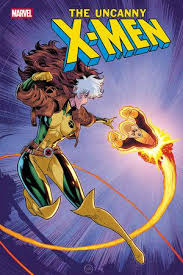 UNCANNY X-MEN vol 6 #29
“Who’s Been Sleeping in My Bed, part four: A Prison and a Pyre”
Writer: Gail Simone
Artist: Luciano Vecchio
Colour artist: Mattherw Wilson
Letterer: Clayton Cowles
Editor: Tom Brevoort
THE X-MEN:
Rogue. She seems remarkably unfazed to learn that Gambit has grown dragon wings, and even continues to accept his (correct) assurances that the “Cannonball” she’s fighting is a fake and can safely be killed. Nonetheless, once the crisis is over, her top priority is to focus on helping him, and she plans to take a leave of absence from the team to get help for him.
Her plan for dealing with Greymalkin was to send in M undercover as a prisoner to gather evidence, which would be more effective at bringing down the operation in the long run than simply smashing up the building. Quicksilver has been acting as a courier to relay M’s messages. That goes some way to explaining how M was in better health than she ought to have been given the prison food, though it’s not really made clear how Quicksilver was getting in and out.
Rogue sees herself and M as “bonded” by their shared high power levels, even though they don’t know each other well “aside from that bit with the Avengers” – referencing the Uncanny Avengers miniseries from “Fall of X”. She asks M and Quicksilver to lead the Louisiana X-Men in her absence.
M. Presumably she accepts Rogue’s offer, so we’ll treat her as a team member.
Her full name, Monet Yvette Clarisse Maria Therese St Croix, has been given before (in X-Men vol 4 #18).
She seems absolutely confident that she can take Perimeter in a fight. She’s presented as substantially more powerful than Rogue here, to the point of being able to take on Sarah Gaunt without any of the difficulty that Rogue had in the opening arc. (Admittedly, Sarah has been in Graymalkin for much of the intervening period so she may not be on top form.)
Quicksilver. He shows up to help his partner M at the prison. M refers to him as “my love”, which he says is the first time.
Nightcrawler, Jubilee, Wolverine and Gambit deal with the fake “New Mutants” and then teleport to the prison to finish off Perimeter.
SUPPORTING CAST:
The Outliers (Ransom, Jitter, Calico and Deathdream) and Mutina. According to Ransom, once everyone realises that they’re in a simulation, they break the spell and appear back at Haven House, still wearing their New Mutants costumes. It’s possible that Perimeter stretching himself too thinly has something to do with it as well.
Calico is annoyed that Jitter never mentioned her epilepsy (which we found out about last issue).
Marcus St Juniors is at Haven House, but doesn’t get much to do.
Siryn. Like all the prisoners, she starts the issue under Perimeter’s mental control. He sends her to kill Banshee when he shows up at the prison, presumably out of sadism rather than coincidence. Once Banshee appears, however, she and Blob both seem to be freed from Perimeter’s influence. It’s understandable that Siryn gets freed by the emotional shock of seeing her father, but Blob has no such investment, so perhaps Perimeter is just distracted.
Banshee. His Irish dialogue reads (I think): “I was ambushed (?). I’m sorry. Come now, my dear. Your dad is here. I’m here.”
He says that he didn’t come to break Siryn out earlier, because “after the Vigil, I didn’t think you’d want me to.” That refers to a scene in Hellfire Vigil where they cross paths and she asks him to leave her alone, presumably under some degree of outside psychic influence.
It’s not entirely clear why he shows up at the prison here. If we assume it’s not just pure coincidence, then perhaps he’s also in on the scheme and he’s been tipped off about the likelihood of things at the prison coming to a head (which, after all, M saw coming several issues ago).
A bunch of other characters also appear as prisoners who get freed from Perimeter’s influence in the course of the issue:
- Fawn, who was captured by Sarah Gaunt in the opening arc.
- Blob and Wild Child, who have been there since issue #6.
- Dazzler, who was publicly abducted at Hellfire Vigil.
- Omega Red, who was captured in Sentinels #1.
- Sebastian Shaw, who was captured in Sentinels #2.
- Johnny Dee, Stacy X and Tommy (from the Morlocks), none of whom have been shown as prisoners before.
VILLAINS:
Perimeter. At some point in the past, he was on medication and was lucid; this was when he and M were friends. He says that during this period, he was thinking of being part of the “mutant community” and a hero. At the same time, though, he says that he used to torture animals until developing empathy for them, but has no empathy for humans (including mutants). He claims to have given up the medication when he learned that Corina had become an anti-mutant campaigner, but acknowledges that that in turn was prompted by him killing their parents. The general suggestion seems to be that in his eyes he tried being “normal”, but ultimately decided to embrace his horrific nature.
He has mental control over the prison population, though it fades when he’s distracted. He has no discernible effect on M, presumably because of her own telepathy. He seems to expect the prisoners to accept him as a “beloved warden”.
His actual motivations remain unclear, and may not extend beyond causing chaos and slaughter. He seems to violently resent any suggestion of being contained. M continues to regard him as basically someone in need of psychiatric help. We’re never given any clear explanation of what he was trying to achieve with the Outliers/New Mutants thing.
His host body (Scurvy’s corpse) is disabled when Wolverine claws him through the head. Apparently this causes him to return to his original body in its vault. The plot here is a bit confusing: Rogue and M both seem to agree that without a host body, his mind control powers ought to be contained for now by the technology in his vault. But… wasn’t the whole point that they needed Scurvy to keep him under control, and that as soon as Scurvy died, Perimeter was free to spread his influence? Why is the vault technology suddenly up to the task now?
At any rate, there is apparently a plan to rehab him, though both Rogue and M are sceptical about it. He seems to remain contained in the prison by the end of the issue.
Corina Ellis. As Perimeter starts to get out of control, she shows uncharacteristic concern for the prisoners, to the point of trying to go back to rescue them. She tells Ezra that she “meant for something good to come at the end of all this”, but doesn’t specify what – presumably, part of her motivation was simply to get her hands on the resources to contain Perimeter.
Banshee destroys her helicopter as she tries to escape, but we’re told that she survives with “some burns and broken bones”. Her status, and that of the prison, are a little vague at the end of the issue; Rogue and M both anticipate that the evidence they’ve gathered will create a scandal that will bring down the prison operation, but at least formally it’s still a prison and still containing Perimeter.
Corina says that “‘The degree of civilisation in a society can be judged by entering its prisons.’ Fyodor Dostoevesky said that. Supposedly.” He didn’t. It originated in 1969 on the masthead of Fortune News, the newsletter of a prisoners’ rights group called the Fortune Society. For some reason, Fortune News misattributed it as a quotation from Dostoevsky’s House of the Dead (1860-1862).
Captain Ezra. Ever dutiful, his priority is to get Ellis to safety – though as events cross the line where she’s no longer the warden in any meaningful sense, he’s increasingly unable to conceal his exasperation at her. Despite apparently believing that it’s a suicide mission, once he’s got Ellis out of the way, he does go back to try and help, though we don’t see him contribute much.
Sarah Gaunt. Still seems to be basically evil whether or not she’s under Perimeter’s control. Either M is much more powerful than Rogue or Sarah is much weaker than she was in the first few issues – M claims it’s the former.
“The New Mutants”. Simply Perimeter’s “AI” duplicates of the team. It’s not entirely clear what being AI means in this context, since they’re apparently creations of Perimeter’s powers; perhaps the idea is that since he’s spreading his attention so thinly, he’s using the Greymalkin prison’s AI system (which is what “Perimeter” originally referred to) to fill in the gaps.

An utter mess of an issue: garbled, incoherent, just poor writing from start to finish. To think I was actually thrilled at the news that Simone would be writing this book, she’s making clumsy mistakes even an inept rookie wouldn’t make
The combination of a rushed resolution to a long-running subplot that doesn’t coherently tie in to the apparent main plot at the start of this arc + switching up the main cast smacks of a deck-clearing exercise, like another reboot or a new creative team is about to drop.
I decided to play a drinking game and take a shot every time this review used any variation of the terms “presumably”, “perhaps”, “possibly”, or “not made clear”.
I’m in the hospital now with liver failure, so thank you, Gail Simone. Keep up the good wo…..well, keep up the work.
So, if medication made Perimeter “normal”, he’s such a threat as-is and the prison has little regard for human (mutant) rights… why weren’t they force-medicating him?
@yrzhe
If DNX is one issue/month, the next line deckchair-shuffling should be in January or so.
I’m cautiously excited in Pietro joining a main X-Men team
OK so Rogue’s plan was to have Monet infiltrate the prison BEFORE X-Manhunt. That’s why Rogue was initially willing to return Xavier to Graymalkin. But did SCOTT know? Because his actions during X-Manhunt were INSANE and they make a lot more sense if Scott knew about the plan to neutralize Ellis.
How did the Outliers figure out it was Inmate X behind the simulation?
I think Simone was trying to say something about mentally ill people on their medication but I’m not sure what. Oscar comes off as an entitled jerk who couldn’t handle that everyone didn’t forgive him when he was acting nice for five minutes.
Omega Red appeared in the Spider-Man/ Wolverine series between Raid on Graymalkin and this issue. He could have escaped and been recaptured or Spider-Man/ Wolverine could take place after this story.
Banshee’s destroying Ellis’s helicopter was supposed to be a Papa Wolf moment but it seemed selfish to me. Monet and Quicksilver were fighting for their llives against the possessed inmates. They could have used his help. Instead he went after Ellis, who was no threat- she was just whining about how her intentions were noble.
I hope that Calico isn’t the only one who is angry at Jitter for hiding her epilepsy. She endangered herself, she endangered her teammates and she endangered civilians. If she’d been honest about it, they could have worked out some way to handle it.
I’m still not sure if Oscar is controlling the Perimeter AI or if he IS the Perimeter AI somehow.
Gambit teleporting Wolverine in to stab Oscar was the most anticlimactic way possible to end Oscar’s story, considering all the buildup about how powerful Oscar was. And this was the second book this week with an anticlimactic ending to an ongoing plot. (The other one being Storm.)
Agreed it makes no sense that the tech in his cell can contain Oscar once Scurvy’s body is destroyed- Oscar trapped the Outliers in the simulation BEFORE Scurvy died.
This entire arc was completely nonsensical. Why did Oscar trap Mutina in the simulation? He never met her and she wasn’t an X-Man.
I don’t know why Simone spent so much time on the Outliers being in the simulation- it had nothing to do with Oscar’s defeat.
It seems like Brevoort and Simone FINALLY realized that the readers hated Graymalkin Prison and how inept it made the X-Men look and decided to get rid of it. Plus Shaw will be appearing in the Hellfire Murder next month.
Why did Rogue choose Monet and Quicksilver to lead the Louisiana X-Men? Why not Wolverine or Nightcrawler, who the Outliers actually know? WE know that Wolverine will be busy with Avengers business starting next week but Rogue doesn’t.know that. I don’t think Monet’s ever acted as a field leader and she doesn’t really have experience mentoring young mutant. Quicksilver I could sort of see since he was the head of the Inhumans’ militia and mentored at-risk young superhumans in Avengers Academy.
Is Quicksilver a mutant again? There have been non-mutant members before, but it would be weird to have one leading the group.
Also, given Monet’s ego and Quicksilver’s impatience, their co-leading a team would seem to be a recipe for disaster.
Otherwise, I agree with Michael that Wolverine or Nightcrawler would have been a better choice since both have experience at leading teams of inexperienced superheroes.
Another problem- in issue 26, Deathdream says while he’s at the Mansion that he can sense that there’s been a death recently. What was the point of that?
@SanityorMadness- Even when he was on the medication, he wasn’t “normal”- he went off the medication out of spite toward his sister even though he knew people would likely suffer and die as a result.
I can buy Rogue asking M and Pietro to lead the team. Wolverine disappears too often, Jubilee’s not ready, and Nightcrawler’s got his situationship to worry about.
But the question sort of makes me wonder why there IS a team. Like, do they have some remit other than raising the Outliers that I don’t remember?
This issue got the Krusty “What the hell was that?” reaction from me.
Having said that, I tend to love this book when it’s Nawlins and atmosphere focused and the Graymalkin plot was kind of a dog, so I guess I’m glad it’s over.
Oscar (now that’s an intimidating villain name) must be a huge fan of Sauron. Hey, I’m with ya, Oscar.
This is some grade-A ‘90s plotting right here. Let’s bring in…the New Mutants? OK, and they’re being led by…let’s say Sauron? Who’s behind the entire thing? I don’t know. We’ll figure it out eventually. Hey, let’s make it a new character! Great job. That’s five issues down and the Greymalkin subplot running from the beginning of the series finished. Does it read coherently? That’s the job of the readers, Marvel doesn’t pay us to bother with the little things.
Quicksilver did manage to vibrate through solid objects in Orlando’s relatively recent Scarlet Witch and Quicksilver, so that could explain how he was getting Monet food. At least he doesn’t have a time-traveling treadmill yet.
I had entirely forgotten that Monet and Quicksilver were a couple. They just don’t really seem to fit together personality wise. Unless it’s their respective superiority complexes.
Gotta agree, we didn’t need -another evil mutant reality warper.
I enjoyed the random mutant cameos even though they didn’t necessarily make sense. Tommy because she has a great visual, Johnny Dee because… reasons? I wish we’d gotten more time to see people within the prison itself, otherwise what was the point of sidelining characters like Dazzler? It feels like plans really did change.
Given how good Simone is, I bet there was editorial interference at play.
I’d very easily believe that editorial suddenly wanted the Graymalkin thing wrapped up, leading to this frankly ridiculous issue.
But the thing is, these “well, I guess that’s what happened” moments have been plaguing this book for months and months, albeit to a lesser extent.
@The Other Michael: Editorial interference might account for the messy pace/structure of the storyline – less so, I think, for Simone’s unfathomable decision to try and evoke the reader’s sympathy for Corina Ellis, the most direct representative of Mutant ICE. The fact that she survives Banshee’s blow – in dialogue, after the fact – is truly baffling.
@Sean Whitmore: I give Paul kudos for trying his absolute best to make sense of nonsense, but you’re right, the language of these annotations makes it clear that storytelling clarity is *not* a feature or priority of the Brevoort regime.
@Si,
Just as the Marvel editorial / the X-office has quietly allowed Grant Morrisson’s OG 2000s plot of “Magneto really being New XMen Xorn (or actually secretly fused with Xorn/Zorn [ala Darwin and Vulcan]) and then controlled by Kick/Sublime” to be canon again as of the 2010’s pre-Krakoa I vs X / X-Men Blue era , so long as nobody spotlights it too much , I suppose they have done the same for Pietro and Wanda indeed being the actual bio-offspring of Max/Magneto and Magda , considering that mostly nobody (except die-hard hard-core Magneto haters) liked or respected Ick Perlnutter-forced worst retcon ever, since even the writers directly the retcon the years such as Rick Remender (Vision discovering a “secret” about the High Evolutonary’s plans for the Twins) and James Robinson (never revealing who their actual bio-daddy is , even when having them talk directly with their deceased bio-mommy in her ghost-form) and Steve Orlando (mysteriously having only Wanda be able to complete the magick circuit with Legion and Proteus , the bio-offspring of the First Age’s 2/3 other founders in order to create The Waiting Room X-gene mutant afterlife pocket dimension) all left too-obvious “outs” that can later be used to organically explain away the said retcon. They even have the Twins be his kids again in the XMen 1997 revival , which is the biggest cartoon success Marvel has had in years aside from the Spiderverse movie franchise.
@Diana
Maybe Sean was holding back from going all the way in killing her (in character for him) or Perimeter somehow saved his sister using his reality-warping powers or Corina’s own latent mutation activated (ironic , but I wouldn’t put it past Gail to do something rather out of left field , considering she’s already done it before repeatedly her entire X-Men run)
@Michael
Maybe Perimeter got burned out by using his powers too much for the first time in a long time so he got weakened enough for the prison technology to now contain him properly. After all , getting fatally wounded by Wolverine’s adamantium claws is what depowered Omega-level Magneto enough in 2001’s Eve of Destruction to make him a crippled invalid in 2001’s E for Extinction
They just kinda blew up Graymalkin Prison out of nowhere here. The Outliers story was completely pointless and irrelevant to the plot, Banchee showed up (in a new costume?) to kill the Ellis… and didn’t even succeed in doing that, and I guess we’re adding Quicksilver and Monet to the cast of X-Men who get one panel per issue anyway.
But what bothered me the most here was that Monet was Rogue’s plant, not Cyclops’s. I was expecting that she was calling in his team for backup, or maybe one of the other various teams he has as contingencies (like the Bedlam Brothers). That would have explained why he was willing to let the prison stay standing, if he had a plan all along to tear it down from the inside. Having this be Rogue’s plan doesn’t fit Simone’s characterization of her at all, and just seems out of nowhere.
Magneto had his spine severed by Wolverine’s claws. Magneto is a mortal man. Of course that is enough to cripple the man. Still, Magneto just needed time to repair his spine, and he was good to go as Xorn soon after.
The on-panel explanation makes no sense as they mentioned it was specifically Scurvy being alive that was keeping him contained earlier, and he had no host body until after Scurvy died, but he still managed to leak out. The character is a mess. If Marvel wanted to create a new, monstrous threat for the X-Men, this was a terrible fumble. It’s like Simone was writing a story for Legion, and editorial mentioned that Legion wasn’t available (no idea if this is true), so she switched to a new character without thinking if the plot still made sense. Then, by the point of the reveal, she had forgotten what she did reveal about the new character. Again, at a technical level, Simone is an overall better writer, but this is Howard Mackie level storytelling. That’s certainly not the type of description I ever expected to write about Simone considering her work prior to this.
@Chris V: I rather suspect it was Proteus, not Legion, specifically because of the possession angle (and the sadism)
@ChrisV
But was Howard Mackie ever really that bad ? He was a major written for multiple major Marvel franchises (Spider-Man, the X-Books , Ghost Rider , etcetera) in the 1990s after all , and even in the 2000s , he was still writing The Brotherhood , which was successful enough that he only voluntarily ended it because he got traumatized by 9-11
Jdsm24: Quoth Paul himself, “The final few issues of Mutant X are among the worst comics I have ever read. Gloriously liberated from bourgeois concepts of coherence and logic, Howard Mackie’s stories were almost surreally inept.”
While I’m sure he’s read worse since, in answer to your question: yes, Howard Mackie was really that bad.
Yep. Howard Mackie put out lots of awful comics back in the 1990s. I remember them.
His Ghost Rider was an excellent example. Brotherhood was so bad that it took a very long time for the writer to be revealed. Moon Knight, Spider-Man…
The 1990s were a very bad time for Marvel by a creative perspective – but not due to a shortage of output. We were virtually deluged with awful comics at the time.
@Jdsm24: That was Leah Williams writing Wanda in Trial of Magneto.
Someone was drinking the Mackie Kool-Aid. The Brotherhood only ended because of 9/11. After nine issues. Otherwise, it’d still be proudly published by Marvel today. The sales weren’t abysmal, at all, no. Mackie wouldn’t even reveal his name as writer of the comic because he claimed that people wouldn’t buy the book due to them having an aversion to the name “Howard Mackie”, which should tell you something. Regardless, most readers had guessed that “X” was Mackie based on how cliched and nonsensical the plot of The Brotherhood was quickly becoming. That was Mackie’s legacy, he had become synonymous with terrible writing by 2001.
For what it’s worth according to Comcihron, issue 9 of the Brotherhood came in 67th, issue 8 came in 59th, issue 7 came in 64th, issue 6 came in 52nd, issue 5, which came out in September of 2001 came in 38th and issue 4 came in 27th. So the book was selling relatively poorly by the end but the drop came after September 11th. But there’s no way to know whether the drop in sales was caused by September 11th or readers figuring out it was Mackie writing it (or simply a series declining after the first 5 issues which sometimes happens). So Mackie’s fibbing if he says he ended it because he was traumatized by September 11th- the sales trajectory was clear at that point- but he might have concluded the book failed because of September 11th.
To be fair, Mackie’s Ghost Rider was a big hit.
Michael-That sounds even more terrible. Mackie was traumatized by 9/11/01 because it led to sales declining on his comic. heh
I’m pretty sure that someone walking into the bar dressed as Uncle Sam, for absolutely no apparent reason, and beating up the main character was a jump the shark moment for the readers still buying that book. It was one of the most unintentionally hilarious moments in the history of comics.
[…] X-MEN #29. (Annotations here.) The final part of “Who’s Been Sleeping in My Bed”, and unless we’re coming […]
I won’t go so far as to say Mackie had nothing to do with Ghost Rider’s success, but I think that comic would have sold well with any reasonably-competent scripter. The character design was perfect for a reader in 1990 looking for something badass as Wolverine or Punisher. The Saltares & Texiera art looked good, and the solo Texiera art was cool and gritty. Then there were the gimmicks, the crossovers, later anrtists, and the speculator market keeping the book hot. Some people liked Mackie’s stories, I guess, but it’s telling that few of his other comics could be described as fan favorites.
@Mike Loughlin- Mackie was a very inexperienced writer when he started writing Ghost Rider- he had fewer than three dozen issues to his credit and his major run up to that point was writing the Hawkeye Feature in Solo Avengers for a year.
It’s worth noting that Marvel was by all accounts surprised by how well Ghost Rider sold. The previous Ghost Rider series had been a low seller. It was bimonthly for over 30 issues. And when Tom DeFalco took over as editor, he tried to save the book by getting Roger Stern and JM DeMatteis to write it. They produced some memorable stories but the series was cancelled anyway. So a lot of people thought this Ghost Rider would fail too.
One thing that’s often mentioned is that Mackie was often talking about a new Ghost Rider series to Mark Gruenwald before for years prior to the series being approved. So it’s possible Mackie was the writer who was most enthusiastic about a new Ghost Rider book.
And Ghost Rider was a VERY well selling book. As I understand it, it sold better than anything at Marvel except the X-Books and the Spider-Books at first.
I thought this was a fun issue, and Simone did a fantastic job of cleaning up this flawed plot-line that everyone is sick of. Sure, I am one who is quick to blame Brevoort, and he did seed this exact story element, but in his *ack* er… in his def…*cough*… Look, it was messed up being deferential and in service to Hickman’s never to be published Xavier in space [either Exiles or Imperial Guard] series. With the hints all being for Xavier, and then not Xavier… Proteus was a good retrofit. Sure it was yet another direct continuity conflict and making a new character instead solved much of this. M’s friendship with Proteus would make more sense, but this works well enough with the convoluted slop that was put in front of her. Marvel has had irritating editorial decisions for many decades, and Brevoort is only one albeit a strong example.
Avians, whatever that is, will apparently be revisited later. Since we have gone from Xavier being an Avian to Perimeter being the ‘last Avian’ does this mean that Xavier no longer counts or should we be reading that as ‘last Avian on Earth’?
Mutina seems to have some sort of mental powers that are vaguely Mirage adjacent instead of reality warping and pure telepathy. While it seems clear to me that Oscar was hijacking her power to attack the X-Men, and then when the X-Men left whoever was left around. This certainly could have been made clearer. The whole AI thing seems random, but involves multiple writers so… yes, maybe that could have been made clearer as well, but it is isn’t in itself baffling, simply not yet flushed out. Distracting the Outliers with [Siren’s, Blob’s, AI’s…] knowledge of the New Mutants feels appropriate to the story and on a meta level worked as a statement to argue that Simone knows X-lore. (Results clearly vary)
Supposition time. While teen and adult onset seizures certainly do exist, commenters are reading this as irresponsible lack of communication from Jitter. What if this is a side effect of her powers? She took (borrowed or copied?) a skill from someone who also has seizures?
“Some people liked Mackie’s stories, I guess, but it’s telling that few of his other comics could be described as fan favorites.” -Mike Laughlin
Very fair. As the only person on this site who liked Mutant X, let me point out that it’s jarring hostility to having a plot was the best part. Finish a sentanc… nope! No time for that! Here is another unfin… gone!
@Eve Ewing – As a person who generally likes your writing I am pointing you to this Simone story as the way to do “fast action packed” where there is mostly meaningless combat. Even if I roll my eyes at the technobabble here, it is better than having six untrained technobabble assisted nontelepaths telepathically attack a new character in uncoordinated and confusing ways. Confusing enough to lose the readers as well.
@Chris V – YES! I feel validated that someone else sees the Ginsberg in Nocenti’s writing.
@Quicksilver – you aren’t leading, Rogue was being polite and including you as M’s plus one.
Ooops… wrong place.
Sorry!
@Michael: Mackie being an inexperienced writer, having a pitch, and Marvel not having too much faith in the then-new Ghost Rider explains why he was tapped for the job. It’s funny that few people realized a biker with a flaming skull and a spiked leather jacket was the coolest thing ever to young, mostly male readers in 1990. The original GR didn’t look nearly as cool, at least by the time the book ended. The band Suicide put it best in their song, “Ghost Rider:” “riding around in his blue jumpsuit/ baby, baby, baby, baby he’s looking so cute.”
@Woodswalked: I’ll got to bat for the first year or so of Mutant X. It was a fun, off-the-wall book with some good ideas (vampire Storm being called “Bloodstorm:” >chef’s kiss<). Your description of its later issues made me laugh, and is the perfect summary of how it felt to read them.
Too bad Tom Raney didn’t work on the series for too long, his art had just enough weirdness to fit the series. He ended up on Ellis’s Stormwatch and was the right artist for that cynical take on government super-heroes, so I can’t complain too much.
I had a friend who only collected Star Wars (this before the first movie was released which turned out was wildly different) and Ghost Rider. He had a Ghost Rider jacket, t-shirt, several posters and when I asked him about the comics… he only looked at the pictures.
This has always affected my outlook towards Ghost Rider’s fan base.
So out of curiosity, now that Quicksilver is an X-Man, who’s the longest running mutant who hasn’t joined yet? Scarlet Witch? Whirlwind?
Hmmm… my guess is Peepers. Probably Selene by in-universe timeline. Publication wise, does Tad Carter count?
Everyone forgets Solarr.
1963 Whirlwind
1973 Solarr
1977 Peeper
I probably only remember him because I built him for my Champions campaign.
Yeah, I mean in publishing terms. I think Woodswalked is right about it being Tad Carter. He seems to be the first mutant character that Marvel published, second after Namor was recognized after a mutant.
In universe, it’s got to be either Selene or Apocalypse, but then it comes down to whether or not you want to count Krakoa as Apocalypse joining the X-Men.
Ohhh…I forgot about Steve Orlando’s Threshold storyline in Mauraders. They were in universe even before the Celestials.
*in univrerse meaning on Earth 616 not 616 in total. Come to think of it, do time travellers count? Defenders was very meta.
…and yes, I forgot Solarr!