RSS Feed
Aug 30

Daredevil Villains #85: Skip Ash
Posted on Sunday, August 30, 2026 by Paul in Daredevil

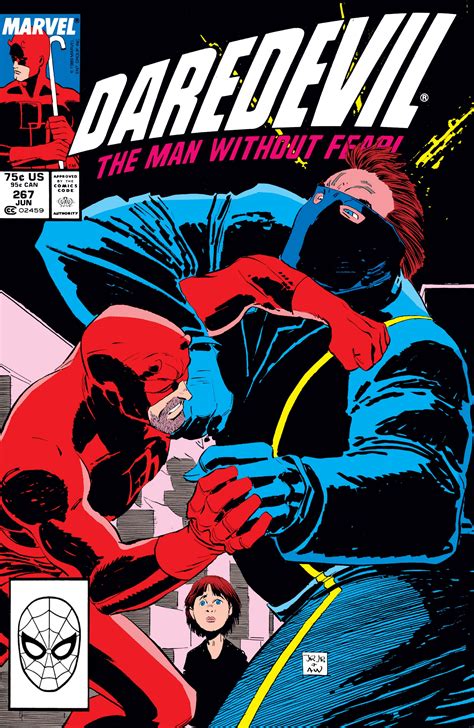
DAREDEVIL #267 (June 1989)
“Cremains”
Writer: Ann Nocenti
Penciller: John Romita Jr
Inker: Al Williamson
Colourist: Gregory Wright
Letterer: Joe Rosen
Editor: Ralph Macchio

Skip Ash isn’t really the main villain in issue #267. In fact, he’s not even an antagonist in the story at all. But it is his debut, and he continues to appear into the #270s, and he has a really weird side project that makes him count as a villain. So he makes the cut.

As issue #267 begins, Daredevil has lost Karen Page thanks to Typhoid, and his Storefront law clinic has been closed. He’s tormented by his urges to seek revenge, but changes his mind after an altercation with Bullet, which leads him to conclude that Bullet himself is just a guy, and not the real problem. Disillusioned with everything, including himself, Matt gets a random train ticket upstate. When the train passes a government plane crashed in a nearby field – don’t ask how anyone identifies it as a “government plane” at that distance – Matt jumps off the moving train to help.

The sole occupant of the plane is Skip Ash, and Matt gets him to safety before the plane catches fire. But Skip goes back anyway to salvage the guns and cocaine that were in the plane, quite reasonably assuming that Matt won’t be able to see what he’s doing. They walk to the nearest town, and Skip decides to offer him a job, apparently because he thinks it might be useful to have someone around who can’t see what’s going on. For some reason, despite being a government affiliated drug and gun-runner, Skip also runs a farm, which is named after his daughter. It’s called “Brandy’s Gently Killed Chicken Farm”. Skip invites Matt to come and meet him there in a few weeks.

This seems to be setting up a story where Matt goes to work on a chicken farm which is actually a front. But that’s not what happens. Nocenti isn’t interested in the drugs and guns, although Skip’s government connections continue to be acknowledged. It’s suggested that Skip is assisting illegal CIA operations with money laundering, and providing cover for their agents. But Nocenti is more interested in the factory farming, although even that forms part of a wider theme about programming and control.

When we next see Skip, in issue #271, he’s being brought up to date on the miserable conditions of his factory farmed animals, by an aide who is clearly at least somewhat troubled by the whole thing. But Skip can’t see the problem. He doesn’t believe in animal rights and he sees protestors as hypocrites who still eat meat and wear leather. Skip has also hired a bunch of geneticists, partly to make him GM chickens, but also to modify human women into the “perfect wife”, which seems to mean an indestructible tradwife. Skip is particularly taken with a subject called Number Nine, and is absolutely convinced that she’ll love him back – after all, he’s her “creator” and “father”, with her original personality and memories overwritten. We’re told that Number Nine and her fellow subjects volunteered to be turned into “perfect beings, just like the girls they saw all their lives in all the glossy magazines”, but the creepiness of the whole thing is obvious, and Skip presents it as the next logical step from GM chickens.

Skip’s daughter Brandy stages an animal-rights raid on the farm, and inadvertently frees Number Nine in the process. Skip is determined to get Number Nine back, and calls in his government contacts. They send Shotgun along to deal with it, and we’ll come to him in a future instalment. Suffice to say that he doesn’t get the job done. So in issue #274, where Skip decides that he can do a better job himself, and simply shows up at Brandy’s home to demand Number Nine back. When Daredevil won’t let her go, Skip tries to fight for her with predictable lack of success. Once he’s subdued, Daredevil and Brandy threaten to publicly expose his activities unless he stops his government work.

Skip seems to accept this, but protests that he’s always allowed Brandy to think for herself and that she and Daredevil are both vigilantes with no right to judge him. While Daredevil sticks to his guns on the threats, he also gives a bizarre centrist speech about how Skip and Brandy should “respect each other’s political passion, which is a rare thing to have these days”. Skip hangs around for another few issues as a mostly constructive background member of Daredevil’s supporting cast, while the focus of the plot moves on to the Inhumans and Acts of Vengeance. He fades out after issue #278, without any further resolution of his storyline.

All this is ultimately about conditioning. Freeing the factory-farmed animals is a futile gesture because they can’t survive in the outside world. Brandy couldn’t get by without her father’s money, and returned to the family fold. Daredevil has left New York but is still going through the motions of being a hero because he has no frame of reference for what else he might do – hence, presumably, his spouting of inappropriate platitudes at points in this storyline. Number Nine signed up for Skip’s experiments because of the expectations on women that she’s internalised, and she’s been turned into a virtual parody. Even the scientists in Skip’s lab, who have enough of a moral framework to be alarmed at any suggestion of going further, have apparently adjusted to their current experiments as being the norm. In this context, Skip seems to be an internalised conservative. He’s not exactly evil, he’s just working on a framework of expectations that he can’t see past, much like everyone else.

The oddity in all this is Number Nine. Even if we take at face value the claim that all the women involved were consenting volunteers (which would surely imply that they weren’t very well to start with), it’s hard to imagine either centrist Daredevil or progressive Brandy regarding this as remotely forgivable in 2026. But in this story it’s treated as about on a par with running a chicken farm. To some extent, of course, that’s the point. Brandy and Daredevil both react to Number Nine in the same way that they would treat the less extreme women that she caricatures. Brandy thinks Number Nine is a gender traitor, not a victim. Daredevil can’t even seem to fully register the concept that she might be a victim since he finds women unintelligible in the first place. He can’t seem to see the problem in having someone make his meals, and talks as if Number Nine was making a free choice to serve him that ought to be respected. Perhaps the idea is that Skip atones to some degree by the mere fact of breaking from his own established role, but if so, it’s not really developed to completion.

Skip never appears again after this arc, and obviously he’s tied very specifically to the short-lived supporting characters of Brandy and Number Nine. It’s perhaps more surprising that Number Nine never returns, given that her storyline isn’t fully resolved, and her relevance has hardly diminished. Something more should have been done with her, at the least.

Bring on the comments

  1. Michael says:

    The really weird thing is that Skip disappears shortly before his daughter is killed and we never get to see his reaction.

  2. Luis Dantas says:

    For some reason I don’t care whether Skip would react at all. Then again, he is quite the lost cause from the start, so there is that.

    Maybe he is “inexactly” evil, but he is quite evil indeed.

  3. Matthew Murray says:

    Number Nine was in the 2006 All-New Official Handbook of the Marvel Universe A to Z, so I look forward to her being discussed in a future episode of House to Astonish.

  4. Chris V says:

    While I agree that a lot more could be done with Number Nine, especially with the changes in society since 1989. However, at the same time, there is something to be said for her being allowed to be given a happy ending. She goes off to find a purpose in her life, and we have to assume she finds a much better life for herself somewhere. I fear that if she had been brought back along the way, at best (in more recent years) she would’ve been made into some sort of superhero, while in pre-recent years (‘90s or early-‘00s), I dread what most Marvel writers would have done with Number Nine’s fate. Sometimes being left to the imagination is the better alternative for a comic character.

  5. Luis Dantas says:

    Of course, that still means that a seriously naive and inexperienced woman ends up fending for herself without as much as a residence or a source of income, so maybe it is not that great a situation.

  6. Omar Karindu says:

    There’s thematic continuity here from the Typhoid arc, most obviously with Number Nine, who likewise reflects stereotypically male perceptions of and desires for women.

    The government and conspiracy angles play into the factory farming stuff, too; Skip is part of the military industrial complex of both the United States and the Inhumans’ genetics council, suggesting a throughline there, as well. And Skip and the Inhumans’ council both also seem to want to control physical and social reproduction, down to the genetic level. Skip’s creation of Number Nine is of a piece with this.

    Bullet and Shotgun, whose names sort of echo one another, reflect variations of the professional contractor, the enforcer of the programmed status quote who have fully bought in to parts of its logic.

    Heck, there’s a bunch that will be done in “Acts of Vengeance” with Ultron trying to grapple with the contradictions in his own programming, while the equally programmed Number Nine develops a very strange and brief connection to Ultron.

    The arc resolutions seem to focus on characters who are either destroyed by their inability to break out of the system or who embrace some form of freedom from it, albeit with no guarantee that freedom will leave them any better off.

    So Ultron ultimately fails to transcend its conflicted programming and loses mostly due to self-destruction. Gorgon and Karnak ultimately allow Ahura/the Pope to choose his own life, defying the genetics council. Brandy sacrifices herself and becomes an angel. And Number Nine learns about good, evil, and free will from Lucifer and ends uop deciding to choose her own path. (This last bit suggests a more morally ambiguous take on what free will means, or at least a link between freedom and nonnormative ethics.)

    Skip, Shotgun, and Bullet don’t really break out of their standard roles and assumptions. As a consequence, they just sort of pass out of the storyline, still locked away in their little systematized worldviews and their programmed functions.

    Daredevil’s fate seems a but ambiguous, though Nocenti leaves him in a place where he’s consciously reclaimed his identity and seems to have achieved some stability of place and purpose, albeit after (once again) losing nearly everything.

    Whether this is meant to be self-awareness or falling back into old patterns is, I think, deliberately ambiguous, and kind of has to be given the nature of serialized comics and inevitable creative team change.

  7. Thom H. says:

    I love Nocenti’s strange, associative logic and her on-the-nose political themes. But it’s still difficult for me to believe these stories happened in a comic book published by Marvel called Daredevil.

    I know it will get even weirder soon, but about 1/3 of the way through this entry, it started reading like a dream journal. In a post about the street-level, crime-fighting, gangster-punching hero Daredevil.

  8. “I know it will get even weirder soon”

    Weirder than a story that combines factory farmed chicken and genetically engineered super-wives?

    I’ve only read a handful of issues from the Nocenti/JRJR run, and those were relatively sane; I had no idea it was so bonkers.

  9. Chris V says:

    Yes, Nocenti moved more into her style she’d use on her Kid Eternity as the Number Nine/Mephisto arc progresses.
    There is a lot of allusion as well as inversion with Christian symbolism in the final part of Number Nine’s story. Number Nine as an Eve figure rejecting the apple being offered to her by Blackheart in disguise. A Gnostic interpretation of Garden of Eden, with Number Nine rejecting the seeming perfection of Gabriel for (what seems like the far less than perfect) Lucifer. Number Nine was created. She was created to be perfect. She was also created to be a perfect slave of her creator. Then, Lucifer teaches her of the knowledge of good and evil, and Number Nine makes the decision to embrace free will and leave behind the perfection of perfect slavery to take the risk that will come with freedom in an imperfect outside world, away from the creators (both of the father-figures Skip Ash and Mephisto).

  10. Drew says:

    “Of course, that still means that a seriously naive and inexperienced woman ends up fending for herself without as much as a residence or a source of income, so maybe it is not that great a situation.”

    Whatever you do, Matt, keep her away from Neil Gaiman and Amanda Palmer.

  11. Chris V says:

    There was a story about factory farming in Jamie Delano’s Hellblazer a few years after this one (#37, 38) which was far less subtle (yes, far less subtle than Nocenti) and imaginative, but did seem to have some superficial aspects in common with the DD story. A son who was opposed to the father’s work, although he was abused by his father. Delano’s Hellblazer is my favourite run on any comic book, but that two-parter was, by far, Delano’s weakest plot. It’s the only two issues of Delano’s HB I’d say one could safely skip. As opposed to Nocenti’s genetically engineered factory farming extended arc, which I’d argue is Nocenti’s strongest plot on DD (which, granted, becomes the story of Number Nine branching beyond simply the factory farming setting).

  12. Thom H. says:

    @thekelvingreen: Yeah, strap in. Imagine everything Chris V. summarized above, but with added Inhumans in the nude. It’s wild.

  13. Michael says:

    And then there was the arc where Matt fights Bullseye dressed as Bulleseye while Bullseye is dressed as Daredevil.

  14. Si says:

    I’ve just been reading the story, why is there no mention of Skip Ash looking like Magnum PI with an even bigger moustache? It’s the kind of thing you should be braced for.

Leave a Reply