Daredevil Villains #93: Shock
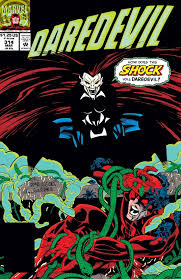 DAREDEVIL #314-315 (March & April 1993)
“Shock Treatment” / “Shock Therapy”
Writer: DG Chichester
Penciller: Scott McDaniel
Inker: Bud LaRosa
Colourist: Max Scheele
Letterer: Bill Oakley
Editor: Ralph Macchio
We’ve skipped issue #311, which is the second half of the Nameless One story that I wrote about last time. We’ve also skipped issues #312-313, which are a straight crime story involving an arson. And that brings us to this two-parter, in which Chichester and McDaniel try to retool Mister Fear for the 1990s.
It’s been a long while since we’ve had a Mister Fear. By this point Daredevil has already been through two of them, or three if you count Starr Saxon acting as an impostor. But the last time we saw a Mister Fear in Daredevil was in issue #91, and that was back in 1972.
Instead, the identity was picked up by the Spider-Man books, who introduced a fourth Mister Fear, Alan Fagan, in Marvel Team-Up #92. His origin story is that he’s the third Mister Fear’s wastrel nephew, and he inherited the equipment. Gripping stuff, I think you’ll agree. That was in 1980, and he didn’t appear again until 1990, when he was the main villain in Web of Spider-Man #63. And that was it until he showed up here.
As the story begins, he’s in jail. Some other prisoners attack him and skin his face. It’s that kind of story. It’s 1993.
Those prisoners are working for a woman called Ariel Tremmore. She’s hired an underworld chemist to extract the residue of Fagan’s fear gas from his flesh, and use it to make a serum that gives her powers. It also transforms her into a harpy-like creature, and she starts calling herself Shock. This all seems a bit of a stretch – it’s a fear gas, not a mutagen, and this all seems a bit above the pay grade of a drugs chemist. But it works, so who are we to judge.
Much of this story consists of Shock trying out her new powers. Unlike Mister Fear, who just affected people’s emotional states, Shock apparently emits an enhanced fear gas that creates outright hallucinations of things that will terrify the people around her. So a random bystander whose greatest fear is being alone becomes convinced that everyone else in Manhattan has vanished, until Daredevil washes the fear serum off him and the illusion goes away. Daredevil chases Shock across town, but keeps having to break off to deal with the chaos in her wake. Eventually, he corners her and manages to turn her back to human form, at which point she’s handed over to the police.
Towards the end of the story, we establish that Ariel is Alan Fagan’s daughter – or at the very least, she believes that she is. Her mother told her that Fagan had abandoned them, and drummed into little Ariel that she had to be better than her father. At some point, Ariel’s mother was left comatose after a fire, and Shock is keeping the unfortunate woman in her lab. The broad idea is that Ariel has been driven to terrible things in order to protect her mother, and that she wants to take out her frustrations on the father who wasn’t there for her mother when he was needed. But she also seems to have taken the injunction to be “better than him” literally, leading her to try and become an improved version of Mister Fear.
In terms of its visual style, the book is in a transitional phase at this point. McDaniel’s art is getting more exaggerated and dramatic, but it isn’t yet as stylised and geometric as it will be. Aspects of that style are creeping in around the edges, though, and Shock herself feels like a design more suited for a future style. Her face is distorted; her hair fills the panel backgrounds to an improbable degree. Some of the hallucination scenes in issue #315 have a similar style. Shock might have worked better if she had come along a little later, when the whole book looked like that.
The oddity of this story is that Shock’s primary motivation is to get revenge on her father, yet she achieves that from a distance in the first scene by having his face cut off. After that, he simply drops out of the plot. But issue #315 ends with an epilogue – billed as a “prologue” – showing Fagan in the prison hospital and looking for revenge. So apparently this was laying the groundwork for a storyline where Fear and Shock would feud with one another, and it makes a lot more sense if you read it that way – as a free-standing story there’s not much to it. But Chichester will be on this book through to issue #342 and neither Shock nor Mister Fear appears again.
Upgrading Mr Fear for the nineties isn’t unreasonable. In theory, he makes sense as a classic Daredevil villain who plays off the hero’s “Man Without Fear” gimmick. But all he does is create one emotion, which is pretty limited and not all that visual. Shock solves those problems by being more of a physical threat and by adding the hallucination sequences. But she has other problems.
Her motivations are weird and, at least in this story, they’re largely academic. She cares about two other characters: Fagan, who’s in hospital, and her mother, who’s in a coma. The idea that she wants to be a better Mr Fear feels forced. The name “Shock” seems dubious too: she doesn’t create shock, she creates Even More Fear. Okay, “Terror” was taken, but… shock is something else entirely.
After this story, Shock remained in limbo until 2024, when she showed up out of the blue in Punisher vol 14 #3, with her powers inexplicably restored, and calling herself the Fearmaster. This is the miniseries that featured ex-SHIELD agent Joe Garrison as the new Punisher; he apparently kills her by breaking her neck.
Shock might have worked if we’d actually got the Fear vs Shock storyline that’s clearly being set up here. It would presumably have expanded on her back story and motivations, and as an introduction to build up a new character for future use, this two-parter isn’t so bad. But without any of that follow-up, it’s at best unfinished, and at worst rather pointless.

How would Chichester have gotten to his puntastic story titles without calling her “Shock”?
This reads like a “New 52”-era Batman book by Scott Snyder Scarecrow story. Sure, you could credit it with being ahead of its time, in that sense, although I wouldn’t say any of that is a positive.