Daredevil Villains #58: Ladykiller
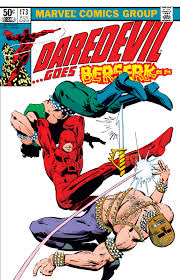 DAREDEVIL #173 (August 1981)
“Ladykiller”
Writer, breakdown art: Frank Miller
Finished art: Klaus Janson
Colourist: Glynis Wein
Letterer: Joe Rosen
Editor: Denny O’Neil
Our last two entries kicked off Frank Miller’s writer/artist run in style, with Elektra and the Kingpin. Up next will be the Hand. And in the middle… there’s this guy. When people talk about the highs of the Frank Miller run, they’re not thinking of this issue. It hasn’t aged so well.
Miller actually intended “Ladykiller” to be the name of the story. The character himself is only referred to as Michael Reese, when he’s named at all. The name “Ladykiller” only gets used in-universe in Amazing Spider-Man #219, where Daredevil mentions this story in passing for no particular reason. It’s an odd story to reference purely for a bit of Marvel Universe world-building, because Michael Reese is a sex offender, and this is a story about rape. Now, this is still a Code-approved comic from 1981, and so it can’t say in terms that it’s a story about rape, but it’s less than subtle in getting that point across.
As subject matter, this can go badly in superhero comics. It can easily come across as exploitative. It can also simply feel like a clumsy attempt to be adult, clashing horribly with the traditional superhero tropes in a way that ends up drawing attention to all the residual elements still unchanged from children’s comics past. And that’s pretty much what happens here.
Technically, we first encounter Michael Reese beating up a man, but that’s only so that Reese can get to the guy’s female companion. Reese is a hefty chap in a BDSM harness who slaps her around while saying things like “Bad girl” and “Have to punish you.” I have my doubts about how much of a grasp on BDSM Miller actually had – the character’s behaviour positions him as an abusive dominant, but the costume makes him look more a gimp. Anyway, Daredevil drives him away, and the police quickly arrest the wrong man: Melvin Potter, the Gladiator.
We last saw Melvin in issue #166. In that story, he had become obsessed with his social worker Betsy Beatty, and was insanely convinced that she was in love with him. In an attempt to impress her, he abducted her and a group of children, and threatened to murder the kids with buzzsaws. That story clearly presents Gladiator as mentally ill, but ends on the questionable note of having Betsy treating him as a childlike and vulnerable man who just needs love and understanding. Insofar as it was suggesting that the violently mentally ill require medical treatment rather than punishment, there’s nothing wrong with this. But the book will go on to make Melvin and Betsy an actual couple. Objectively, this is deeply ill-advised on Betsy’s part – indeed, somewhere between unprofessional and downright suicidal – but once the book has committed itself to the idea that Gladiator is a sympathetic figure, story logic dictates that it must be a Good Thing that he finds love.
So: Melvin Potter is wrongly arrested for Reese’s attack. Why? Because the two of them look identical. There’s no reason for this – it’s just a remarkable coincidence.
But that’s not all. Matt is defending Melvin, and so he goes to meet the client, and takes Becky Blake with him. You might remember that she was introduced back in issue #155 as a wheelchair-bound lawyer and potential new love interest for Matt. By this point the romance angle has been shelved. Nothing else has come along to replace it, so her role is pretty much to listen to Matt and Foggy’s exposition if no one more important is around to do so.
This, however, is her spotlight issue. She takes one look at Melvin and faints. Later, after some very persistent questioning from Matt, she explains. When she was a student at Harvard three years ago, she was attacked by Reese. In trying to defend herself, she managed to tear his mask off, and since Melvin and Reese look identical, she takes them to be the same man. Reese’s attack caused permanent injuries, hence the wheelchair. Now, technically, what Becky actually describes in dialogue is just a violent assault, but it’s perfectly obvious what Miller is getting at: “It was so humiliating… I knew I was helpless… it was up to him, whether I lived or died…” Becky says that the whole thing was too traumatic for her to go through it again by reporting it to the police.
With his signature empathy, Matt’s response is to yell at her for not going to the police, and to blame her for the attacker still being at large. To be fair, the whole point of the story is for Matt to gain more empathy for Becky, so Miller isn’t presenting this as a correct position, but at the very least he’s presenting it as a reasonable starting point for the book’s hero, and that hasn’t aged well.
Reese attacks Betsy, but gets run off. Betsy is able to advance the plot by offering some thoughts on Reese: as a social worker, she’s very familiar with “his kind”, who “usually … only hurt themselves”, and she points Daredevil in the direction of “several local hangouts”. This leads to a frankly excruciating scene in which Daredevil tracks down Reese in a BDSM bar, only to get beaten up and humiliated by Reese and his BDSM mates. This allows Matt to have an epiphany and understand how helpless Becky felt, before fighting back to defeat Reese.
You can see what Miller is going for, but there’s an obvious problem in terms of the ground rules of the book. Daredevil spends a lot of time at this point going into underworld bars and beating up all the professional criminals singlehandedly. It’s a regular trope of the book and it has to be suspended for this story so that Daredevil can be on the verge of defeat to a bunch of complete amateurs. It can’t just be weight of numbers – the thugs in bars always have weight of numbers on their sides. Hell, the Hand will have weight of numbers on their side when they show up, and it won’t do them much good either. The Kingpin needs to change his recruitment strategy. Get rid of Turk, place more adverts in the classified columns of Ball Gag Enthusiast.
Once Reese is captured, Melvin is exonerated. Matt persuades Becky to testify against Reese – but this time, instead of presenting it as a matter of duty, he sells it to her as something she needs to do in order to take back control for herself. So you can see what Miller was going for.
But the clash between the subject matter and the superhero tropes is an unholy mess. An attempt to make us empathise with the trauma of rape victims sits in a plot with two wildly improbable coincidences and a cartoon gimp. And it tries to combine all this with a B-plot about the sympathetic Gladiator and his need for compassion and understanding. Miller seems to think that the difference lies in the fact that Reese is just a violent sadist, while Gladiator is fundamentally driven by a need to be loved. It’s true that Gladiator has a motivation that’s easier to empathise with, but that’s simply because he has a motivation. There’s no particular reason to think that Reese is any less troubled than Melvin, since the story isn’t interested in why he’s doing this – the BDSM gear seems to be regarded as a sufficient explanation in itself (despite Betsy telling us that people like him are mostly harmless). For another, the last time we saw Gladiator, he was threatening to kill children with a buzzsaw. We’re expected to look past that because his arc is running on the rules of children’s fiction.
That may be the fundamental problem with this issue. It comes close to being a Very Special Issue, and clearly wants to say something serious – but it combines that with too many elements that are simply silly, without being fully aware that it’s doing so. The passage of time has done it no favours, but it was a weird misfire to start with.
As for Reese himself, it’s fairly obvious why he doesn’t come back – even if you think this particular story works, it’s still a fundamentally difficult thing to do within the constraints of the Code, especially when you can do sadism as a subtext for serial killers without cranking up the sexual angle to this extent. If Becky had developed into a major character then no doubt somebody would have done something with Reese at some point, simply because of his importance to her back story, but without that, there’s no need for him.

Yeah…this is just an odd story all around. Miller will keep on using BDSM imagery in various other works, such as The Dark Knight Returns, typically as shorthand for a character being either a depraved sadist or a fetishized warrior woman type.
I don’t think Becky Blake really got any significant role in the Miller run after this, and she eventually just drops out of the title entirely. It’s a bit odd to see her get a spotlight issue like this one.
Miller also hasn’t really moved into the angle that Matt is psychologically messed up, His best stuff wis usually not about Matt Murdock standing up for the legal system and civic duty. It’s about Matt’s innate sense of The Law in an almost religious sense clashing with his aggression and with the compromises he sometimes has to make in the moment. (The Kingpin arc from the previous few issues ends on this sort of note, and it’s much more what you expect from the Miller run.)
This issue also does a little work reminding readers of the Gladiator in order to set up his trial in the next couple of issues. But the “Ladykiller” plot isn’t exactly a seamless way to do that.
I wonder how much of this is Miller working at an early point in his term as writer and artist, still trying to play out some of the Roger McKenzie leftover plot material and the traditional characterization of the main character.
“Ladykiller” is a misfire, but it’s a very familiar, boring kind of misfire, with identical strangers as a plot device, on-the-nose moments, and clunky moralizing speeches. It could pass for any lousy one-off Marvel story of the era.
It’s quite different from various later Frank Miller comics which are arguably spoiled by his unexamined anger or disgust at something or his unrestrained fixation on certain character archetypes.
There’ll be another of these “boring” misfires soon, with the crummy Power Man and Iron Fist crossover issue that fails at being a comedy issue. I think that issue reads very much as if Miller resented having to interrupt his nicely running Kingpin storyline to spotlight a couple of tonally dissonant guest characters in as an editorial mandate from Denny O’Neil.)
“Reese attacks Betsy, but Daredevil runs him off.”
No, Betsy fights him until her neighbours come to help. When Daredevil shows up she is already giving a statement to the police.
I’m pretty sure Clowes’ Like a Velvet Glove Cast in Iron is the only time BDSM has been used well in the world of comic books. Otherwise, the two seem to be a poor fit. Brian Azzarello’s “Ashes & Dust” was one of the worst stories in the history of Hellblazer. That Rucka Black Widow mini-series wasn’t exactly good, but it was at least better than this or the Azzarello.
@Bengt: You’re right, I’ll fix that.
Betsy is indeed quietly phased out of the book after this story. We don’t even get any clear follow-up to her role in this one. It will be decades before she becomes a true character again; Miller only used her later in short speaking cameos with a fairly bureaucratic role.
The bar fight scene was implausible in another way as well. Going strictly by what is shown, tought and said on-panel, we would have to believe that Daredevil has learned a measure of humility due to nearly having been defeated by this specific crowd this specific time. Maybe it is just me, but I don’t buy it. Daredevil has not been _that_ consistently victorious in all his fights for all these years. He _knows_ defeat and he _knows_ helplessness already, particularly given the child backstory that Frank Miller himself emphasizes.
With hindsight, this story feels like a one-time meeting of several converging factors, not all of which will last for very long.
First and foremost, this is Frank Miller experimenting with his own creative tastes and boundaries. As so much else of what he wrote, this story also shows the seeds for what will eventually take form as “Sin City”, with its unique blend of gross, repulsive, resignated and comical. His early issues of Daredevil had some experimentation with dark humor, but by this point that is mostly gone already, other than a last full-issue gasp coming in #185 – which is itself something of a done-in-one and ends up having its logical consequences fully ignored for good measure.
More than likely Miller also wanted to gauge the boundaries of the CCA and of Marvel itself: how much fall-out would he get from a clear implication of rape in a story? We even get a few lines of dialogue with a suggestively clad woman companion to Ladykiller, which might have been expanded into a more complex plot if a follow-up ever came. Again, this is very reminescent of “Sin City”. Had he already developed his aesthetical senses to the form they eventually acquired and felt more encouraged by the environment around him, he might well have turned Daredevil into something more similar to “Sin City” in the months to come.
Despite all that, this feels like and mostly is a done-in-one. A nice way to fill a month if the schedule becomes a worry, easy to fit into most any place between Gladiator stories that are themselves of fairly malleable placement. Denny O’Neil was very confortable with those, and doubtless found them useful for his own confort as Editor. O’Neil himself wrote “Iron Man” #160 nearly a year later, which is an even better example of the done-in-one that can be placed where convenient.
Yeah, Matt blaming Becky for not coming forward is horrible. Later writers portrayed this as part of a larger character flaw with Matt- Nocenti had Heather Glenn accuse Matt of wielding his morality “like a club”.
“The name “Ladykiller” only gets used in-universe in Amazing Spider-Man #219, where Daredevil mentions this story in passing for no particular reason. It’s an odd story to reference purely for a bit of Marvel Universe world-building”
It was common practice in the early 80s at Marvel to reference a recent story in other books. In the first battle between Spider-Man and the Juggernaut , for example, the Avengers are unavailable to help Peter because they’re fighting Moondragon on another planet.
“This leads to a frankly excruciating scene in which Daredevil tracks down Reese in a BDSM bar, only to get beaten up and humiliated by Reese and his BDSM mates. This allows Matt to have an epiphany and understand how helpless Becky felt, before fighting back to defeat Reese.”
In fairness, Matt was only helpless for ten panels. It’s not as ridiculous as the Spider-Man/ Nightcrawler team-up where Peter is knocked unconscious by being pistol-whipped by two of Jigsaw’s goons.
The Gladiator getting together with Betsy after his violence towards her has Unfortunate Implications. But it wasn’t unusual in 80s and early 90s comics. In the Flash. Speed McGee got back together with his wife who he abused and tried to kill. In the Thing, Vance Astrovik going back to his father who had been beating him after his father promised to change was treated as a good thing. New Warriors later showed that was a mistake. And in the Justice League of America. Gypsy admitted her father hit her when he was drunk sometimes but her going back to him was treated as a good thing. (In fairness, this is arguably justified. since J’onn can read minds and tell if a drunk who loses his temper is really trying to change. Besides, they had Despero kill her father a few years later.)
But at least this never happened in the X-Books. The X-Men never entrusted a teacher who abused her students with the responsibility of teaching more students. Um, never mind.
The Amazing Spider-Man issue referenced has the same cover date at this issue of DD, it has a cover by Miller, and was (of course) written by O’Neil. “Hey kids? Did you enjoy this Spider-Man story? Well, there’s a rapist gimp story in the current issue of Daredevil. You’ll want to check it out.” It might have made more sense for Matt to reference the prior DD issue, featuring Kingpin and Bullseye. It makes you wonder if O’Neil or Miller (more likely O’Neil) were proud of getting this story published at the time. O’Neil was fond of comic stories with a social message, after all. It’s handled awkwardly (perhaps to make it fit within the confines of the CCA), but certainly no more awkwardly than using harpies to address a topical overview of “women’s lib”.
Michael-I think you missed some issues of the Speed McGee story-arc. McGee had become unhinged because he injected himself with an experimental steroid he was working on. After his heinous actions, the drug in his system caused him to go into complete kidney failure, which nearly killed him. During his recovery, the steroid was treated by the Soviet scientist who saved his life. Only after this was McGee and his wife reunited. He was no longer shown to be abusive. The story is basically a “Just say no!” to steroids PSA, as if you take steroids, you’ll abuse your wife and nearly die of kidney failure.
@Chris V:
If I had to guess, the reference to Daredevil in ASM #219 was just a typical attempt at drawing the attention of readers towards other ongoings. Soon enough Daredevil and Power Man/Iron Fist will do the same towards each other. As we saw previously and soon will see again, Daredevil and Iron Man sometimes did much the same thing for no obvious reason beyond editorial being willing to try the exercise.
Frank Miller himself drew “Peter Parker the Spectacular Spider-Man” #27-28, guest-starring Daredevil and having the Masked Marauder (mainly a DD foe) as the adversary, right before first becoming penciler in Daredevil. At this point in time it would feel natural enough to point out that a traditional Spider-Man foe was doing his thing in another book. Indeed, it will happen again and with more clarity during the second Frank Miller run in Daredevil, right in the middle of “Born Again” (Amazing Spider-Man #237).
@Chris V- The problem is that the story tries to have it both ways. Ordinarily we don’t consider voluntary steroid abuse an excuse for domestic violence. Of course, ordinary steroids don’t grant you super-powers.
But the story wants us to treat this as a metaphor for abusing “normal” steroids while not holding McGee accountable for the actions he committed while abusing steroids.
And this isn’t the only story where steroid abuse is treated as a get-out-of-jail-free card for domestic violence. Thunderstrike’s wife’s new husband hit her and locked himself in a room with Thunderstrike’s son. But the story treated him s sympathetic and blamed Eric for losing his temper.
My mistake. I meant Amazing Spider-Man #277.
@Luis Dantas- The Amazing Spider-Man 277 story is really a different category. It’s how continuity is supposed to work. PAD had Peter learn Matt’s secret identity and become friends with him. Miller had the Kingpin destroy Matt’s life and get away without being arrested. So DeFalco had Peter confront the Kingpin over what he did to Matt.
Michael-Yes, but you’re conflating two issues. Should McGee be held legally responsible for his actions? Yes. Is his wife right to forgive him and give him a second chance? I’d say so.
If a person is addicted to drugs and is abusive to his/her partner under the influence, but gets professional help and is genuinely sorry, the partner giving the addict another chance to show they have changed is an acceptable action. The situation with McGee is, granted, not realistic, as he only needed to be treated by the Soviet scientist for the steroid to no longer be in his system. McGee nearly died for his wrong decisions and there is no hint that he plans to start using steroids again, nor was he shown to be a violent individual prior to injecting himself with the steroid. I see no problem with his wife forgiving him and giving him a second chance. This isn’t Curt Connors, who is going to continually find ways to accidentally turn himself back into the Lizard, while his wife and son stay loyal to him. If McGee started messing around with steroids again and the wife still decided to stay with him, then there’s a serious problem.
As far as McGee’s criminal actions while under the influence of steroids, that’s a separate matter.
@Michael
I was troubled by that Flash story as well. My take is that we are meant to understand that dealing with the plots going on the book at the time had changed the characters to the point that they reached better mutual understandings and achieved more wisdom and respect, but it really is implicit at best.
A significant complication is that for a considerable time we see very little of Jerry McGee after their fight in Flash #6. If I am not mistaken, he collapses, is hospitalized, and Wally becomes entangled in complicated plots that are meant to save his life. We only really see him again in #15 when Tina has already warmed up to him again – and the writing has been shifted from Mike Baron to William Messner-Loebs and the editorial from Mike God to Barbara Kesel for some time already.
I think we have to file that one under “unresolved plots that new writers and editorial prefered to let go of”.
@Chris V
You find it easier to hold Curt Connors as responsible for the actions of the Lizard than to accept that Jerry McGee should not be excused for being under the influence of steroids?
I wish I could say that I see the logic. But I truly do not.
Luis-Based on the nature of the plot, though, we are to understand that McGee was not a violent individual prior to his decision to inject himself with an experimental steroid. He immediately attacks other workers in the lab, and this is treated as aberrant behaviour by McGee. If the plot was that McGee was a terrible person, surely the plot would have included, “Gee, Speed is always fighting with everyone, but he’s never been able to do this level of damage before!”. We are meant to assume that the steroid causes wildly increased aggression in the person. Hence, when the Soviet scientist uses the treatment, it returns McGee to the person he was before. We are also to assume that McGee and his wife had a loving relationship before the steroid, and they used the time when McGee was recovering in the hospital to put their relationship back together. Messner-Loebs portrays McGee as a nice guy in all his other appearances. It’s not, “McGee is drunk at the bar again. Better get him sobered up so he can help me.”
Luis-I’m saying that Connors continually experiments with ways to become the Lizard. He seems to secretly want to become the Lizard. Meanwhile, McGee is never shown experimenting with steroids again. One is shown to be sorry his actions, while the other seems to not care. Basically, a heroin addict who after recovery decides to change his life and move away from his addict friends versus a heroin addict who says he’s not using anymore but spends his time hanging around with his addict friends. Which one seems to be more likely to actually change their life?
You must have been reading a set of Spider-Man stories that clashes with those that I did. Probably a different Mike Baron Flash run as well.
It’s possible you read the alternate Flash series where Mike Baron continued his aborted (terrible) run on Flash, since most of the Speed McGee appearances came from William Messner-Loebs after Baron. Baron only wrote two issues featuring Speed McGee.
So, tell me, how bad did Baron’s run on Flash become after issue #14? I’m guessing really bad. Welcome to this reality where we got an excellent lengthy Messner-Loebs run on Flash instead of Baron. I don’t know what your Earth was like, but this one must surely be a better world.
I’m being partially facetious about Curt Connors, but there was an issue of X-Men: First Class that revealed that Peter Parker had cured Connors of being the Lizard after the first time, but Connors started the same experiments again, and turned himself back into the Lizard.
@Chris V- But there was considerable controversy about whether that issue of X-Men: First Class was canon.
In any case, Connors has been separated from the Lizard for the past 4 years and hasn’t done anything to try to remerge with the Lizard.
It’s been a long time since I read the story, but I seem to recall Tina taking Jerry back because he had her at “Hello.”
No, wait. Sorry, that was Jerry Maguire, not Jerry McGee.
Carry on.
Michael-Unfortunately, the lesson came too late. Curt had already eaten Billy. If after devouring your own son, you try to become the Lizard again, you don’t deserve to live. Good thing for cloning.
PSA: Remember kids, if you try to regrow an amputated arm using lizard DNA, you will end up eating your own son. Just say no to genetic engineering!
Wasn’t Conners often portrayed as changing into the Lizard due to stressful situations, not unlike Hulk? I feel that was the case during the Lee/Romita Sr. “tablet” storyline, where Conners is forced to translate it for Silvermane because his wife and kid are hostages. He’s constantly worrying the strain is going to trigger a transformation, which it of course does.
Which makes Conners a guy who made a bad decision that had lasting consequences for his life. Consequences which he’s tried to adapt to in different ways. Amazing Spider-Man #313 says Curt and Linda separated at some point, but Billy still wanted to see his dad, and Conners felt he had recently learned to control the transformation to feel safe to be around.
Being an Inferno tie-in (Spidey briefly fights the possessed Macy’s parade balloon of himself), all the demonic energy overwhelms his control, and even counteracts the serum when Spider-Man whips some up in the chem lab, but Conners does show signs of resisting the Lizard during the fight.
So I don’t think it’s as clear cut as “Curt Conners keeps turning himself into the Lizard, not like good ol’ Speed McGee, who just needed his kidneys to fail to learn his lesson.”
Again, I was mostly joking about Connors (using one ret-con story, which I wasn’t aware may not count as canon). Still, if I was going to turn into an uncontrollable monster that hates mammals whenever I get stressed (and damn, is life stressful), I’d have myself locked away, not keep staying with my wife and kid. I know of parents, and even when they try to be the sweetest parents in the world, kids are damn stressful. I’m just saying, Billy was bound to get eaten eventually.
With Speed McGee, the point of the story was to treat steroids as an addictive drug. Yes, that is what happens in many cases of addiction, the individual hits the proverbial rock bottom before they realize that the drugs are hurting them. In the case of McGee, I’d say he was punished by nearly dying. The Soviet scientist then administered a treatment which led to the experimental steroid no longer being in his body.
As I said, McGee should have still faced criminal charges. Using drugs is not an excuse for committing serious criminal acts. However, if you are in a relationship with a drug addict, and your partner sees that you have made changes in your life and are no longer abusive and using drugs, I don’t think there’s anything wrong with giving someone a second chance.
Any other examples of comic characters who just happen to look identical? We’re only a couple of years before Madelyne here, but that turns out to not be a coincidence at all.
@Dave- Bizarrely, Bucky Barnes looks identical to Rick Jones, Jack Monroe and Agamemnon of the Pantheon. I guess Bucky just has one of those faces.
Sue Richards and Alicia Masters look identical except for their hair color. Which Byrne probably should have thought of before having Johnny fall for Alicia.
The weirdest one has to be Walter Lawson and Captain Marvel. When Mar-Vell was assigned to infiltrate Cape Canaveral. a scientist named Walter Lawson who worked at the base was killed by a laser aimed at Mar-Vell. The two of them looked identical, despite Captain Marvel being from another planet, so Mar-Vell was able to trick the Cape’s head of security, Carol Danvers, into thinking he was Lawson. Lawson showed up alive decades later as a villain, claiming that the resemblance between him and Mar-Vell wasn’t a coincidence and that the Kree had deliberately tried to kill him. But what you should really take away from this is that Carol Danvers was a really incompetent head of security.
“Any other examples of comic characters who just happen to look identical?”
A few that were utilized solely to set up secret identities back in the Golden Age…
Wonder Woman and Diana Prince.
Black Condor and Senator Thomas Wright.
#711 and his friend Jacob Horn.
The sheer amount of identical ringers for Bruce Wayne and Clark Kent throughout the Golden and Silver Ages was downright ridiculous, from ordinary people to mobsters to Kryptonians.
Cable and Stryfe. (lol)
Thor has a lookalike with brown hair, I think Al Ewing brought the character back not long ago. And Storm is a dead ringer for her own ancestor, which wasn’t even a golden/silver age story so there’s no excuse.
I read the first Alicia Masters story only recently. It got me thinking about how the Fantastic Four are a family, except Ben Grimm. But what if Alicia looks a bit like Sue (the other FF realised it wasn’t her pretty quickly) because Papa Storm and Alicia’s mother had an affair? If they’re half-sisters, then Ben is an in-law. Which is slightly less contrived than two strangers looking like twins. I don’t know enough about Alicia to know if this retcon would actually work.
There was a terrible story in one of those anthology titles when Ben and Alicia married, where Sue knows Ben is in love with her, so pushes him into a relationship with her lookalike as a consolation prize. I mean, this went through all the steps of writing, editing and publishing, and nobody pointed out how psychotic that is
Potentially Kent Allard (the Shadow) and Lamont Cranston.
Bruce Wayne has already been mentioned, but I think it is particularly noteworthy that he was enough of a lookalike to Julie Madison’s eventual husband that he secretly married her in Prince Jon of Tybern’s stead. Talk about having a type.
Still at DC, Chuck Dixon once created a new pair of Trigger Twins who lived in the present day. They believe that they are literal twins separated at birth, but I don’t think that has been confirmed.
@Si
Apparently Chris Claremont believes that people often are dead ringers for their own ancestors and descendants, even when separated by several generations. We learned that in the prelude to the Dark Phoenix’s first appearance. I have no idea of why he believes in that.
An early issue of the 1970s “Marvel Team-Up” series gave us a flashback to Alicia’s childhood. Nothing there proves that she is Jacob Reiss’ biological daughter, I suppose… but nothing there hints otherwise either.
Oh, let’s not even get into identical twins and cousins (when used to replace a dead/missing/incapacitated character with a previously unrevealed family member) because there’s Tweedledum, Tweedledum, and Tweedledunson (or whatever)… and also the multiple Oxes from the Enforcers. Just to name a couple.
At DC, Carol Ferris was chosen as the Star Sapphire’s queen because she was identical to their previous queen. There was also another Star Sapphire we saw once who was identical to Carol and decided to make Hal her consort despite not knowing him because if they were identical and Hal was a good match for Carol. then he’d also be a good match for her. That’s Silver Age “logic” for you.
In fact. Carol and Maddie are similar in a number of respects- they both were women in careers involving planes (Maddie a pilot, Carol owned an aircraft company), they both fell in love with pilots, they both were doppelgängers of other characters and they were both turned into evil dominatrixes.
The Wasp was a doppelgänger of Hank Pyn’s first wife.
Keith Kincaid, Jane Forster’s husband, was a doppelgänger of Donald Blake. Ton DeFalco came up with the obvious explanation- that Odin modeled Blake on Kincaid. Then Roy Thomas retconned that there was a real Blake but he was accidentally killed by Loki’s wife years ago. which raised the question of why Kincaid and Blake resembled each other. Of course. Roy Thomas always came up with the most convoluted explanation possible when it came to continuity problems:
“Black Canary is physically a couple decades younger than she should be . How can we explain it?”
“Well, Roy. Maybe we could say that she was exposed to fragments of the same meteor than gave Vandal Savage his immortality?”
“No, I’ve got it. The current Black Canary is the daughter of the original. And she looks identical to her mother. And she’s got her mother’s memories, presumably including her memory of having sex with her father. And Superman knew all along and didn’t tell anyone ,for reasons. And this isn’t at all creepy or convoluted.”
Hang on. Donald Blake was a real guy who could turn into Thor. Then he was a magic fake identity. Then he was a real guy who died. Then he was a real guy who was still alive and turned into a mad god-killer. Am I missing any other permutations of this really quite uninteresting guy? Honestly, he’s the anti-Bruce Banner. A dull man who has to wrestle with the trauma of turning into a sexy god whenever he feels like it. But writers keep coming back to him?
At some point the magic fake identity was transferred to Beta Ray Bill, no idea if that fits the timeline or if it’s another permutation.
Recent events have made a bit ambiguous what exactly is the current situation (or at least current memory) of Thor, Beta Ray Bill, Donald Blake and secret and alternate identities.
Still, having Thor as secret ID can be very unconfortable, if the modern revival of Marvelman is any indication.
I don’t know that Bill ever had a secret identity as such; during the Walt Simonson run he acquired the ability to return to his original fully organic form without cyborg implants by using Stormbreaker. It was an obvious callback to the Thor-Don Blake dual identity, but it was not a secret id.
The “villain looks enough like the hero to fool everyone and frame him” trope was a pretty standard pulp convention, I think. Edgar Rice Burroughs had THREE separate dudes who looked enough like Tarzan to fool everyone over the course of 24 books, a frankly astounding one doppelganger per eight books pace. I don’t think anyone in comics ever equalled that, but you can certainly see comics’ pulp roots in that trope.
I believe Bill’s transformation ability was described as the “become mortal” enchantment being passed from Mjolnir to Stormbreaker (without the Donald Blake persona— at that point Blake was fake anyway).
I’m always a bit disappointed nobody does much with Thor having at least the memories of having lived decades of a mortal life on Earth (though I suppose it explains why he’s so fond of the place). I think there’s a Joe Casey Avengers origin mini where he directs a nurse to prep a patient for surgery as Thor, in full Asgardian dialect.
As for Claremont’s identical ancestors, I think we can blame that on his habit of pinching things from movies or TV he was watching— the supernatural soap opera Dark Shadows went to that well a lot.
If we are including people getting surgery …
Professor Zoom making himself look like Barry
Secret Empire Cap
There was also a gangster who happened tyo look exactly like Barry allen in one issue of the Cary Bates run of the Pre-Crisis Flash. It was actually something of a plot point.
After Iris Allen had been killed off, Barry Allen had become interested in an attractive neighbor, but she seemed repelled by him. Turned out she was in witness protection or somesuch and thought Barry was his gangster lookalike.
Another Silver Age-y example was Van-Zee of Kandor, who looked so much like Superman that he could substitute for him. Van-Zee even fell in love with Lois Lane,a nd ended up hooking up with a near-double for her, an Earthwoman named Syklvia DeWitt. Van-Zee later took up Superman’s Kandorian secret identity as the vigilante Nightwing (which was, indeed, the Pre-Crisis source of Dick Grayson’s post-Robin codename).
There was also the Pre-Crisis version of Vartox, the alien superhero infamouslky modeled on Sean Connery in the bizarre science fiction movie Zardoz, complete with receding hairline and skimpy outfit. He first encountered Superman after his wife mysteriously died, having apparently been the “psychic twin” of an identical-looking human woman who’d been killed by an armed robber. That was another Cary Bates plot.
There were also a few stories with super-powered, heroic döppelgangers of Supergirl back in the 1950s and early 1960s, at least some of which had Supergirl trying to set Superman up with them (yecch!).
To add to the list of Marvel Universe examples, there’s also Steve Rogers’s identical — and identically named — ancestor from the revolutionary War era, created by Jack Kirby in the 1970s.
The Scarlet Witch arguably qualifies these days, since she’s no longer Magneto’s biological daughter, yet still looks identical to Magneto’s dead wife Magda.
Oh, and on the grosser side, theres also Sinthea Schmidt’s mother, an unnamed servant on the Isle of Exiles whom the Red Skull apparently chose to bear his child because she apparently looked jut like his mother. (This Oedipal bit was, naturally, a J.M> DeMatteis plot point. The man loves his Freud!)
As to the many Bucky Barnes lookalikes, would Fred Davis also count? He was the retconned in Bucky who acted as sidekick to the second and third Captain Americas in the post-World War II 1940s.
“As for Claremont’s identical ancestors, I think we can blame that on his habit of pinching things from movies or TV he was watching”
Yup. 1981 was the year of the werewolf in film. “The Howling”, “Wolfen”, and “An American Werewolf in London” all came out that year, and a year later, Claremont introduced a new team that included a werewolf.
Claremont was basically Keyser Soze. He’d make up stories using whatever he happened to be looking at.
Speaking of Cary and the late era Flash, there’s a great (awful) bit where the Flash is unmasked during his trial and he no longer looks like Barry, because after he got beaten up by someone (maybe Big Sir) he had to have plastic surgery and he got a new face,
That trial of the flash stuff has some just odd stuff in it.
Regarding Claremont and the “identical ancestors,” the Dark Phoenix Saga stuff seemed like it was just illusion at the time. Jean’s supposed “ancestor” is in a relationship with some historical version of Mastermind (Jason Wyngarde) in his illusory handsome guise, all part of brainwashing the present-day Jeanix into loyalty to the Club.
The original idea was that the “timeslips” were just Mastermind’s illusions, which is why everyone in them looks like the present-day Inner Circle: The minister at the “wedding” of Jean’s supposed ancestor is Sebastian Shaw, for example, and the other Inner Circle members are there as well. Moreover, the majority of the “timeslips” are just “ancestor” Jean’s romance with Jason Wyngarde, who has no counterpart when the Grey family eventually gets retconned in to the 18th-century Hellfire Club.
Later, when Jeanix has created her psychic rapport with Cyclops, he gets pulled in to and he and the other X-Men are given illusory appearances to fit the supposed time period.
It was only later that someone decided to have the actual Grey family have been members, which doesn’t really make much sense. In the original arc, Warren Worthington III is a member of the broader Hellfire Club and explicitly states that he’s in because his parents were. So why aren’t Jean’s family members part of it in the present? How did the Greys lose their “old money” wealth if they were once the kind of folks who could be part of the Club?
But then, as the current Emma Frost series shows, the Hellfire Club as originally depicted has been retconned to hell and back by later writers, who wanted to make it a part of various characters’ family histories and later to justify Emma Frost as a broadly heroic X-team member.
@Omar- The biggest example of the Hellfire Club retcons is Sebastian Shaw. Under Claremont it was clear that he WASN’T old money and often felt out of place around people who were. The problem was that when Peter Milligan wrote the Adventures of Cyclops and Phoenix series he had Apocalypse encounter several Hellfire Club members, one named Shaw. Which would still work, as long as Shaw wasn’t a DIRECT descendant of the Shaw that Apocalypse met. The problem was that when James Robinson was writing Cable, he had Sebastian Shaw say that the encounter with Apocalypse was a family legend. So other writers like Ben Saab and Kieron Gillan explained that the Shaws were once wealthy but had lost most of their wealth by the time Sebastian came along. Which unfortunately made his backstory too similar to Norman Osborn’s.
The criminal Mel Jay aka “Red Fever”, looks like Archie Andrews, courtesy of Punisher meets Archie.
Sebastian Shaw is the spitting image of his ancestor, Hiram Shaw, Sorcerer Supreme. Imagine the Black King learning magic, there’s an alliance between him and Selene for that purpose.
(Tongue in cheek on this one) Barry Allen happens to look like the character find of 1990, Buried Alien.
@Drew: even Mickey has an evil doppelganger. Miklos the Grey Mouse has lighter-colored fur than the real thing, but is otherwise identical and dates back to 1953.
@Mark Coale: Secret Empire Cap (now going by Grant and, unbelievably, “Flag Smasher”) did not have plastic surgery to become more similar to Steve Rogers; he is the Steve Rogers of his native reality. You may be thinking of the 1950s “Flag Smasher” Cap, William Burnside, who did.
@Omar Karindu: Wasn’t Fred Davis blond and speckled?
Also, the prelude to Dark Phoenix did indeed present those visions as telepathic projects, illusions from Mastermind.
Then all of a sudden, midway through #132, a thought ballon from Scott describes them as “timeslips (…) where she (…) physically (takes the place of) an ancestor”.
It caught me entirely by surprise at the time, and I don’t think I will ever stop perceiving that as way out there.
Deciding out of the blue that the Inner Circle aren’t always such bad people also dates back to the original Claremont run. Specifically Moira’s speech in #165. It was an odd time.
@Luis Dantas- In issue 165, Xavier is too wrapped up in self-pity to teach Karma. Moira then suggests finding other teachers for Karma:
MOIRA: I was thinking more along the lines o’ Magneto.. if we can find him.. or Emma Frost’s “Massachusetts Academy.”
XAVIER: Are you insane, woman?! Magneto is the X-Men’s greatest foe and Ms. Frost’s cohorts in the Hellfire Club are almost as bad! You’d turn the child over to villains..evil mutants!!
I always read that as Moira deliberately suggesting unfit guardians for Karma to snap Xavier out of his self-pity.
Yeah, I meant 50s Commie Shasher Cap.
@Luis Dantas: Scott is thinking about what Jeanix has told him, and, in context, she’s been fooled into thinking that she is indeed, living the life of some purported identical ancestor. But this doesn’t mean that the ancestor is real, just that Jeanix thinks so.
The presence of so many other fundamentally unreal elements in those “timeslips” — the wholly invented Wyngarde persona chief among them — suggests that it’s all meant to be one big fake reality that mastermind has made “real” to Jeanix.
Note also that Mastermind’s illustory appearance in the present is identical tot he supposed 1700s “Wyngarde,” so that might suggest that both “identical ancestors” were originally meant to be fakes created by Mastermind to brainwash Jeanix.
In that context, Cyclops’s thought balloons are arguably a case of the characters being misled, not the story making a genuine reveal. Jeaniz believes the timeslips are real — they’re not — and therefore believes she had an identical female ancestor who was romanced by some guy named Jason Wyngarde.
(Quite how a team with two telepaths never managed to learn the civilian name of one of their old enemies remains unclear, since that would’ve blown the whole deal. Of course, in context, “Jason Wyngarde” probably wasn’t originally meant to be Mastermind’s real name.)
It’s not until 1999, in Ben Raab’s Hellfire Club miniseries, that it’s retconned in that there really was a Lady Jean Grey in the 1700s iteration of the American Hellfire Club. And what we see of the events there is not that similar to what we see in Mastermind’s “timeslip” illusions in the Dark Phoenix Saga.
Amusingly, calling Jean’s alleged ancestor “Lady Jean Grey” invariably makes me think fo the much earlier and otherwise quite different English historical figure Lady Jane Grey. I suppose that there’s a little bit of fun to be had with a historical figure who had an exceptionally brief tenure as Queen and Jeanix becming and abandoning the role of Black Queen in a single evening.
I doubt, though, that it was an intentional allusion by Claremont, Byrne, or Raab. The century’s completely wrong, for one thing.
I’m surprised no one has mentioned Marvel’s three most prominent dopplegangers: Steve Rogers, Clint Barton, and Hank Pym.
Sure, Scott learned that from Jean.
And I suppose Mastermind might have somehow influenced that perception of “indentical ancestors” off-panel. Despite dealing with arguably the strongest, most disciplined telepath of the time.
Still… it is just weird, way too weird. I have to assume that if it happened to me I would reject that strange, unfounded interpretation outright.