Daredevil Villains #58: Ladykiller
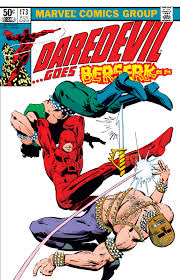 DAREDEVIL #173 (August 1981)
“Ladykiller”
Writer, breakdown art: Frank Miller
Finished art: Klaus Janson
Colourist: Glynis Wein
Letterer: Joe Rosen
Editor: Denny O’Neil
Our last two entries kicked off Frank Miller’s writer/artist run in style, with Elektra and the Kingpin. Up next will be the Hand. And in the middle… there’s this guy. When people talk about the highs of the Frank Miller run, they’re not thinking of this issue. It hasn’t aged so well.
Miller actually intended “Ladykiller” to be the name of the story. The character himself is only referred to as Michael Reese, when he’s named at all. The name “Ladykiller” only gets used in-universe in Amazing Spider-Man #219, where Daredevil mentions this story in passing for no particular reason. It’s an odd story to reference purely for a bit of Marvel Universe world-building, because Michael Reese is a sex offender, and this is a story about rape. Now, this is still a Code-approved comic from 1981, and so it can’t say in terms that it’s a story about rape, but it’s less than subtle in getting that point across.
As subject matter, this can go badly in superhero comics. It can easily come across as exploitative. It can also simply feel like a clumsy attempt to be adult, clashing horribly with the traditional superhero tropes in a way that ends up drawing attention to all the residual elements still unchanged from children’s comics past. And that’s pretty much what happens here.
Technically, we first encounter Michael Reese beating up a man, but that’s only so that Reese can get to the guy’s female companion. Reese is a hefty chap in a BDSM harness who slaps her around while saying things like “Bad girl” and “Have to punish you.” I have my doubts about how much of a grasp on BDSM Miller actually had – the character’s behaviour positions him as an abusive dominant, but the costume makes him look more a gimp. Anyway, Daredevil drives him away, and the police quickly arrest the wrong man: Melvin Potter, the Gladiator.
We last saw Melvin in issue #166. In that story, he had become obsessed with his social worker Betsy Beatty, and was insanely convinced that she was in love with him. In an attempt to impress her, he abducted her and a group of children, and threatened to murder the kids with buzzsaws. That story clearly presents Gladiator as mentally ill, but ends on the questionable note of having Betsy treating him as a childlike and vulnerable man who just needs love and understanding. Insofar as it was suggesting that the violently mentally ill require medical treatment rather than punishment, there’s nothing wrong with this. But the book will go on to make Melvin and Betsy an actual couple. Objectively, this is deeply ill-advised on Betsy’s part – indeed, somewhere between unprofessional and downright suicidal – but once the book has committed itself to the idea that Gladiator is a sympathetic figure, story logic dictates that it must be a Good Thing that he finds love.
So: Melvin Potter is wrongly arrested for Reese’s attack. Why? Because the two of them look identical. There’s no reason for this – it’s just a remarkable coincidence.
But that’s not all. Matt is defending Melvin, and so he goes to meet the client, and takes Becky Blake with him. You might remember that she was introduced back in issue #155 as a wheelchair-bound lawyer and potential new love interest for Matt. By this point the romance angle has been shelved. Nothing else has come along to replace it, so her role is pretty much to listen to Matt and Foggy’s exposition if no one more important is around to do so.
This, however, is her spotlight issue. She takes one look at Melvin and faints. Later, after some very persistent questioning from Matt, she explains. When she was a student at Harvard three years ago, she was attacked by Reese. In trying to defend herself, she managed to tear his mask off, and since Melvin and Reese look identical, she takes them to be the same man. Reese’s attack caused permanent injuries, hence the wheelchair. Now, technically, what Becky actually describes in dialogue is just a violent assault, but it’s perfectly obvious what Miller is getting at: “It was so humiliating… I knew I was helpless… it was up to him, whether I lived or died…” Becky says that the whole thing was too traumatic for her to go through it again by reporting it to the police.
With his signature empathy, Matt’s response is to yell at her for not going to the police, and to blame her for the attacker still being at large. To be fair, the whole point of the story is for Matt to gain more empathy for Becky, so Miller isn’t presenting this as a correct position, but at the very least he’s presenting it as a reasonable starting point for the book’s hero, and that hasn’t aged well.
Reese attacks Betsy, but gets run off. Betsy is able to advance the plot by offering some thoughts on Reese: as a social worker, she’s very familiar with “his kind”, who “usually … only hurt themselves”, and she points Daredevil in the direction of “several local hangouts”. This leads to a frankly excruciating scene in which Daredevil tracks down Reese in a BDSM bar, only to get beaten up and humiliated by Reese and his BDSM mates. This allows Matt to have an epiphany and understand how helpless Becky felt, before fighting back to defeat Reese.
You can see what Miller is going for, but there’s an obvious problem in terms of the ground rules of the book. Daredevil spends a lot of time at this point going into underworld bars and beating up all the professional criminals singlehandedly. It’s a regular trope of the book and it has to be suspended for this story so that Daredevil can be on the verge of defeat to a bunch of complete amateurs. It can’t just be weight of numbers – the thugs in bars always have weight of numbers on their sides. Hell, the Hand will have weight of numbers on their side when they show up, and it won’t do them much good either. The Kingpin needs to change his recruitment strategy. Get rid of Turk, place more adverts in the classified columns of Ball Gag Enthusiast.
Once Reese is captured, Melvin is exonerated. Matt persuades Becky to testify against Reese – but this time, instead of presenting it as a matter of duty, he sells it to her as something she needs to do in order to take back control for herself. So you can see what Miller was going for.
But the clash between the subject matter and the superhero tropes is an unholy mess. An attempt to make us empathise with the trauma of rape victims sits in a plot with two wildly improbable coincidences and a cartoon gimp. And it tries to combine all this with a B-plot about the sympathetic Gladiator and his need for compassion and understanding. Miller seems to think that the difference lies in the fact that Reese is just a violent sadist, while Gladiator is fundamentally driven by a need to be loved. It’s true that Gladiator has a motivation that’s easier to empathise with, but that’s simply because he has a motivation. There’s no particular reason to think that Reese is any less troubled than Melvin, since the story isn’t interested in why he’s doing this – the BDSM gear seems to be regarded as a sufficient explanation in itself (despite Betsy telling us that people like him are mostly harmless). For another, the last time we saw Gladiator, he was threatening to kill children with a buzzsaw. We’re expected to look past that because his arc is running on the rules of children’s fiction.
That may be the fundamental problem with this issue. It comes close to being a Very Special Issue, and clearly wants to say something serious – but it combines that with too many elements that are simply silly, without being fully aware that it’s doing so. The passage of time has done it no favours, but it was a weird misfire to start with.
As for Reese himself, it’s fairly obvious why he doesn’t come back – even if you think this particular story works, it’s still a fundamentally difficult thing to do within the constraints of the Code, especially when you can do sadism as a subtext for serial killers without cranking up the sexual angle to this extent. If Becky had developed into a major character then no doubt somebody would have done something with Reese at some point, simply because of his importance to her back story, but without that, there’s no need for him.

The plot of this phase of the Dark Phoenix Saga relies on mastermind managing to brainwash Jeanix into adopting wholesale the persona of the Black Queen of the Hellfire Club, down to imagining herself as a different person.
Various moments in the Dark Phoenix Saga, such as Jeanix’s combined repulsion and attraction to what she terms the decadent thoughts of various people she encounters such as in the club where Dazzler is performing in issue #130, imply that Mastermind’s scheme worked temporarily because Jeanix was at some level drawn to the impulses expressed in the Black Queen persona. These same impulses, once let loose, are what turn her into Dark Phoenix.
More broadly, though Jeanix’s power levels are pretty much whatever the plot needs them to be across the whole Phoenix and Dark Phoenix eras.
She can go toe-to-toe with Firelord and seal the M’Krann Crystal, but then falters in battle with Magneto in his volcano base and can be affected by the Hellfire Club Knights’ telepathic disruptor, requiring a rescue from Dazzler.
She can casually scan minds, even without trying, and effortlessly rewrites people’s memories, but she also never notices that Jason Wyngarde is telepathically projecting his illusions into her mind via the White Queen’s mindtap device.
As a “No-Prize” sort of explanation, perhaps this can all be squared away as the waxing and waning of her sense of self-restraint, but in practice it’s all a bit inconsistent and follows the needs of the plot.
My reading is that Claremont was hinting – heavily – that Jean had plenty of power and self-control, but did not _enjoy_ having to use it constantly.
We see glimpses of her enjoying herself while torturing Emma Frost when they first meet, losing patience with the prospect of convincing the Prydes that Xavier deserves the chance of teaching Kitty, and finally chastising Mastermind in a way that she presumably doesn’t fully understand.
Perhaps most significantly, when she is in her best mutual understanding with Scott those moments of loss of power or self-control do not seem to happen. Even in her full Dark Phoenix form she shows a bit of vulnerability when Scott speaks to her without judgement.
A very Jungian form of characterization, which somewhat leads into the later decision by Claremont to retcon Jean as someone strongly attracted to Wolverine.
Regarding Jeanix being affected by the Hellfire Knights’ brainwave scrambling device- Clarremont repeatedly used a brainwave scrambling device to incapacitate powerful characters. In issue 136, Beast uses a brainwave scrambling device on Jeanix, though she’s eventually able to overcome it. in issue 264, the Genoshan Magistrates use a brainwave scrambling device on Jean. In the Days of Future Present Annual, Ahab. uses his whip ,which is said to be derived from the device the Magistrates used, on Rachel, Franklin and Nathan.
It’s worth noting that Rachel’s Phoenix powers were also inconsistent. She was an extremely powerful telepath yet she could be controlled by Mesmero.
Even worse, with Rachel, the inconsistencies extended to her telekinesis. She could change people’s clothing easily but when an evil Iron Man whose armor was in automatic mode attacked, she couldn’t just defeat him by turning his armor into a business suit.
And then there was the time that she learned martial arts skills from Kitty without Kitty teaching her. Kitty claimed that Rachel didn’t learn these skills by reading her mind but by “watching her fight”. Because Rachel is famous for her power of photographic reflexes.
“Marvel’s three most prominent dopplegangers: Steve Rogers, Clint Barton, and Hank Pym.”
Nice. Batman and Superman fooled their foes by swapping clothes in that shared title in the 00s. Nobody even said, “hey why is famous personality Bruce Wayne dressed as Superman?”
Madame Web looked like Aunt May in a costume when she first appeared.
“Madame Web looked like Aunt May in a costume when she first appeared.”
And of course the first Jackpot looked EXACTLY like Mary Jane would in a costume, even though we later found out she wore a wig as part of the outfit. (Inspired by her favorite actress… Mary Jane Watson). All evidence screamed “Mary Jane” at the time. Truly a bizarre set of circumstances.
Lazy scripting. It surely doesn’t count as subverting readers’ expectations if a character is either a) who they appear to be, or b)someone you’ve never heard of who could only appear to be the other person via a series of incredibly unlikely coincidences up to and including having a name that refers to a pickup line the other person once used.
When Jean was fighting Magneto in his volcano base, she was surprised to find her powers had reached some kind of limit. It turns out she subconsciously placed it there after the M’Krann Crystal to avoid losing control.
@The Other Michael- Another truly bizarre impersonation is one of Mary Jo Duffy’s issues of Catwoman where Selina is able to trick a man into thinking she’s his wife in the dark because they have the same chest size. It didn’t go over well since Selina is usually not written as a talented vocal mimic like Bruce. Do Selina and the man’s wife also have similar voices?
Well, Jim Balent kept increasing Selina’s breasts size until they were bigger than her head. The number of women who look like that is very minuscule, so maybe the guy overlooked any inconsistencies based on the unlikely coincidence of two women with breasts bigger than their heads ending up in his bedroom.
Alternately, if the guy was so obsessed with his wife’s breasts that he felt he could identify her based solely on that, either the guy probably doesn’t pay attention to any other facet of his wife (“Her voice? Her eyes? What are we talking about here?”), or he simply mistakes any human-shaped person with breasts to be his wife.
Power Girl had been around for years before I noticed that she had a head.
The boob window draw bullets just like Batman’s yellow oval.
When Kingdom Come came out, I had never even heard of Power Girl. I wondered why the Pamela Anderson super-hero kept showing up, she was clearly a sight gag, right?
Reminds me of a joke. Stop me from posting this if you’ve heard this one.
A man has been casually dating three different women for some time and decides he wants to choose one of the three women to date exclusively.
He gives each of them a large sum of money to see what they’ll do with it. The first woman spends all of the money on herself. The second woman spends half of it on herself and the other half on the man. The third woman invests the money, doubles it, and returns the original sum back to the man.
Which woman does the man choose?
Answer: The one with the biggest breasts.
All these posts about Miller’s run are really driving home how I barely remember it, and I read it all. For a classic run, it barely stuck with me.