Daredevil Villains #62: The Congregation of Righteousness
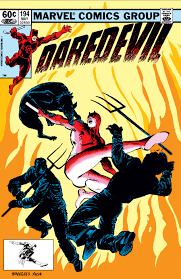 DAREDEVIL #194 (May 1983)
“Judgment”
Writer: Denny O’Neil
Artist: Klaus Janson
Letterer: Joe Rosen
Colourist: Glynis Wein
Editor: Linda Grant
Following Frank Miller on Daredevil is not an enviable task. After two quite decent fill-in stories, the man who takes on the assignment is the book’s editor Denny O’Neil – not so much because he wanted the job as because somebody had to do it, it would seem. He’ll be with us until issue #226, give or take a few fill-ins scattered along the way.
This issue doesn’t read like the start of a planned run, though. The next issue starts some actual storylines, with issue #200 looming on the horizon, but issue #194 this feels like it was intended as the book’s third consecutive fill-in. The editor credit tends to confirm that the book was playing for time at this point. Officially, Marvel didn’t have writer-editors in 1983, but they may have been paying lip service to that policy here. Linda Grant, credited as “guest editor” on this issue and “special editor” on the next, was not a full-fledged editor, but O’Neil’s own assistant. She remains the credited editor up to issue #200, after which the book is finally reassigned to a different office.
The Congregation of Righteousness are a bit of a borderline inclusion in this feature. “Judgment” is clearly a one-off story and the Congregations were never candidates to be recurring characters. But they’re not exactly generic either, and besides, it’s the first issue of a new writer. So let’s have a look at it.
Jeremiah Jenks grew up in a puritan religious sect, the Congregation of Righteousness, who reject all modern technology. They even take exception to drawing, so talented artist Jeremiah wound up killing his father in self-defence and running away. Jeremiah made a fortune using his artistic skills as a counterfeiter but still fundamentally subscribes to the Congregation’s religion. Now in old age and declining health, he wants to atone for his crimes by reconciling with the Congregation before he dies. As a first step, he’s tried to return to their traditional way of life, and part of that involves burning candles that he buys from a Congregation farm. Lots of candles. Tons of candles.
Since the Congregation will kill him if he shows up in person, Jeremiah hires Matt to speak to them on his behalf. So Matt and Foggy head up to the Congregation’s community in upstate New York.
The Conregation are quite obviously modelled on the Amish. Jeremiah even has two simply-dressed sons who show up in Manhattan in a horse and cart. But the story stresses that the Congregation are way more draconian, and are rumoured to kill and torture heretics. This is all a bit odd. While the Amish do shun excommunicated members (or at least some groups do), they’re hardly associated with extrajudicial killing – if anything, they’re generally perceived as harmless pacifists. Perhaps the story is just running with the idea that weird country folk are always a bit scary. Or maybe it’s just cranking up excommunication to the point where it can work in a superhero plot, but it’s not evident that the Amish become any more interesting for being made more like the Taliban.
Matt speaks to the Congregation’s elder, Nahum – Jeremiah’s own brother, though that point isn’t particularly stressed. Nahum tells Matt that Jeremiah was sentenced to death seventy years ago, and the decision is final. Rather than getting into the point about the Congregation doing extrajudicial killings – which, to be fair, probably wouldn’t be very persuasive – Matt instead tries to persuade Nahum that his religious beliefs are a bit extreme. Unsurprisingly, this prompts a rant about how the Congregation have no crime, violence or divorce. Except when they kill heretics.
Meanwhile, Jeremiah asks the Kingpin to arrange some security for him – presumably he thinks that Matt’s visit might prompt retribution. The Kingpin decides to go one better, and sends his henchmen to intimidate the Congregation into taking Jeremiah back. This is very helpful, because it provides some thugs for Matt to punch. After that’s finished with, Matt is thrown off the Congregation’s land.
At this point, Matt finally figures out that the Congregation is already killing Jeremiah by poisoning the candles. He races back to Jeremiah’s home just in time to save him – a remarkable bit of timing, considering how long Jeremiah has apparently been burning the things.
So far, all of this is perfectly fine, and Janson’s art is rather striking. But the story ends on a very weird note, as Jeremiah decides that to stop running from his past. He’s going to present himself to the Congregation, “and let them do as they will”. This makes sense in terms of Jeremiah’s world view, but Matt doesn’t even try to talk him out of it. Instead, Matt immediately accepts Jeremiah’s wishes, more or less congratulates him for taking responsibility for his actions, and lets him go on his way. Bye, Jeremiah! Good luck with being murdered!
You’d expect the ending here to be Jeremiah insisting on the sacrifice which he believes to be a necessary part of his atonement, and Matt either reluctantly deferring to his wishes or somehow being given the slip. It might simply be a case of the story running out of room, and not having enough space to let Matt properly argue the point. But it reads very strangely.
Religion will eventually become a major theme in Daredevil. But that hasn’t happened yet; in 1983, Daredevil is still a basically secular character, unless you count the mystical elements introduced by Frank Miller via Stick. And even there, Matt is a secular figure from outside Stick’s mystic tradition. This story might well have been a better fit for the later, more religious, Daredevil. He would more plausibly have respected Jeremiah following his beliefs to a suicidal conclusion – and he would have found more in the story to resonate with his own self-destructive tendencies. In 1983, Matt doesn’t yet bring that to the story; he’s simply playing a secular visitor to a fringe religious culture, and he’s much easier to swap out for other heroes.
But it’s not a bad issue – it’s just the third de facto fill-in story in a row. That must have left readers wondering what the post-Miller direction was, if there was one at all. The next issue will start to address that.

Denny O’Neil’s run on Iron Man started the same way- his early issues featured stories with Moon Knight and the Serpent Squad that felt like fill-ins before he started the main plot with Stane.
> Officially, Marvel didn’t have writer-editors in 1983, but they may have been paying lip service to that policy here.
I mean, writer-editors are a bad idea because a lot of the very basic functions of editing – looking for stuff like typos, plot holes and just general bad ideas – can’t be satisfactorily done without a second pair of eyes, at least (since presumably if they make it to the editor, the writer has missed them or thinks they’re fine).
> Since the Congregation will kill him if he shows up in person, Jeremiah hires Matt to speak to the them on his behalfSo Matt and Foggy head up to the Congregation’s community in upstate New York.
Two sentences run together here.
@SanityorMadness- Writer/ editors also had a bad reputation at Marvel because of what happened when Steve Gerber and Roy Thomas were writer/ editors. Steve Gerber was notoriously late and editor Steve Gerber never pressured writer Steve Gerber to meet deadlines.
In Thomas’s case, even though he was supposed to be a WRITER/ editor, he sometimes hired other people to write or co-write the books. One co-writer later claimed that she wrote the whole thing and got paid a fraction of what Roy was paid (although she also claimed Roy got Steve Gerber fired. which is contrary to how everyone else remembers it, so who knows whether or not she was being truthful.)
I recall reading somewhere that O’Neill wasn’t a very hands on editor during his time at Marvel, with one colleague saying he basically didn’t edit at all and instead worked on his scripts for Marvel and other companies. That’s why Byrne’s Alpha Flight ended up edited by O’Neill, as he just let Byrne do whatever he wanted.
Well, it is a good thing that current Marvel EIC C.B. Cebulski respects the long heralded ban on writing by editors and would never have gone to the extreme of inventing a fake, ethnic stereotype alter ego in order to circumvent this rule and then deny it for years under public scrutiny…
Oh, wait. Nevermind.
It’s a good reminder that a lot of editorial issues within Marvel are nothing new.
Paul also inches closer and closer to Micah Synn.
It’s funny to hear Denny was not a good editor at Marvel, given how successful he was as Bat editor.
A lot of the ideas about Denny O’Neil not being a good editor come from Jim Shooter making excuses about firing O’Neil. O’Neil apparently did admit that he was doing freelance writing work while he was supposed to be doing work as an editor, although that doesn’t mean he didn’t do his job as editor at all. He said he had a very “hands off” style as editor (which could also be said about Nocenti as an editor). Christopher Priest, on the other hand, has made positive comments about Denny helping him improve his writing when he was starting out with the Power Man & Iron Fist series.
I think that O’Neil would work with the writers on their own terms. Byrne seems to have been a creator who wanted a lot of freedom, and O’Neil gave this to Byrne. The incident that led to O’Neil getting fired was due to Shooter making the claim that O’Neil wasn’t doing anything as an editor. Byrne turned in all splash panels issue of Hulk, and O’Neil was worried that Shooter would get upset with him if he published it, so he decided to pull the story at the last minute, which led to Byrne quitting on the Hulk. Shooter blamed O’Neil for Byrne growing angry with Marvel Comics, and a higher-up at Marvel told Shooter he should fire O’Neil.
The GI Joe comic is a good example of O’Neil’s ability as an editor, as the quality on that book took a precipitous decline in quality immediately after O’Neil was no longer the editor.
“Shooter blamed O’Neil for Byrne growing angry with Marvel Comics”
Sounds like Shooter, alright.
Byrne hated Shooter. He parodied him in an issue of the Legends miniseries for DC. It was pretty funny.
@AMRG: The Akira Yoshida stuff is still so funny. I don’t know if it’s necessarily disqualifying but it is such a George Costanza thing to do.
“It says on your resume you pretended to be a Japanese man to circumvent company policy.”
“Was that wrong? Should I not have done that?”
Those Akira Yoshida comics were TERRIBLE too!
“Officially, Marvel didn’t have writer-editors in 1983, but they may have been paying lip service to that policy here.”
Would Jim Shooter (as Editor-in-Chief) not count?
At this point should we lobby Paul to count Lady Deathstrike as a Daredevil villain?
@Chris V- Shooter isn’t the only one who had problems with Denny as an editor. Jo Duffy and Kurt Busiek also had problems with Denny when they were writing Power Man and Iron Fist:
https://iamironfist.com/2020/12/04/kurt-busiek-power-man-iron-fist-cancellation/
It was Denny who drove Duffy off the book because he wanted it to be darker.
(Incidentally, Busiek notes Denny wrote fill-ins for that book while editing it.)
And Denny seemed to want Busiek to write the book darker but wouldn’t tell him that in plain English.
And Priest has said that it was Denny who ordered him to kill Danny and have Luke framed for it. Although, Priest is probably overstating Denny’s responsibility. The last 3 issues of Power Man and Iron Fist were edited by Bob Harras- Denny had been fired and Harras. who was editing X-Factor, Hulk and GI Joe, agreed to edit the last 3 issues. I have no doubt Denny ordered it originally but Harras was probably in a hurry to get back to editing his usual books- if Priest had decided not to kill Danny, I doubt Harras would have objected.
Denny’s importance as a Batman editor cannot be overstated. When he took over the Batbooks in 1986 they were selling at levels that would be cancelled if they were at Marvel. He successfully revamped them so that they became DC’s flagship books, surpassing Superman.
But at the same time. his editing had flaws. Take Batgirl, for example. When Frank Miller was working on Batman: Year One, he had originally intended it as an out-of-continuity one-shot. Denny convinced him to make it an arc in the regular Batman series and not to worry about the continuity. So Miller wrote a story that had Jim Gordon’s wife giving birth to their first child in Batman’s first year as a crimefighter. Meanwhile, before he left as Batman’s editor, Len Wein had promised Alan Moore that he could cripple an adult Barbara Gordon in the Killing Joke. Denny told Moore that he’d honor Len’s promise. The Killing Joke takes place less than a decade after Year One.
When Denny told this to Barbara Kesel and Robert Greenberger, they pointed out that there’s no way that Barbara could be an adult if Gordon’s first child was born less than a decade ago. So they came up with the “Barbara is Jim’s niece, not his daughter” retcon in Secret Origins. Denny’s insistence on working with Miller and Moore “on their own terms” had created a contradiction a child could spot.
Yes, but even if some writers had problems with O’Neil as an editor, their complaints are different than Shooter’s claim that O’Neil wasn’t doing his job as an editor. Busiek and Duffy are both seem to be arguing the opposite, that O’Neil was too demanding of an editor, rather than that he wanted to get paid for not doing any work as an editor and was using the position just to work on his freelance scripting.
As far as killing Iron Fist, yeah, I’ve read Priest mention that, but it wasn’t to disparage O’Neil as an editor. Priest said that O’Neil was so angry at Marvel cancelling Power Man & Iron Fist, that he told Priest to sabotage the characters. Whether you think that’s a horrible idea or not, it really doesn’t reflect on O’Neil’s ability as an editor, and as stated, O’Neil had been replaced as editor by that point, so the fault cannot fall completely on O’Neil, whoever you would want to blame for the decision.
@Chris V- BTW, what problems did you have with GI Joe when Bob Harras was editor? I heard many people complain about Harras’s editing of the X-Men but I never heard anyone complain about Harras’s editing of GI Joe.
It wasn’t a problem with Harras as editor on the book, I just found that the quality of the writing went downhill after O’Neil left as editor. I can only guess that the two are related, that O’Neil was working closely with Hama to help him develop his plot ideas and writing on the title. On the other hand, it could be coincidence. Right after O’Neil left as editor, Serpentor was introduced (I know that Hama was opposed to using too outre concepts on the book, but Hasbro forced Hama to include Serpentor), then there was a lot more attention to Cobra Island, which I found ridiculous. It also could be that after writing 48 issues of the GI Joe comic, Hama was running out of ideas…even though he’s technically never stopped writing the damn characters.
I didn’t have a problem with Harras as editor on the book, I just thought that maybe he wasn’t able to give Hama the same type of help forming plots and character-work as O’Neil.
@AMRG
It has been almost forty years and I still don’t know how I feel about Micah Synn.
If nothing else, he should be acknowledged as a genuine attempt at giving Matt conflicting motivations.
Beyond that, I really don’t know what to think.
@Jeremy H- Whenever Shooter wrote an issue, he had an editor supervising him, and he as editor-in-chief supervised the editor. For example. when Shooter was writing Avengers, Jim Salicrup was his editor, even though Salicrup was answerable to Shooter in the chain of command. Some have argued that this system resulted in Hank-hitting-Jan and another writer would never have been allowed to get away with that. OTOH, Salicrup also was the editor who let Jean kill the Asparagus People and Carol Danvers have a five-minute pregnancy, so Salicrup seems to have just been an editor who let his creators push the envelope.
The same system existed when Tom DeFalco was editor-in-chief- he wrote Fantastic Four and Thor, an editor supervised him, even though the editor was answerable to DeFalco.
@Skippy- she shouldn’t but her father, Lord Dark Wind, was definitely the main villain for issues 196-199.
“Some have argued that this system resulted in Hank-hitting-Jan and another writer would never have been allowed to get away with that.”
Eh, I wouldn’t argue that myself. That’s an easy argument to make with hindsight, but at the time, I doubt anyone would have, or could have anticipated that the story would be so detrimental to Hank’s character that readers would still be talking about it forty years later. I think it would’ve been allowed regardless of who the writer was.
It’s still wild to me that Hank hitting Jan continues to define every depiction of the character forty years later, but Spider-Man hitting a pregnant Mary Jane has been (correctly) memory-holed out of existence. Is it just popularity? We as fans all collectively agreed Spider-Man would never do that, and so rendered that story non-canon, but no one cares enough about Hank to do that? And now, of course, it’s been referenced so many times in so many comics that you can’t put the genie back in the bottle.
I wonder how much of it is also due to Hank’s portrayel in The Ultimates? In the original version it was arguably presented (at least in the artwork) as an accidental strike. The Ultimates version was definitely not debatable, with that version of Hank going full on violent and abusive to Jan.
It’s also the reaction from the writer to the event. Hank was in the middle of a nervous breakdown. He was building a robot which could potentially kill an Avenger or an innocent bystander. He ended up going to jail afterward. Jan filed for divorce because Hank hit her.
Compare that to Spider-Man. It was meant to devalue Peter Parker because Marvel wanted Ben to be the true Spider-Man, but what was the follow-up? Peter retires and moves away with Mary Jane to live happily ever after (for a short time).
So, yeah, imagine if the follow-up was that Peter is experiencing psychosis and needs to be locked away in Ravencroft for treatment. Mary Jane wants a divorce because Peter hit her. We’d still be discussing the fact that Peter hit MJ today.
A lot of fan reaction is based on the follow-up and how the writer treats the incident. If the writer makes a huge deal out of it, the character will have a hard time moving beyond the incident. If the writer just sort of sweeps it under the rug, the fans tend to forget.
I think that the difference in the characters also plays a part. Hank was shown as suffering from an inferiority complex and in a toxic relationship with Jan (whether the original writers intended it or not) from the beginning. Spider-Man was always one of Marvel’s most beloved characters.
Hank=The guy who had a breakdown and thought he was Yellowjacket?
Peter=“The Master Planner” story, “with great power comes great responsibility”, etc. etc. etc.
I should mention that Jim Shooter maintains that Henry Pym was not supposed to hit Jan. Shooter says that he put in the script that Hank pushes Jan away in frustration. Shooter blames the artist. He says he saw the artwork, and the artist turned it into Hank hitting Jan and knocking her across the room. Shooter says he intended the incident to be a minor moment in Hank’s breakdown, but due to the finished issue, he says he had no choice but to have Jan file for divorce after Hank hit her.
Shooter said a lot of things, some of which were true and some of which weren’t. I’m not saying he’s lying or misremembering when he wrote about the Hank Pym incident, but I don’t know. He has similarly denied having any significant part of the story in Avengers 200 and put the blame on everybody else. Again, I don’t know if he was correct or if he was lying or misremembering. Regardless, I take the things he said/wrote with a grain of salt.
Anyway, it’s not just one panel. Jan gets a black eye, and (IIRC) shows up to the Avengers who react to her physical state. I suppose it’s possible that an accidental backhand would have had the same result, but the story treats what happened as abuse rather than an accident.
I love Hank, but you can trace his issues back at least to the creation of Yellowjacket, who shows up saying he’s killed Hank and then (forcibly?) marries Jan. Of course, the fact she knows it’s him makes it even weirder.
But you can argue it goes back to the start of Avengers, and the inferiority complex around Stark.
Also, as I constantly say about corporate comics, you can do all the rehab on a character, but the next writer can undo all of it in one issue,
“Anyway, it’s not just one panel. Jan gets a black eye, and (IIRC) shows up to the Avengers who react to her physical state.”
That’s right. Janet was going to end up with a black eye anyway, even if Hall had drawn the actual striking scene the way that Shooter (allegedly) intended it. Hank would have had accidentally hit Jan in the eye while trying to push her away.
“I suppose it’s possible that an accidental
backhand would have had the same result, but the story treats what happened as abuse rather than an accident.”
Well, the artwork informs the script, and Hall depicted Hank deliberately striking Janet, so Shooter scripted it that way.
That’s assuming Shooter is to be believed, of course. For Hall’s part, he was eventually asked about this, and though he didn’t refute Shooter’s account of what happened, he also said that Shooter never informed him that there was a problem with how he drew that panel at the time.
“At this point should we lobby Paul to count Lady Deathstrike as a Daredevil villain?”
We’ll be covering that story, but Yuriko herself isn’t a villain in it, or anything close.
Everyone knows that Lady Deathstrike is a well-established Alpha Flight villain. If only this series was covering Bill Mantlo-era Alpha Flight villains.
@Chris V
Also, Peter’s reaction when he realises what he’s done after blindly lashing out is complete horror.
Pym does a whole series of doubling-down, which attacking Jan is only part of.
It’s pretty bizarre, honestly, that Ewing brought Pym back from the dead. He was probably better left in the past as “guy who used to be important, but is more notable for his heirs”. He’s lodged in a cycle of “writers try to fix him, fail because no-one actually cares about the fixes, rinse, repeat”.
@SanityOrMadness
In comparing Peter to Hank, you’re comparing a man who was momentarily shaken by bad news to a man who was temporarily insane.
Pym was smack dab in the middle of a nervous breakdown when he struck Janet. He was building a robot that he would “save” the Avengers from just to try to keep his job. The man was clearly not well.
I’d say Pym’s characterization stuck because there wasn’t really anything compelling to walk it back to. Played straight, he’s another super scientist on a team (and in a shared universe) with a lot of more interesting super scientists.
Making him an insecure, neurotic mess felt like a natural reading of the repeated failed attempts to tweak his powers and alter ego into a more compelling character (just like Iceman’s sexuality felt like a natural reading of the various attempts to write romantic subplots for Bobby over the years that were as half-hearted and pro forma as a closeted gay man and his beard).
Here’s what Brevoort has said on Hank Pym’s woes:
“And no matter how many times creators have tried to redeem the character and put him back on a noble, heroic path and have him express his sorrow and express how he and Jan have moved on past that moment — and quite honestly, most of the people who dislike these attempts haven’t even read that story or understood that moment within the context of the original story, which was “Hank is having a nervous breakdown and is not in his right mind” — that became what the character is about. And part of that is because that was the most interesting thing that had ever happened to that character, and so that really cemented it. Any number of creative teams since then have struggle mightily trying to get that moment to be overcome, including myself, and nobody’s been able to outperform the gravity of it. But that’s sort of the rare exception. Most everything else is fixable. But that rule’s not quite absolute.”
I’m sure Mark Millar’s decision that it was the only thing interesting to do with Pym in the Ultimates didn’t help that impression because, well, Mark Millar never helps anything.
Here’s what to think about Micah Synn:
He’s a great villain.
If I were writing Daredevil, I’d bring him back at 8:00, day one. [Snaps fingers, lightning strikes.]
I think the best you could do with Hank Pym as an IP is do retro stories either as Ant Man or even the inbetween that time and the Man in thr Ant Hill story. Make him an action scientist, maybe even before FF 1 is set. And if hypertime it, set it during the 1950s or 1960s.
Speaking of Lady Deathstrike, I still think DC should’ve called Rose Wilson Lady Deathstroke. I’m sure someone involved thought of it and decided against it, but I think it beats “Ravager”. I know that name came from Rose’s late brother Grant, the original Ravager but I still don’t like it much. Ravager sounds like a codename for a molester. That’s no good. Lady Deathstroke would’ve been much better.
Although, come to think of it, I don’t think the word “stroke” is good to have in anybody’s codename. It’s a bit… suggestive. Maybe Lady Deathblow? Nope. That’s worse. You know what? Never mind. Ravager’s fine. Forget I said anything.
My two favorite characters are the Punisher and Hank Pym. As a result, it has been a rough few years.
@Skippy — Yuriko Oyama may have debuted in Daredevil but she was not a villain in that book. She teams with Matt to take down her father, Lord Dark Wind, who certainly is a villain (in the yellow peril sense, which in the 1980s was still common in comics). As a kid I always thought “Lord Dark Wind” sounded like a reference to a fart, but maybe I was weird. Yuriko didn’t become a villain until her appearances in Alpha Flight and Wolverine.
@Luis Dantas — Micah Synn is fascinating to me for a few reasons. A lot of people think the era of “oddball corny DD villains” ended after the Miller era and here he is, a year or so after it ended, as essentially “Evil Tarzan” (with a dash of Conan the Barbarian thrown in), which is an odd threat for Daredevil. And while that might have been a neat rogue for an issue or two, Micah hangs around for a year long subplot where he manipulates the media (of 1984) AND manages to make enough trouble for the Kingpin that Fisk gets involved. And finally, after all that, the dude vanishes into limbo without a trace, when even dopes like the King Of The Sewers came back at least once. I mean how many times can Matt face Bullseye, Lady Bullseye, Kid Bullseye, One-Eyed Bullseye, etc.?
Plus, Micah Synn seems to be divisive for some fans. Some, like the dudes at the Appendix to the Handbook of the Marvel Universe, love him. Others found him stupid. There’s no middleground for that guy.
So, yes, I am curious about Paul’s take on Micah and his zebra-skin tunic. But that will be after Lord Dark Wind at least.
@Mark Coale: Yeah, at this point, I think that’s about all that can be done with Pym. Back before the whole “Ultron fusion” bit, I’d have argued instead that a hybrid of the way Steve Engelhart and Dan Slott wrote Pym would work well.
I liked the idea of playing up his emotionality and bad reputation to let him be the actual “good mad scientist” of the Marvel Universe in a way that never quite works for Reed Richards, making Pym a sort of underdog science hero.
Especially as written by Slott, Pym’s heart is in the right place, and he is quite brilliant, but he gets out over his skis sometimes or does things that look pretty questionable from the outside.
He could be the Moon Knight of Reed Richardses.
@Jason: I liked O’Neill’s Micah Synn arc, but I feel that the way it ended would make Synn pretty challenging to bring back effectively.
I wonder if a different take on the same general themes using a new or different villain might not work better.
@Omar Karindu: I thought Slott’s take on Pym in Avengers Initiative and Gage’s take in Avengers Academy were good. He became a viable character, one who was tarnished but doing the work to do good regardless. I forget who played on his ego with the whole “Scientist Supreme” plot, but it made sense for Pym to be tricked due to his mixed feelings of inferiority and hubris. He kept fighting and trying anyway.
Keep Hank away from Jan, and both of them are better characters. In Jan’s case, waaaay better.
@Mike Loughlin — That was Loki, circa 2010’s Mighty Avengers #34. It was during the period when Jan was dead and Pym decided to “honor” her by adopting the mantle of the Wasp and acting almost as reckless as his Yellowjacket years. The tension was that most of the heroes found that very disrespectful, aside for fellow tainted jerks with shady pasts like Quicksilver and (at the time) Amadeus Cho. He ended the arc literally asking Loki to join the team, and nearly everyone quit in disgust. Pym had to rely on Jocasta in the next arc just to fill in the numbers. Ironically, considering Loki’s shift into anti-heroism after 2012 thanks to the MCU, you could argue Pym was ahead of his time on that one.
@AMRG- That was part of the plot- at the end of Siege the heroes only defeat Norman Osborn and the Hood because Loki turns against them and the heroes realize that Hank Pym foresaw this.
You should also keep Hank away from Jocasta. Built to be his “son’s” wife using the brain patterns of his current wife at the time. Yeah, named Jocasta for a reason. 🙂
I mean, it would be nice if he could have some kind of positive relationship with the daughter, but I don’t know if I’d trust modern writers.
“Keep Hank away from Jan, and both of them are better characters. In Jan’s case, waaaay better.”
Yes, we must protect poor, innocent Janet at all costs. Janet, who manipulated Hank into marrying her while he was suffering from a severe case of schizophrenia and didn’t even know who he was.
Try to imagine that same scenario with the genders reversed. A male character taking advantage of a woman while she’s clearly out of her mind by manipulating her into marrying him as opposed to getting her help.
That guy would be canceled so fast. There’d be no coming back from that.
It took years for what Janet did to be properly acknowledged, and when it finally was, it just slid off of her like she was Teflon. Nobody gave a shit. Girls will be girls, I guess.
The official explanation (the Official Handbooks, Earth’s Mightiest Heroes) is that Jan was just playing along because she hoped it would help Hank recover from his transformation into Yellowjacket.
Reminiscent of the Goldie Hawn/Kurt Russell movie Overboard. Imagine that movie in 2025.
I wanted to do a pod about Avengers 59-60 when the last Ant Man movie came out and I couldn’t find out a good way of discussing that plot without everyone looking bad. Like trying to discuss silver Age or even 70s Lois Lane comics.
@Michael- That’s officially incorrect. That’s not how the original story was written nor does it bear any resemblance to how Janet’s reflection when she finally spoke of it again.
Er, that should’ve read “how Janet reflected on it when she finally spoke of it again.”
“Reminiscent of the Goldie Hawn/Kurt Russell movie Overboard. Imagine that movie in 2025.”
They actually did a gender-swap remake:
http://en.wikipedia.org/wiki/Overboard_%282018_film%29
I recalled that being recent, but that’s going on eight years old…
@Moo: gender may or may not have something to do with it, but I think people don’t talk about/acknowledge that first Yellowjacket story because it’s old and really bad.