Daredevil Villains #72: Nuke
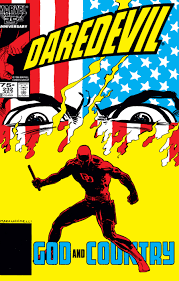 DAREDEVIL #232-233 (July & August 1986)
“God and Country” / “Armageddon”
Writer: Frank Miller
Artist: David Mazzuchelli
Colourist: Max Scheele
Letterer: Joe Rosen
Editor: Ralph Macchio
We’ve skipped a few more issues here, including the tail end of Denny O’Neil’s run. The villain in issue #225 is the Vulture, on loan from Amazing Spider-Man. Issue #226, O’Neil’s final issue, is a Gladiator story. And that brings us to issues #227-233: a seven-issue return for Frank Miller as writer, and the end of David Mazzuchelli’s run as artist. This is “Born Again”, one of the best known stories in Daredevil‘s history. The main villain is the Kingpin, and we’ve covered him before. But he brings in a hired gun for the final two issues, and Nuke is absolutely within our remit.
Before we get to Nuke, though, we need to take a look at what’s already happened. In part, that’s because “Born Again” is important – not just in the sense that it’s an acknowledged classic, but because it makes sweeping changes to the character and to the book’s status quo that will be important going forward. But we also need to look at it simply to figure out what Nuke is doing in this story at all.
The basic idea of “Born Again” is very simple. Although it’s only seven issues long, the story covers an unusually long time frame. By modern standards it’s extremely compressed, but it’s for the best, since the plot calls for long stretches of Matt doing very little and being wholly ineffective – told at a modern pace, it would be glacially depressing.
The story brings back Karen Page, Matt’s Silver Age love interest who left to become an actress. She hasn’t been a regular character since issue #86. Her career has collapsed, and she’s now making porn and addicted to heroin. When she trades Daredevil’s secret identity for drugs, the information makes its way to the Kingpin, who sets about destroying Matt’s life. Matt and Foggy’s law firm had already collapsed by this point. Now the IRS freeze his bank account, the bank repossess his house, he’s falsely accused of bribing a witness, Glorianna dumps him (we won’t be needing her any more), and he loses his licence to practice law. The plan is meant to end up with Matt going to jail, but Foggy manages to stop that. So the Kingpin blows up Matt’s house instead.
Matt winds up homeless and has a nervous breakdown. He fights the Kingpin and loses. Kingpin tries to have him drowned, but Matt escapes, and he’s nursed back to health by nuns who improbably include his long-missing mother Maggie. This is the turning point. Later writers have tended to lose sight of this, but Matt wasn’t noticeably religious up to this point. He finds religion as an adult when at rock bottom and it becomes a much bigger part of his character from this point onwards. Hence “Born Again”.
Meanwhile, the Kingpin is trying to kill everyone else who might have learned Daredevil’s identity along the way, which includes Karen herself. She returns to New York hoping that Matt will protect her. In part four, an out-of-costume Matt rescues her from a Daredevil impostor working for the Kingpin – his first actual win of the storyline. He forgives her and, by the start of issue #5, the two are reunited and starting to rebuild, with Matt working as a diner chef. Infuriated, the Kingpin becomes obsessed with finishing the job, and this is where he brings in Nuke.
Nuke is a bare-chested blond soldier with bullets draped over his shoulders, a massive gun, and an American flag apparently tattooed on his face. The flag is done purely in colouring; there are no lines, at least in the finished art. He takes red pills before going into action – he also has white and blue ones, which seem to keep him under control. We first see him in Nicaragua, on a mission to blow up some military installation. But despite his handler gently reminding him that he’s in Nicaragua, Nuke is utterly convinced that he’s in Vietnam, attacking a POW camp to liberate “our boys”. In other words, he thinks he’s in Rambo, which came out the previous year.
He’s an American government super-soldier, ostensibly in the tradition of Captain America, but the Kingpin has obtained his services by blackmailing a general. The Kingpin briefs Nuke in an office bedecked with American flags. It’s the usual right-wing stuff about true patriots being under siege, with some nonsense thrown in about how the poor Kingpin has simply been forced to break the law just in order to keep the American dream of free enterprise alive in the face of “endless, corrosive legislation”. Nuke listens to all this attentively – well, as attentively as he can, given that the can barely contain himself at the mention of “our boys” – and seems to be clearly on board with this paranoid worldview of liberals.
Nuke dutifully attacks Hell’s Kitchen with ordnance, prompting Matt to finally return to action as Daredevil. The ensuing fight causes so much chaos that even the Kingpin won’t be able to cover up. Daredevil manages to beat Nuke, only for the Avengers to turn up and take him into federal custody – presumably at the behest of the corrupt general who supplied Nuke’s services in the first place. But Daredevil doesn’t find Nuke all that interesting, and turns his attentions back to the Kingpin. Instead, it’s Captain America who investigates Nuke. He learns that Nuke is Frank Simpson, and that he is indeed the final survivor of a botched attempt to create new super-soldiers.
Unfortunately for the military, now that he’s been released onto American streets, Nuke has become convinced that he needs to fight the vaguely-defined enemy at home. So he breaks out of custody in order to return to his mission. Captain America defeats him, and Daredevil winds up taking him to the Daily Bugle as evidence. The strong indication in Miller’s story is that Nuke is mortally injured – he consciously chooses not to take Nuke to hospital, on the grounds that there’s “one purpose he can still serve”.
In the context of “Born Again”, Nuke is an odd character. The rest of the story is a psychological melodrama which tears down the book’s status quo and leaves a clean slate for the next writer to rebuild. In trying to destroy Matt, the Kingpin ends up simply freeing him from the shackles of his dual identity, and giving him the impetus he needed to start a new life, truer to himself. Matt could have had a rematch with the Kingpin for the final act, but that had been done before, and so it makes some sense to bring in a proxy in order to raise the stakes. But the proxy in question is an intentionally broad Rambo parody who isn’t even sure what continent he’s in. What’s he doing here, in this story?
Well… it’s a story about the fragility of the system in which Matt has placed its faith, with the whole thing collapsing in the face of corruption. Even though only one senior military officer actually seems to be outright compromised by the Kingpin, everyone else is willing to go along with his orders anyway. And in a story about the emptiness of the structures that Matt’s life relied upon, Nuke, a literal embodiment of government force, is the final distillation of that. He’s barely a functioning character at all; instead, he’s an intentionally empty symbol, driven completely mad by the same blind faith in the system that had trapped Matt.
Captain America, of course, is here to represent a more decent side of patriotism. But he also lacks the blind faith in the institutions that claim to embody that patriotism; he has no hesitation about distrusting the army and pressing his investigation. More to the point, he finds Nuke offensive. Perhaps the key scene here comes when Cap tries to ask Daredevil about Nuke. Daredevil clearly doesn’t think Nuke is a very interesting topic of conversation, and asks why Cap cares about him. Cap answers that “He wears the flag”, to which Matt replies “I hadn’t noticed.”
For Matt, of course, this is literally true – he can’t perceive colour, so he has no idea that Nuke has a flag tattooed on his face. He just registers a cartoon soldier. But Cap doesn’t know that, and he takes it as a statement that the flag no longer means anything to Matt. Perhaps he’s right there too. The flag means an awful lot to Nuke, of course, but the wrong things.
In some ways, Nuke is almost sympathetic. He’s paranoid and insane, but he’s sincere. He’s not out for himself. He really, honestly believes he’s defending his country. He just believed too much that the system represented the greater good, and this is what it did to him. His patriotism has been exploited by cynics – not just the Kingpin, but the Pentagon. But at the same time, they overestimate their ability to control his deranged nationalistic fervour, and he winds up contributing to the Kingpin’s downfall without realising it. If he was smart enough to understand the plot, he might even approve.
Nuke doesn’t appear in Daredevil again. Miller strongly implied that he was dead, and while that’s hardly conclusive in superhero comics, you can see why it would put people off bringing him back. He finally showed up alive and well in Wolverine: Origins in 2006, in a story that actually had a use for a damaged super-soldier. Since then, he’s wandered around the Marvel Universe and even had a stint in the Thunderbolts.
But Miller’s Nuke was relentlessly one note by design. In theory you could develop him beyond that, but in the context of Daredevil, it would miss the point. Not only would the resulting character would be a more natural fit for Captain America or Wolverine, both of whom have rather stronger feelings about Nuke’s symbolism or his back story, but the “reborn” Daredevil just doesn’t find Nuke very interesting. He represents the forces that Daredevil is moving past, and the book doesn’t have any use for a second Nuke story.

The entry I’ve been waiting to read.
The general behind Nuke in these stories is General Haywerth who later becomes a supporting character, a member of the Commission, in Captain America.
D.G. Chichester apparently didn’t realize that General Haywerth in Captain America was supposed to be the same General as in Born Again because he had a general show up in issue 300 to testify against the Kingpin about the Nuke incident while Haywerth was still appearing in Captain America.
Nuke’s death was confirmed in Captain America 333- Haywerth tells the Committee that Steve was in the vicinity when both Nuke and G.I. Max “met their demises”.
Matt kills people in a helicopter attacking Hell’s Kitchen in this story and it’s barely commented on.
Nuke was brought back by Daniel Way in Wolverine Origins in 2006. Way established that Wolverine helped to turn Nuke in the monster that he is today, including by techniques like coercing his father into killing himself and torturing Nuke.
Nuke also is notable for temporarily crippling US Agent during Siege.
This is a very timely review, since Nuke will be appearing in the Wolverine: Weapons of Armageddon limited series that starts this Wednesday.
Nuke is a gateway to the Nocenti run. In addition to introducing Catholicism as a recurring DD motif, Born Again introduces criticism of America as a major DD theme, and it will continue to be so, on and off, right to the present day. It had been done before on occasion – e.g. thinking of Gerber’s Mount Rushmore scene – but this feels different.
In the near future, Bullet will be introduced as a similar kind of character to Nuke – one who primarily works for Uncle Sam and represents the corruption within the system Matt used to uphold – but unlike Nuke, Bullet has a personality. You can tell more than one kind of story with him.
Born Again could easily have been told with Heather Glenn instead of Karen Page, had O’Neil not killed her off; it would have been a much more natural progression of where we last saw Heather than Karen. On the other hand, I don’t think Heather would have been as useful a character to Nocenti in the run that followed.
@Skippy- I agree that it’s hard to see how Karen went from her last appearance in Marvel Two-In-One 46 to Born Again. But I think part of the problem with using Heather is that the plot requires Karen to be broke so that she sells Matt’s identity. Heather seemed to be very wealthy the last time we saw her.
A very well-regarded storyline. Not by me, though.
Way too much red-blooded posturing by far too many characters, easy and unconvincing “solutions” to what are blatantly deep and difficult problems, and neither “what is true patriotism” nor “finding Christian faith” are plots with any traction whatsoever far as I am concerned.
Not a fan of Mazzuchelli’s art either. Or of the casual, barely commented act of having our hero blowing up a helicopter with people inside.
Of course, this was after TDKR, so I was already forewarned about the Miller preference of drama over ethical substance, so I came with very low expectations.
There is apparently a market for patriotism-spouting characters out there. Thankfully I am in no danger of being a part of that.
I still wonder at times what is the nature of the appeal, though. It is quite alien to me.
Well, yes, the Captain America character does tend to represent “patriotism” (considering the character name), and he does tend to be a fairly popular character at Marvel (being published since 1964).
I’m not sure what’s wrong with the discussion about patriotism in this story. Yes, you may disagree with the sentiment that patriotism is something which should exist at all; however it’s hard to argue with the message being given with the use of Nuke, especially given the reality that like it or not patriotism does exist in varying forms for many people, which is that powerful, cynical figures can misuse patriotism to mislead for their own agendas.
You could argue that patriotism is simply an ideology that is always put to this use, even with the best of intentions, but Miller is meeting half-way with his argument about Nuke, and in a shared universe featuring Captain America, it’s hard to argue fully for the idea that patriotism in any hands is a sum negative without leading to fans questioning what this would mean for the character of Captain America (which, Nocenti will address during her run in a story where Rogers is apparently high on drugs).
—————————————————-
Speaking of Wolverine, it was stated in that dreadful, dreadful story that the flag on Nuke are scars carved into his face by Logan’s claws.
Nuke’s persistence as a character is a bit surprising, given that he’s so very, very tied to 1980s American perceptions of the Vietnam War and the defense establishment more generally.
In terms of character motivation, as Paul notes, he’s fueled by the “backstabbed troops” idea and the “POW/MIA” myth that informed the Rambo movies and other pop culture of the era. But those elements are treated here as signs of a paranoid, corrupt, and ultimately self0destructive form of nationalism.
But he’s also a hyperbolic take on the “damaged soldier” idea. He pops pills that are very clearly signaled as “uppers” and “downers,” recalling the pop-culture take on narcotics use by draftees and traumatized veterans in the Vietnam War.
And his codename is pure Cold War, reflecting both the reasons Vietnam was effectively a proxy war with the Communist countries and the nuclear fears that spiked again around the time “Born Again” was published. It’s also a name that makes him not merely a living weapon, but an especially scary invocation of a weapon that should be too terrible to use. But, of course, a corrupt establishment ultimately turns this weapon loose on its own people
Miller treated nuclear arms this way in his other stories around this time, such as The Dark Knight Returns, and with his paranoid President obsessively holding the nuclear button in Elektra: Assassin, implicitly threatening to use it if he loses the next election.
More broadly, there’s some similarity with Alan Moore’s uses of the Comedian and Dr. Manhattan in Watchmen as emblems of a deeply flawed concept of American military activity in Vietnam and beyond. Nuke also has some visual and thematic overlap with some of the characters and imagery from Marshall Law, which had its own version of “superheroes in a Vietnam-like conflict.”
Nuke is an example of an archetype that turns up in a lot of 1980s superhero comics that aim for mature themes and social commentary.
@Michael and @Skippy: Perhaps the general from #300 is the unnamed general who the Kingpin pressures into loaning out Bullet during Nocenti’s run. The Nocenti-era general doesn’t seem to be Haywerth; for one thing, he’s far too cowed and uncertain.
@Chris V: IIRC, that story also suggests that Nuke’s pills were just placebos that triggered psychological conditioning, which rather misses the point of the original take on the character.
Rick Remender did get some thematic mileage out of a more on-model version of Nuke in what I’d argue was the single best arc of his rather variable Captain America run.
Given it’s 1986, I always presumed Nuke wore Road Warriors-style face paint, since he looks like a roided up pro wrestlers and this is the time when we start getting lot of the copies of the Warriors, including Sting and the future Ultimate Warrior as the Blade Runners.
Being Canadian, I’m trying to imagine Nuke having a mid-80’s Canadian counterpart with a Canadian flag painted over his face, but it’s a little hard to imagine what such a character might be worked up about, apart from Wayne Gretzky being traded to the Los Angeles Kings.
Trying to fool all the Yank and British readers of this site by pretending that Captain Canuck never existed. I mean, I don’t blame you.
@Moo: I don’t know about the 80s, but obviously if this story were written today and by Saladin Ahmed, Nuke would indeed be Canadian.
Anyway this is a good write-up. I haven’t read “Born Again” since I was a teen and I believe I did think Nuke and Captain America were a bit out of left field at the time, but I didn’t have the analytical ability to see what Miller was going for. I’m convinced by Paul’s take.
@Chris V – Oh, not at all. As a matter of fact, I find Captain Canuck far less embarrassing than Alpha Flight (a team that includes a character based on a hockey puck), but Canuck is more of a Captain America equivalent and I’m thinking of Nuke.
@Omar- Nuke WAS mostly ignored after the Cold War ended until Daniel Way brought him back and completely revised his origins. in Daredevil 233, Cap researches his origins and learns that Nuke was one of several men who volunteered for an attempt to recreate the Super-Soldier Serum- the others died but Nuke survived but was driven insane and taken advantage of by the government. in Captain America 333, the head commissioner asks General Haywerth for information about he “most recent” attempts to recreate the Super-Soldier Serum and Haywerth mentions Nuke and G.I. Max. The clear implication is that Nuke was an ordinary dude who volunteered for a project to recreate the Super-Soldier Serum relatively recently and was driven insane.
But when Daniel Way started writing Wolverine: Origins he wanted to show the readers that Wolverine did monstrous things before joining the X-Men, so he retconned that Wolverine was responsible for Nuke. But that wouldn’t work with Nuke’s original origin- nobody would come to Wolverine to recreate a Super-Soldier Serum. So Way decided that Wolverine had been manipulating Nuke since childhood to turn him into a monster.
One pedantic correction – Born Again is 7 issues, not 6.
Interesting timing for this entry – I just finished the Born Again volume of Bloomsbury’s Marvel Age of Comics series.
That it is. I’ll fix that.
Man, that cover is iconic. What a masterpiece.
Also possibly relevant to this: in New X-Men (2001) #145, Wolverine finds a few images of Nuke when he’s looking through the files of the Weapon Plus program. Not sure if that’s what led to Nuke’s subsequent appearance in the Way-penned Wolverine issues in question…
Nuke was Weapon VII, part of Project: Homegrown, experimenting with soldiers from the Vietnam War.
There was no reason for Way to ruin the character just because Morrison tied him to Weapon Plus. Captain America was Weapon I (per Morrison), that didn’t make Way decide to ruin Steve Rogers too. Way’s reasons for ruining so many characters are varied and multi-faceted. If you were a Marvel comic book creator during 2002-2012, just be glad that Way didn’t decide to ruin your creation too.
I think Nuke can still be salvaged. He needs a new look, though.
Everyone can visualize what the Nike logo looks like, right? Imagine that logo painted across his face instead of the American flag, but instead of “Nike” it reads “Nuke”.
Bet you all wish you thought of that, huh? What can I say? It’s a gift.
Great stuff Paul!
–because I’m old enough to have read the issues as they came out, and because I was a dumb teenager, I also have a copy of Marvel Age #36 – the main “article” of which is on the then upcoming return of Frank Miller to Daredevil.
As far as promo-pieces go, it’s pretty good, and quotes Ralph Macchio, and Miller. This is from December 1985 I believe.
Interesting things from the piece –
It talks up Elektra Assassin, and very noticeably, includes artwork from what will be Elektra lives again.
That the intention was for Miller and Mazzucchelli to continue working on DD after #233.
No indication that Romita Jr. is about to be shifted off X Men to take over on Daredevil with Ann Nocenti ( continuing X Men editor I think )as writer.
As I understand it, there’s about a 3 month lead time from production to publishing, it seems odd to me that there wouldn’t have been some kind of promotion of Romita Jr, who must have been their hot artist at the time.
Also going strong at the time is the creators rights movement, of which Miller is at the forefront. Specifically the end of ’85, beginning of ’86 there is a pretty strong call for Jim Shooter and Marvel to return Kirby’s original art.
Daredevil #233 has a dedication to Jack Kirby.
Denny O’Neil, among others, exit Marvel and go over to DC to run the Batman office.
Miller and Mazzucchelli start working on Batman: Year One some time in 1986.
I don’t know if Jack Kirby ever got his originals back.
@Matty- John Romita Jr. didn’t start drawing Daredevil until Daredevil 250, almost a year and a half after Born Again ended. What happened was this- John Romita Jr.’s last issue of X-Men was Uncanny X-Men 211, cover dated November 1986, three months after Born Again ended. Romita Jr. moved to Star Brand, a New Universe title. But the New Universe turned out to be a flop. And by the time he left Star Brand, Marc Silvestri was already pencilling Uncanny X-Men. So Romita Jr. wound up on Daredevil.
Thanks Michael –
Of course !
that explains it all – how could I have forgotten the New Universe ? Poor old John Romita Jr.
DD #234-#249 probably worth a look at.
As a teenager in rural America, I loved the gimmick of Alpha Flight having a member from each province/territory, even if they may have been a little caricaturic.
Byrne should have done a story where an American hero from upstate NY or Washington wanted to join but CanCon prevented it,
Are you asking if those issues of DD are worth reading? If you enjoyed Nocenti’s run with Romita Jr.? Definitely. I would argue that Nocenti’s run hits its peak with Romita Jr. though, but the entire run is well worth reading.
Nocenti’s run doesn’t start until 236 though, or actually 238. 236 is a special issue written by Nocenti with art by Barry Windsor-Smith. Nocenti wasn’t supposed be the new writer, Englehart was starting with 237. There’s debate as to why Englehart quit after turning in the script for 237; he claims it was because Nocenti ruined his Karen Page plot, but that seems suspect to me, with the other reason offered being that no one wanted to write DD coming off of Miller, and Englehart thought his run was doomed to failure due to being constantly compared to Miller (which, based on his writing on FF may have been a very real concern).
Anyway, so Nocenti officially takes over the book with 238. She doesn’t really get a full-time artist until Romita Jr. comes aboard.
Oh, and as a bonus, Nocenti has one last DD short story in the Marvel Holiday Special 1992 anthology. No Romita Jr. art.
I’ve got a lot of fondness for this one, not the least of which because I wrote my Year 12 final exam essay on it a few decades back.
The writing and art is great and it’s a really memorable storyline.
I’m hardly an Alpha Flight expert, but did any version actually have 12/13 members? (One from each province/territory.)
I have to figure that the three territories (combined population 117,322) and PEI (population 154,331) are going to have pretty slim pickings in terms of potential member due to their low populations. (I mean, you don’t even have current NHL players from every territory.) Though, I’m now kind of tempted by the idea of a series of Anne of Green Gables-themed superheroes from PEI.
I don’t think a one-from-each-province Canadian team would get along so well. I think there’d be a lot of mockery going on.
I imagine a USA one-from-each-state superhero team would be the same way. Like if the hero from West Virgina showed up to a team meeting in a bad mood, one of the other forty-nine heroes is inevitably going to ask him if he woke up that morning on the wrong side of his sister.
“Though, I’m now kind of tempted by the idea of a series of Anne of Green Gables-themed superheroes from PEI.”
The manga/anime Bungo Stray Dogs features superpowered characters based on authors and their works, including a Lucy Maud Montgomery resembling a more embittered Anne Shirley. (Anne of Green Gables is a set book in Japanese schools and had a popular anime adaptation made by future Ghibli staff, so it crops up there more than you might expect.)
@Luis – I’d be curious to know what you don’t like about Mazzuchelli’s art? Not that you’re not entitled to your opinion about it, I’ve just usually heard it spoken about in glowing terms, so I’d be interested to know what doesn’t work for you. Is it the abstraction?
As a Canuckophile, I counted and have been to 9 provinces and 2 fly overs. Yes, I have seen hockey (nhl and junior) in 6 of them.vacationed in Atlantic Canada in the summer, when I think we went to both St John and St John’s on the same trip. Never been to the Arctic provinces; but did go out on the Glacier between Calgary and Edmonton.
“…did go out on the Glacier between Calgary and Edmonton.”
I’m guessing you might be referring to the Athabasca Glacier? In Jasper National Park.
That’s not between Calgary and Edmonton, though. Not directly anyway. It’s way west in the mountains. The highway between Calgary and Edmonton is a flat, boring as hell 300 km (186 mile) straight-line drive.
Could be. It was the one where you go out on the buses/trams where the tires are taller than most people. You go like 5-10 miles an hour. I remember the guide pointing to scraggly tires maybe a foot tall and tell us they were like 300 years ago or something like that.
It’s been at least 15 years, so my memory is not perfect. It may or may not have been when we also went to Lake Louise for my 40th in May and it was inbetween resort seasons, although it snowed and the lake was still frozen.
I have always like the scene where the avengers turn up it shows them as step above daredevil in a couple captions and images, makes them feel important and shows that thing have escalated beyond Matt and needs real Heroes to control.
Born again is better the the miller 1 because it is a much tighter story with no weird diversions like the king in the sewers.
Has we moved in to Nocenti we get to count down to Matt greatest foe,only a handful of entries untill Paul gets to write 1000 words on the motivations and legacy of the Vacuum Cleaner lots to look forward to post miller.
Tires?
@Moo
https://youtu.be/JHhrhwkQ26s?si=JPAEF9maeY0CzqAt
Yes, it is Jasper Park/ice Field with the tour “buses” with the giant tires.
@Mark Coale
Interesting, thanks. That’s only a three-hour drive away from where I’ve lived my whole life.
So, naturally, I’ve never been there.
@Matty: Jack Kirby got a fraction of his original pages back. The rest were missing. It has been speculated that many were stolen by staffers and freelancers and kept or sold to collectors. It has been claimed that some were destroyed in a flood that affected a warehouse Marvel was using. There’s a lot of speculation, and researching “what happened to Kirby’s artwork?” leads down a pretty big rabbit hole.
Nuke’s dialogue prefaces where Miller’s writing would go in the future: characters repeating catchphrases while fighting. Sin City and later works are full of this tic. I like a lot of this issue, but I think the end of 232 works better as an end to the arc. Matt & Karen reuniting has more emotional heft than most of 233.
Nocenti’ & JRJr’s DD is 100% worth reading. It’s unlike anything else I’ve ever read from Marvel. Also, Nocenti wrote an excellent short story for DD 500 that was drawn by David Aja, much better than the main story in the issue.
As for Alpha Flight:
Alberta: Shaman, Talisman, Vindicator
B.C: Sasquatch
Newfoundland and Labrador: Marrina
Northwest Territories: Snowbird
Ontario: Guardian
Quebec: Aurora, Northstar
Saskatchewan: Box, Puck
So it looks like Manitoba, the Maritimes, and the Yukon didn’t have an Alpha Flight member. Neither did Nunavut, but that didn’t exist at the time.
Well, there’s probably a superhero based on an oversized tire around here somewhere. Maybe it’s time to go check out that glacier.
Did the Big Wheel ever turn good?
@Mark Cosle- Yes, in Spider-Man Unlimited 12 and iron Man 16 in 2022. Unfortunately, he managed to cause more harm than good in both of these stories.
Okay, because no one demanded it, I took the liberty of creating four new Canadian superheroes. Two of them address the lack of heroes from Manitoba and the Maritimes as noted by Taibak, and the other two… just because.
“Wild Rose” (Alberta): Her name is Rose and she grew up in the wild. As a result, she never learned manners and has been shunned by Canadian society at large for failing to meet the nation’s minimum standards for politeness. (The wild rose is Alberta’s provincial symbol).
“The Blue Bomber” (Manitoba): Despite what the name might suggest, this character has nothing to do with bombs (the explosive type). He’s called the Blue Bomber because by most accounts, he’s the worst stand-up comedian in the business and has been known to empty out a room more quickly than an actual bomb scare. (The Blue Bombers is the name of Winnipeg’s CFL football franchise).
“Jerry” (Saskatchewan) Jerry is a farmer. That’s it. Just a farmer named Jerry. He was the closest thing they could find to a real superhero in Saskatchewan and was chosen solely on the grounds that he happens to be a very good farmer. He might even be the best at what he does. (Jerry is based on my grandfather, who was also a farmer and pretty good at it, so I’m told).
“Norman, the Sub-Maritimer” (Prince Edward Island). He has gills and can breathe underwater. Ironically, however, he can’t swim. He once went missing underwater for nearly a week until he was found and rescued by some scuba divers. He was fine apart from a touch of hypothermia. By many accounts, his wife appeared to be disappointed when he was returned home safely.
You missed the chance to have a hero named Rough Rider and a different hero named Roughrider.
#nicheCFLjoke
@Mark Coale – Oh, it occurred to me. I passed on the chance. It was a toss-up between Roughrider and Blue Bomber as I didn’t want to do two heroes based on CFL teams.
I settled on Blue Bomber because I couldn’t think of anything for “Roughrider” that wasn’t pornographic.
There was an old sketch comedy show that once did a quiz segment: Canadian football team or brand of condom.
And no New Brunswick hero yet? 🙁
Figures. I create the first Maritime province superhero ever but I apparently didn’t choose the right province. I swear, there’s just no pleasing readers.
Also, I just now realized that Mark’s gag about the fact that there used to be both a Roughriders (Saskatchewan) and a Rough Riders (Ottawa) franchise existing in the CFL at the same time sailed completely over my head.
My original idea for Norman, the Sub-Maritimer was that he wasn’t married and he was pined after by a local islander woman, but he flatly rejected her because she wasn’t a mermaid and he’s a hydrosexual.
The board did not like my Canadian flag emoji.