Planet-Size X-Men #1 annotations
As always, this post contains spoilers, and page numbers go by the digital edition.
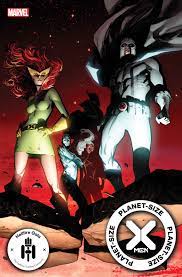 PLANET-SIZE X-MEN #1
“Fireworks”
by Gerry Duggan, Pepe Larraz & Marte Gracia
Planet-Size X-Men. This one-shot is the first issue to bear the name. It’s a play on Giant-Size X-Men, of course.\
COVER / PAGE 1: Marvel Girl, Iceman, Storm and Magneto hovering on a rock in the shape of the X-Men logo, in front of a (presumably Martian) red background.
PAGES 2-6. The omega mutants begin terraforming Mars.
What’s actually happening in this scene is fairly self-explanatory – really, the plot of this issue boils down to “the mutants terraform Mars and teleport Arakko there, and do it all live for the attendees at the Hellfire Gala to watch”. It’s an exercise in showing it at length to emphasise the scale of the endeavour.
Attentive readers may be asking “Hold on, doesn’t Krakoa have a presence on Mars already?” Indeed it does, and the fact that it’s not mentioned in this issue rather suggests that it’s regarded as an unwelcome complication. We saw a flower being planted on Mars in House of X #1, and the resulting Red Farm in Marauders #8. But the script for House of X #1 clarifies that the Martian presence is in the Garden, a very small area of Mars which was already terraformed by Ex Nihilo during Jonathan Hickman’s Avengers run. This is the first time that the mutants themselves have tried to terraform the place.
That aside, the Marvel Universe Mars is indeed largely depicted as a real-life dead world. As you might expect, there are a few horror/sci-fi stories knocking about with Martian invaders, but most of them can be easily dismissed as using “Martian” as a generic term for aliens. Besides, there seems to be only one example that post-dates the debut of the Fantastic Four: Tales of Suspense #29, where the invading alien does indeed claim to come from Mars. Mind you, it’s also a story where the locals identify him as a Martian by recognising the Martian insignia on his flying saucer. So you could make a pretty good case for it being non-canon anyway.
“You were promised fireworks…” The terraforming of Mars is the “fireworks” that were listed on the Hellfire Gala running order.
PAGE 7. Recap and credits.
PAGE 8. Quote from Emma Frost. This comes from X-Men #21 (the immediately preceding chapter of the crossover). The original context is that she was inviting people to join her telepathically in viewing the “fireworks”, acknowledging their right to decline, and strongly advising against it.
PAGE 9. Flashback: Magneto speaks to Isca.
The Arakkans are causing trouble by behaving towards the humans in a way that’s undiplomatic even by Magneto’s standards. We saw something similar in Cable #10.
Isca continues to serve as the spokesman for Arakko, presumably because she’s the only member of the Great Ring (their version of the Quiet Council) that we’ve actually met so far. She’s standing under a tree that seems to have all sorts of decorative tags hanging from it; the significance is not obvious. Isca expressed similar bemusement about the Krakoans’ tolerance for normal humans in X-Men #16.
“Rii the Destroyer” is a new name and, presumably, just some random Arakkii. Chichibu is a city in Japan which does indeed have a distillery – the “master whiskey distiller” is Ichiro Akuto, who was also mentioned in Marauders #16.
PAGE 10. Flashback: Magneto speaks to Hellfire Trading.
Emma’s statement about medicines being requested in higher concentrations is difficult to follow – haven’t we been told that the Krakoans specified the dosage rate?
“We’ve lost our farms in the Savage Land.” In X-Corp #1.
The Mercury is the mysterious shape-changing vehicle used mainly by Christian Frost in Marauders. Presumably Magneto is using it for transport into space, though it’s not entirely clear why, since the X-Men already have a gate to Mars.
PAGE 11. Flashback: Cyclops and Captain America.
The old X-Men Mansion, serving as a symbol of the traditional X-Men set-up, and (as in House of X) overgrown with Krakoan plantlife.
PAGE 12. Flashback: The Quiet Council sign off on Magneto’s plan.
More or less straightforward. Magneto has two basic arguments here: first, they need to get the Arakkii away from the rest of humanity; second, this is an opportunity for the mutants to set themselves up as the spokesmen for the solar system in interstellar matters. (What everyone seems to be overlooking is that they’re not setting themselves up in that role. They’re setting the Arakkii up in that role, and the Arakkii are not on the same page with them at all. In Magneto and Professor X’s case, though, this may all be part of the grand plan.)
Everyone votes in favour, including both heroes and villains.
PAGE 13. The Omega mutants set off for Mars.
Presumably that’s the Mercury, and we really are just quietly ignoring the fact that the mutants already had gates to Mars. The S.W.O.R.D. space station can be seen in the background.
The collection of omega mutants here include three members of the Five, very rarely seen away from Krakoa due to their importance for resurrection – which illustrates how important this is. Magneto, typically, is talking about embarrassment as a “human emotion” as if there were any evidence to suggest that it doesn’t apply to mutants.
Two other high-power mutants are suggested as possible participants: Legion (currently appearing in Way of X), whom Magneto understandably views as far too unpredictable; and Franklin Richards, under his rarely used codename “Powerhouse”. Franklin was retconned into being a non-mutant over in Fantastic Four, hence Magneto dismissing him as a “pretender” (and thus analogous to the Scarlet Witch).
PAGE 14. Magneto in Otherworld.
Mercator. The first panel shows Magneto trying to enlist the aid of “Mercator”, an Otherworld kingdom which had a very peripheral role in “X of Swords”. According to the Otherworld cosmology established there, Mercator used to be populated by a race called the Telmenetes, but a mysterious force took over the land, renamed it Mercator, installed an anonymous king, and declines to explain further.
The fact that Magneto approaches the place in response to a question about further omega mutants may suggest that Mercator is in fact connected with Absalom Mercator, the reality-warper from District X (also known as “Mister M”). Way, way back in House of X #1, we were given a list of omega level mutants. Literally every other mutant on that list is either on this mission, or expressly dismissed by Magneto. And nobody is on the mission who is not on the list (aside from a couple of new arrivals from Arakko). So the implied connection between Mister M and Otherworld Mercator is… pretty strong.
Monarch. Jamie’s attempt to trade for Magneto’s cape is a callback to Hellions #5, when he tried the same thing with Mister Sinister. That thing he’s wearing in the final panel is actually called a mantle, but it’s a type of robe, I guess.
PAGE 15. Magneto meets the Great Ring.
It’s the first time we’ve seen any of Lactuca, Sobunar or Xilo. The first two were named in a data page in X-Men #16. They were part of the “Day” group on the Great Ring; perhaps Xilo is the third, redacted name.
Isca is very clearly presented here as the de facto leader of the Great Ring – at the very least, a “first among equals”. It’s notionally a round table for discussion just like the Quiet Council, but only Isca actually sits at it.
PAGE 16. Sobunar contributes the water to kickstart the Martian ecosystem.
“It’s no wonder Dryador fell.” In X of Swords: Creation, when the Arakkii forces invaded it.
Arabia Terra is a large area in the north of Mars.
PAGE 17. Storm terraforms.
Feilong Industries. Feilong is a mythical Chinese dragon. There’s no shortage of real-world Chinese companies already using the Feilong name. As far as I know, it’s the first mention of the Marvel Universe company.
PAGES 18-19. Elixir and Xilo terraform.
I’m not sure when Elixir’s powers got upgraded to figuratively healing ecosystems, but sure, whatever.
PAGE 20. The Arakkii are brought to Mars.
The idea here seems to be that the hyper-competitive Arakkii need to be presented with a challenge in order to feel comfortable that they’ve earned their island.
The External Gate was the gate to Otherworld created by Apocalypse in the run-up to “X of Swords”. Quite how it can be converted into a transport to Mars… look, don’t think about it too closely.
“The one island is now two forevermore.” “X of Swords” and the run-up thereto hammered repeatedly the fact that Krakoa and Arakko were parts of a single island that had been separated long ago. X-Men #16 established that they didn’t really want to reunite.
PAGE 21. Hope and Kid Omega enjoy the new beach.
Nil Fossae is a plains region on Mars.
“If the Arakkii hadn’t fallen and fought, there wouldn’t be a Krakoa – or Earth.” Hope is referring here to the Arakkii’s sacrifice when the islands were split into two, and they spent centuries in Amenth continuing the war against invading monsters.
PAGE 22. Arakko arrives on Mars.
The caption tries to claim that it’s a week after Arakko arrives on Earth in X-Men #16. That only really works if there’s a surprisingly long gap between X of Swords and X-Men #16, since there’s no possible way that everything from “X of Swords” onwards has taken place in two weeks. That would include five issues of each title, plus the entire King in Black crossover, and enough time to set up the entirety of the new S.W.O.R.D. operation.
PAGE 23-24. The Arakkii settle in.
Sobunar’s speech doesn’t entirely inspire confidence. The X-Men seem to be handing over a planet to a bunch of obsessive warmongers. But, to be fair to them, the Arakkii culture did become war-dominated when they were defending themselves against endless attacking armies. Yes, they attacked Otherworld in X of Swords, but that was under the influence of Annihilation. Maybe they’ll mellow out with no one to fight… or maybe they’ll turn on each other.
PAGES 25-26. Introducing the Lake Hellas Diplomatic Ring.
This is part of Magneto’s plan to set up Mars as an interstellar diplomatic post (and thus claim the initiative for mutantkind). Again, the problem is that he’s giving that initiative principally to the Arakkii. Then again, maybe the hope is that this will draw enough trouble to keep the Arakkii occupied and happy.
PAGE 27. Xilo creates statues.
These are statues of Apocalypse and Genesis, who remained behind in Amenth to rule there, in X of Swords: Destruction.
PAGES 28-31. Monarch creates S.W.O.R.D. Station Two.
He’s a reality warper, so he just conjures up a duplicate of the one from Earth. His rather literal interpretation of “giving birth to an idea” seems to be just his own eccentricity.
PAGE 32. Monarch creates Port Prometheus.
It’s a spaceport. Prometheus was responsible for creating humanity from clay, and stealing fire from the gods; I suppose the analogy is that the mutants are similarly challenging their station with this whole enterprise.
PAGES 33-34. Arakko is unveiled.
Magneto expects this to go down badly with the normal humans. Emma Frost, who makes it the centrepiece of her diplomatic party, presumably thinks otherwise.
PAGE 35. Data page: Arakko announces itself to the interstellar community, declares itself the capital of the solar system, and claims that someone-or-other is “the regent of Sol”. All going smoothly, then.
PAGE 36. Data page: a map of Arakko, with a mixture of Martian locations and as-yet-unexplained Arakkan locations. The “Hellfire Farms” are presumably the new Martian flower farms.
PAGE 37. Data page: a memo from Delores Ramirez, the CIA monitor from Marauders. She’s reporting back, fairly straightforwardly, from the Hellfire Gala. Consistent with her depiction in that book, she’s relatively trusting of the mutants, and expects that to be vindicated when her mind is scanned for interference.
PAGE 38. Data page: NASA give us some pseudoscience about how this all works, and throw in the information that even some sympathetic humans are a bit annoyed by the hubris of claiming the whole planet. DiRocco is a new character.
PAGE 39. Trailers. The Krakoan reads NEXT: BACK TO EARTH.

Minor nitpick, but Mister M is a matter manipulator (like Molecule Man) rather than a reality warper like Monarch – though ultimately matter manipulation is indistinguishable from reality warping in comics, particularly at those power levels.
I’m not clear on what Xilo’s power is supposed to be or how it works. Additionally, if you had told me that one of the Arakki Omegas had the power of omniscience, I would have assumed it was the one called Ora Serrata the Witness, since that name has some relation to vision. Not sure why the omniscient character is named after lettuce.
What did Exodus contribute to this whole endeavor? He seems to have just been standing around. He’s supposed to be the Omega-level telekinetic, but it’s Jean and Magneto who do all the major tele/ferro-kinetic work here.
I assumed Elixir’s role was that he was healing Xilo’s “blood loss” so that he could continuously discharge enough water to create an ocean.
It was Sobunar who created the oceans, not Xilo. Sobunar is the big purple axolotl guy, Xilo is the big worm who burrowed into the ground.
It’s not explicit in the issue, but I would guess that they opted not to use the Martian gates because of the violence of the terraforming process (Magneto hurling asteroids from across the Solar Systam, Vulcan tearing the mantle opened to expose the core). You wouldnt want Elixir walking around while that’s all ongoing
Note that in Way of X #2 it was Legion who turns down Magneto because he doesn’t trust Magneto.
Of course Magneto would claim it was the other way around, and even use the exact same excuse for it.
I don’t know. Where do you go after a story showing a small group of regular characters turning an entire dead planet into a sustainable biosphere in a week? Why didn’t they do that to Earth when Knull had his event? Why not use all this power on Earth to instantly kill all the humans so there’s no more sentinels? Any mutants killed in the event can easily be remade, after all.
The only way you can keep the ongoing Marvel Universe setting going is to immediately ignore that they have this much power. In which case, why bother doing it in the first place? I’m all for being flexible with continuity to tell a good story, but this is a bit much.
It has never been Moira or Xavier’s plan to kill all the humans.
The humans aren’t the true enemy.
At heart, I believe that Xavier and Moira do still want to save humanity.
It does present the idea that the mutants are achieving a level of scale where they could begin to hold their own against the Phalanx, and eventually challenge the Dominions.
If you are playing on such a vast cosmic perspective, you need to be able to operate at such a scale.
Remember in life six, post-humanity was arrogant. They felt like they were gods. They had turned a planet in to a world-mind.
That’s a vast, unimaginable scale for current humanity.
Yet, what did they discover?
In the grand scheme of things, they were still insignificant.
They attracted the Phalanx, who saw the only worth of organic beings to feed on them for energy. Post-humanity could be rewarded by becoming a tiny part of a vast god-being.
It put post-humanity in their place.
For mutants to be truly immortal, they need to realize that the universe is far more vast than mutants and humans squabbling over just one planet, or even the solar system.
—————————————-
On a different note, we still haven’t found out the purpose behind Xavier breeding Legion. He must have a large part to play in Moira’s plan.
Moira and Xavier planned the birth of their children for a specific role.
We know that Proteus was bred for resurrection.
What was Legion bred for?
I will say though, Si, and I’ve said this from the beginning: Hickman is writing a great science fiction novel which is hampered by taking place in a shared universe.
It’s hard to not feel like the Marvel Universe has been taken over by mutant books.
The scale that the X-Men are operating on compared with other superhero titles, it certainly makes Spider Man feel like an insignificant comic.
Si-Orchis is also to be considered. They are terraforming Venus, and have come pretty far using technology. There is already an entire Sentinel city operational on Venus.
They’ve also started work doing something with Mercury.
I don’t know the timeframe of how long it took Orchis to accomplish this, but it can’t have been that great a period of time.
We know that the Forge didn’t come online until Krakoa was established.
They had been operating on Venus and Mercury for a longer period of time, but Orchis hasn’t existed for that long.
Orchis beat the mutants in escaping for the planet. In some ways, they were ahead of the mutants.
Although, what the Omega-class mutants accomplished on Mars so quickly put them ahead of Orchis again, I’d say.
Still, Orchis is quite advanced.
I figured borrowing the ship was to make it easier for Magneto to pop on over to get all the asteroids needed, though I don’t remember that actually being supported anyway.
Otherwise… that happened. It wasn’t bad or anything, but considering how much it seemed to be the plan everyone suggested, “Yup, that happened” is about the extent of my reaction. A whole bunch of details explaining how it happened. They were all good details, but they combined together into the thing we thought would happen, and some specifics around Arakko that didn’t have a lot of weight to me because Arakko’s still mostly this blank slate.
I guess what I wanted were to see more reactions, or maybe details on that last “regent of Sol” namedrop that actually was a surprise.
So perfectly well done, but also not as groundbreaking as I think they hoped it would be.
I found the most interesting line to be Magneto name-dropping “dominion” again.
I doubt he would choose that word at random, since he knows about Moira.
Hickman is super into terraforming Mars, isn’t he?
@Chris V: I don’t think there really is a plan for Legion. Moira’s journals from HoXPoX suggest that they just needed a reality-warping mutant for resurrection in the future and that both she and Charles had identified potential mates to create such a mutant. Now that they have Proteus, they don’t need Legion.
On a more general note, I don’t think writers have ever had a plan for Legion per se – the in-universe story of Xavier being a neglectful and distant father is basically the product of writers not knowing what to do with David’s plot device powers and therefore avoiding the character. I like Legion, but I don’t think he would have ever played much of a part in Krakoa if it weren’t for Spurrier being a fan of the character too.
There are moments when this comic feels like the original run of The Authority, when big moments could still make you think “did that just happen” than “yup, that happened.”
I think the best take you can do on big widescreen moments now is go for quiet majesty, because there hasn’t been shock value in 20 years or so.
I’ve been reading the original New Mutants lately. The original Legion story had Xavier having no idea that he had a son. This in fact was one of the major plot threads. Legion was also much more a place for the story to happen than an actual character, having literally no personality. It’s another case of a character being meant as a one-shot becoming popular, stretched way beyond the original purpose, and not really working because of it.
By the way, that story finds a way to be grossly offensive to all sorts of groups. Arabs, autistic people, women, Arabs even more, and oh boy does it ever revel in Xavier’s gross abuse of a psychiatrist’s power over their patient.
Oh and just after that story is the return of Amahl Farouk, who definitely is Farouk and not the Shadow King.
I used to find the Legion story really offensive to Arab people, and maybe it still is in parts, but it’s more nuanced that I once remembered.
The Jack Wayne personality of Legion is presented as the villain, while Jemail, who became part of Legion’s psyche, redeems himself in the end. He is willing to work with the Jewish Israeli woman (Gabrielle) in order to stop the macho man aspect of Legion’s personality and save her son.
It’s really more a plea of tolerance than anything else.
It is terribly dated in its understanding of autism, and really mental illness in general. There’s no getting around that aspect,
The Xavier/Haller thing was definitely pretty creepy. Although good evidence for something like Onslaught or this version of Xavier.
K-.Yes. I’m thinking about the Authority killing “god” at the end of Ellis’ time as writer.
Si-Oh, you know what? Xavier must have reset his memories to an earlier backup after impregnating Gabrielle.
Xavier mentioned that he couldn’t deal with everything involving Moira, so he reset his memories two times.
I am now assuming the fact that he basically raped Gabrielle Heller for the purpose of breeding Legion was too much and he reset his memories.
So, that was one of the two times. That explains why he didn’t remember having a son, even though Hickman’s ret-con says he planned specifically to create Legion.
These kinds of stories remind me that Hickman really wanted to write an Eternals series. Just translate mutants/X-Men to “Eternals” and Arakko to “Deviants,” and it’s more satisfying. Then you stop and you realize you’re back in the Marvel universe and get frustrated.
I wanted to read X-Men comics, not this.
Barely anything is explained on the page. If you didn’t have these annotations or the vast knowledge of X-canon in your head already, what would make sense?
It may be a coincidence, but “Attempt no landing except at Port Prometheus” feels like a riff on the message HAL broadcasts at the end of Arthur C. Clarke’s 2010: “All these worlds are yours – except Europa. Attempt no landing there.” In that book Europa had its own developing species that humans were forbidden to disrupt, so there’s a similar sentiment.
I’ve been waiting since say, 1997 for the X-Men to do something BIG with their powers. I hated after so many years the X-Men standing in a line saying, “But will their ever be a day where they don’t hate and fear us ?” I despised all the resets to the status quo. Krakoa, so many mutants doing things, life saving human pharmaceuticals, Terra-forming Mars, It’s all so exciting for me again !
Did they really need anyone other than Monarch to do all this? The guy pulled a space station out of his belly at a moment’s notice. He couldn’t just drop some iron in the planet’s core himself?
I think it’s fairly clear that we’re headed for some version of a cosmic reset button for the X-Men line at the end of Hickman’s run. Moira’s powers have openly foreshadowed that since the beginning. No doubt a more traditional take on the X-Men will follow, probably timed to launch whenever the characters show up in the MCU.
In the meantime, I’m perfectly happy to run with the Hickman era for a few more years, and see where he’s going with all this. His Avengers run bought him a lot of credibility with me.
I’m not especially enjoying Excalibur or New Mutants, and I think X-Force is very hit or miss. But the other books range from good to excellent, and that’s a pretty strong hit rate.
ASV-I think it’s about Moira and Xavier’s goal to have mutants learn to use their powers together to accomplish greater goals…similar to the resurrection protocols.
The Omega mutants are seeing that by using their powers together they can change an entire world.
It’s based off of life nine, where Krakoa allowed Sinister to create the Chimeras. Sinister created clones with multiple power sets.
Each generation were growing more powerful than the next, until Sinister messed up the cloning procedure.
Moira doesn’t want to see the Chimeras in this life, but she learned about the potential that comes with such powerful mutants.
So, in this life, Moira and Xavier are encouraging the mutants to work together with their powers to accomplish things similar to the Chimeras.
I think Moira is working towards Krakoa becoming more like a hive-mind.
That’s how Xavier described the Five, that they were developing in to a voluntary collective.
At some point there has to be like a character arc or story resolution or something in one of these books right?
“That aside, the Marvel Universe Mars is indeed largely depicted as a real-life dead world.”
The Mariner 4 flyby of Mars happened in 1965, so it’d have been topical fairly early on in the development of the Marvel Universe, and it severely dropped the serious credibility of life on Mars.
(By contrast, the slightly earlier start of DC’s Silver Age and its continuous publications running back to the 30s give it more roots in a time when a habitable Mars was easier to suspend disbelief in.)
The “Attempt no landing” line HAS to be a nod to 2010.
@Uncanny X-Ben: Considering Hickman seems to expect readers to be emotionally invested in Arakko of all things… probably not, no.
There was once a Supergirl story in Superman Family #182 (1977) where Supergirl actually flew into space to rescue the Viking I probe so that it could send pictures of Mars back to Earth. Then she returned to her civilian life in order to join the crown in awe for the novel images of the red planet. Later still, in the same story, she fought Luthor on Mars’ surface.
It was a delightfully inconsistent tale, treating access to Mars as both routine and a marvelous accomplishment without batting an eye.
There was, of course, the Killraven series at Marvel, based around ideas from Wells’ War of the Worlds.
That was an alternate universe though, so I guess for some reason that universe had a Mars that was populated.
As for Xavier, David and Gabrielle, yes, that was pretty creepy stuff, and I must assume that Claremont realized that well.
He took his sweet time to show consequences after having Gabrielle reveal David’s existence to Moira. By the time that Xavier finally meets Legion they are busy trying to deal with the immediate crisis, and not too long after Xavier is hurt by Fenris and has to spend a long time away from Earth with the Starjammers and Lilandra. Right after trusting Magneto to lead the X-Men.
The whole set-up was meant to make us question how wise and how ethical Charles really was. Or at the very least to stop relying on his judgement quite so often.
Chris V: Killraven’s Martians were Badoon who had used Mars as a staging post. May be the Badoon will attack Arakko and take over mars ready for a war of the worlds revival.
That’s not really far-fetched.
In Moira’s sixth life, post-humanity had to defeat the invading Badoon.
It was at that point they realized that the universe is so vast that defeating mutants wasn’t a huge accomplishment in the grand scheme.
That’s how they ended up attracting the attention of the Phalanx.
That was in the far future of life six though.
That means the Badoon will probably attempt to invade the solar system again in this lifetime.
So Monarch pulls an entire space station out of himself and -then- whips up an entire space port. (My personal belief is that he yoinked them from another timeline, or from the future, or something.)
Between him, Proteus and Legion (and Scarlet Witch when she’s a mutant), that’s multiple mutants who can basically do anything they want with time, space, and reality. Humanity is right to be worried.
I love the thought of going big with their combined powers to terraform other worlds, change the world, and achieve other feats, because it’s way past time to see mutants do something more productive than beat up each other with their heat vision and sparkly fireworks and steel skin.
This reminds me a little of some of what JMS seemed to be trying to do in Rising Stars, way back when.
And it’ll be a shame when it inevitably has to be rebooted/reset/scaled back because Marvel will never let this sort of major change go on indefinitely… or will they? I guess comics are cyclical, change is an illusion, progress is a lie, and so on. And this kind of thing is probably too big to sustain once Hickman-as-architect moves on.
Re: Legion. His ability to essentially manifest any power possible through his personalities seems like it might be potentially significant if we get to the “chimera” stage of Krakoan progress. Or maybe he’s “designed” as a living Cerebro, where they’ll download backups of every mutant ever into his psyche as a last resort scenario.
(Imagine it now. The time has come when all has failed. Krakoa is doomed, Orchis has succeeded, and Moira has one life left. As the end approaches, they load David up with the collective memories and experiences of Krakoa, and fling him into the past, even as Moira dies. And then the entire X-Men sequence resets back to zero. “Dawn of the Mutants…”
They’d have to fling Legion in to a new timeline along with Moira.
Sending Legion in to the past wouldn’t save the information from Moira’s current life, unless Legion were able to exist outside of space and time as a Dominion.
I just don’t see Marvel restarting their universe over again, with most likely almost zero changes, like they let Hickman do with Secret Wars.
It seems like Hickman would just be redoing Secret Wars again. Everything is horrible. The universe ends. Everything restarts again, but almost the exact same as it was before the universe ended.
I am now foreseeing Moira succeeding and becoming immortal. She lives to the end of time. When the current Marvel Universe ends, she survives, and lives in to the next universe…since we know that the Marvel Universe is eventually going to end and give birth to a new universe.
Destiny’s words to Moira were along the lines of, “Ten lives, perhaps eleven…if you make the right choice in the end.”
The right choice being to survive the death of this universe and continue in to the next one.
I have heard rumours that the MCU may be interested in the current direction of the X-Men. So, this new direction could continue.
I’ve heard the rumour that the MCU is planning to introduce mutants as living isolated on an island, which is why no one has heard of mutants in the MCU yet.
Take it with a grain of salt, but it could be possible.
I don’t know about Mars being deliberately left barren by Marvel writers just because of facts. Facts didn’t even slow Stan Lee down. In Thor’s first appearance he fought the Stone Men of Saturn, a planet that is famously not made of stone.
Later retconned of course, as were the Killraven Martians. Speaking of Killraven, does anyone remember a decade or two back when multiple Marvel comics showed glimpses of the future, and they were all about Killraven-style Martian tripods?
It’s probably easier to keep Mars (and the rest of the solar system) lifeless since it’s so easy to jump to other galaxies now.
It used to take time to get to Shi’ar space, for example, but the X-Men seem to visit on a regular basis anymore.
So who needs stone men from Saturn when you’ve got plant men from Super-Far-Away-Planet whenever you want them?
I’m still shocked they didn’t use the Secret Wars reboot to clean up and modernize continuity.
What was the point otherwise?
I guess it was about writing a farewell to the Ultimate Universe.
Yes, though, that’s what has convinced me that Marvel is never going to totally reboot their continuity like DC is doing constantly.
If they didn’t do it with Secret Wars, I doubt they’re going to give Hickman a second opportunity.
Si – yeah, that upcoming Martian invasion was either dropped completely, or it was modified to be the Hydra takeover in Secret Empire, from something I think I read.
Marvel editorial has been saying since at least the late ’90s (so across several editors-in-chiefs) that Marvel doesn’t have Crises like DC, but Marvel does have Secrets. Marvel doesn’t reboot their history like DC does, they say, and are proud of it.
Marvel had to reiterate this several times leading up to and during Secret Wars, and as it turns out, they weren’t lying! History wasn’t rewritten and all of your favorite stories still happened.
So yeah, I highly doubt we’re getting a line-wide reboot at the end if this.
“Remember that time we all lived on an island, conquered death, fucked like rabbits, and were best friends with our worst enemies?”
“Oh yeah. The gas leak year. What a wild time that was.”
Marvel is probably wise to avoid true reboots. DC aimed high with Crisis and it did not turn very well for them.
Subtle as the distinction between whatever Secret Wars was and a true reboot may be, it seems to be enough to keep writers and editors far enough away from the temptation to provide “new and definitive takes” on previous stories and characters.
DC has largely failed at achieving that goal. The end result is an ever growing collection of presumably definitive yet rather provisional grand cosmic schemes and new retroactive timelines that will be lucky to last for five years before being revised again.
Their continuity is now unyieldly yet unreliable, underdeveloped and quite hazy, to the point that attempting to clarify it often becomes a major plot point in ongoing storylines.
“I have heard rumours that the MCU may be interested in the current direction of the X-Men. So, this new direction could continue.
I’ve heard the rumour that the MCU is planning to introduce mutants as living isolated on an island, which is why no one has heard of mutants in the MCU yet.
Take it with a grain of salt, but it could be possible”
Chris V, that would kind of ruin X-Men in the MCU for me. Little would distinguish them from the Eternals. The whole appeal that I got from it as a kid (mostly from the 90’s cartoon and then from the Claremont run) was that anyone living a normal life, not on a monster island, could hit puberty and suddenly have these uncontrollable changes that made them a pariah to society. Maybe the MCU needs to go in a different direction than “X-2” but I can’t imagine explaining all the backstory and retcons of House of X to an MCU audience, and without that the island is merely window-dressing.
I think the idea is that the island would be a haven for those who develop mutant powers, that there is an island where they can live and avoid persecution.
Xavier would call to them when they develop their mutant powers.
Something happens in the outside world which brings mutants to the attention of the outside world.
I don’t really follow the MCU, but based on what I have read, in a lot of ways the MCU version of the Inhumans kind of already took a lot of inspiration from pre-Krakoa mutants.
Which makes sense, since there was that period when Marvel tried to replace mutants with Inhumans, due to the FOX situation.
I think the MCU will have to move in a different direction for X-Men, considering that part of the premise of both Inhumans and Eternals is that these other species have been living unknown amidst humanity.
Then, do the same with mutants?
It would seem like non-comic reading movie goers who are following all these MCU productions would start to wonder how many damn plots are going to feature a secretive “other” living secretly with humans.
Then again, the rumours may be just rumours.
The Pre-Crisis multiverse was explained when needed by 1 panel with multiple earths. Simple enough for a kid to understand.
Crisis fixed some stuff but was almost undone and then the patching made it worse each time.
They should have stuck with Hypertime in the late 90s.
DC has ended up spending years writing lore about reboots.
Nobody wants a story about which reboot beats which other reboot. Nobody wants a story to straight up tell you how many more reboots are coming up for the rest of this century.
Isn’t DC set on ‘everything happened, even the stuff that contradicts everything else’ now, after the last round of Death Metal: Knights of Nu-Metal, or whatever it was called?
I can help plenty with old stuff, but I basically gave up on most of DC when Nu52 started. It was easier in my head to remember 70 years of continuity than the 10 since then, or whatever the years are now. 🙂
I don’t know, Krzysiek.
That is a proper question. Also a fine illustration of DC’s self-inflicted dilemma. Questions such as yours are both natural and proper yet also impossible to truly answer.
If past situations are any indication, the best answer may well be “Yes, it is. For now. With any luck it will still be in five years time.”
There were similar attempts at lasting answers in the past. Hypertime was one of my favorites, although it sort of made Crisis pointless. There was Multiversity a while ago. After Captain Atom rebooted the Wildstorm universe there was an attempt at establishing how the two related to each other, but it seems to have been forgotten soon enough.
Even the New 52 had a Earth-Two, and the current version of Superman actually went through a very convoluted story that makes him both the pre-New 52 Superman and the New 52 Superman (but not quite).
More recently there was a series of heavily publicized alternate realities Batmen leading to the Death Metal event, as you point out. And more or less at the same time there was Doomsday’s Clock.
Ultimately, most or all of those attempts end up drowning in a sea of uncertainty of canonicity. As DC keeps attempting to create ambitious high concepts to explain and sometimes resolve their various alternate realities, it ends up creating more and more open questions that are not likely to ever receive proper answers – and making more and more of their output be about the existence and validity of its own continuities, further complicating the situation.
I don’t think that clear continuity is even a selling point at DC anymore. They seem to have largely embraced a model of diffuse continuity, at least when other media come into play. There is no longer an expectation that animated or live action characters will have behavior and personality that roughly coincide with those of their supposed counterparts in other shows and media.
As I understand it, the current DC position is basically a reversion to Grant Morrison’s Hypertime: everything happened, but that doesn’t mean it happened in THIS timeline. Matters are complicated by some bizarre claims that characters also have memories of their previous incarnations, which looks like it’s going to be quietly ignored (in the same way that nobody pays any attention to the fact that Bishop remembers the entirely of the Age of Apocalypse).