X-Men #7 annotations
As always, this post contains spoilers, and page numbers go by the digital edition.
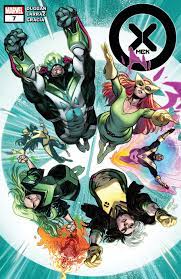 X-MEN vol 6 #7
“The Secret Origin of Captain Krakoa”
by Gerry Duggan, Pepe Larraz & Marte Gracia
COVER / PAGE 1. The X-Men fly into action, with Cyclops as “Captain Krakoa”.
PAGES 2-4. Dr Stasis drugs his chimeras before sending them to battle the X-Men.
Stasis’ use of animal chimeras sets him up as a parallel to the High Evolutionary and his New Men, who we saw in issue #3. It also echoes the references in House of X and Hellions to Mr Sinister developing “chimera” mutants as a way forward.
Bornan is the same aide we saw with Stasis in issue #2.
PAGE 5. Recap and credits.
PAGES 6-7. Cyclops is resurrected.
This storyline isn’t told in chronological order, so this scene shows Scott being resurrected after his death at the hands of Dr Stasis (which he see later in the issue). Emma really just tells us what we already knew from last issue: Scott died in a way that was so public that he can’t simply go back to the X-Men in New York without giving away the secret of Krakoan resurrection.
Now, I quite like the idea of Captain Krakoa in theory, but there are quite a lot of problems with it in practice. For a start, it’s the Marvel Universe and people have come back from seemingly incontrovertible public deaths really quite often. It doesn’t feel like it should be that hard to come up with a plausible cover story about clones or illusions or impostors or whatever. Which means you have to work extra hard to make the plot premise work, and I don’t think this story does that.
And two, if this is such a concern, why are characters like Jumbo Carnation allowed to wander around New York openly, given that he was a high profile celebrity death? And why keep throwing copies of X-Force at Orchis (as we learned in Inferno, which surely gives the game away to precisely the people you don’t want to know about it? Shouldn’t there be a bit more urgency for everyone about not getting killed, if resurrection is as top secret as this? It’s a nice enough story idea but the underpinning plot support is definitely wonky.
Jumbo Carnation, in the unlikely event you don’t know, is the mutant fashion designer who mainly appears in Marauders.
PAGES 8-12. The chimeras fight the X-Men in New York.
The chimeras are completely insane at this point, and while they’re meant to be fighting the mutants, they seem quite happy to attack anyone in sight. Perhaps they’re just causing some chaos in order to draw the X-Men out – Borman seems to be faking it when he joins the fight later on – but it looks a lot more likely that neither they nor Stasis care very much.
“It’s a nice change of pace from spaceships.” The X-Men fought various alien attackers (or the High Evolutionary) in issues #1-3.
Cyclops gets to dominate the field, partly to show us that he’s iconic, but also to remind us that the optic beams are very much his thing – so switching identities is easier said than done.
“What you said back at the Hellfire Gala.” Synch is referring to the election for membership of the X-Men. The one-panel flashback is the first time we’ve actually Scott’s pitch: “I am the X-Men.” This is basically right, of course – not only was he the first recruit, but he’s the one who stuck around into the 1970s and beyond. His stint away from the X-Men in the 1980s is a small part of his overall career.
PAGE 13. Stasis sends Bornan into action.
This is the clearest shot we’ve had of Bornan yet; apparently he’s got the head of a tiger on the body of a gibbon or something along those lines.
PAGES 14-17. Cyclops rescues a baby from Bornan.
Synch’s use of Jean’s powers is addressed after the main story, so we’ll come back to that.
Basically, this is Cyclops dying heroically while saving a baby. It’s not in the least subtle, and even in the Krakoan era, it feels a bit arbitrary for him to take that sort of damage that quickly while fighting a butler.
PAGES 18-19. Stasis, posing as an EMT, makes sure Cyclops dies.
Stasis tells Cyclops where to find him – the point is to test whether resurrected mutants keep their memories up to the point of death. We know that they don’t.
There are, again, some awkward problems with the mechanics here. The plot here absolutely hinges on Cyclops’ death being very very public, but all we get is a few shadowy people in the background – who have apparently materialised from nowhere in the three panels since Stasis dramatically slashed Cyclops throat. Again, for this plot to work, the death needs to be very public, and this… doesn’t feel especially public. Especially when the same story has a plot about Ben Urich’s memory being erased. Doesn’t this need the smartphones-and-Twitter, genie-out-of-the-bottle scene?
PAGES 20-21. Scott and Jean discuss matters in the Quiet Council chamber.
The Captain Krakoa outfit is evidently the creation of Forge and Jumbo, with Forge providing the mechanics that (presumably) use Scott’s optic beams to power him.
Ben Urich told Cyclops in issue #5 that he had learned about resurrection and was planning a story about it, but had lost all his memory of that by issue #6. Since Jean wasn’t responsible, Scott is understandably suspicious that Emma is the one covering Krakoa’s tracks – but he describes it as a feud with the Quiet Council as a whole, suggesting that he suspects she’s acting with the approval of the likes of Xavier. If Cyclops has a problem with the Quiet Council using telepathy to preserve state secrets, what does he make of X-Force?
The closing page seems to have Stasis viewing his EMT gear in a display case.
PAGE 22. Data page about Synch’s latest power-up, copying Jean’s powers when she isn’t even there. Dr Reyes suggests that Synch hasn’t been powered up to the point where he can copy someone on another planet – rather, he can use at least some powers that he’s synched to in the past. In Jean’s case, the fact that she’s a teammate and he’s spent a lot of time around her recently should help.
PAGE 23. Another data page, this time about the “Earth-Arakko-Relay” (or EAR) which allows telepathic communication between Earth and Arakko. Apparently these things are packed with cloned brain parts from Professor X. Lovely. And that sounds like the sort of thing with the potential to go very badly wrong. Interestingly, while EAR itself is public knowledge among the mutants, the rather unpleasant way it works is some sort of state secret.
The Cheyenne language is indeed endangered, with an estimated 1,900 or so speakers.
Blightspoke is the graveyard of failed dimensions which forms part of Otherworld over in Excalibur.
The Children of the Vault were the posthumans whose time-distorting Vault Synch and X-23 spent centuries trapped in (from their perspective).
The Beast was, we’re told, unhappy that the EAR was launched without him having any involvement. The heavy implication is that he would have wanted to bug the thing on behalf of X-Force. The lesser implication is that he’s been deliberately cut out of the loop for precisely that reason.
“Mutant communication is fundamentally telepathic.” I mean… it isn’t, is it? They mostly talk to one another, and the telepaths are a small minority. Let’s be generous and assume he means long-distance communication.
PAGE 24. Trailers. The Krakoan reads NEXT: MODOK – just like it says at the bottom of page 21.

“Basically, this is Cyclops dying heroically while saving a baby. It’s not in the least subtle, and even in the Krakoan era, it feels a bit arbitrary for him to take that sort of damage that quickly while fighting a butler.”
This is one of the big problems with the concept. Yes it cheapens death for the characters, as we saw in Way of X when Pixie deliberately got herself killed just to be cool. But it also cheapens death narratively. Supposed elite fighters like Cyclops and Wolverine, who have survived 50-odd years of stories (mostly), are now dying every few weeks, just because the writer can get away with it. Even when we knew a character would be back within six months, having someone die in the comic used to have an impact. Now they’re just dropping dead like rookies.
You could explain it away in-story by saying immortality is making the characters reckless or careless, but it still makes them look less competent.
The fact that resurrection is somehow still secret when it’s openly advertised to every single mutant is a difficult conceit to swallow. Like, are they actively stopping mutants from returning to their home countries if they’re not members of Hellfire? Because unless there’s mass telepathic control going on it would leak somehow-mutants who are self-interested, mutants who aren’t loyal to a country that’s existed for a tiny amount of time over their home nations, mutants who let things slip when chatting online…
Basically it’s another case where the writers ask us to believe that a supermajority of mutants are loyal to Krakoa above all else and all other loyalties fall away.
This sounds like a story Roy Thomas would have written in 1966.
We really need to see the Quiet Council members’ actual thoughts on this, not just the vote or party line. I can see it working if, say, Xavier and Magneto have realized too late that they don’t actually want to let the cat out of the bag, several people are humoring them ‘until we can get the message out on our terms’, Exodus is entirely happy to unrealistically try and keep mutant knowledge to mutants, etc.
But X-Men is setting it up as Scott vs the Council, so the QC is presented as a bloc and not individuals. That makes sense for the story, but as many have said it also makes the Council seem out of touch with the reality. They want to do information control after the horses have left the barn.
I think the best path would be if Immortal X-Men were already out and we got the ‘Council as a general antagonist’ plotline here, and then saw the details of what the Council members thought in Immortal. But we’re not there and it’s entirely possible Duggan hasn’t even thought it through enough anyway.
Oh, I can see most of the Council onboard with the decision to attempt to enforce silence about the resurrection protocols.
It’s going to lead to a human/mutant war when it’s finally revealed.
The Council may be deluding themselves that they can keep it a secret, but it’s basically an “ostrich with its head in the sand” defence mechanism. There’s no way to reveal this fact to the world without turning a majority of the human nations against Krakoa.
Krakoa offered helpful drugs as leverage for human nations to recognize Krakoa as a sovereign nation.
In practice, Krakoa has failed pretty miserably with their promises.
Xavier said these drugs would be a miraculous boon by wiping out influenza, Alzheimer’s, ALS, many types of cancers, and much more.
In reality, as we saw in X Deaths, there is a shortage of the drugs so that Jane Foster can’t even acquire the drugs in order to help Moira.
Then, Krakoa is going to reveal that mutantkind is functionally immortal.
Except, most likely due to a shortage of logic diamonds (or due to the functioning of Cerebro? or because mutants are more important than humans?), this is of benefit solely to mutants.
So, Krakoa offers some paltry drugs with which they can’t even fulfill their obligation…while everyone on Krakoa is immortal…and they want to proclaim themselves the world’s sole superpower.
How is most of humanity going to react?
It would work if Scott still had issues with Emma over what she did to Alex in Hellions. Her plan to stop Sinister involved putting Alex under the control of EMPATH, of all people. Alex is lucky that he just destroyed the only means to bring back Kwannon’s son and that Empath didn’t make him burn down an orphanage and a nunnery for kicks. And even though Scott forgave Emma after she seemingly had Maddie cured of being the Goblin Queen, it’s understandable that that would be some lasting suspicion whenever Emma uses her powers against innocent people without their permission.
The other possibility is that there’s more to Maddie’s resurrection than Scott told Alex and Scott doesn’t like it. The solicits for the upcoming New Mutants issues have Maddie trying to take over Limbo just as Illyana is neglecting the place. which does seem a bit convenient. The Council brings Maddie back just as Illyana starts neglecting Limbo, which could be disastrous? Hmmm…
@Ceries- Also, what about resurrected minors with human parents? For example, its been implied that one of the reasons Black Tom is loyal to Krakoa is because they’ve promised to resurrect Sammy Squidboy, the kid Tom felt guilty about killing. OK, but Sammy’s parents are humans. Are they going to tell his parents when they resurrect him? If not, who is going to take care of him?
This was a clunky issue with nice art.
Was there any benefit to not telling the story linearly?
Did Jean and Scott have to run for the team? Wasn’t it explicitly stated before the election that they were the leaders and automatically on it?
A monkey butler could kill Cyclops, making him one of the greatest supervillains of all time.
Yes the idea that the secret of resurrection could last more than a week is preposterous. Even if they said “if we prove you leaked it, you’ll never be brought back” it would still get out by malice, stupidity, accident, or insanity.
Ok, let’s say that resurrection is still a secret, but Cyclops was killed publicly and Jumbo Carnation being seen hasn’t been explained yet. Couldn’t the leaders of Krakoa get in front of things by saying they’ve been experimenting with resurrections and Jumbo Carnation was their first successful test subject? Then, Cyclops is presented as their second and they open resurrection to humans who recognize Krakoa as a sovereign nation?
Probably not. I can’t see a scenario in which mutant resurrection doesn’t lead to human resentment and violence. Duggan has not demonstrated that he’s the writer to handle the complications of the Krakoa era. Mind-wiping Ben Urich is too convenient, unless there will be serious repercussions. Hell, I could see them pinning it on, like, Mesmero so the important characters don’t get derailed. The art in X-Men is gorgeous and the story is fun enough, but I just want to skip to the Ewing, Gillen, and Spurrier comics.
@Chris V- I think the problem with the drugs was that nobody anticipated that there would be a major epidemic in the real world shortly after that story started. So either COVID didn’t happen in the Marvel Universe or the drugs can’t be that effective.
You’d think Reed or Tony or Hank or even Doom would have found a cure. Another reason not to bring the real world into the funny books.
Dang. Cyclops went out like a punk. And people snickered when Storm beat him way back in Uncanny #201…
“just because the writer can get away with it.”
That’s the main issue I have with the Resurrection aspect…it’s fine if a couple of characters are killed off once a year and brought back, but otherwise…
“You’d think Reed or Tony or Hank or even Doom would have found a cure. Another reason not to bring the real world into the funny books.”
That’s the problem with Marvel comics, they want it both ways, they want these fantastic supergeniuses running around but they need to keep everything grounded and real and close to our world.
Because in a world with people like Reed Richards, Tony Stark, Dr. Doom, all the scientists in Wakanda, and just about all the other geniuses, there would be no cancer, AIDS, Alzheimer’s, covid, etc. Cars would be flying, technology would be more green and efficient, etc. The world would be like the modern Wakanda.
The resurrection protocols are like healing factors.
Of course the writers are going to take advantage of them for dramatic purposes. Would not be much point in having them around otherwise.
This issue and this discussion has convinced me to drop D-men. I found the ideas from the first few issues interesting, but this Captain Krakoa stuff is boring and nonsense.
I suppose it can be stiffling to write about mutants with such fabulous and varied powers while also attempting to keep the world they exist in both recognizable (not too dissimilar to our own) and somewhat coherent with what may be established in other MU books. That is probably why alternate universes such as Age of Apocalypse, House of M and Age of X-Man arise every so often. They nicely compartimentalize the stories being told away from non-mutant books’ demands and provide workable rationales for the absence of unwanted long term plot consequences.
Still, the Krakoa setup brought many important questions with it and has largely avoided attempts at answering them. Even the goals and motivations of Moira, Xavier and Magneto are largely up in the air and available for widely conflicting interpretations after well over two years of stories revolving around them. That goes beyond “intriguing” territory and well into “unsatisfying”.
I am slightly optimistic for Destiny of X, even though its very existence seems to have demanded that Inferno did not resolve much at all and it will apparently result in part from X Lives/Deaths of Wolverine.
But let’s see.
X-Men by Gerry Duggan may well evolve into an engaging book if it fully addresses the conflicts with the Quiet Council and the dilemmas with Arakko.
Immortal X-Men may prove to be a good book. Kieron Gillen seems to be a good match to what I perceive the role of that book to be.
Steve Orlando will be writing Marauders. That suggests to me that it will become something of a horror book, which is probably good news – not least because it implies a measure of compartimentalization from other X-Books of the time.
X-Force. Not my cup of tea, and not the easiest of books to justify at the best of times. Also keeping the same writer, so I will just assume that this needs stronger editorial supervision and support than most.
Knights of X by Tini Howard. Potentially good if Tini manages to make her plot clear and to keep the plot sufficiently apart from the Krakoa environment. But I am not very hopeful about either.
Legion of X by Si Spurrier. One of the biggest hopes of the relaunch IMO. Spurrier is one of the best writers of the line, and it looks like he will be given significant editorial support.
Wolverine by Ben Percy. Pass.
New Mutants by Vita Ayala. This can easily be very interesting and engaging. If anyone can handle Illyana, it is probably Vita Ayala.
X-Men Red by Al Ewing. No idea really. I liked what I read of his Immortal Hulk, but I have no idea of who Storm is these days, and having Arakko as a setting is daring at best. I would rather have S.W.O.R.D. continue, but I suppose that would be difficult to reconcile with Krakoa editorial.
Also, Claremont is returning with a Gambit miniseries and Steve Orlando will bring the original Thunderbird back. Thunderbird can be interesting.
My bets, best to worst:
Legion of X.
Immortal X-Men.
Marauders.
X-Men.
Thunderbird.
New Mutants.
X-Men Red.
Pass on Wolverine, X-Force, Gambit, Knights of X.
I’ve missed the Claremont/Gambit announcement completely. Looking around now, it seems there’s only the cover to judge by… and from that it seems to be another continuity implant miniseries about the time Remy was running around with Kid Storm?
Which, IIRC, at the very least was actually largely left off-screen in the original comics, so it would be actually showing something that was implied to happen, and not shoehorning in some new random nonsense.
I mean, it still might be random nonsense. I guess Claremont won’t be able to keep himself from using Shadow King again…
I thought it was OK that the ‘butler’ took out Cyclops, by the way he did it and the fact that it DIDN’T kill him – Stasis had to do it. The fat that he had to do it sneakily while the story has to have it be very public is more of an issue.
They can hand-wave the secrecy issue away well enough for me by saying some Krakoan telepaths do a general psi-scan for the issue of resurrection, and if it comes up as having been revealed to some humans then they get Urich’ed.
@JCG – Yeah, that’s just what I was about to say. Characters suddenly dying a lot more now that they can resurrect isn’t any different than how the characters with healing factors are always the ones who get massively injured. Or how the robot and cyborg characters are always the ones who get dismembered by villains. (Especially since a metal arm would be more durable than a flesh one, so if anything those folks should be the *least* likely to suffer that fate.)
@Michael – Also, what about resurrected minors with human parents? For example, its been implied that one of the reasons Black Tom is loyal to Krakoa is because they’ve promised to resurrect Sammy Squidboy, the kid Tom felt guilty about killing. OK, but Sammy’s parents are humans. Are they going to tell his parents when they resurrect him? If not, who is going to take care of him?
He will be offered a place in Akademos Habitat with the other young mutants, because that is how a Perfect Society operates.
Now that I’m thinking about it, maybe Hickman’s original idea was that the drugs made humans unable to bear human children and it was vetoed because it was too close to conspiracy theories about the Covid vaccine causing infertility- that would explain why Moira’s plan was so vague in Inferno.
Doubtful. Mystique and Destiny would praise Moira for helping to bring about total superiority of the master race and declare Moira a saint.
My apologies- I meant mutant children.
The idea that Moira’s plot was for the miracle drugs to prevent the births of mutants from human parents has been brought up in the comments section here before…
it does seem quite plausible, since the drugs were given a big introduction in Hox/Pox but don’t seem to have had any kind of dramatic payoff yet. Furthermore, it could have been explained in just a couple of word balloons in Inferno, where Moira’s plans seem very unclear.
The main thing that this idea has going against it, is that if the story were that easy to do, why didn’t it make it to the page?
Marvel being squeamish about potential parallels with COVID conspiracies does seem like a plausible reason, and has the added bonus of being a conspiracy theory ABOUT a conspiracy theory. 🙂 If you squint hard enough, any thing can seem real …
I think because in the new post-Hickman direction, everything about Krakoa has to be positive and uplifting.
My assumption on Hickman’s original plan is that Moira’s revelation would make it so that Krakoa could no longer offer the drugs to humanity. The new direction doesn’t want the baggage that the drugs were negative. So, Moira’s cure is left nebulous.
The thing about the Krakoan drugs theory is, how does that square with the drugs only being for humans and not mutants since day one? If they really were Moira’s Trojan horse, she would have wanted mutants to take it too. And narratively, the big reveal is a stronger, more dramatic shock — with bigger consequences — if that’s the case.
If it really had been the plan all along, I see no reason, on a creative level, for it to have been a human-only drug this whole time.
—
Also, on a completely different note, didn’t the Empyre tie-in miniseries have that exploding kid tell his zombie self that their relationship with their human family was improving? Wouldn’t an improved relationship — or any relationship — imply interacting with the family, which would imply letting them know they’re alive again?
How does that square with keeping resurrection a secret?
YLu said: The thing about the Krakoan drugs theory is, how does that square with the drugs only being for humans and not mutants since day one? If they really were Moira’s Trojan horse, she would have wanted mutants to take it too. And narratively, the big reveal is a stronger, more dramatic shock — with bigger consequences — if that’s the case.
The idea is that the drugs lead to non-X-gene births, but they they do so in a way that keeps mutants happily isolated on Krakoa long enough for the diminishing world mutant population to make mutants irrelevant.
If this happens on Krakoa, then mutants there very quickly wonder why the mutant island nation can’t produce mutant kids, and they have several immediate theories to turn to, none of them good for Krakoa: the drugs, Krakoa leaching mutant life energy, and so on — and Krakoa collapses as soon as it’s noticed.
But eliminating mutant births only among humans means that, on Krakoa, everything seems great even as, across generations, mutants become less and less of the world population. Resurrection also reduces reproductive pressure over time; if you can’t die, you’re less incentivized to have lots and lots of kiddos.
So mutant resurrection, the occasional mutant birth on the island, and the general mutant nationalism there mean Krakoa becomes more and more attractive to mutants, concentrating mutants there and keeping them there until, generations later, it’s too late and the math of reproduction is just insurmountable. The persistence of the X-gene on one little island and its isolated population becomes quietly irrelevant, as opposed to some immediate “no mutants have been born anywhere for the last two years” realization that giving the drugs to mutants and non-mutants alike would cause.
Powers of X was, in part, about how all of this human-mutant-posthuman-AI popilation shift stuff works across many centuries and generations. Moira’s not trying for an instant, perfect effect, but playing a very long game that relies on avoiding direct conflict.
I would not be surprised if the Krakoan drugs were either 1) plot devices whose main purpose was to bring mutants wealth and recognition by other countries and nothing more, or 2) a plot point Hickman abandoned, possibly out of disinterest. His post-HoxPox X-Men series jumped all over the place, but he never went any farther with the Krakoan medicines or, for that matter, the far-future timelines and chimeras.
We’ll see if any other writers do anything with the medicines.
Omar is correct.
Hickman hinted at it multiple times during House/Powers:
-Mutants are naturally the future due to the fact that more and more mutants are going to continue to be born, until humanity goes extinct.
-The post-humans explain it in Life Six. What good is one mutant born when post-humanity can create ten superhumans? The only way humans can compete with mutants is to become something other than human. If mutants are no longer naturally the future, then humanity doesn’t need to surrender being human in order to survive.
-Also, it’s explained in Life Six and Nine that humanity uses genetic engineering to breed out the X-gene. Moira’s solution is an alternative. Humanity doesn’t need to turn to genetic engineering, because her “cure” will eliminate all humans from reproducing the X-gene.
-Moira is in a race against time. It’s stated multiple times. She was working to bring about mutant dominance before post-humanity arises. Now, in Life Ten, Moira’s plan became the opposite. She was in a race against time to slow down mutant population growth until humanity can outbreed mutants to remain the dominant species.
-Orchis members explicitly point out they were waiting for an “extinction-level event” to become operative. This refers to the fact that once the mutant population reaches a certain point there will be more and more mutant births, until humanity will either slowly go down the path to extinction or turn to technological means to ensure that humanity has some form of future (post-humanity). Moira was trying to prevent this determinist future.
George R.R. Martin wrote such detailed and coherent societies in his “Song of Ice and Fire” books that sometimes the plot became difficult to follow.
Hickman-era X-Books suffered from the opposite difficulty. The plot overpowers any considerations of character or environment that might require attention. I find that distracting, because I like to see some exploration of the nuances and complexities of societies making it to the written page.
Apparently that trend is getting a bit worse still now that Hickman is gone. The Krakoan environment is no better defined nor explained, and the plots seem to be not so much resolving or evolving as dispersing.
If I am reading the trends correctly, the continuity strands tying the X-books will become lighter so that they may tell their own stories without having to pay too much attention to events of other books. Probably the best choice if we must keep Krakoa, but I still feel that that setup is much too ambitious to keep going on without some effort at exploring the nature and movement forward of that environment. It is much too radical a setup to be abstracted into the background without comment.
It would be nice to have some relatable characters making it to the page as well. It has been a while. With few exceptions such as Children of the Atom and X-Factor the characters have existed to the plot’s convenience with little to no nuance or personality.
Krakoa must have been originally designed to succeed, since we see from Omega’s timeline that mutants won and weren’t bred out. But since Omega went back and set up Orchis, her actions — and likely the creation of Nimrod — must have been the turning point to cause Moira to change her plan. Which I think means the drugs, at least in HoX, weren’t intended to be the sterilizing factor, since they would have pre-existed Nimrod coming online.
In other words, going to the Cure may have been a recent decision on Moira’s part, a Plan B. in response to Orchis.
Alternatively, [a] Moira may have always had a plan to “alter” the drugs in production if it came to this, so “Round 1” of the drugs were good and “Round 2” were bad or [b] in the Omega 10B timeline, they may have also found a way to neutralize Moira so she couldn’t enact the plan.
As an aside, the Fox LOGAN movie had that plot where genetically altering corn rendered the X-gene inert, so this may be an idea kicking around Marvel for a bit.
Yes, “Inferno” being a rushed mess certainly ruined everything.
The problem with Omega Sentinel travelling back in time changing Moira’s plans is that Destiny told Mystique long before Omega Sentinel travelled back in time, “If they refuse to bring me back, burn the island to the ground.” It seems that Destiny foresaw that Krakoa wasn’t the mutant utopia as promised.
Also, Moira’s “no precogs” rule existed before the establishment of Krakoa. She told Xavier that there must be “no precogs” before Krakoa was founded. What would be Moira’s reason unless she was planning to betray mutants?
Moira didn’t know about Nimrod or Orchis until after Krakoa was established. So, Omega Sentinel travelling back in time to lead to Nimrod being created earlier couldn’t be the impetus for Moira to finally give in to despair and decide to pursue the mutant cure instead. Otherwise, Moira wouldn’t have had her “no precogs” rule prior to the founding of Krakoa and Destiny should have seen the original timeline, where Krakoa did succeed, so she would have had no reason to warn Mystique about the island.
Here’s what I think happened:
The end of Hickman’s first chapter was always meant to end with Moira being discovered as a traitour.
The alternate Life Ten timeline shows Hickman’s plans before he decides to quit.
So, Destiny gets resurrected, Moira is defeated.
The drugs are revealed as Moira’s cure. Krakoa can no longer provide drugs to humanity.
The world’s nations withdraw their support for Krakoa, leaving Krakoa isolated.
This is when the Children of the Vault emerge.
The human nations unite to fight the Children, but are losing. The humans turn to Krakoa for aid, and Krakoa joins the war. The human/mutant alliance wins.
Not longer after, the mutants discover that humanity is planning to betray their newfound allies. The human/mutant war occurs, which the mutants win. Etc.
I have this image of whole populations just popping drugs that came from a nation founded by terrorists, as if they were bought from some guy in the toilets at a rave. Nobody’s checking the chemical makeup, doing trials, tracking the population for potential side effects, just eat up those toilet drugs until you suddenly notice there’s been no babies for 60 years.
Si: Here’s where the problems/disinterest in connecting Krakow to a recognizable real world comes into play- antivaxxers are a thing. Religious extremists exist. White supremacists are a real problem. How do these groups perceive and effect the Krakoan drug offerings (besides being cartoonish thugs who attack mutants with guns or power armor)? Marvel, the X-editors, and/or the X-book creative teams aren’t currently going in that direction.
OTOH, I’m still on board with seeing how the post-X Lives & Deaths comics shake out. There are some good writers and artists on board, and I’ll at least give them a chance.
“Hey, want some of these great drugs?”
“Where are they from?”
“I don’t know. A bunch of mutants…like Magneto.”
“Isn’t he that crazy guy who tried to wipe out humanity on multiple occasions?”
“Yeah, but now he’s a dictator on some island largely based around Plato.”
“Well, if you can’t trust Plato, who can you trust? Give me those drugs, man.”
“Hey, take this drug. It’ll extend your life by five years.”
“Ah, I see. And it’s been around how long?”
“Eight months or so.”
Considering Cyclops very publicly Did A Very Bad thing and died in Death of X would seem to make him a poor choice for this role. At least they didn’t drag it out for years this time. Even putting that aside, having his throat slashed hardly meets the Marvel universe threshold for fatal injuries.
The Very Bad Thing being, for posterity, overseeing the destruction of a poisonous murder cloud.
I’m never going to get over how clearly they were making it up as they went along. They were comparing him to Hitler even. Amazing.
If Magneto is somehow perceived as respectable enough to fulfill the roles that he currently does, it should be hard to even remember that Scott was once seen as a bad boy.
Good and bad turns are increasingly common and surprisingly quick anymore in the X-books. Claremont and co. obviously depicted the ultimate good-to-bad turn with Phoenix and the ultimate bad-to-good turn with Magneto. Are we just seeing corrupted versions of those classics over and over, or is this happening throughout the Marvel universe or in superhero comics in general?
I don’t think Claremont succeeded with Magneto as much as some people seem to believe, but he definitely wanted to.
I see Claremont as a spearheader there – and a not very refined or successful one at that, mind you.
It goes well beyond Jean and Magneto; he wrote lots of very grey characters, starting with Wolverine and some of his supporting cast, among them Ororo. Then there is Illyanna, and at points even Mystique and Colossus.
But that trend extended _way_ beyond Claremont himself. There were the Punisher, John Walker, the Peter Gillis run on Doctor Strange, and for a certain time even Adam Warlock.
It is really scary how decisively mass entertainment turned towards darker narratives around 1990. Maybe it was in part an attempt at validating new worldviews that had less space for needs to contain the evil URSS and more need to explain Desert Storm.
Thom-I think it’s part of the comic book zeitgeist, or at least Marvel’s own.
They seem to not want to publish superhero comics anymore, in the old sense of morally upstanding do-gooders fighting against evil. Instead, they want to publish morality plays where morally compromised superhumans perform morally questionable actions.
For a while, it seemed like Marvel’s protagonists spent more time fighting each other than actual villains.
It seemed as if Marvel tried to rectify this trend, but they seem to have failed to maintain that decision.
Perhaps it a consequence of what Morrison pointed out a few years back when he bemoaned that superheroes were no longer sympathetic, but were treated as part of the military-industrial complex. Pointing out how it seemed to be a cynical compromise with a post-9/11 American establishment.
Rather than continue to embrace the early-21st century status quo instead current-day comic writers are more interested in tearing down the once sterling exemplars of an outdated bipolar world view.
Much like wrestling, comics suffer when you have shades of gray (bro), instead of actual heroes and villains.
I think shades of grey are okay, even good, but in superhero comics you need the absolute good and the absolute bad. As long as you have Spider-Man as a paragon and Green Goblin as anathema, you can afford to have Black Cat and J Jonah Jameson muddying the waters a bit.
But yeah, superhero stories run on polar opposites, and that doesn’t have to mean goofy kid stories either.
Now I’m getting angry again about Apocalypse been given a position of honour.
“… not only was he the first recruit, …”
Unless it’s been retconned, the backup stories in Classic X-Men 41-42 established that Jean was recruited to the X-Men before Scott. Her arrival at Xavier’s school in X-Men #1 was staged. You can quibble about semantics, but Jean was helping Charles find additional recruits. So she clearly was involved in the project before Scott. And frankly, apart from when she’s been dead—and even then in several forms—Jean’s involvement has been equally continuous, perhaps even more so than Scott.
Nu-D said: Unless it’s been retconned, the backup stories in Classic X-Men 41-42 established that Jean was recruited to the X-Men before Scott. Her arrival at Xavier’s school in X-Men #1 was staged. You can quibble about semantics, but Jean was helping Charles find additional recruits. So she clearly was involved in the project before Scott. And frankly, apart from when she’s been dead—and even then in several forms—Jean’s involvement has been equally continuous, perhaps even more so than Scott.
And as I recall, this built on the Jean flashbacks in Bizarre Adventures #27.
Claremont used a lot of ancillary material in the early to mid-1980s to effectively retcon the franchise, including his own earlier work. There’s a lot of stuff meant to downplay Cyclops and Professor X in various ways and to center other characters, especially Jean (often posthumously) and especially Storm and Wolverine.
Part of why this stuff is forgotten by later writers is that it showed up in somewhat obscure locations, in publishing terms. But part of it is that the bulk of the published stories make Cyclops a much better character if you want to comment on the classic X-Men ethos. Jean has a lot of the Phoenix Saga baggage complicating her as the archetypal “classic” X-person.
So by default, Cyclops assumed the kind of role in the franchise that Captain America often has in Avengers stories, as the character you use to comment on the “archetypal” Silver Age version and the pop-cultural memory of the franchise’s “original-model” themes and ideas. (Cyclops, in publishing history, has a much stronger claim to this than Captain America, since he really was written this way almost from the start. And Cyclops didn’t join in issue #4.)
From a writer’s perspective, if you want to say things have changed and the old archetypes don’t hold, you make Cyclops or Cap either come across as out-of-touch or you have them change ion some shocking way. Or if you want to say the old values or the classic team archetype is the best, you have Cap or Cyclops hold true and come across as the rock.
So Captain America literally gets a movie calling him “the first Avenger” and is effectively treated as such in the comics when you could argue that term ought to belong more to Iron Man in movie terms or to the Hulk, Thor, Iron Man, the Wasp, or Hank Pym in comics continuity terms.
And Cyclops is thematically “the first X-Man” and “Xavier’s first pupil” in ways that Jean, Bobby, Hank, or Warren won’t be…even if there’s a continuity implant that puts Jean “before” him in the strictest sense. Jean, by contrast, is always going to be as much defined by the Phoenix stuff, the things that make her exceptional, not archetypal, as a “classic” X-character. Indeed, it’s worth noting that Cyclops is maybe the only classic X-Man whose powers and/or design concept didn’t get a major, lasting overhaul across the franchise’s history. He’s the character whose role is defined more in terms of a certain relationship to the X-Men concept, not a distinctive character concept. In that regard, he’s more the archetypal X-person than Captain America is the archetypal Avenger.
I’d argue that moral ambiguity was baked into the Marvel Universe from the beginning. In the early issues of FF, the Thing doesn’t get along with anybody. He even threatens to switch sides when Diablo offers him a seemingly-viable cure. The Hulk was an angry monster and also a headliner who could be menacing or heroic. The second wave of Avengers was Captain America and 3 reformed villains. The Marvel public was as quick to turn against super-heroes as it was to embrace them. Hell, Namor was pretty anti-social and anti-human way back in the ’40s.
I’m not saying I want every character to be morally gray, or that I think it makes sense that villains are forgiven for past crimes. I like the amnesty concept as a storytelling device, however. It allows minor villains like the Blob or Tempo to turn over new leaves. It presents opportunities to reposition Mr. Sinister, Apocalypse, and other “big bads” as more than just antagonists to beat up. I completely understand if other readers don’t buy it or think it goes too far. For me, however, it’s very Marvel.
I may have missed something but my understanding was that Jean came as a traumatized child and Xavier helped her. Then when he was ready to build the X-Men, he went recruiting and found Scott first. Then the rest. Then Jean came back and he was ready to use her. Scott is the first X-Man but not the first student.
Mike-It’s not that I have a problem with the things you mention about Krakoa.
I really enjoyed Hickman’s direction and how it opened up new possibilities for Marvel’s mutants. It’s the fact that when mutants were referred to as “the next stage in human evolution”, it always revolved around Xavier’s dream of peaceful coexistence between man and mutants. Mutants were the future because of the power of Xavier’s moral vision. Now, mutants are simply the future because of genetic determinism. There is nothing morally superior in this vision for the future, it’s simply cold and sterile. I don’t particularly like these characters or care if they overcome or succeed.
I expected there would be some way out of this morass on Hickman’s part, where it would be revealed that divisions between humans and mutants were creating the horrible futures witnessed by Moira. No, instead there was really no way out, Xavier’s dream was a fool’s dream, and the future is just bleak.
I see enough of that in reality. I don’t have a problem with gloomy, depressing literature. I really didn’t want it to be the conclusion of a supposed “superhero” comic book.
I had no idea I would have such a viscerally negative reaction to seeing Rogue’s ’90s costume again.