X Lives of Wolverine #5 annotations
As always, this post contains spoilers, and page numbers go by the digital edition.
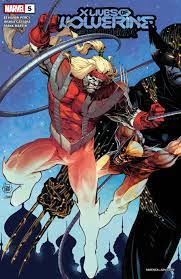 X LIVES OF WOLVERINE #5
Writer: Benjamin Percy
Artist: Joshua Cassara
Colourist: Frank Martin
Letterer: Cory Petit
Editor: Mark Basso
COVER / PAGE 1. Wolverine fights Omega Red, with a Russian skyline and Omega Wolverine in the background. Needless to say, this is a companion to the cover of X Deaths of Wolverine #5, which will have the other half of the image (Wolverine fighting Omega Wolverine, with present-day Wolverine and a Krakoan skyline in the background).
PAGE 2. Omega Red possesses Wolverine and attacks Professor X.
Picking up directly from the end of issue #4. The background is a montage of images of Wolverine (or Logan) at various points in his life, mostly fairly generic. To the extent that they’re recognisable, starting top left on the first full row:
- Row 1: Wolverine in his yellow and black mask.
- An unplaceable image of a young Logan.
- Logan as Patch in Madripoor.
- Logan in Team X.
- Old west Logan.
- Teen Logan.
- Logan in some sort of headband.
- Row 2: Morrison/Quitely era Wolverine.
- Weapon X
- Just an extreme close-up.
- Department H Wolverine.
- Wolverine in his classic yellow and black.
- Oddly, what seems to be a version of Old Man Logan, despite the fact that that doesn’t form part of Logan’s past.
- Another image of Logan in his classic mask.
- Row 3: Ditto.
- Logan in the wilds, probably before Origin II.
- World War I Wolverine.
- Wolverine in what looks to be Japanese costume, from one of his many stays there.
- Fur trapper Wolverine, presumably.
- Wolverine in the blue-grey version of his mask from a previous incarnation of X-Force.
- Wolverine in the modified version of his brown costume from around the time of Jeph Loeb’s Wolverine #50.
- Row 4 onwards are all quite generic images.
PAGES 3-4. Professor X and Marvel Girl struggle to locate Wolverine in the timestream.
Presumably Jean is also doing the hard work of keeping Omega Red subdued during this period.
Page 4 seems to show three more or less random panels of points from Wolverine’s past where he was dealing with Professor X. The first has him in Xavier’s study, the second is a Danger Room training exercise (with Nightcrawler in the background), and the third shows Wolverine attacking Xavier. Since there’s no suggestion of Omega Red being involved in this, it might be the “Original Sin” crossover from X-Men: Original Sin, X-Men: Legacy #217 and Wolverine: Origins #29, which showed Wolverine attacking Professor X shortly after arriving at the Mansion and before being deprogrammed from Romulus’ influence. The suggestion seems to be that Mikhail’s attack on Krakoa has left Wolverine simply revisiting all points in his past rather than specifically the points that Omega Red was targetting.
PAGE 5. Recap and credits. The present-day Wolverine is highlighted in red to show him as possessed.
PAGES 6-8. 1900 Logan returns to the wild.
Thanks to losing touch with Jean, Logan has spent months with Benedict Xavier, but is apparently now returning to the woods – presumably at least in part to make sure that he doesn’t mess up the timestream.
Oddly, Logan claims here to have allegiance to any country, despite claiming in earlier stories that he had found his homeland in Krakoa. He’s been away a while, subjectively, and presumably this is meant to indicate him sinking into his past persona in some way.
The watch that Benedict gives to Logan is, of course, the same one that Logan was looking at in the present day in the opening scene of issue #1.
PAGE 9-10. Assorted Logans make their way to the present.
The suggestion here seems to be that this story is literally non-linear, that Logan has been in various points of his past at once, and that all these assorted Logans are now being drawn back by Professor X to reconstitute the present day Wolverine and fight off Omega Red.
The reassembled persona of Wolverine fights off Omega Red and wakes. The bone tentacles just fall off – presumably that’s partly due to Wolverine’s healing factor.
PAGE 11. Data page, filling in what actually happened in lives 2 and 3 (which the series never really got around to dealing with).
Both involve an attack on the lives of ancestors of Professor X’s mother Sharon Xavier. Life 2 is basically a western story that we didn’t get to see. Life 3 relates to Wolverine’s service in the Devil’s Brigade in World War I.
The Devil’s Brigade were a Canadian black ops unit during World War I, apparently connected with Romulus. This was established in Wolverine: Origins #17, apparently misunderstanding or wilfully re-interpreting a passing reference in Alpha Flight vol 1 #33 to Wolverine having served with the Devil’s Brigade – which, in real life, was a US/Canadian commando unit in World War II.
PAGES 12-14. Mikhail abandons Omega Red.
Wolverine’s rejection of Omega Red has apparently caused some sort of explosion. On perfectly sound time travel logic, Omega Red wants to just keep trying, but Mikhail realises that Wolverine is about to show up before that can happen, and so he makes a break for it. The blank-faced guys standing next to him are the “Russian doll” genetically engineered soldiers from X-Force.
Mikhail’s parting shot is to dismiss Omega Red as a product of the USSR (which indeed he was – his back story involves a failed supersoldier programme) and talk cryptically about his plans for a “new Russia”. Quite what that means in practice remains rather obscure, and given current events, I wouldn’t want to be writing a story about Russia on the lead-in times that comics require.
PAGES 15-21. Wolverine fights and defeats Omega Red.
Gateway teleports Wolverine to the location, since there’s no Krakoan gate already there. We’ve seen him do this before in X-Force.
Omega Red uses the Cerebro Sword as a weapon in the fight, and considering that it was created as an ornament whose main interest was the data it contained, it seems to be surprisingly viable.
During the fight, we get single-panel flashbacks to assorted fights that Logan had in the past with possessed people, over the course of the series – one for each of the nine prior “lives”. Specifically…
- Page 17 panel 2: Logan fights the Xaviers’ groundsman in issue #1.
- Page 17 panel 4: Logan fights the possessed whale in issue #3.
- Page 17 panel 6: Logan fights Itsu in issues #2-3.
- Page 17 panel 8: Team X Logan, possessed by Omega Red in issue #4
- Page 17 panel 10: Old West Logan fights Omega Red as described in the data page earlier in this issue, and seen briefly in issue #3.
- Page 17 panel 12: Symbiote Logan from issue #4.
- Page 18 panel 2: Department H Wolverine fights his unspecified opponent, seen briefly in issue #3.
- Page 18 panel 4: World War I Logan, as described earlier in the issue and seen briefly in issue #3.
- Page 18 panel 6: Logan attacks Lord Dark Wind’s kamikaze plane in issue #4.
Logan also gives us a talk about how revisiting his past helps him remember how far he’s come, but with the combined instability of his history and his erratic memories – we’ve long since abandoned the idea that he got all his memories back after House of M, I think – the details really aren’t worth worrying about too much, and what matters more is where he goes from here. All of this feels more than a little anticlimactic to me – has anything really changed at all as a result of this series, other than Omega Red’s tentative alliance with the Krakoan authorities being over and the Cerebro Sword (which was never anything more than a macguffin) being written out?
PAGE 22. Data page. The Russian government is unhappy that Mikhail’s plan failed. Quite why this is described as a “referendum” on him, I have no idea – a referendum is a public vote.
PAGES 23-24. Have you considered picking up our sister title?
Wolverine returns the Cerebro Sword to Sage and is promptly packed off to join the fight against Omega Wolverine, which already began over in X Deaths of Wolverine #5.
PAGE 25. Data page. The Krakoan reads NEXT: CLAW SCHOOL.

I think the Wolverine on page 2, row 4 panel ~6 is meant to be the far future old Phoenix Wolverine from Jason Aaron’s Thor/Avengers runs. Though again, it doesn’t make sense if these are visions of his past.
“the far future old Phoenix Wolverine from Jason Aaron’s Thor/Avengers runs”
I don’t think Jason Aaron is a bad writer, but he’s certainly getting there.
Remember, a few years back, when WOlverine was dead? Looking at the covers of books in recent weeks, I noticed that Wolverine is sure appearing in a lot of books again.
@Joseph
Heck, Wolverine was appearing in a lot of books even when he was dead. Old Man Logan was just Wolverine with a different hair color. Giving a dead family and guilt about being used as a weapon to someone who already has those doesn’t produce anything new.
I sure remember that time. It was the time when it felt like no one had more sons emulating their father than Wolverine. It was also the time when there were a lot of miniseries about Wolverine and how everything in the Marvel Universe revolved around him.
We may well be seeing less of him now than when he was dead. He is not quite as overemphasized as Batman or even Spider-Man, but he is certainly a contender.
On a scale of 1 to 10 how badly do you think Marvel editorial is freaking out about the Russia parts of Percy’s works?
So far, probably not too much, since the content doesnt seem to amount to much more than “Russian nationalism = bad” which, if anything, is an easier sell than it was six months ago. But I’d be parking any more stories about Russia while things remain so unpredictable, if I were them.
I’d certainly be spiking any stories about Vampire Nation for the time being.
@Jenny: a 1, I’d think. What’s changed in the last month that would make the Russian government a worse choice for a villain, really?
Fair enough; I just think it’s a unfortunate coincidence with them making up a fake Vietnam just a few years earlier in order to avoid timescale issues. Maybe DC has the right idea to use fake cities and countries.
Busiek still references the USSR in The Marvels, which was a series that fleshes out the Vietnam revision (and is a mess), but this either contradicts the timescale or the Soviet Union still existed in the 21st century of Marvel. Iron Man (and other Marvel heroes) are featured in the story, but Iron Man didn’t exist prior to 2001. Which brings up the fact that Stark’s revised origin takes place in Afghanistan rather than Vietnam. While it did seem like Marvel would never need to worry about this, since it began to appear like the American fighting in Afghanistan would never end, if Marvel Comics still exists in twenty years, they’ll have to revise Tony Stark’s origin again.
Pretty sure The Marvels consistently refers to the Russians as, well, Russians rather than Soviets. Sure, the Red Guardian shows up working for them, but he does that in modern comics, too.
I’ve sort of lost interest in the comic, so I haven’t been following it that carefully, but it was talking about how they were backing the Communists. I guess it could be Russians backing the Communists rather than the Soviets. I wish Busiek would have created a different backstory rather than taking elements from the Vietnam
War then copying and pasting the history on his fictional country.
I’m behind on Marvels – and I’m not sure if I’ll go back to it – but yeah, it says the Sin-Cong War was between communist and capitalist factions within Sin-Cong, backed by different outside powers.
The Marvels has been a slog. I thought the book would be Kurt Busiek & co. telling a variety of fun stories with an eclectic mix of Marvel characters. Instead, it’s been Fake-Vietnam Mysticism Backstory: The Series, guest-starring some super-heroes.
Once again, Joshua Cassara & Frank Martin produce stunning visuals in service of a ho-hum story. Percy doesn’t do anything with the Cerebro Sword. He doesn’t do anything with Mikhail. He doesn’t do anything with Prof. X being seriously injured. He repeatedly goes for the most mundane storytelling choices in X-Lives. At least X-Deaths has crazy nonsense to keep me interested. X-Lives felt flat.
What can you do with an injury to Xavier? First, they have the healing gardens, and second, there’s resurrection.
“the far future old Phoenix Wolverine from Jason Aaron’s Thor/Avengers runs”
“I don’t think Jason Aaron is a bad writer, but he’s certainly getting there.”
Why do you think Jason Aaron is a bad writer ? He’s always full of ideas and zaniness.
Has Marvel already done some revisions to this storyline? The first issue of this mini had the Kremlin announcing Mikhail as Putin’s co-equal and suggested Putin was being mind controlled. Now apparently Mikhail answers to the Russian government rather than controlling it.
That’s one advantage of these data pages – easier to mock-up a before printing revision there. This is not a good time to try predicting Russian politics, or suggest that Vladimir Putin isn’t responsible for his actions.
@Chris V- The idea of Sin Song as a pseudo-Vietnam was already used for Swordsman’s origin in Avengers Spotlight 22 in 1989 by Lou Mougin and Don Heck- it was stated that Swordsman was a Frenchman who sided with the Communists against the French. (The French involvement in Vietnam ended in 1954, so using the real Vietnam would have made Swordsman too old.) Busiek decided that since a pseudo- Vietnam was already used for Swordsman’s origin, why not use the same one for everyone else’s origins?
End of time Phoenixverine was pretty fun, but not as great as Iron Fist Starbrand Ghost Rider Sorcerer Supreme Dr Doom at the End of Time.
Dave: “What can you do with an injury to Xavier? First, they have the healing gardens, and second, there’s resurrection.”
In the short term, the injury could have added some drama. Xavier is taken out while the immediate threat is happening, so Jean and Wolverine have to stop Mikhail & Omega Red without his help or power. Sure, Xavier comes back once the story is over, or rallies with all the power he can muster while dealing with the pain of life-threatening injuries before succumbing and is healed or revived.
Percy had a possessed Wolverine stab Xavier at the climax of issue 4. The impact on issue 5 is… nothing. Instead of adding drama and tension to the narrative, the implications of Xavier not being able to help (at full capacity, at least) is just ignored. Anything that would be hard to get out of (like traveling to pre-Logan times) is not done in order to get to a fight and recover a MacGuffin.
Daly said: Why do you think Jason Aaron is a bad writer ? He’s always full of ideas and zaniness.
His version of zaniness has gotten pretty repetitive at this point: “What if these preexisting character concepts or gimmicks were mashed together” has become his go-to move to the point that he seems unable to get through a story arc without it.
More generally, when everything’s zany and over-the-top all the time, it gets kind of…boring. The zany becomes the norm, so it stops seeming zany. This is especially the case when the zaniness so rarely seems to have any thematic underneath or when the book turns around and wants readers to think there’s real stakes as a result of all the zaniness.
Aaron’s Avengers has had that problem for awhile, but it was there before, too, in books like Wolverine and the X-Men, where the Hellfire Kids were comedy villains who were also somehow supposed to seem threatening when the story needed to be “big.”
More generally, he has a hard time developing antagonists who aren’t one-dimensional sadists or petulant lunatics.
So it all just kind of turns into a constant manic sugar rush, which is fun for a little while, but gets exhausting and empty very quickly.
Having lots of little wild ideas is nice. Being able to connect them to actual, meaningful ideas is better. Aaron can do that, and has in the past, but his superhero writing has moved further and further in the direction of trying to top the last story’s zany mashup nonsense without much care for anything else.
Also, some of Aaron’s ideas just don’t work. The reason Coulson turned evil is because… Mephisto turned him evil when he resurrected him. Which is an artificial way to turn a supporting character evil.( See also: Madelyne Pryor.) And then there’s the whole “She-Hulk likes being ugly because ugly women never get sexually harassed” which is too offensive for words.
Jason Aaron is capable of writing compelling, fleshed-out villains. In his creator-owned series Scalped, main antagonist Lincoln Red Crow was the most interesting character in the book. Similarly, Coach Boss in Southern Bastards is the center of the series, and his scenes are usually the best in any given issue. I don’t like the Hellfire Club Kids (does anybody?), but Aaron made the unloved Azazel and Dog Logan workable villains in his X-Men comics. I think you all are right that the character mash-ups, reliance on zaniness, and constantly upping stakes has negatively impacted his writing.
“And then there’s the whole “She-Hulk likes being ugly because ugly women never get sexually harassed” which is too offensive for words.”
Wow. I’ve read some of his Avengers, but I missed that scene. Yikes.
That’s a very uncharitable interpretation of the She-Hulk story.
I was expecting that the scene in question was being read in a sensationalistic manner.
It’s the finale of one-half of the next big event in X-history. What are fans talking about heading in to the next stage of the Krakoa-era? Kurt Busiek on The Marvels and Jason Aaron. Ah, $25 well spent for everyone who bought X-Lives.
I would argue that Aaron does have range. Scalped was one of the most emotionally draining comics. His run on Thor was written in a serious style. There was no “zaniness” involved in either series.
The idea of “upping the stakes” is also something I want to see in an Avengers comic. It’s what an Avengers book should be about. The greatest superheroes facing threats too great for any single superhero.
There could be a clash of styles between Aaron’s scripting and what he is doing with his Avengers plots though.
I feel like maybe Aaron is burnt out on superhero comics at this point. Overstaying on a superhero series can also hurt the writing on the series as it goes along.
>> like traveling to pre-Logan times
I think Percy forgot to write out his own plot with this, but the way this seems to have worked is that if they’re using the Cerebro Sword to identify these times and places where Xavier’s ancestors would be — and if they’re not, I’m not sure what the Cerebro sword is even doing — so they’re probably having to use the memories in the sword as some part of the Mikhail-Omega-Sword machine. I don’t think they could go to a time without Logan because they were hopping to time periods from Logan’s memories.
This is also assuming Rasputin was too dumb to try to use Apocalypse’s or Selene’s memories instead (or they’re conveniently not accessible via the sword.)
Chris V. said: The idea of “upping the stakes” is also something I want to see in an Avengers comic. It’s what an Avengers book should be about. The greatest superheroes facing threats too great for any single superhero.
Always upping the stakes pretty quickly gets you to the point where the stakes are too abstract to matter: last month’s villain wanted to enslave the Earth; this month’s villain wants to enslave all reality; next month’s villain wants to blow up the multiverse…and the month after that, there’s nowhere left to go.
The Avengers are unlike the X-Men, who have always had a distinct mission statement that easily connects to specific political valences (except in their mid-to-late-60s doldrums period). But they also aren’t the classic or Morrison-era JLA, forever battling the next vast menace to the universe.
The masthead text aside, I’d say The Avengers< as a franchise has usually been more about what it means to put the Varsity Team of Marvel heroes together and try to make it work as a psuedo-professional organization. The intra-team dynamics and the members' personal issues — especially the members without titles of their own — have been more central to the franchise.
Indeed, many of the mainstay Avengers villains have strikingly personal ties to the membership, whether it’s Ultron’s Oedipal weirdness around Hank Pym and the Wasp, the Grim Reaper’s fraught relationship with his brother and his own idealization of his brother, and a range of villains who form up a Masters of Evil mostly because they have a personal grudge against a specific Avengers, such as Egghead and the Zemos.
Even in their earliest issues, the Avengers started out as a bunch of heroes getting pulled into Loki’s sibling rivalry with Thor, then spent a couple of issues falling out with the Hulk and recruiting Captain America, and then had a long run where most of the stories were about Cap’s retconned wartime foe Zemo coming at him again and again and needing some extra muscle to keep the other Avengers busy.
And as son as that running plot ends, the team becomes the Kooky Quartet, surely no one’s idea of “Earth’s Mightiest Heroes.” You don’t need a team of the Marvel Universe’s top powerhouses to deal with the Swordsman.
So The Avengers have more typically been a team fighting the foes too great for a single member of the current roster to battle. The attraction of the book was more often the roster shakeups and its development of internal character relationships, complete with personalized villains. It’s book that has usually had periodic “big threat” storylines, but has lots of stuff in between that’s much lower-key.
Part of the issue is that, unlike the JLA, the Avengers have competition in dealing with vast cosmic menaces. The FF had the big, cosmic, conceptual baddies sewn up already, Doctor Strange typically gets first dibs on magical menaces, and then there’s the development of a whole “Cosmic” side to the Marvel Universe.
So this means that the kinds of things that would show up in the average JLA story at DC are more likely to turn up in other books. The Avengers has therefore worked by mixing up the stakes — here a threat to one member’s sense of self; there, the government hobbling the team’s effectiveness; this time, a villain whose agenda fosters division within the team; and, yes, sometimes a powerhouse foe or invading army from the future that needs to be fended off.
Ultron, arguably the best of the Avengers villains, has that position in part because the character works in all of these different kinds of stories and with all these different kinds of stakes.
Well, this “upping the stakes” critique doesn’t really apply to Aaron on Avengers, considering he’s been writing the book for 54 issues now. The last threat was a Multiversal Masters of Evil, with each member having some sort of thematic link with a member of the Avengers.
Anyway, that was why I like Hickman’s Avengers. He did write stories that kept upping the stakes and making it work.
Anyway, that was why I like Hickman’s Avengers. He did write stories that kept upping the stakes and making it work.
Albeit that the end of his story was that the Avengers couldn’t stole the threat, and in the end it was Doctor Doom who kept things halfway together long enough for Reed Richards to find a working solution.
And, Hickman took the stakes about as high as they could go, what with literally every universe being under threat. His story had to end where it did, because there was no further place to go. Kind of a perfect example of “and what do you do once the whole multiverse is at stake?” Well, you wrap things up in a big event miniseries and you leave the franchise.
I wish Aaron would take a break from the Multiverse stuff for a while. Seems like all he has done lately.
I didn’t like the Hickman Avengers because it got too big, too fast. A huge roster, concepts like the Builders, and very little character work resulted in a series I stopped reading. The Captain America time-travel arc was where I checked out.
I think Hickman’s Big Ideas worked better with FF (a series that often runs on big ideas) and HoX/PoX (using big ideas to totally change the status quo). Tellingly, his X-Men series was at its best when he wrote about Krakoan culture and epic events.
I preferred the Englehart, Stern, & Busiek/Perez/ et al Avengers. Those writers mixed big threats with smaller stories and personal drama. Aaron mixes in a lot of elements, but the character writing has been weak.
I wish we could collectively back away from the multiverse for a while. It seems to be *the* thing at the moment, and it’s quickly losing its luster.
From Marvel movies (Spider-man, Dr. Strange) to DC’s next big event (the JLA are dead but not in the universe you know!) to the X-Men (Moira’s multiple lives) to Aaron’s Avengers (I don’t even know) to a million What If? stories (What If Mile Morales or Gwen Stacey was every other Marvel character?).
I can’t figure out why this trope is so popular right now. Is it about the fragmenting of truth? Or, more positively, our collective consciousness expanding to include more truths? Both? The end of storytelling possibilities with these characters? The endless hammering of the same few popular concepts by creatively bankrupt corporations?
Mike-I definitely enjoyed Englehart’s Avengers more than Hickman. Englehart is probably my favourite Avengers writer.
Hickman’s run isn’t my favourite, and it’s not my favourite of Hickman’s writing. I was just pointing to it favourably in comparison with Aaron.
Thom — My guess is corporate executives seeing the success of Into the Spider-Verse and thinking it was the cross-dimensional aspect that made it so popular.
I think the multiverse is popular because it’s a relatively fresh idea in mainstream pop culture. Crossovers are nothing new, but live-action super-hero crossover movies that incorporate the multiverse are. We can now see stars and characters from pre-MCU/non-MCU movies in MCU movies. I thought it was a good gimmick in Wandavision (until the stupid “Ralph Bohner” thing) and Far From Home, but it’s going to wear thin fast. Same with DC, although I’m all for more Michael Keaton in anything.
Into the Spider-verse worked for many reasons- the animation, writing, acting, and music were great. The multiverse aspect was something we hadn’t seen much on the big screen. The multiverse was more than a gimmick, though. It led to characters appearing who increased representation in the general public’s perception of Spider-Man. By focusing on Miles and making Gwen the experienced hero, it made “the hero who could be you” mean more to children of color and girls.
Also, the MCU Avengers series reached its climax and most of Marvel’s remaining characters don’t have the box-office draw of Iron Man or Cap. The multiverse is an angle that worked for Spider-Man and is building buzz for Dr. Strange. I’m sure they’re looking to use it as a way to keep viewers interested as they build to the X-Men & FF.
I’ve said before, multiverse became overused because it’s a way for creators to recycle IP without giving up original characters to Disney or WB.
I loved that kind of metatextual stuff before it became so over saturated. The once a year JLA/JSA crossover made it something to look forward to, now it’s omnipresent and beaten to death, spoiling the good stories with all the chaff.
Multiverse mania has been a long time coming. It was more than several years ago when some creator — I don’t remember who — coined the current era of comics the Prismatic Age, with its focus on new perspectives on existing characters, whether that’s through pastiches, alternate continuity versions, or simply idiosyncratic takes by idiosyncratic creators.
I don’t pay too much attention to DC these days, so someone correct me if I have it wrong, but it feels like these days the out of continuity stuff is their main product and the stuff actually in a shared continuity is one line within that, the way 2099 or Ultimate comics once were at Marvel.
“Why do you think Jason Aaron is a bad writer ? He’s always full of ideas and zaniness.”
I mean, I literally said I DON’T think he’s a bad writer, but he is getting there. His Avengers run is written for 6-year-olds with ADHD, for example. His Dr. Strange run was about getting rid of magic and then bringing magic back, which . . . changed nothing and wasn’t much of a story besides good guy vs bad guy.
I’d rather see him scripting someone else’s ideas, because he seems to be running out quickly.
“when everything’s zany and over-the-top all the time, it gets kind of…boring. The zany becomes the norm, so it stops seeming zany”
Bingo. All of his Wolverine/X-Men work really suffered from this. I guess a lot of his work does.
In contrast, Grant Morrison throws out zany ideas, but the plot rarely focuses on any of them for more than a panel. Morrison stories have more to do with character dynamics.
“I can’t figure out why this trope is so popular right now.”
20 years ago, Bill Jemas was forcing every Marvel writer to focus on domestic-level struggles, and DC had forbidden any multiverse shenanigans. So writers had been repressing their wacky multiverse urges for a long time.
10 years ago, Marvel starts dipping its toes into mixing and matching its properties (all the bizarre and random Avengers and X-Men line-ups), and DC brings back the Multiverse (52), botches the follow-up (Countdown), poorly presents the next follow-up (I like Final Crisis, but it was marketed terribly, and all the Countdown stuff marred its release), and holds off on more until Grant Morrison figures it out for the company.
5 years ago, Hickman and Slott open wide the Marvel multiverse (Secret Wars, Spider-verse), DC opens wide the DC multiverse (Multiversity), the CW Flash show gets everyone excited about multiversal possibilities (with the very excellent first season, whose quality was never matched with future seasons).
“and DC brings back the Multiverse (52), botches the follow-up (Countdown), poorly presents the next follow-up (I like Final Crisis, but it was marketed terribly, and all the Countdown stuff marred its release), and holds off on more until Grant Morrison figures it out for the company.”
Even earlier than that, all that DC stuff was happening from 2005 to 2008…
Wasn’t Final Crisis mostly a Grant Morrison story that wasn’t a Crisis-type event that DC ended up marketing as a Crisis-type event?
Mark Coale said: I’ve said before, multiverse became overused because it’s a way for creators to recycle IP without giving up original characters to Disney or WB.
Also, it allows for conventional kinds of Tv and movie narrative closure — Professor Badguy falls to his death at the end of the season or film — with the option to use the character again in a later installment because this is the Professor Badguy of Earth-964.
And if the actor who played Badguy the first time doesn’t wanna come back or costs too much, you can more easily justify a recast because this is a variant Professor Badguy.
Heck, you can even use it the way DC did, to bring in
YLu said: Multiverse mania has been a long time coming. It was more than several years ago when some creator — I don’t remember who — coined the current era of comics the Prismatic Age, with its focus on new perspectives on existing characters, whether that’s through pastiches, alternate continuity versions, or simply idiosyncratic takes by idiosyncratic creators.
And there’s this, too: multiverse means that anyone’s take on a character can exist as a wholly self-consistent version, while still letting the ongoing continuity and shared universe aspects exist in some fashion.
And you can have stories that violate the “illusion of change/toys back in the box” mentality as long as you call it one chunk of the multiverse or have a standard-model multiverse version ready to leap on in.
Of course, when it eventually gets tangled, all those infinite earths might just need a crisis to clean it all up. And then you can “bring back” the sorely missed stuff destroyed in the crisis….
DC pioneered that last bit, but the rapid turnaround at Marvel from “the Ultimate Universe has been destroyed” to “it’s been restored” seems to reflect the rapid cycling of these moves we’re seeing lately.
Mark Coale said: I’ve said before, multiverse became overused because it’s a way for creators to recycle IP without giving up original characters to Disney or WB.
Also, it allows for conventional kinds of Tv and movie narrative closure — Professor Badguy falls to his death at the end of the season or film — with the option to use the character again in a later installment because this is the Professor Badguy of Earth-964.
And if the actor who played Badguy the first time doesn’t wanna come back or costs too much, you can more easily justify a recast because this is a variant Professor Badguy.
Heck, you can even use it the way DC did, to bring in newly acquired IP intact, then justify rebooting it as part of your main lien while the older stuff remains “stuff that happened, but in another part of the multiverse.” Rumors abound that Marvel may be about to do this on streaming TV with Daredevil.
YLu said: Multiverse mania has been a long time coming. It was more than several years ago when some creator — I don’t remember who — coined the current era of comics the Prismatic Age, with its focus on new perspectives on existing characters, whether that’s through pastiches, alternate continuity versions, or simply idiosyncratic takes by idiosyncratic creators.
And there’s this, too: multiverse means that anyone’s take on a character can exist as a wholly self-consistent version, while still letting the ongoing continuity and shared universe aspects exist in some fashion.
And you can have stories that violate the “illusion of change/toys back in the box” mentality as long as you call it one chunk of the multiverse or have a standard-model multiverse version ready to leap on in.
Of course, when it eventually gets tangled, all those infinite earths might just need a crisis to clean it all up. And then you can “bring back” the sorely missed stuff destroyed in the crisis….
DC pioneered that last bit, but the rapid turnaround at Marvel from “the Ultimate Universe has been destroyed” to “it’s been restored” seems to reflect the rapid cycling of these moves we’re seeing lately.
Sorry for the duplicate comment, all!
So I’m getting a “little from column A, little from column B” vibe from everyone’s answers.
Recycling IP in the form of alternate universe versions allows corporations to continue profiting from the same popular concepts. It also increases diversity, which (hopefully) fosters more real-world inclusivity in fandom. So kind of a win-win.
And I hadn’t factored in creators’ interests. I suppose if you want to create a new character these days, you can just pick and choose from established IP traits instead of coming up with something of your own. It’s like early Image, with its blatant character rip-offs, has found a home in mainstream Marvel. While Image has become the place to create new IP.
On reflection, the part that I find exhausting about all of this multiversal storytelling is the focus on the multiverse itself. Continuity becomes so complicated and heavy during these stories, as Omar mentioned. The plot becomes tangled in its own mechanics, and we get bogged down in exposition of how the multiverse works (DC for the past 30 years) or how time-travel works (Avengers: Endgame). I’m 100% burnt out on those stories.
At the same time, I enjoy jumping into a new version of established characters. I was excited for the redesigned Legion of Super-heroes until Bendis’ story turned out to be a dud. And I really like the noir-ish take on the JLI in King’s Human Target series. It’s fun to see slightly askew versions of characters I’ve been reading for years, as long as they aren’t constantly obsessed with how to keep universes from merging or whatever. Not every story has to be Crisis on Infinite Earths.
“Wasn’t Final Crisis mostly a Grant Morrison story that wasn’t a Crisis-type event that DC ended up marketing as a Crisis-type event?”
Eh . . . yes and no? I don’t think the title was Grant’s idea, and the story was certainly more of a continuation/coda to the Fourth World characters, but it was a crisis-worthy story (I’d say a lot more was at stake than was in Infinite Crisis).
The core of the story wasn’t really about the multiverse, but the Monitors (from across the multiverse) were important characters, and it’s really Superman Beyond that took a stab at making the multiverse an interesting concept again.
Josie: I remember the last issue of Final Crisis had characters from the multiverse join the end battle- Sunshine Superman as Obama made quite a splash- but, yeah, it was Big Operatic Storytelling rather than an end unto itself. Reading X-Lives 5, I wish we’d gotten the Morrison version. Professor X traps Omega Red in his self conducted false memories while the collected memories of Wolverine stab the Cerebral Sword to pieces from the inside.
In DC’s June 2022 solicitations, I see they’re finally bringing back the Multiversity “brand,” as it were, for a particular limited series.
On one hand, I’m glad someone is finally picking up the baton.
On the other hand, geez, it’s been almost a decade.
The June 2022 DC solicitations also read as if Dark Crisis will repurpose material worked up for Dan DiDio’s 5G initiative, like Future’s End before it.
More generally, DC seems to be adrift right now, with a mix of creators leaving early and belated editorial rethinks resulting in planned storylines and initiatives being cut short or needing substantial, sudden revision.
This is also why the Black Label stuff feels like the “main” product: there’s no well-defined, stable editorial direction or clear flagship titles for the line as a whole, so the imprint that is specifically for self-contained visions of characters will look more focused and stronger by default.
Final Crisis was absolutely Morrison’s sequel to Crisis on Infinite Earths-not the multiverse part, but rather Darkseid’s threat after he helps defeats the Anti-Monitor that when he and Earth’s heroes next meet, they would be as enemies. Not a literal sequel, of course, but a spiritual one.