X Lives of Wolverine #5 annotations
As always, this post contains spoilers, and page numbers go by the digital edition.
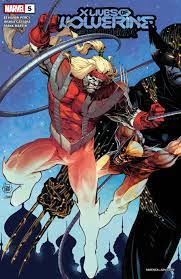 X LIVES OF WOLVERINE #5
Writer: Benjamin Percy
Artist: Joshua Cassara
Colourist: Frank Martin
Letterer: Cory Petit
Editor: Mark Basso
COVER / PAGE 1. Wolverine fights Omega Red, with a Russian skyline and Omega Wolverine in the background. Needless to say, this is a companion to the cover of X Deaths of Wolverine #5, which will have the other half of the image (Wolverine fighting Omega Wolverine, with present-day Wolverine and a Krakoan skyline in the background).
PAGE 2. Omega Red possesses Wolverine and attacks Professor X.
Picking up directly from the end of issue #4. The background is a montage of images of Wolverine (or Logan) at various points in his life, mostly fairly generic. To the extent that they’re recognisable, starting top left on the first full row:
- Row 1: Wolverine in his yellow and black mask.
- An unplaceable image of a young Logan.
- Logan as Patch in Madripoor.
- Logan in Team X.
- Old west Logan.
- Teen Logan.
- Logan in some sort of headband.
- Row 2: Morrison/Quitely era Wolverine.
- Weapon X
- Just an extreme close-up.
- Department H Wolverine.
- Wolverine in his classic yellow and black.
- Oddly, what seems to be a version of Old Man Logan, despite the fact that that doesn’t form part of Logan’s past.
- Another image of Logan in his classic mask.
- Row 3: Ditto.
- Logan in the wilds, probably before Origin II.
- World War I Wolverine.
- Wolverine in what looks to be Japanese costume, from one of his many stays there.
- Fur trapper Wolverine, presumably.
- Wolverine in the blue-grey version of his mask from a previous incarnation of X-Force.
- Wolverine in the modified version of his brown costume from around the time of Jeph Loeb’s Wolverine #50.
- Row 4 onwards are all quite generic images.
PAGES 3-4. Professor X and Marvel Girl struggle to locate Wolverine in the timestream.
Presumably Jean is also doing the hard work of keeping Omega Red subdued during this period.
Page 4 seems to show three more or less random panels of points from Wolverine’s past where he was dealing with Professor X. The first has him in Xavier’s study, the second is a Danger Room training exercise (with Nightcrawler in the background), and the third shows Wolverine attacking Xavier. Since there’s no suggestion of Omega Red being involved in this, it might be the “Original Sin” crossover from X-Men: Original Sin, X-Men: Legacy #217 and Wolverine: Origins #29, which showed Wolverine attacking Professor X shortly after arriving at the Mansion and before being deprogrammed from Romulus’ influence. The suggestion seems to be that Mikhail’s attack on Krakoa has left Wolverine simply revisiting all points in his past rather than specifically the points that Omega Red was targetting.
PAGE 5. Recap and credits. The present-day Wolverine is highlighted in red to show him as possessed.
PAGES 6-8. 1900 Logan returns to the wild.
Thanks to losing touch with Jean, Logan has spent months with Benedict Xavier, but is apparently now returning to the woods – presumably at least in part to make sure that he doesn’t mess up the timestream.
Oddly, Logan claims here to have allegiance to any country, despite claiming in earlier stories that he had found his homeland in Krakoa. He’s been away a while, subjectively, and presumably this is meant to indicate him sinking into his past persona in some way.
The watch that Benedict gives to Logan is, of course, the same one that Logan was looking at in the present day in the opening scene of issue #1.
PAGE 9-10. Assorted Logans make their way to the present.
The suggestion here seems to be that this story is literally non-linear, that Logan has been in various points of his past at once, and that all these assorted Logans are now being drawn back by Professor X to reconstitute the present day Wolverine and fight off Omega Red.
The reassembled persona of Wolverine fights off Omega Red and wakes. The bone tentacles just fall off – presumably that’s partly due to Wolverine’s healing factor.
PAGE 11. Data page, filling in what actually happened in lives 2 and 3 (which the series never really got around to dealing with).
Both involve an attack on the lives of ancestors of Professor X’s mother Sharon Xavier. Life 2 is basically a western story that we didn’t get to see. Life 3 relates to Wolverine’s service in the Devil’s Brigade in World War I.
The Devil’s Brigade were a Canadian black ops unit during World War I, apparently connected with Romulus. This was established in Wolverine: Origins #17, apparently misunderstanding or wilfully re-interpreting a passing reference in Alpha Flight vol 1 #33 to Wolverine having served with the Devil’s Brigade – which, in real life, was a US/Canadian commando unit in World War II.
PAGES 12-14. Mikhail abandons Omega Red.
Wolverine’s rejection of Omega Red has apparently caused some sort of explosion. On perfectly sound time travel logic, Omega Red wants to just keep trying, but Mikhail realises that Wolverine is about to show up before that can happen, and so he makes a break for it. The blank-faced guys standing next to him are the “Russian doll” genetically engineered soldiers from X-Force.
Mikhail’s parting shot is to dismiss Omega Red as a product of the USSR (which indeed he was – his back story involves a failed supersoldier programme) and talk cryptically about his plans for a “new Russia”. Quite what that means in practice remains rather obscure, and given current events, I wouldn’t want to be writing a story about Russia on the lead-in times that comics require.
PAGES 15-21. Wolverine fights and defeats Omega Red.
Gateway teleports Wolverine to the location, since there’s no Krakoan gate already there. We’ve seen him do this before in X-Force.
Omega Red uses the Cerebro Sword as a weapon in the fight, and considering that it was created as an ornament whose main interest was the data it contained, it seems to be surprisingly viable.
During the fight, we get single-panel flashbacks to assorted fights that Logan had in the past with possessed people, over the course of the series – one for each of the nine prior “lives”. Specifically…
- Page 17 panel 2: Logan fights the Xaviers’ groundsman in issue #1.
- Page 17 panel 4: Logan fights the possessed whale in issue #3.
- Page 17 panel 6: Logan fights Itsu in issues #2-3.
- Page 17 panel 8: Team X Logan, possessed by Omega Red in issue #4
- Page 17 panel 10: Old West Logan fights Omega Red as described in the data page earlier in this issue, and seen briefly in issue #3.
- Page 17 panel 12: Symbiote Logan from issue #4.
- Page 18 panel 2: Department H Wolverine fights his unspecified opponent, seen briefly in issue #3.
- Page 18 panel 4: World War I Logan, as described earlier in the issue and seen briefly in issue #3.
- Page 18 panel 6: Logan attacks Lord Dark Wind’s kamikaze plane in issue #4.
Logan also gives us a talk about how revisiting his past helps him remember how far he’s come, but with the combined instability of his history and his erratic memories – we’ve long since abandoned the idea that he got all his memories back after House of M, I think – the details really aren’t worth worrying about too much, and what matters more is where he goes from here. All of this feels more than a little anticlimactic to me – has anything really changed at all as a result of this series, other than Omega Red’s tentative alliance with the Krakoan authorities being over and the Cerebro Sword (which was never anything more than a macguffin) being written out?
PAGE 22. Data page. The Russian government is unhappy that Mikhail’s plan failed. Quite why this is described as a “referendum” on him, I have no idea – a referendum is a public vote.
PAGES 23-24. Have you considered picking up our sister title?
Wolverine returns the Cerebro Sword to Sage and is promptly packed off to join the fight against Omega Wolverine, which already began over in X Deaths of Wolverine #5.
PAGE 25. Data page. The Krakoan reads NEXT: CLAW SCHOOL.

DC wants to have its cake and eat it, too. They’re telling DiDio’s 5G story, but it’s not *really* happening because it’s…in the future…of another timeline…or something. You know.
Politically, it’s very smart. They’re concurrently replacing the JLA with their younger and more diverse counterparts while continuing to print comics about the current JLA. So they appease fans who want more diversity without alienating fans who get bent out of shape about diversity.
But that definitely leads to a lack of focus in the line. Every character has spun off so many other characters with the same name and/or powers that it’s not clear where we’re supposed to look. That leads to a lot of individually great books (e.g., Far Sector), but seems less than cohesive on the whole.
“there’s no well-defined, stable editorial direction or clear flagship titles for the line as a whole”
More than that, it feels like over half their output is Batman, Superman, Joker, and Harley Quinn. Like . . . I get that they can’t support B- and C-list character titles anymore, but they’re just going overboard with Batman.
“Final Crisis was absolutely Morrison’s sequel to Crisis on Infinite Earths-not the multiverse part, but rather Darkseid’s threat after he helps defeats the Anti-Monitor that when he and Earth’s heroes next meet, they would be as enemies. Not a literal sequel, of course, but a spiritual one.”
From everything I am seeing online, in Morrison’s own words, it seems that it’s more of a sequel to Seven Soldiers and 52 than anything else. And one other quote from Morrison:
“More than anything else, it’s the Final Crisis of the Monitors, as we’ll see in #7 and brings that story from Crisis On Infinite Earths to a logical conclusion. It’s also the Final Crisis of the Fourth World. How the challenges, possibilities and rules of the emerging Fifth World are developed is something that will either be acknowledged or overlooked by other DC creators in the years to come.”
Granted, COIE only had one Monitor (2 if you count the Anti-Monitor), so not sure how it brings things full circle, but sure Jan.
wwk5d said: Granted, COIE only had one Monitor (2 if you count the Anti-Monitor), so not sure how it brings things full circle, but sure Jan.
In my reading, Final Crisis is Morrison working through his own creative distaste for the original Crisis on Infinite Earths and its various rehashes, each of which aimed to excise characters and concepts at DC and each of which went further and further into grimdark.
Morrison seems in pat to be playing off of the way that the Monitor started out as Wolfman’s fanfic villain added to the actual stories, then was repurposed for COIE, a story that had him killed by his evil counterpart who then killed lots and lots of characters and stories Morrison treasured.
I think Morrison intended some kind of statement about authors, editors, and readers. So the Monitors are sort of like psuedo-characters who really serve as the instruments of continuity and tone changes, which are, of course, what the multiple earths allow writers and editors to play around with. They’re editorial and writerly visions and choices presented as if they are characters.
So Morrison’s multiplying vampire-Monitors are there as kind of fallen, decayed rehashers arguing with each other about the shape of Reality — where DC should go, creatively — while actually just feeding on it.
Nix Uotan is the one Monitor who doesn’t just feed on recycling thin variants of old stories and characters, but actually inspires, restores, renews, and refreshes the characters, largely by embracing and championing the stuff that others see as too goofy or contrived. (This is pretty literally done with the Zoo Crew in the final issue.) So Nix Uotan is Morrison, or at least the writerly sensibility Morrison favors.
And while Darkseid is the ultimate villain in the story, the villain with so much narrative “weight” that he is the archvillain across all continuities threatening every one of them, Mandrakk the Vampire Monitor is the ultimate enemy of the story itself, of DC having additional stories that are worthwhile. Mandrakk is the reader-creator who wants to keep their old superhero stories around, but by dragging them down into the primal darkness and feeding on them rather than contributing to them. So Darkseid winning — evil winning in a superhero story — would just drag everything down to Mandrakk’s level where all the joy and life could be sucked out of it.
Mandrakk is the writers and editors and fans who won’t give up superheroes and thinks they and Darkseid are cool and awesome and epic, but also insists that they change to reflect said fan-writer’s quasi-adult ideas.
So it was “full circle,” but mostly in terms of Morrison’s own experiences as a reader and creator during and after Crisis on Infinite Earths. For me, Final Crisis as a whole is kind of an interesting idiosyncratic mess. Ironically, I found Morrison more compelling when he was “just” writing a Batman story and putting his creative ideas into practice, not turning the story into a thesis about those ideas.
Naturally, after Final Crisis DC went even darker, eventually deciding to reboot again with Flashpoint, a story whose premise is literally that the villain can go back and preemptively win, but the hero trying to fix the damage will just make things worse because heroism has to based in trauma.
Unsurprisingly, a lot of Morrison’s post-Flashpoint comics have been much more direct criticisms of how Morrison sees the characters are stuck in both a “classic” general status quo while appearing in stories that keep mistaking a stagnant, adolescent cynicism and bitterness for realism and maturity (to borrow from Morrison’s Flex Mentallo.
And so The Multiversity ends with the great nihilistic evil still out there, threatening all comics, while Nix Uotan — again, Morrison’s image of a good superhero comics writer — temporarily puts things right and gets some cash in hand for it to scrape by and pay rent, becoming a work-for-hire type and not a grand visionary.
^Crisis of Infinite Words
“I think Morrison intended some kind of statement about authors, editors, and readers.”
Well, yes, on a subtext level, Final Crisis is literally a story about stories and information. If you pay attention throughout, light and by extension information (because they are symbolically synonymous in the story) is a weapon first utilized by the villains and then coopted by the heroes.
Fire (light) kills Martian Manhunter, and then light/information is used via TVs and computers to infect the world with the anti-life equation. Characters like the Ray (light-based) gather and transmit information back and forth, and the Tattooed Man paints a light-based protective shield on his face, which is evocative of Metron. Eventually, it’s the Green Lanterns who wield light that kill Mandrakk.
And lest we not forget that Nix Uotan is Odin, the god of information, as is Mercury, who the Flash represents.
Final Crisis can be read on three levels. On one, it’s a DC superhero story. On a metatextual level, it can be read as a statement about authors, editors, and readers. On one other level, it can be read as a metaphysical plot based around a Gnostic-interpretation of Christianity.
Woden, the god of wisdom, can be seen as a Christ-figure.
Banished to a lower-level of reality without knowledge of his true origin or purpose. Awakened by a higher-power to his true nature. Come to free reality from the Anti-Life Equation, preventing humanity from evolving to the level of the Fifth World.
Darkseid can be seen as an Archon, keeping humanity in chains.
Wonder Woman uses Truth to free humanity from Darkseid’s control.
Darkseid’s defeat reveals the true face of evil, which is Nix Uotan’s father, a demiurgic force.
Mandrakk feeds on ideas from the Overvoid rather than truly creating anything original on his own (also playing in to the metatextual reading), until Mandrakk will be all that remains.
The repeated motif of use of the light in order to defeat the dark.
Nix Uotan, or Odin, is a Norse figure. He doesn’t die. He doesn’t sacrifice himself for anything.
Morrison used names derived from different pantheons for the Monitors which are related to either wisdom/knowledge or writing. Morrison isn’t using strict Norse/Germanic mythology for the story.
Uotan/Christ is the redeemer.
Christ means “Anointed One”. It doesn’t mean sacrifice.
You might want to reread your Poetic Eddas.
Odin sacrifices himself to himself for wisdom.
Nix Uotan, or Odin, is a Norse figure. Grant Morrison is explicit on this use of Odin. Nix Uotan doesn’t die. He doesn’t sacrifice himself for anything. He’s Odin. He’s Norse.
I don’t know why you insist on being wrong about this when there are explicit interviews on this.
I really don’t trust your reading comprehension skills after you once again replied with “sacrifice”.
Did you miss where I explicitly said “Gnostic-interpretation of Christianity” or do you just not understand the term Gnosticism?
Did you miss where I told you to read the Poetic Edda? Odin sacrifices himself for wisdom. Your repeating “sacrifice” as if it’s some profound statement would apply just as readily to Odin as to the Christ.
Also, Nix Uotan actually does die. Then, he finds himself reborn on Earth.
He said he took the name from Woden. He never said he was writing American Gods.
Tahoteh is named after Thoth…not Norse or Germanic.
Hermuz is named after Hermes…not Norse or Germanic.
Dax Novu is named after Nabu…not Norse or Germanic.
Final Crisis is a very Blakean work. Superman Beyond’s cosmology with the origin of the Monitors is heavily indebted to Blake’s prophetic works, which are in turn inspired by Gnostic teachings.
“Nix Uotan actually does die”
This doesn’t happen in Final Crisis or Multiversity. I genuinely can’t believe you’re arguing about a comic you’ve clearly never read.
Here. Morrison explains everything (what the story was about, the function of the Monitors, etc.)
https://www.ign.com/articles/2009/02/03/inside-the-mind-of-grant-morrison
Moo said: ^Crisis of Infinite Words
I’m working on a sequel to be called Zero Editor, featuring the villains Extend and Prolix.