NYX #10 annotations
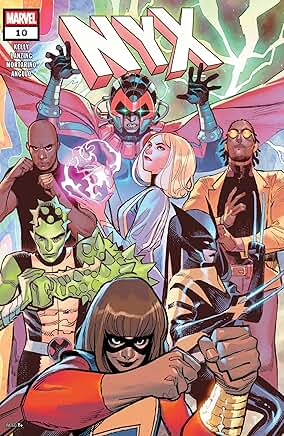 NYX vol 2 #10
Writers: Jackson Lanzing & Collin Kelly
Artist: Francesco Mortarino
Colour artist: Raúl Angulo
Letterer: Joe Sabino
Editor: Annalise Bissa
This is the final issue of NYX. The Laura Kinney: Wolverine ongoing series continues, and Ms Marvel’s storyline will be picked up in the upcoming Giant-Size X-Men one-shots.
THE CORE CAST
Ms Marvel. She’s preoccupied about cousin Bilal hunting down Ms Marvel and trying to find out her true identity, back in issue #7. As the only cast member with a dual identity, she offers a traditional superhero argument for keeping a secret identity, i.e. to prevent her family being used against her. But David seems to read her as being at least as concerned about what her family will think, and he seems to be right. He also argues that she’s been too concerned about protecting her family, and not enough about the impact on herself of living a dual life.
Ultimately, she reveals her true identity to Bilal (see below). Later, she tells her family that she’s heard that Ms Marvel is taking a break for a while because she “doesn’t want to live as a mutant”, though she seems to be fishing for them to agree with her that this would be “sad”. In fact, they don’t seem to have very strong feelings on it at all, beyond her father Yusuf musing that Ms Marvel’s parents would probably be relieved if she quit.
Sophie Cuckoo. Her psychic powers have now mostly returned after issue #5, although there’s still a degree of static. Still, she can pull off a mass-audience “power of love” ending, channelling mutant culture at Mojo.
She isn’t hugely sympathetic to Kamala’s worries about her secret identity, and thinks that secret identities just flag up to your enemies that your private life is a weak spot. But she acknowledges that she doesn’t really have a family in the way that Kamala does, so doesn’t really identify with the issue. As established in X-Men: Phoenix – Warsong, Sophie and the other Stepford Cuckoos are all clones of Emma Frost, and Sophie says that Emma only refers to them as her children ironically. (She doesn’t spell out precisely how the Cuckoos feel about Emma, beyond recognising that she doesn’t act as their mother.)
Prodigy. He says that his parents and sister have always known everything about him and been supportive. That comes from his debut in New Mutants #4 (2003) – if you’re wondering, his parents are called Dorothy and Christopher, and his sister’s name is Kim.
Wolverine. She rounds up the regulars to fight Mojo. Despite the threat being to the entire city, she seems to care entirely about the fact that Mojo has kidnapped Kiden Nixon. This feels like it was going to be a romance angle, or at least an obsessive friendship, but reads a little oddly given that Kiden hasn’t merited a mension in Laura’s solo series to date.
Kiden Nixon. Mojo has her for most of the issue.
Hellion. Treated as a core cast member in this story, for what it’s worth – he gets his head shot on the recap page. Presumably, this is what would have happened following his rescue in issue #8, if the book hadn’t ended.
Anole and Synch both also show up for the fight.
SUPPORTING CAST
Local. He still refers to Laura as “Scratch”, the name she gave to him in issue #2; he now regrets not turning on Mojo back when he first appeared.
Mojo is using his powers for his grand scheme (see below). He can use his powers in conjunction with Sophie to help channel the power of the city at Mojo. It’s not clear whether this is because she’s channelling something city-like, or simply because he’s so embedded within the structure of what Mojo is doing. )
After Mojo’s defeat, Local is missing and apparently has become one with the city. His closing narration seems consistent with this, though there’s wiggle room.
Sobunar. He has a mobile phone and, somehow, he has mobile reception in the Morlock tunnels. (Maybe one of the Morlocks has helpful powers in this regard.) He’s perfectly happy to round up Morlocks to help against Mojo
The Stepford Cuckoos. They show up to fight Mojo. Esme seems equivocal, but the others apparently prefer the view that Mojo taking over their city would be, on balance, a bad thing.
Dante has a non-speaking cameo. Yusuf, Muneeba and Aamir Khan are there at the end, but we’ve covered what they contribute.
VILLAINS
Mojo. Last issue, he stole the last Krakoan seed and left Anole and Ms Marvel with a fake. He explained in the epilogue that his power was to use the seed, combined with Local’s connection to the city, to “mak[e] an infinite me”. This turns out to involve growing Krakoan fauna all over the city and, somehow, using it to spread his influence by absorbing people.
Wolverine reminds us that Mojo “functions on belief”. This was the idea set up in issue #2, where Wolverine was unable to beat Mojo due to the power base of followers who were invested in him. Quite why people who are simply being absorbed into Mojo become believers is a little unclear, but presumably mind-control is involved, and mind-controlled belief counts for this purpose – after all, it’s still belief while it exists.
The mechanics of the whole Krakoan scheme are a little vague, to be honest. Mojo seems to have physically integrated into the Krakoan plantlife, rather than just using it as a tool, though it’s not clear what that has to do with anyone’s power set. Presumably the original idea was that by using the imagery of Krakoa in this very literal way, Mojo was able to divert mutants’ belief in Krakoa towards himself, but there isn’t really space to develop that theme
Consistent with the belief theme, though, Mojo can be defeated by a “power of love” routine of Sophie channelling mutants’ belief in their authentic culture.
Wolverine refers to some of Mojo’s followers as “the balaclavas” – those would be the guys in yellow balaclavas who hang around with Local, most obviously seen in issue #2.
Cousin Bilal. He’s genuinely surprised to find that Ms Marvel is his sister. This seems to dissuade him from trying to harm her, or exposing her true identity, but he advises her to keep her secret identity because it would break her parents’ hearts. She seems to take this seriously, at least in terms of it being how her parents would react.
GUEST CAST
Doop. He answers the call to fight Mojo – not as random as it seems, because he also showed up for a rally in issue #5. Don’t get excited about his one line of dialogue, which is in a version of his standard font, but just reads “DOOP GIBBERISH”.
MISCELLANEOUS
- The graffiti-themed montage on page 1 is a callback to the similar opening page of issue #1.

“Cousin Bilal. He’s genuinely surprised to find that Ms Marvel is his sister.”
He should be, since Kamala is his cousin.
Kamala’s decision to quit being Ms. Marvel is completely out of character. I get that this is meant to set up the Giant-Sized series, where she gets motivated by traveling through mutant history, but still…
So I guess we’re supposed to assume that the Cuckoos are back on the side of the angels now that they helped save the city from Mojo? That was anticlimactic. (Yes, I know, they needed to put the toys back in the box because they were cancelled early. But still…)
“Sophie says that Emma only refers to them as her children ironically.”
That isn’t how Emma’s feelings towards them were portrayed in Duggan’s Iron Man.
Having Kamala decide that yep, it’d break her parents’ hearts to learn she’s Ms. Marvel is so strange. Her parents already knew once; her mother figured it out sometime in the first volume of Kamala’s solo series and told her father later on. Then Saladin Ahmed had that mindwiped by “helpful” aliens.
They worried about her safety, or that she was taking on too much responsibility, but I never got the impression they were disappointed in her for trying to help people.
I do wonder if NYX’s cancelation means David and Tommy will get back together or if they’re going to stay broken up until it’s their 50th anniversary.
@Msaku J- Breevort has said repeatedly that David and Toomy weren’t broken up because of NYX, so it’s unlikely they’l get back together. I don’t think anyone has ever explained why they were broken up.
As we all know, it’s very hard to maintain a long-distance relationship when one or both characters are in limbo. You either remain static until the end of time, or you break up offscreen because the next writer to use one of them wants to establish a new status quo.
Same reason Julie Power can’t keep a girlfriend.
On the bright side, this means Northstar and Kyle will remain married forever.
@Michael – The in-universe reason was Tommy reminded David too much of Krakoa.
No, it doesn’t make sense that Kamala would want to keep her parents in the dark about her identity. She shouldn’t even expect to be able to – after all, her mom recognized her once already.
My no-prize answer is she doesn’t want her family to know that A) she died, and B) their memories have been repeatedly tampered with.
Wasn’t there something about if the parents found out Ms Marvel’s identity again, it might literally kill them via some psychic foofaraw? I cancelled my Unlimited subscription, I can’t check.
I liked the trend for Marvel Now characters to have secret identities, but only from the media and the cops, close friends and families were fine to be in on the secret.
Also, I suspect the reason Tommy and David broke up was because one belongs to the Avengers stable and the other to the X-stable, and now that both characters are being used again for more than cameos, it’s more hassle to keep on top of continuity than it’s worth. I mean, they didn’t have one of the great love stories or anything, they mostly just kissed in the background while more important characters were talking.
A little bit of a disappointing ending. While they didn’t try to speed-run the plot as much as X-Force, there was a lot of shoehorning.
The “beat the villain with the power of love” ending seems pretty similar to how they triumphed in the first arc using the power of intersectionality. Was that the Hivemind’s planned solution to every arc or did they just get rushed here?
Overall, this was a pretty good book and I’m bummed that it got cancelled while we still have room for 18 Wolverine books. I didn’t care for most of these characters when they were “Young X-Men” or “Academy X” but they’re a lot more interesting as adults. The weakest part of the book is Ms Marvel, but I understand that she was a forced include from editorial or higher up, and they did the best they could with her.
And as I said in an earlier comment, I would really like to see Lanzing and Kelly get a flagship X-Men book after a relaunch.
@Si: Maybe? Saladin Ahmed is a perfectly serviceable writer, but his Ms. Marvel didn’t have the fun of G. Willow Wilson’s take.
@Si: “Wasn’t there something about if the parents found out Ms Marvel’s identity again, it might literally kill them via some psychic foofaraw?”
You might be thinking of Superman, over at the Distinguished. Lex did a whammy on Supes using Manchester Black – erased minds and now anyone outside of a handful (Lois, Bats, Wondy, etc) who figures it out gets heart-attacked.
Kamala’s parents never knew that she was a mutant, however, so maybe there’s some wiggle room there? They came around to being supportive of her as a hero, had their mind’s wiped, and then Kamala was killed and came back as a mutant. It’s not exactly doing the Ahmed storyline over again.
@Si: As part of Kamala Khan’s resurrection and transfer to the X-books, Emma Frost erased Kamala’s death from her parents’ and friends’ minds along with knowledge of her secret identity.
@Pseu42: There was also a plot point back in the original run of Power Pack in which the parents not knly had knowledge of their kids’ secrets erased from their minds, but were also made extra-gullible to any excuses the kids made. But if they were confronted with irrefutable evidence of the children’s duplicity or identities, they’d become violently irrational.
This happened, naturally, and was then fixed with some additional psychic brainwashing. I’m not sure how it was all eventually resolved, since the Power kids’ identities now seem to be public knowledge.
The Superman revamp pitched back in the late 1990s by Mark Waid, Grant Morrison, and Mark Millar would have done something more like what Si mentions. Because they believed the Superman-Clark-Lois triangle was a core part of the mythos, the first arc would have involved some shenanigans with Brainiac that would leave Lois and the world without any memories of their marriage or Superman’s identity, and revealing it would kill Lois or cause the apocalypse or something.
The pitch was not accepted, and we got the Jeph Loeb/Joe Kelly/Joe Casey/Mark Schultz era instead.
The bit in G. Willow Wilson’s Ms. Marvel where Kamala’s mother reveals that she always knew about her secret identity was terrifically heartwarming. This just seems forced and pedestrian.
Lansing and Kelly revealed on Substack that after their Giant-Sized X-Men event with Ms. Marvel is over, they are out at Marvel.
https://fandompulse.substack.com/p/jackson-lansing-and-collin-kelly
Shame. NYX hit for me much more often than it missed. It was the most interesting series of the current crop, even if the execution of its ideas was sometimes lacking.
Just as a warning to people, that link to Fandom Pulse leads to a rather … um… extremely opinionated blog of a right-wing, conservative, MAGA Comicsgate sort of nature. I made the mistake of clicking through.
To skip the politics and see the actual interview, head over to
https://aiptcomics.com/2025/04/21/x-men-monday-kelly-lanzing-giant-size-2/
My bad. Had no idea. I will be more careful the next time.
Shame this is cancelled. It’s another book taking some second and third stringers and making them interesting to me! It also had a compelling post-Krakoa narrative.
I really dislike Ms Marvel being revealed as a mutant and then shoe horning into X-Men. Kamala is fun, breezy, hopeful – as a solo star, she’s not a tonal fit for the unrelenting misery in most X-books! Fine if she’s a mutant but keep her a foot outside the door. It’s a disservice to both franchises at the moment.
I don’t like the constant playing with secret identities especially when they are kept from the people who we know from experience will most support the Protagonist. At the moment May Parker is in the dark while JJ and Norman are Peters support system. (Along with MJ and Felica.) May has been aware 3 times and it’s always been meaningful. ASM 400 although she (the actress) died was a perfect reveal. The JMS run till BND she was open and supportive and gave her a depth to her character the 1st time she had been part of Peters adventures. In more recent runs where she has been in the now along with giving her a role on FEAST ect, has help moved her from frail May. But know we are back to a secret that no longer needs keeping as this may will not have a stroke from the shock.
Secret identities are a classic superhero comics element that many considers essential.
But they might work better with one-and-done stories as was the standard back in the day.
Might get annoying when you try to have a longer form continuity between the issues.
@Evilgus- the problem is that Kamala’s solo series don’t sell enough for an ongoing. In and of itself this isn’t necessarily the end of the world- this has been true of Storm and Hawkeye for most of their history. But Storm has the X-Men and Hawkeye has the Avengers to fall back on. The team books Kamala is most associated with are the Inhumans and the Champions. Marvel is trying to forget the Inhumans and the Champions have been replaced by the New Champions. So first Kamala was shoehorned into Spider-Man and now she’s been shoehorned into the X-Men.
This is also the problem with Nova. The New Warriors was supposed to serve as the team book Rich appears in when he doesn’t have a series but that’s been out of the question since Civil War. Marvel’s solution has been to basically feature Rich in every series taking place off Earth. (He’s in X-Men Red, he’s in Phoenix, he’s in Imperial.)
In (’90s) What If…? 26, Spider-Man’s identity becomes public. Immediately after that happens, Aunt May is killed in an explosion. To me, that’s the most realistic outcome of a secret identity becoming public knowledge. The trope is still useful, even if it’s used less and less.
Keeping one’s identity secret from family and maybe a handful of friends, however, doesn’t make much sense. The hero always looks like a huge jerk. “Sorry Grandma, I have to leave Thanksgiving dinner because… uh, I forgot I have a dentist appointment!” Writers can still wring drama from a secret identity. Loved ones having to cover for the hero, being worried or disapproving, not being able to tell every single person they want to tell, etc.
Kamala works better as a character with her family and best friend(s) knowing. I thought the last page or two of this issue would be her revealing her identity and mutant status in order to prove her cousin wrong, but it didn’t happen and the justification was weak.
I don’t think you can get much drama from a secret identity if the family and friends know.
We don’t usually get to see those interacting much with outsiders, it’s mainly the hero interacting with them.
The traditional value of a secret identity is that it allows for a main character with a regular, recognizable everyday life, instead of making them a full-time law enforcement professional or obsessive vigilante.
Yes, but how many secret identities end up as an easy plot device? Keeping an identity secret from the public is one thing, but keeping a secret from your loved ones? Even so, police officers don’t keep their identity secret. They don’t worry, “If I let the world know my name, all these hardened criminals will target my family because I’m a cop.”
Another reason for keeping an identity secret is because these superheroes are vigilantes. They’re breaking the law.
Let’s focus on Peter Parker. In the early days, he was a loner with a fragile aunt who was constantly on the verge of death. So, it made some sort of narrative sense to keep his identity a secret.
Skip ahead to after high school, and Peter has a social life. Writers tried to creative narrative tension by having Spider-Man get blamed for Capt. Stacey’s death. So, Peter couldn’t tell the love of his life that he was Spider-Man. Well, that means Peter was saying, “If I tell my lover the truth about myself she might break up with me, so I have to keep lying to her.” That’s a sign of an unhealthy relationship.
Mary Jane made even less sense, and yes, Peter did eventually tell her, but I’m thinking a lot of women might question staying with a partner after they reveal, “Listen. All those times I told you I was doing this? I was doing that.” It’s kind of the sign of a pathological liar, regardless of the circumstances. “Um, we’re you ever sleeping with other girls and also lying to me about that?” “Never, MJ. I only lie about one thing.” “Yeah, but you were really convincing and committed to the lie. That’s kind of scary.”
The best excuse is, “I did not trust you until just now.” That’s kind of a flimsy excuse. Sure, you need to get to know someone to know if they trustworthy, but after a period of time, it’s either an insult or a bad sign that you kept being intimately involved with someone who you felt you could not trust.
Rather than allowing them a recognizable, everyday life, many times the secret identity does the opposite. “I can’t go on a date with her because I’ve got to fight Doc Ock tonight. How can I convince her I still want to get in bed with her without telling her the truth?” “Whoops! Now Mary Jane won’t talk to me because I told her I was going to wash my hair instead of go to the dance with her. Crazy dames!”. Revealing his secret identity to loved ones would (and has) only enhance having an everyday life. “Mary Jane, I’m so sorry. This date is really fun, but my duty calls, so I have to leave early.”
It added to the soap operatics of the superhero genre to keep this handy trope, even though it fits best with the Silver Age.
Secret identities, or at least secrets of the location of residences and headquarters, probably don’t make a whole lot of sense anymore, in these days of satellite surveilance, widespread security cameras and smartphone GPS tracking. Realistically, every NYC mayor ought to know precisely where Daredevil, Spider-Man and others live, until and unless they begin to adopt some sort of generic civilian disguise before going home.
Similarly in DC for the locations of the Batcaves, Superman’s Metropolis residence, and even the Fortress of Solitude. Were I Superman I would attempt to live next door to Metropolis’ equivalent to Grand Central Station or Central Park and attempt to convince the mayor that it would be to everyone’s best interests to have a network of subterranean or airborne entrances with camera blind spots spread around the place for Superman’s privacy and ability to change and blend into the crowd. Quite the operational nightmare and would probably require some form of responsibility of surveilance from Superman himself over the private areas, probably coupled with a variant of diplomatic immunity.
Very complicated, but I see no other way of realistically keeping a secret identity in a contemporary metropolis.
[…] #10. (Annotations here.) And that’s another cancelled title. Still, never mind, I’m sure they’ll announce […]
@Chris V: I certainly won’t deny that the secret identity became a source of melodrama. But in early Spider-Man, it was also a way for Peter to remain the outcast at school while having an exciting, secret life in which he’s a hero (if a misunderstood one). That’s a fantasy a lot of readers might connect to: “They don’t know how awesome the real me is.” The other elements of it were avoided by through the relatively chaste nature of superhero comics, so the sexual ethics weren’t much of a concern.
The cost to Peter’s relationships is also, thematically, the price of his sense of responsiblity and guilt. He doesn’t get to forever transcend the mundane or even be seen as an awesome dude in his private life, because he’s paying off what he feels as a heavy moral debt. The idea that guilt and responsibilities make it hard to consistently be there for other people is also a relatable theme, one that works as an allegory fro all sorts of real-life feelings and dilemmas.
@Luis Dantas: There are a great many things superhero comics generally have to fudge for most stories to work, from limiting the real effects of physical violence on the body and the mind to the improbable psychologies of most characters.
The idea that all this surveillance tech fails to track the heroes perfectly is part of that, right up there with al those supervillains who manage to build vast multibillion-dollar lairs with ordinary-looking facades, presumably with some kind of stealth construction crews. Or the bizarre ease with which characters seem to concoct new aliases in a world where identity documents and government databases should make that hard to do.
Just drawing on the current X-Books, where the hell are 3K supposed to be meeting in the first place? How exactly did Mister Sinister create an entire false identity and a popular app company on such short notice?
So the comics already cheat on a lot of this stuff, unless a particular storyline is designed to subvert expectations by introducing a dollop of reality to disrupt the genre conventions. Secret identities shouldn’t be too hard to fudge, either.
Pretty much every genre has these necessary fudges. No one seems to have any trouble hearing in a gunfire-filled action movie, for example. And the average medical drama depicts a hospital that would be sued into oblivion in real life (at least in the U.S.).
It’s just the sort of thing that we ignore to get the pleasures of the genre or to make a fantastic allegory for a general experience or viewpoint to work as a plot.
“Jackson Lanzing: So, as do a lot of the core ideas in the X-Men Office, this came right from the mind of Conductor of X, Tom Brevoort. Tom came to us with the basics of this already squared out”
@Chris V- It’s certainly true that writers can use secret identities to create drama with loved ones until the audience is sick of it. Readers got sick of Peter Parker’s secret identity ruining his dating life, which is why by 1984 Peter’s two main love interests, MJ and Felicia, both knew his identity. And it’s why most readers view the current situation with Shay as a throwback.
But the flip side is that the heroes’ loved ones can become unsympathetic if they know the heroes are out saving lives and still complain. Kurt Busiek once said that he felt MJ had become completely unsympathetic since 1984 because she KNEW and still complained while innocent people’s lives were in danger. And if you want an example of what he was complaining about, look at Maximum Carnage. Peter thinks Dagger is dead, Carnage’s scheme involves things like mind-controlling mothers into murdering their children, the entire city is depending on Peter to stop Carnage and instead of supporting Peter, she’s yelling at him about how he can’t go out because it’s too dangerous. Stories like Maximum Carnage are often cited by writers as a reason why Peter and MJ being married is a bad idea.
Or take the example I cited on the Daredevil thread. Hal Jordan was trying to save both a planet and Ferris Aircraft, and his reward is his grilfriend Carol slapping him and giving him an ultimatum to quit the Corps. That turned writers and readers against Carol so badly that Carol stayed a villain for seven years.
So while using a secret identity to cause drama between a hero and his loved ones can be bad, having them know the truth and still complain while innocent lives are in danger can be even worse.
Michael-It seems like those are examples of poor writing. It’s a very natural reaction to be selfish and not want to see your loved one in danger. I know there have been stories where MJ talks to Peter about being afraid that one day he won’t come home,
I think that is a more natural type of drama that you can still use with secret identities. It works better than, “Uh, MJ, I forgot that I left my dryer running. I gotta go or I could burn my clothes.” in the middle of a date. It involves the supporting characters being selfless and heroic in their own way, to be able to put their selfish emotions aside and accept that saving other lives is important, while not denying that we worry about our loved ones. Of course, it takes good writing to do it in a way so it doesn’t devolve into whining.
Which is, of course, another juvenile aspect to a lot of comic books, being aimed at a young male audience, having the nagging female character trying to stand in the way of the male doing fun or heroic actions. A ten-year old boy understands having a mother as the female-figure in their life, and they often feel like this female-figure is standing in the way of them being allowed to be “men”.
“Readers got sick of Peter Parker’s secret identity ruining his dating life, which is why by 1984 Peter’s two main love interests, MJ and Felicia, both knew his identity.”
What? No, Mantlo had Peter reveal his identity to Felicia because he was laying the groundwork for a future story that was flatly rejected by Shooter upon pitching it. The idea being that Felicia would have a baby with Peter out of wedlock.
As for Mary Jane, in the story where she reveals to Peter that she’s known his secret for years– that happened because Marvel had recently made the decision to marry Peter to MJ (in concert with Stan Lee’s newspaper strip version of Spider-Man, or as close as they could manage it)
@Moo- Re:MJ learning Peter’s identity- You’re getting things confused. in 1984, in Amazing Spider-Man 257, MJ reveals she’s known Peter’s identity for years. Later on, in 1986, Stan Lee convinced Shooter to go through with the wedding. And Peter proposed in issue 290, in 1987.
@Michael- Alright, I misremembered those events being much closer together since, from my perspective as a reader at the time, it felt to me like Peter’s breakup with Felicia was still relatively recent at the time he married MJ. Everything from MJ’s return all the way up to the marriage itself felt rushed to me as I remember it.
But, I’m curious to know where that “readers were sick of this in 1984.” assertion comes from. How could you know that? I mean, I was there, and I can’t even make that claim. There was no Intenet. No platform for readers to share their opinions. Just the smattering of opinions printed in the letter columns. Maybe if you put an effort in, you could find a pen pal. That was the extent of “social media” at the time.
So, even if the marriage was decided upon after DeFalco decided to write MJ in on Peter’s secret, did he actually say in some interview, “I wrote that because my readers are sick of Peter’s identity ruining his dating life.”? Were readers okay with other things ruining Peter’s dating life? Because Felicia was also in on Peter’s identity, and they ended up breaking up regardless.
@Moo- I should have worded it differently about the readers being sick of it. You’re right, there was no internet back then.
And Peter’s breakup with Felicia was recent when he married MJ- his second breakup. Peter and Felicia broke up in Spectacular Spider-Man 100. But then Peter was responsible for Felicia’s power loss and saved her from Sabretooth. So she allied with the Foreigner and resumed their relationship in Spectacular Spider-Man 123. Her plan was to put him in danger from the Foreigner and then save him, just like he had caused her power loss and then saved her. This happened in Spectacular Spider-Man 129 and their relationship ended. But she actually fell back in love with him, so it wasn’t the sweet revenge she imagined.
And shortly after this, Peter married MJ.
@Michael – Lol. See, I don’t even remember them getting back together and breaking up again. I’m sitting here trying to force myself to remember this stuff on my own without reading a summary online somewhere, but my brain is just laughing at me and saying, “Do you know how old we are? Now go make breakfast.”
I remember their first breakup. I remembered that it had something to do with some ethical disagreement between them. Then I thought, “Oh, yeah. It was because she killed Phantom Rider.” Then I remembered, “No, wait. That was years later. In a completely different series. With an entirely different couple.”
I definitely remember Felicia acquiring luck powers at some point because I remember laughing at that story and thinking to myself, “Luck powers are stupid, and stupid things happen in threes.” Eventually, Longshot and Domino showed up and said, “Hello, there. You were expecting us.”
Oh, I completely forgot about luck-powered Irish superheroine, Shamrock, who made her debut nearly two years before Felicia acquired luck powers in the original Contest of Champions miniseries (which I read). But she was so unmemorable that I must’ve already forgotten about her by the time Felicia got luck powers. Can’t believe I remembered her just now. The only details about the original Contest of Champions that stayed with me over the years were that it was Marvel’s first ever miniseries (I remember actually finding that to be exciting), and that the creative screwed up royally by tallying the results of the contest incorrectly.
You know, come to think of it, you’d think *somebody* involved with the original Contest of Champions series would have known that if you’re going to set up a “best of (number of matchups)” contest, that the number in question ought to be an odd number so that the contest can’t end in a tie (which it actually did, despite what the writer apparently thought).
That’s what happens when you enlist comic book nerds to write sporting event plots, I guess.
I wonder if Shamrock still has that broken foot that she had in Excalibur #108?
Nah. She appeared in Girl Comics #2 working as a hairdresser. Apparently, the broken foot took a toll on her workout routine to stay in superhero shape, as she was now overweight.
Chris V: Sounds like you want a superhero version of Apollo 13.