Daredevil Villains #70: The Council of Ten
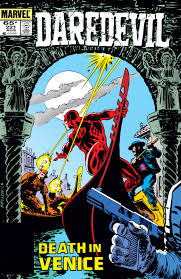 DAREDEVIL #220-221 (July-August 1985)
“Fog” / “Behold My Vengeance”
Writer: Denny O’Neil
Artist: David Mazzuchelli
Colourist: Christie Scheele
Letterer: Joe Rosas
Editor: Ralph Macchio
We’ve skipped another a couple of issues. Issue #218 is a Jester story. Issue #219 is a small-town crime story by Frank Miller and John Buscema where Matt only appears as a silent, unnamed stranger. As a straight crime story with one-off villains, it doesn’t get an entry in this feature, but it’s an intriguing oddity that has more in common with Sin City than it does with Miller’s previous Daredevil stories.
That brings us to issues #220-221, which will be our final entry for the Denny O’Neil run. He stays on the book for a few issues more, but issue #222 involves some people fighting over a sample of Mr Fear’s fear gas, and issue #223 is a Secret Wars II tie-in, with the Beyonder as the antagonist. Issue #224 is another fill-in (which we’ll be covering), issue #225 is the Vulture, and issue #226 is the Gladiator.
While I’ve listed this story as a two-parter, the Council of Ten only really appear in the second part. The first part – which carries a “special thanks” credit to Frank Miller, who was very much on his way back by this point – is principally a Heather Glenn story. As usual by this point, Heather is drunk, and she calls Matt for help as a pretext to get him to come and see her. Once he realises that, Daredevil ignores her irritating whining and heads off to fight some street criminals instead.
The next morning, Heather is found hanged in her apartment. At first Daredevil blames himself, but then he realises that her safe has been robbed, and he concludes that she must have been murdered. He tracks down Silvio Gulio, a Venetian businessman who had previously expressed an interest in buying her patents. As you might expect, Daredevil is right – Silvio has stolen the patents and sent them back to his employers in Venice, the Council of Ten. Quite what this achieves, given that you can look up patents in a public register, is never really made clear, but the story seems to be working on the assumption that stealing the document somehow gives you ownership of the patent. This is nonsense, but it’s just a macguffin so we can ignore it.
So – Daredevil beats up Silvio and his men while self-righteously berating them all for their indifference to human life. But it turns out that they didn’t kill Heather, after all. She was already dead when they arrived, and she really did just commit suicide because Matt ruined her life.
In isolation, there’s nothing necessarily wrong with this idea. In Matt’s defence, a lot of Heather’s problems actually stem from the Purple Man ruining her father’s life, which would have happened whether he’d met her or not. But Heather was also established as a mentally unstable character from the outset, and you can make a pretty decent case that Matt made matters much worse by adhering to the normal conventions of superhero secret identities with her. Miller may have wanted her out of the way for other reasons – she was a loose end character who knew Matt’s secret identity, and she was going to be supplanted as even a potential love interest in the next few months.
None of this, frankly, has much of anything to do with the Council of Ten, who are simply a plot device to get rid of Heather. But that means Daredevil has to spend the next issue in Venice dealing with the Council. Since Google doesn’t exist yet, Ben Urich shows up to tell us about the Council of Ten. According to the admirably extensive Daily Bugle files, they’re a neo-fascist group with designs on overthrowing the Italian government, who “named themselves after a 13th century group with a similar program.”
Historically speaking, this is all rather confused. There was a real body called the Council of Ten, but it wasn’t formed to overthrow anything. It was part of the government of the Republic of Venice, initially created as a response to a failed coup attempt in the early 14th century (not the 13th), and surviving until 1797. It did have some heavy-handed authoritarian tendencies at times, but it was way too early to be characterised as neo-fascist.
Mazzuchelli has cracked out the reference books and has a pretty good grasp of the buildings, but literally every boat on the canals is a gondola. There are a lot of gondolas in Venice, but that’s because they’re a tourist attraction. There are also plenty of modern boats, because people live in Venice and they need to get to work.
The Council of Ten turn out to be a bunch of weirdos who have a high-tech palace but who are all dressed in period costume. They also have a robot suit of armour to fend off intruders, and Daredevil defeats it in a rather nice three page fight scene. Daredevil goes on to escape a couple of deathtraps before being captured, at which point he demands that the Council’s leader Emilio Reuss “surrender yourself to the American authorities”. You’re in Italy, Matt.
Just in case we were in danger of sympathising with the Council against this imperialist American, Reuss gives us a Make Italy Great Again speech. There’s a need to restore order to a chaotic world, and Mussolini was great apart from the bit when he allied with a German. The Council are collecting useful things from all over the world for their future plans, such as those patents . You know, the ones they could have looked up in the public register. The Council brick Daredevil into a room (with “quick drying mortar”), but he escapes, and defeats Reuss just as the building starts to collapse. There’s no particular reason for it to collapse just then, as far as I can see – the story is probably getting a bit worked up about the idea that Venice is sinking, which was getting some traction by the mid 80s.
The Council of Ten are basically an afterthought: they let Mazzuchelli draw some Venetian locations and some action scenes. And he does both of those things extremely well. This is fortunate, because there’s really nothing else to the Council of Ten beyond the local colour that they provide. The bit about fascism is just hand-waving; the story isn’t about that, or about anything, really.
This would be fine if the Council were just there to be goofy Silver Age throwbacks. The trouble is that they’re the back end of the Heather Glenn suicide story, the result being a very nasty tone clash indeed. It ends on a sombre note, as Daredevil visits Heather Glenn’s grave to muse on his continuing feelings of guilt. Perhaps the Council’s story needs to be lightweight precisely because it’s not supposed to provide Matt with any meaningful closure – or maybe the idea was simply to lighten the mood instead of doubling down on suicide.
But there’s no reason for anyone to use the Council of Ten again. Even if you wanted to do a story about anachronistic conservative throwbacks in period dress, the Royalist Forces of America or even the Hellfire Club are more convenient options. Issue #221 stands entirely as an art showcase, and it’s a testimony to Mazzuchelli’s skill that it at least succeeds on that level.

Wait. Now I have a story idea to bring them back! A league of anachronistic ultra-nationialists from various nations, who have decided to team up to take the world back to the Eighteenth Century. So the Royalist Secret Empire, the Council of Ten, some Japanese guys in kimonos, some Prussian martinets, some Napoleonic fanbois, etc. Give them their own superpowered hench, I dunno. Turner Three Centuries.
Love the link to the Rondo Venaziano video there. That weird thing haunted my youth; I’m sure ITV put it on every weekend morning for some reason.
The Council of Ten does work as a farcical representation of Italian fascism with Mussolini’s constant references to the Roman Empire. It’s political rhetoric. Sure, dressing up like role-players from the Society of Creative Anachronisms is ridiculous, but one could argue that Mussolini’s (or D’Annunzio before him) appeals and motifs to ancient Rome were also ridiculous and yet (which was probably the point O’Neil was trying to make in a fumbling attempt)…Plus, it’s the Marvel Universe. Everyone dresses up in goofy costumes if they have an agenda and want to be taken seriously. Otherwise, they get stuck in the background as random criminals in fill-in stories. Which was the Council of Ten‘a date, sure, but they were giving it a good try.
A lot of writers have trouble understanding that a patent does not allow its owner the right to use something- it merely prevents others from using the subject of the patent. The worst example has to be the Michael Chrichton novel where the corporation patents a man’s DNA and after their cell lines are destroyed their lawyers inform them that the patent grants them the right to take replacement cells from any of his descendants even if they don’t consent.
“he escapes, and defeats Reuss just as the building starts to collapse. There’s no particular reason for it to collapse just then, as far as I can see”
What happens is this- when Matt is being bricked up, a priest hints that there’s a way to escape through the floor. Matt does so but winds up in a dungeon whose wall borders the canal. Using a sword he finds in the dungeon, he damages the wall and the water floods in. Matt swims to safety but he notices that the water is knocking a lot of masonry loose. And then in the next panel, one of Emilio’s goons says “Emilio… the building is tilting”. I think the idea is that Matt caused the building to collapse when he damaged the wall and caused the water to flood in.
@Michael- True, but even if patents did confer patent owners the right to use the subject of the patent, this plot point would still be nonsense. I can’t become the legal owner of somebody else’s car by swiping their registration from the glove compartment.
Yes, the concept behind the legality of patents in the Marvel Universe, apparently, is far stupider than the Michael Crichton book. Crichton was attempting to make a socio-political point, regardless of whether one finds it alarmist. Based on O’Neil’s usage of a patent, anyone who holds a successful patent in the Marvel Universe must be living in fear. Imagine if some random stranger off the street managed to steal the patent for the telephone from Bell?
I think O’Neil might have confused patents with blueprints.
I can envision an alternate earth where evil Tony stark, evil Reed Richards, evil Hank Pym are constantly fighting each other to hold the parents on various superpowered devices.
“The Infringinati”
“I think O’Neil might have confused patents with blueprints.”
From the description, it sounds like he confused them with bearer bonds.
Maybe Glen Industries invented and patented the “stealable patent” and that’s why someone wanted to steal the patent for it. So they could then steal more patents using their stolen patent-stealing tech.
“…Mazzuchelli has cracked out the reference books and has a pretty good grasp of the buildings, but literally every boat on the canals is a gondola.”
My memory could be failing me, a cursory google didn’t find anything.
I think there was a promo story in Marvel Age back in the 80s, that was about how O’Neil and Mazzuchelli were going on some kind of a junket to Venice, where Mazzuchelli could draw the city for this issue.
Maybe he really loved the gondolas.
@Matty – Maybe, and he probably figured that most readers wouldn’t know better anyway.
I bet if he’d illustrated the story just four years later, he’d have included the motorboats because by then, everyone would have seen Indiana Jones and the Last Crusade.
Orphan Black has an even dumber version of the own a person thing. So the show is about bunch of Tatiana Maslany clones running around. Since human cloning is frowned upon they have been illegally and secretly created. At one point they discovered that they have a copyright notice in their junk DNA. It is treated as this means they (and the daughter of one of them) is the property of the creator, rather than a criminal helpfully leaving their name at a crime scene.
There is a novella by Thomas Mann titled “Death in Venice”, on which a 1970s movie was based, although the plotline is a totally different story.
When I first read the villain’s name “The Council of Ten” I thought that it sounded like something out of a mid 90s Forgotten Realms sourcebook.
@Mark Coale: “I can envision an alternate earth where evil Tony stark, evil Reed Richards, evil Hank Pym are constantly fighting each other to hold the parents on various superpowered devices.”
That could be Marvel’s version of Spy vs. Spy, and it would rule.