Daredevil Villains #55: Edwin Cord
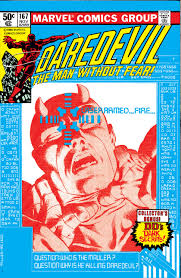 DAREDEVIL #167 (November 1980)
“…The Mauler!”
Writer: David Michelinie
Penciller: Frank Miller
Inker: Klaus Janson
Letterer: Joe Rosen
Colourist: Glynis Wein
Editor: Denny O’Neil
So here’s what happened since our last instalment. Issues #163 and #164 don’t have villains: the first one guest stars the Hulk, and the other is the story where Daredevil admits his secret identity to Ben Urich, who decides not to publish. Issue #165 has Dr Octopus, on loan from Amazing Spider-Man. Issue #166 brings back the Gladiator. And that’s the end of Roger McKenzie’s run as writer.
By this point, Denny O’Neil has taken over as editor, and as of issue #168, Frank Miller will be writing as well as pencilling. But first, we have another fill-in.
This one is a rather better fit than the Steve Ditko story we looked at last time. For a start, it still has the regular art team of Frank Miller and Klaus Janson. But this time, our guest writer is David Michelinie. At this point, he’s about 30 issues into his run on Iron Man, and he’s already completed “Demon in a Bottle”. So this feels like a contemporary Marvel comic from 1980.
It’s just that the contemporary Marvel comic in question is Iron Man. This issue’s villain, Edwin Cord, is an evil industrialist. He’ll never appear in Daredevil again, but he’ll show up in Iron Man #145 (April 1981), and he’ll make occasional appearance in that book throughout the 1980s. Oh, and this issue also features a guy in a suit of hi-tech armour. If it wasn’t for the fact that word processors weren’t around yet, you could be forgiven for thinking that Michelinie had done a search-and-replace job on an unused Iron Man script.
We open with Matt and Heather as guests at Cord’s country club party. Her heiress status explains why they’re there, but it still feels like a scene for Tony Stark. Cord is a creep, and he tries to recruit Matt by offering to help him dodge tax – a bold approach to take with a lawyer he’s only just met. Matt is grossly offended, and he’s about to storm out when the Mauler crashes the party and attacks Cord.
The Mauler is our guy in a suit of hi-tech armour, though Miller’s design veers more towards the semi-realistic than the typical Iron Man design – with a bit of charity, you could just about imagine this as some sort of exploration suit. The name supposedly stands for Mobile Armored Utility Laser Emitter, Revised, which isn’t the most impressive acronym in Marvel history. Anyway, we’re given to understand that the Mauler wants to kill Cord, but Daredevil drives him off.
Cord won’t explain what any of that was about, so Daredevil breaks into his home to interrogate him. This time, Cord identifies the Mauler as Aaron Soames, a disgruntled employee fired for “clerical reasons” who stole the prototype armour and wants revenge on the company. Daredevil isn’t entirely convinced, but we haven’t quite reached the stage where he’s a walking lie detector, so he leaves it at that for now.
It turns out that the Mauler really is Soames. He’s 63 years old, he spent 35 years working for Cord as a filing clerk, and he’s been fired to make way for a computer. With less-than-subtle irony, a computer glitch has wiped out his entire work record, and Cord is using this as a pretext for not paying Soames’ pension. With his litigation tied up in delays, Soames has stolen the armour to get revenge. But he only want to take symbolic revenge by incinerating Cord’s ID. He achieves that goal, and then gets gunned down by security guards. Cord invokes national security to cover up the whole incident, so Daredevil decks him before leaving.
And that’s the issue. It’s an early example of the “computer says no” trope. In 1980, this doubtless all seemed very new, hence the cover art with all the surrounding computer lettering. In 2025, such things make it look like the Mauler armour operated on ticker tape.
For that matter, the story handwaves away the quesiton of how exactly Soames managed to steal the Mauler armour in the first place, given that he was just an ageing filing clerk. Mind you, Turk will also manage to steal the Mauler armour in issue #176 – its only other appearance in Daredevil. So apparently Cord’s security is so useless that it can’t even keep out the comic relief. Considering Cord’s national security clearances, this probably ought to be a bigger deal than it is, but then I suppose that explains why Cord doesn’t want to bring in the police.
The Mauler armour itself has nothing to do with the theme of the story, and serves only to give Daredevil something to fight. Fundamentally, it’s a story about a long-serving loyal employee being screwed over by the capitalist who only cares about profit. The core of that story ages perfectly well. You could do it today with AI.
Of course, Cord doesn’t have to be corrupt in order for him to fire people in favour of machines. That just requires him to be ruthless. But it’s much more satisfying if he’s a crook too, which is why he’s dodging tax, refusing to pay Soames’ pension and invoking his national security clearance for cover-ups. Still, Cord’s level of actual villainy is at the low end. It’s enough to position him as someone deserving a punch in the face, but stops short of making him a full-bore villain. In his own eyes, he’s a normal businessman bending the rules just like everyone does. He’s greedy, but he has no plans to conquer the world or ally with supervillains. He’s just an asshole in a position of power, which is enough.
Well, it’s enough for this story, anyway. When he shows up next in Iron Man, he’s a more conventional villain. He sends his own armoured guys to fight Iron Man, and he gets brought down by SHIELD. Later, he becomes an armour dealer with a grudge against superheroes. All of which is fine, for a generic Iron Man villain with a dash of recognition factor. In Daredevil, Cord plays more on the tension between law and justice, as somebody working the system to his advantage. But Kingpin will soon have that role sewn up.
As for the Mauler armour, it might have found a better niche in Daredevil than in Iron Man. Suits of armour are everywhere in that book. As a budget option for fighting the likes of Daredevil, Mauler might have found a home. Miller used the armour again, albeit in a comic relief subplot, so he must have liked something about it. But Soames himself isn’t designed for return appearances, and the armour is too generic to stick around without him.

This may be a relatively early example of a character following the writer. Edwin Cord, clearly, is a better foil for Iron Man than for Daredevil. Not a particularly notable or original foil, but an okay one.
He fulfills all the basic requisites with few or no caveats to restrict the writer: access to just the right level of resources, means and motivations, largely a blank slate since he is a brand new character, just the basics of established personality traits.
He has malleable ties to existing continuity; Cordco and the Cord family date back to 1968’s “Iron Man #2” by Archie Goodwin. Janice Cord was Tony Stark’s love interest when she was killed almost accidentally by Titanium Man in #22. Cordco has an indirect role in the origin of the Controller, who is a significant villain. Absolutely none of that matters for this story, or for most if not all future stories that mention Edwin or Cordco – but writers have the option to tap into that continuity if they want. It is convenient to have some such characters floating in the background for ready access. And that is indeed how Micheline uses Edwin in “Iron Man” a few months later. Not every villain has to have a long, complex or nuanced backstory. There are presumably at least a solid half dozen so far unnamed, unrevealed business rivals to Tony Stark that can fill much the same role as Edwin Cord, but he has been named already and is right there, ready-made for immediate use. And using him makes the possibility of thickening the plot that much easier and more organic if the need arises, without much risk of being told that the character is reserved for some event or plot in another book.
Oddly enough, this is yet another stance of loosely connecting Daredevil to Iron Man – something that has no obvious reason to be done, but kept being done. It will be done again in #195, which shares a scene with Iron Man #171.
“If it wasn’t for the fact that word processors weren’t around yet”
Apple I and various CP/M based home computers was around from the mid 70s. An example of an early word processor is WordStar which was released in 1978.
For no reason other than my own amusement:
S.H.I.E.L.D.
S.W.O.R.D.
M.O.D.O.K.
M.O.D.A.M.
M.A.U.L.E.R.
H.E.R.B.I.E.
Also, “guy who righteously steals a suit of armor from his crappy employer” will be part of Guardian’s origin in Alpha Flight a few years after this story.
It’s become a trope. It’s usually inventors taking something they invented from their corrupt employers though, and most of the other examples I can think of involve African-American characters.
Thunderball, at Marvel, invents something which the employer steals and claims credit for inventing then fires Franklin, so Franklin attempts to take back his invention, only to find himself arrested. Although, this instance doesn’t involve armour, and he’s the only one who ends up as a villain.
Then, at DC, there is Steel who worked as an inventor for a weapon’s manufacturer. Irons discovers that weapons he invented are being sold to criminals and street gangs by the corporation, so he takes the armour he invented for the company to become a superhero to make up for the weapons that were sold to cause mayhem.
Also, Hardware from Milestone Comics is a genius prodigy inventor hired by a corrupt corporation with ties to the US government. Realizing that Metcalf can’t go to the authorities for help, he takes the armour he invented for the company and uses it to try to bring down his corrupt employer.
Related, but slightly different, is Marvel’s later anti-corporate vigilante, Cardiac (although also created by Michelinie). Setting Cardiac apart is that he funds his own company to create his armour, but his motivation is to gain revenge against a pharmaceutical corporation which refused to release a life-saving drug as it would be more profitable to continue the already available drugs for the condition, which are not a cure for the condition. Once again, it’s a case of Michelinie writing a plot for Iron Man but shoehorning it into a Spider-Man comic. The design of Cardiac could have been better, but I think Cardiac could have been a more popular character if he would have been used as an Iron Man character.
Luis> This may be a relatively early example of a character following the writer.
*Mantis has entered the chat*
I feel like they missed a trick by not going with “Mobile Armored Utility Laser Emitter (Registered Trademark)”.
It’s fairly common in serialized superhero comics for creators to take pet characters from series to series. Claremont was well known to never want to let characters he had written in the past leave his purview. Bill Mantlo and Jack Of Hearts was another situation sort of like Englehart and Mantis. Somehow Jack ended up as an apprentice to Iron Man while Mantlo was writing that book.
Michelinie is a writer who seemed to have a niche for writing Iron Man. Even when he was writing other comics, he seemed to be thinking about characters or plots that would work well with IM. He also enjoyed the idea of the pure-hearted wealthy elite fighting against corrupt mega-corporations. He foresaw post-Cyberpunk, I guess, where instead of down-on-their-luck lumpen characters fighting against the dystopian system, it was uber genius, nouveau riche tech moguls trying to make a “better world”.
It is certainly true that characters “follow” their creators often enough in current comics, but I don’t know that it was so common before 1980. My gut feeling is that for villains specifically there was a perception that they were to some extent the editorial office’s property to use or deny as they saw fit. To use an X-Men-related example, Sabretooth was originally an Iron Fist villain and IIRC Claremont could not or did not try too hard to use him in X-Men or Wolverine stories before late 1986, just a few months after Power Man/Iron Fist was cancelled. Granted, that seems to be far less of an issue currently.
@Bengt
Word processors were indeed in existence back in 1980, but still far from widely adopted. Apparently George R.R. Martin adopting WordStar 4.0 in 1987 was something of a trendsetting event.
I used CP/M for a bit, in fact used it in my first paying job, and I feel secure to say that it was not part of the average fiction writer’s toolkit as of 1980. That probably only came to be once either Apple’s Macintosh or Microsoft’s Windows became more widely known, at some point after 1984. Personally I am nostalgic of text-only interfaces, but I am hardly typical or representative of David Micheline’s working routine as of 1980.
The problem with this story is that the government would certainly have records of Soames’ employment. Companies are required to periodically submit lists of their employees and their salaries to the government. So it’s not clear how Cord thought this would go if Soames sued him, unless he was planning on cheating Soames since Soames started working for him. It’s also not clear why Soames couldn’t get Social Security- Micheline tries to hand wave this by saying that the guy at the Social Security office fell asleep while Soames was talking to him.Micheline had a questionable idea of how the government worked and once had an official from the State Department tell Tony Stark he was being sued for damages to a federal prison in Colorado. Who knew that Colorado was a foreign country?
“Considering Cord’s national security clearances, this probably ought to be a bigger deal than it is,”
It’s mentioned that Cord’s poor security on the Mauler project has caused the government to wonder whether they should keep doing business with him in Iron Man 145.
@Luis- Readers have been arguing about whether Cord is really related to to Janice Cord or if they just have the last name for decades.
The reason this issue was a filli-n was because this issue was supposed to start a two-parter featuring the Punisher that involved young people getting addicted to drugs. But the Comics Code refused to approve it. The two-parter eventually saw print in issues 183-184 after a little editing.
@Luis- there were certainly examples of writers reusing “pet” characters before 1980. Claremont used Boomerang in Iron Fist and then used him again in Marvel Team-Up. In 1977 and 1978 alone, Gerry Conway used Poison Ivy in Secret Society of Super-Villains 10 and DC Special Series 6 (a two-parter), then in two issues of World’s Finest, then in one issue of Justice League. In 1981, he used her in three issues of Batman. Of course, Claremont wasn’t Boomerang’s creator nor was Conway Ivy’s creator. But even earlier, Ivy’s creator Robert Kanigher used her in a two part backup story featuring Thorn in Lois Lane after she failed to catch on in Batman.
It’s true that the editorial office had the power to deny using a character. But it’s not clear that that’s why Claremont didn’t use Sabretooth- Sabretooth hadn’t been used as a villain in Iron Fist for four years before the Mutant Massacre. Characters bounced back between series all the time. Sandman was both a Spider-Man and a Fantastic Four villain in the 70s. Electro bounced back between Spider-Man and Daredevil.
It’s interesting to read Claremont’s late 70s stuff and realize that once he’s only writing X-Men, all these non-X characters (Sabretooth, Carol Danvers, Jessica Drew, Captain Britain, and others) will make their way into the broader X-Men supporting cast.
BTW, I see we finally reached the (first version of) the arced logo for the book, since Paul didn’t comment on it.
I used to read Power Man and Iron Fist, and I distinctly remember reading a letter from a reader suggesting that Sabretooth ought to meet/fight Wolverine.
I wonder if he ever came to regret writing that letter.
@ASV: Hell, look at how closely Longshot wound up associated with the X-Men.
Is nobody caring enough to mention that guy called Ted Kord over at DC?
Him being a („good“) industrialist tycoon, also entangled with high tech suits and such, conceiving a character called „Edwin Cord“ could be more than coincidence, I guess.
Granted, back then he was still with Charlton and the bwa-ha-ha Justice League is still seven years in, but appearing in an anthology issue teaming up with The Question „in the early 80s“ might have brought him on the radar of some people in the industry already that far back then.
@Luis
I’m only 50, but I did play around with BASIC on my fathers CP/M computer in the mid 80s. After it was hit by lightning we got a 286 running DOS with a greyscale monitor (the old one had a green/brown monochrome), which was much more fun for the young me as it had games readily available. 🙂
Lol, BASIC. I used BASIC a lot. On my Commodore Vic-20.
It took a while before word processors became reliable enough for professional writers to feel confortable with using them.
For instance, storage wasn’t without a measure of adventure up until mid 1980s or so. Hard drivers were prone to damage if moved carelessly, floppy drives were even more fragile, and not a few people had to rely on cassete tapes that were not any more lasting or reliable either.
Betsy Braddock is another in the same category as Sabretooth and the others.
@ChrisV: A lot of Michelinie’s Spider-man plots were also kind of like Iron Man stories. He brought in both Justin Hammer and later Sebastian Shaw twice over, using them as evil corporate types who hire or create super-menaces.
Jonathan Caesar was another rich creep with super-goons at his beck and call.
And as the poster Michael has noted in the past, Caesar’s backstory as a pampered, murderously possessive psychopath who got away with murder as a child is reused almost exactly in the Kathy Dare plotline in Michelinie’s Iron Man. And the Life Foundation was a recurring bunch of crooked rich people, too.
Cardiac, curiously enough, appears to be a Michelinie combining the “beta particle generator” device he’d introduced in his second Iron Man run with a wholsesale reworking of the powers and motif of a very minor character Michelinie created at DC when he was writing the Legion spinoff Karate Kid series in the late 1970s.
As stated at the “Karate Kid Characters” section of the DC Cosmic Heroes fansite, Pulsar was a reluctant mob assassin who had “circuitry…implanted between his heart and a contact in his hand. Whenever a special fiberglass staff touched that contact, it turned him into Pulsar, focusing the power from his atomic heart into pulse-bolts.” Sound familiar?
@flateric: Michelinie (and Bob Layton) seem to have been aware of the Charlton books, since the Ghost — introduced later in their second Iron Man run — has a very similar appearance to the Ghost from the old Ditko-pencilled Captain Atom stories.
@Michael: Another late-1970s “pet” character was Roger Stern’s use of Karla Sofen as the second Moonstone. He practically invented the character from a standard “gun moll” type in a forgettable issue of Captain AmericaIncredible Hulk and Captain America, and then brought her in to an issue of Spectacular Spider-Man before making her a recurring Avengers villain.
In the 80s, Stern also adopted Mister Hyde with the explicit intention of building the villain back up after Hyde’s lackluster 1970s appearances. So Hyde goes from Captain America to Amazing Spider-Man to Avengers in just a few years’ time, all under Stern’s plotting and scripting.
Going back to the 1970s, Steve Engelhart had at least one other pet character besides Mantis. His co-creation Necrodamus debuted in Defenders, came back in his Avengers, and eventually showed up in his 1980s run on Fantastic Four.
Englehart also kept going back to his creation Midnight, origianlly a one-shot Master of Kung-Fu villain who died in his first appearance. But there Midnight is in the Legion of the Unliving story from Engelhart’s Avengers, and later still Engelhart has the Kree decide to revive him as an anti-Silver Surfer weapon renamed “Midnight Sun.”
Claremont is still probably the most visible example of this, but that’s because few other writers got to have so many sustained runs across so many different books at Marvel. Jim Starlin and Gerry Conway tended to jump around a lot more from company to company and book to book, and Engelhart and Steve Gerber tended to get fired or have relatively short runs on titles. And all of them were less prolific than Claremont. So they all had fewer opportunities to reuse their “pets.”
Before the 1970s, it’s really difficult to note writers using “pet characters,” since before then the writing on almost all the books was credited to Stan Lee, and then to Lee or Roy Thomas. There weren’t enough writers moving between books to make it visible.
Even so, Stan seemed to like Doctor Doom and the Mandarin a lot, and he had them turn up in all sorts of comics. By contrast, Magneto has a single non-X-books appearance by Stan, over in the Thor series in Journey into Mystery, and the story reads a lot like a plug for X-Men.
Among more minor villains, books Stan oversaw made a bit more use of the Trapster than you’d expect. He was a guest-villain in some of Stan’s later Silver Age books, like Daredevil and Captain America. The Beetle also got to jump books a lot, showing up in Amazing Spider-Man a couple of times, fighting Daredevil once, and even KOing Captain America in the Avengers story that introduces the Collector.
And, of course, Stan just loved the Circus of Crime. They start in Hulk, fight Spider-Man a couple of times, give Thor trouble, and get a minor appearance in Lee’s Avengers v.1 #22.
Steve Gerber would often create stand-in viewpoint characters for himself rather than taking pet characters from series to series. Richard Rory, Howard the Duck, the Greg Salinger Foolkiller (to an extent). He did eventually bring Rory to Omega the Unknown.
Englehart didn’t just take Mantis with him from Marvel series to series though, he also took Mantis to DC (Willow in Justice League), then to Scorpio Rose, his creator owned series at Eclipse.
I’m not going to count Stewart the Rat as the same character as Howard, for Gerber, as the two characters are too different for it to be the same situation as Englehart refusing to let go of Mantis, who was obviously the same character at three different publishers.
You know, a writer refusing to let go of a character could be an indication that the character is based on someone they know and is therefore very personal to them. Mantis is Vietnamese. I looked up Englehart’s biography see if he’d served in Vietnam. He apparently did serve in the United States army for a period, but was honorably discharged as a conscientious objector to the Vietnam War. I was unable to find any further information about whether or not he served a tour in Vietnam before becoming a conscientious objector, but his particular fondness for Mantis would make a great deal of sense if Mantis were based on a woman he met there
@Chris V: true, a lot of the characters Gerber created were based on himself. However, he also had a small group of previously established characters that he worked on and bounced them between series (Daredevil showing up in Man-Thing, Defenders, and MTiO; The Thing making an appearance in Defenders while Valkyrie appeared in MTiO; Man-Thing wandering into MTiO and Howard the Duck; the Defenders teaming up w/ Howard; etc.) maintaining a little pocket of continuity across titles.
Regarding Edwin Cord, it seems like Michelinie ended up using him as the moe crass, overt, and unsuccessful corporate villain. This contrasts with icheklinie’s uses of Roxxon execs like Jonas Hale and Carrington Pax or the behind-the-scenes, overtly criminal Justin Hammer. Those villains never seem to suffer any real consequences, just the failures of their current scheme.
In contrast, Edwin Cord always comes across as jumped-up small fry, bit like the film version of Justin Hammer, and he tends to suffer actual legal consequences in many of his appearances.
As to Daredevil, my sense is that Edwin Cord wouldn’t have stuck for very long even if Michelinie hadn’t retained a sort of “ownership” of the character. The “corporate corruption”angle shows up in the form of the shady executives in Glenn Industries, who were arguably introduced back in the Doctor Octopus story, and were later used by Miller. And Miller is never that interested in using this for legal drama with Matt Murdock, who instead tends to defend specific individuals in short cutaways in the Miller run.
Nocenti, in turn, has the Kingpin step up to this role in his efforts to show Murdock that the law itself is a shame. The Kelco plotline runs through most of the early part of her run, and plays up Foggy Nelson’s unthinking selling out in “Born Again” against Matt’s “ghost lawyering” through a legal aid clinic.
It’s surprising that we don’t get that many Daredevil stories about Matt using his costumed identity to try to remedy the imbalance in legal resources or access for the victims of more conventional forms of corruption or injustice. Even the Kelco plotline never had Matt using his Daredevil identity to, say, intimidate the executives or get crucial evidence from their files or whatnot.
A lot of this is the way the organized crime and ninja stuff always seems to take a front seat, and stories about Matt’s legal career focus more on the usual question of vigilantism against criminal violence.
And none of DD’s prominent villains are really unjust-but-arguably-legal types. The Kingpin comes the closest, but he’s more of a well-insulated mob boss, even when he plays at being the mayor.
So it’s no surprise, I guess, that the only elements of this story that recur in later issues are the gizmos: the Mauler suit is stolen by Turk, and before that, the “vibro-mace” device that kills Soames is used to break down a wall in the upcoming Kingpin arc.
@Mike Loughlin: I tend to see writers turning their ongoing stories into crossovers or wrapping up aborted storylines in their remaining ongoing titles a bit differently than I define “pet characters.” I tend to think of “pet characters” as the ones that the writer keeps bringing back for multiple storylines in multiple books. (I’m not saying that you are calling this the same thing as “pet characters” that writers just like to use all the time.)
But in any case, Gerber didn’t really do much of that. I’d say the closest he ever came was his use of Wundarr, who goes from a one-shot Superman parody in his Man-Thing appearance over to Marvel Two-In-One where he’s part of a running arc.
Maybe he’d have made further uses of his Defenders villain Ruby Thursday, who gets to kill off Omega the Unknown at the end of his series, or his Howard the Duck comedy villains the Band of the Bland, who came back in Gerber’s She-Hulk run.
But after his original falling-out with Marvel, Gerber just wasn’t around long enough on other titles for these characters to pop up in lots of different storylines or series.
Daredevil does stop a couple of Kingpin’s goons from trying to intimidate a juror near the end of the Kelco story. Prior to that, Nocenti wrote that 2-parter with the voodoo drug dealers(?) where one of the cops convinces Daredevil to gather evidence and let them arrest the crooks, rather than just jumping in a beating people up. So Daredevil spends a few pages sneaking around, covertly recording conversations.
As far as writers and their pet characters, how do we characterize something like Jim Starlin and Thanos? Lots of other writers use Thanos, but each time Starlin returned to the character, he’d spend several pages explaining how those weren’t the real Thanos, or if it was, he totally lost that fight on purpose.
@Moo: So you were the other person with a VIC-20!
From what I could quickly glean from Googled interviews, Englehart served in the Army as a journalist stationed stateside at the Aberdeen Proving Grounds in Maryland. Mantis was Vietnamese because the Vietnam War was happening.
We had a TRS 80 (with cassette drive) and then an Apple IIc in college. I was only 1 of 3 people on my floor as a freshman with a computer in 1988.
In AP Computer Science, we did basic and my intro to computer science in college was in C.
@Omar Karindu: Layton was definitely fully aware of the Charlton characters, he was the editor of the original Charlton Bullseye, the official fanzine for Charlton, back in the 70’s.
“Mantis was Vietnamese because the Vietnam War was happening.”
You’re reminding when the Vietnam War happened? Steve, I owned a Vic-20, remember?
Clarification: I was the *other* person who owned the VIC-20.
Layton later wrote that dreadful L.A.W. series for DC back in ’99 that featured the Charlton characters.
@Eric G: Can’t believe I forgot about that! I tend to remember the Bullseye mostly for the serial in which John Byrne and Roger Stern finished up the Ghost storyline left hanging in the later 1960s run of Captain Atom.
@CalvinPitt: Those are good points. I guess I’d still be interested to see Matt deal with a recurring character who uses the law for unjust ends rather than engaging in blatantly illegal acts like jury tampering, extortion, and drug dealing. Would Daredevil genuinely step outside the law to remedy an injustice the law doesn’t and cannot fix?
As to Thanos, that’s an interesting case, with Starlin claiming an informal creative ownership of the character and using him as a feature player. But Starlin also generally came back to Marvel specifically to do Thanos stories, especially after the runaway success of Infinity Gauntlet, and the editors let him de-canonize Thanos appearances he disliked up into the early 2000s. By then, even Adam Warlock really wasn’t Starlin’s favored protagonist; it was Thanos at the center of things from start to finish.
And Starlin always did like creating Thanos-like characters elsewhere. Mongul is, at base, the entirely villainous 1970s Thanos as a Superman villain. And the High Lord Papal in Dreadstar is almost a fusion of Thanos’s childhood and the Magus’s role in his 1970s appearances.
@Omar Karindu: Yeah, that could be an interesting challenge for Daredevil. Really test his commitment to the law. I get the impression she’s not taken very seriously (probably from being introduced in Superior Foes of Spider-Man), but Janince Lincoln, the current Beetle, was supposed to be a pretty good lawyer. She might be a character that could tie Matt up in legal loopholes on any number of things.
That might mean you need a boss behind her that has her on retainer (the Minotaur guy that runs Roxxon?), but she was portrayed as not content with simply being a great lawyer. Maybe all the things she’s using the law as a shield for as part of some larger plan she’s got.
Claremont was poaching characters from PM/IF from the very beginning. He brought Misty and Colleen into Uncanny in his first year. Of course, the X-Men appeared in IF at the same time.
He snatched up Multiple Man from FF after just one appearance in 1978.
Also in 1978, Claremont and Byrne created Arcade in MTU to fight Spider-Man and Captain Britain, then brought him over to UXM just a few months later.
Ditto Karma, several years later c. 1982. Created by CC in a MTU with Spider-Man and the FF. By that time, he probably created her with the intention of bringing her over to NMU.
Frankly, don’t think it was really all that rare for writers to grab their favorite characters from other titles, unless those characters were in regular use. After all, we’re already post-Champions, the Defenders are an ongoing title, and there have been several MTU style books. By the late 1970’s Marvel’s shared universe was in full swing, villains and heroes trading partners with wild abandon.
===
My family had a VIC20. I think it’s still in the attic, along with two Commodore 64s, a 128c, an Amiga and an Apple IIe.
Sabretooth’s second written-and-drawn-but-not-published-immediately appearance was in Ms. Marvel, and I haven’t read it in years but I think it connects him to Wolverine? Or maybe just Canada in general?