Uncanny X-Men #17 annotations
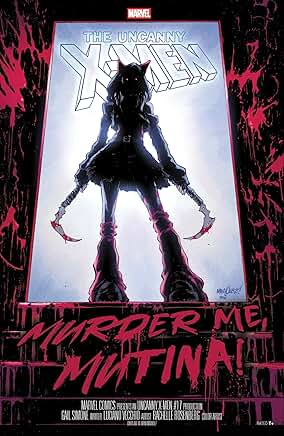 UNCANNY X-MEN vol 6 #17
”Murder Me, Mutina”
Writer: Gail Simone
Artist: Luciano Vecchio
Colour artist: Rachelle Rosenberg
Letterer: Clayton Cowles
Editor: Tom Brevoort
THE X-MEN.
Rogue. She seems genuinely surprised at the existence and success of a slasher movie where the killer is a mutant (see below). She assumes that it’s likely to lead to attacks on mutants, and worries about the Outliers.
Gambit. He’s entirely unbothered about Calico and Jitter being suspended from school – he seems to be taking it as read that they were defending themselves against a bully (which isn’t quite what happened).
Nightcrawler. Well, he’s there, but there’s not much to say about him this issue.
Jubilee. She argues that mutants need a PR firm. They did in fact hire a woman called Kate Kildare during the San Francisco / Utopia era.
Wolverine. He seems somewhat more open to the film than his teammates. After all, when your arch-enemy is Sabretooth, you can’t really argue that a mutant slasher is an unreasonable character.
Ransom. He assumes that Hotoru’s behaviour must be because he was badly hurt by someone and offers a rather unwanted supportive hug.
Jitter. She generally likes slasher films. Murder Me, Mutina made her feel bad “for some reason” but she can’t articulate why. She’s started calling Calico “Ballerina”, referring to their dance scene in issue #9.
Calico. She’s never been to a cinema before. She seems very uncomfortable about going to see a horror movie and can’t see the appeal. She has nightmares afterwards, and winds up coming to sleep on Jitter’s bedroom floor.
She seems unaware of how mutants are perceived by the general public, and asks whether people really think of them as monsters. At first glance, this sits a little oddly with what she’s told us about her mother’s beliefs about mutants (which she was reminding us about last issue). But then again, she seems to be generally rejecting her mother’s views, or at least coming to recognise that her upbringing is idiosyncratic, so maybe she’s genuinely surprised to learn that this particular opinion is more widely held.
Seeing Deathdream’s powers in action makes her wonder whether mutants really are monsters after all.
The Outliers are openly mutants at school – certainly, Jitter is known to be a mutant and Calico uses her powers openly. When Tommy Newbury (the bully from issue #6) is seemingly trying to help Jitter, she immediately runs him off – maybe she’s not paying attention to what he’s doing in that scene, or she doesn’t care given his behaviour in the past, or maybe she just wants to keep a potential rival away from Jitter. That last one is how Jitter seems to read it.
Deathdream. He goes along to see the film with the rest of the Outliers, but doesn’t actually seem very interested in it. He suggests in apparent seriousness that they should see a kids’ film called Otter Party instead – it’s possible this is a deadpan joke, but he does fall asleep ten minutes into the film. Possibly he just can’t work up any interest in a story which assumes that dying is a bad thing, although he gives an uncharacteristically opinionated speech later about how the film is an example of showing mutants at their worst in order to break their spirit.
He orders lots of “cimmonom pretzels” to eat, which he discovered a liking for in issue #9.
He claims not to know what hugs are, and doesn’t think he likes them..
SUPPORTING CHARACTERS
Marcus St Juniors. He strongly disapproves of the film, which will “lead to pain and hurt”. This seems to be a view based more on the film’s foreseeable consequences than on any concluded view about the filmmakers’ intentions.
Chelsea St Junoirs. She appears as the kids are leaving for school, but doesn’t do much.
Waffles. The name given to the Sentinel dog from last issue, which was reset to “good boy” personality and found its way to Haven. It seems particularly affectionate towards Deathdream, presumably because he was responsible for restoring its personality.
Ember. Calico claims that she can’t call Ember to fight Leticia because “he hates knives”. It’s not entirely clear whether she means that he would literally refuse the call, or whether she simply isn’t willing to put him in that position. Nor is it clear how Calico knows Ember’s feelings on knives, or what happened to lead him to have any in the first place.
Tommy Newbury. The bully from issue #6. He apologises to Jitter here and offers to help her clean anti-mutant graffiti off her locker. He claims to empathise because he also used to have a stutter.
VILLAINS.
Leticia Leech. The actress who plays Mutina. Her name is given on the poster that Scott and Betsy are looking at – which also gives her an “introducing” credit, implying that it’s her first significant acting role. According to Jitter, she’s an anti-mutant online troll. In the past, she seems to have appeared wearing an improvised mask with a simplistic face on it, showing crying eyes and a smiling mouth.
We see the lower part of her face in her dressing room, but she keeps the rest in shadow. In the part of the film that we see, she’s wearing a mask; she puts the same mask on before turning to face Jitter and Calico.
She’s apparently a mutant: she says that calling her a “normie who hates mutants” is “half right”, and complains that “All mutants ever do is talk. You make them hate us.” She seems to think that other mutants have brought on anti-mutant sentiment themselves by not choosing to blend in, which has led to her being caught in the crossfire.
Her powers aren’t directly explained, but she claims that “You can’t hide from me in shadow, it’s kind of my thing” and that “I live in every shadow”. She seems to be able to disappear into the shadows and reappear elsewhere (possibly in the same way as Silhouette from New Warriors). She also knows Jitter’s real name, suggesting some mind reading ability. She reacts to Jubilee lighting up the room as if it’s causing her real pain.
She attacks Jitter and Calico almost immediately, which is arguably reasonable enough, since they’ve got into her dressing room without permission. However, she clearly means to kill them and seems convinced that it’ll be good publicity for her.
She refers to “your little county fair” – the mutant friendship event announced by the mayor last issue.
Elliot Spence. Credited as the writer, director and producer of Murder Me, Mutina, which is described as an indie film. We see him briefly during the news report at the start of the issue. He insists that his film is not anti-mutant and argues that it’s actually a pro-mutant revenge story – in other words, he’s positioning it as a mutant version of I Spit on Your Grave.
What little we see of the film does seem to confirm that the plot involves Mutina returning to her high school to kill the bullies who persecuted her. Jitter’s inability to articulate precisely what unsettles her about the film, and the equivocal comments from some of the talking heads in the news report, suggest that it isn’t simply an anti-mutant propaganda screed. That might suggest that Spence is being sincere, or at least that he’s not trying to do anything worse than make an exploitation film. On the other hand, he did cast an anti-mutant lunatic in the lead role, which seems like something he’d be unlikely to miss.
The film poster credits Elliot Spence as writer, director and producer of the film, and Edgar Armand and Felicity Forrest are the other main actors.
GUEST CAST
A whole bunch of characters have cameos in this story, either phoning the X-Men to talk about the film, or appearing as talking heads in the news report.
- Kate Pryde from Exceptional X-Men phones in from Chicago. Oddly, she seems to be looking at a “coming soon” advert even though the film has already opened. The advert wrongly links mutants to the Terrigen Mists (which are mutagenic, but they’re part of the Inhumans’ mythos).
- Wolverine (Laura Kinney) phones in from New York.
- Scout is with Laura but has no dialogue. Scout shows up in Laura’s book this issue (mutilated, but chances are she gets better). That issue also contains a passing reference to the film.
- Cyclops. He claims that the X-Men have been making “real progress” for mutants before the success of the film. This might seem a little ambitious in terms of anything that’s happened during the post-Krakoan era, but if he’s talking specifically about the state of mutant-human relations in the town of Merle (which is where he is) then he has a point.
- Psylocke. Scott’s second-in-command is with him, but says nothing.
- Blade. Appears as a vox pop. He takes the film to be anti-mutant and dislikes it accordingly.
- Elsa Bloodstone. Another vox pop. She defends the film; she thinks a degree of caution about mutants is rational, and evidently thinks the premise of a mutant serial killer is well within legitimate bounds.
- Daimon Hellstrom. Appears as a vox pop but offers no view on the social issues – he just dismisses the director’s previous work.
- Magik. She appears as a vox pop, refusing to talk.
- C Robert Cargill. He’s a real screenwriter. He argues that the film is punching down.
- Nancy Collins. Novelist. She gives a stock liberal answer about the powerless before realising that this doesn’t quite work for mutants with superpowers.
- Emily Andras. Billed as a writer/director here, she’s a showrunner on shows like Wynnona Earp. She’s worried about the reaction to the film but argues that it’s a legitimate subject.
- Joe Hill. Novelist. He criticises horror films for stigmatising the most defenseless in society and argues that they should fight back – of course, this is exactly what Spence claims his story to be doing.

A weird one. One of those issues where the mutant metaphor and social commentary feel each just a touch off and it cascades into somehow being both overly obvious and confusing at the same time.
Yes. It seems that Marvel continually wants to point out how badly the mutant metaphor works for real minorities in society lately.
Simone flags it with Nancy A. Collins’ comments. There are probably a thousand valid reasons for humans to fear mutants. I doubt an exploitation horror film is going to be any sort of tipping point. “Well, a couple years ago Magneto threatened to wipe out all life on the planet. Now, he’s hanging around with the supposedly ‘good mutants’. I was ok with all this until I saw a movie featuring a fictional mutant serial killer, now I want to see mutants in a concentration camp.” (I guess that’s how they expect the typical Marvel Universe denizen to think. Which would be bad enough, but now Marvel seems to want to remove suspension of disbelief.)
Compared to something like “bathroom wars”, I think there’s a fair and large disconnect between the “mutant metaphor” and the real world.
Honestly, I’m surprised there’s never been a film centering a mutant as the villain. I’d have expected an entire slew of mutant films to have been produced over the years, possibly starting with Dazzler: the Movie. The Morrison years presented a huge explosion of mutant culture which pretty much existed until M-Day, and the Krakoa era should have also sparked a resurgence.
I could imagine an entire series of slasher flicks inspired by Wolverine or Sabretooth alone.
(For all I know, these ideas were touched upon at some point, but I’m old and my memory isn’t what it used to be)
So it’s kind of weird that -now- there’s this concern over a mutant revenge/slasher flick.
Slight correction. Scott and Kwannon, not Scott and Betsy. Old habits!
This feels like it should be the kind of nice two patter that’s a fun spin on things. But the tone can’t decide what it’s trying to be, and the cast is so bloated. Why even have Kurt and Jubilee?
I can’t believe the X-Men are this worried about a movie when they have more important things to deal with. Dazzler was just kidnapped and an entire audience did nothing. 3K produced a video that portrayed the X-Men as sellouts and featured a Magneto impostor supporting them. But yeah, the REAL problem is an anti-mutant movie.
Shouldn’t Blade be a pariah after what happened in Blood Hunt? Varnae took over his body and tried to unleash the vampire apocalypse. I mean, presumably the heroes told the authorities what happened, so he wasn’t charged, but still…
“They did in fact hire a woman called Kate Kildare during the San Francisco / Utopia era.”
And she got replaced by Mr. Sinister. And before that they had Cameron Hodge. who was secretly the leader of an anti-mutant group potting to destroy them. They really don’t have much luck with PR people.
Mutina’s powers aren’t very clearly defined, and that’s a problem with a lot of Simone’s new characters- the Outliers, for examp0le.
“Leticia Leech” seems like it could be a stage name, and the shadow powers — and the line about “liv[ing] in every shadow” might also suggest some kind of supernatural aspect to the character.
The name “Leticia” derives from the Latin laetitia, which means some kind of exuberant happiness or joy. So her name might suggest someone who leeches happiness and joy, making the world an, er, shadier place. Dunno whether that’ll turn out to be literal or figurative.
Less likely is that “Elliot Spence” seems a bit like “Ellott Spencer,” which was apparently revealed as the original human name of Pinhead from the Hellraiser film series. If that’s intended — and I think it’s a stretch on my part — it may just be a clever little horror-genre wink.
When I see Elliot Spence, I think of Leverage’s Eliot Spencer instead. 🙂
Ambiguous powers can be a wise tactic for writers. If the character proves popular, they can later narrow the abilities down to something that works in whatever stories also prove popular. If they say outright what a new character can do, any changes will seem like a retcon.
Of course, there is always the risk of becoming like the early 90s, where every new supervillain seemed to have the power of “clouds of exciting green stuff that somehow kills everyone”.
Re: Si, remember when everyone’s new power was, “siphon bio energy” “redirect energy” “use bio blast”
Not reading this book, but I like the cover. 🙂
Kurt in the early years such had shadow powers as seen in the Leprechaun of Cassidy Keep story. So maybe he will get to play an active role as this arc progress rather then being Gambit Rogue and the Outliers.
This seemed interesting from the solicits, but not at all in the actual issue. Just another one that backs up that X-Men comics shouldn’t concentrate too much on the mutant minority/culture aspect.
I was so pleasantly relieved that there was nothing referencing Mojo either directly or indirectly. While there have been good Mojo stories before, it’s complete /0a1b1sence is a win here.
*absence
@Si and Daly: The 90s also gave us two different X-villains who leech people’s life through tentacles (Omega Red and Senyaka) and multiple versions of the generic furball-with-claws characters rounding out the various villain teams (Crule, Hairbag, Shrew, Spoor, and — over in the very X-Men-like Bob Harras run of Avengers — Sloth, not to mention Thornn and Feral).
@davethe story isn’t finished yet
Given the horror movie cliche of killers returning from the dead, having a Jason/Freddy type be a mutant makes a lot of sense.
The obvious movie with a mutant murderously lashing out at her oppressors with psychic powers: Carrie. Why isn’t that cited as promoting anti-mutant sentiment?
You could probably make an entire X-Men team out of Stephen King characters: Carrie, Firestarter, Walken from Dead Zone. Cujo as their mascot and Christine as their car.
@Mark Coale: also Danny Torrence from The Shining. He already has a codename: Doctor Sleep.