Daredevil Villains #60: The King of the Sewers
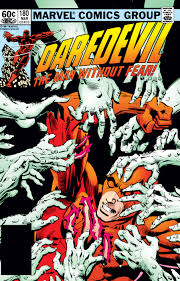 DAREDEVIL #180 (March 1982)
“The Damned”
Writer, penciller: Frank Miller
Finisher, colourist: Klaus Janson
Letterer: Sam Rosen
Editor: Denny O’Neil
Frank Miller’s first run as writer covers issues #168 to #191, but it’s built heavily around the trinity that we’ve already covered: Elektra, the Kingpin and the Hand. There are some edge cases in the rest of Miller’s run who might have qualified for this feature, to be sure. The Kingpin’s mayoral candidate Randolph Winston Cherryh gets a major speaking part, but he’s still basically a Kingpin pawn. There’s a subplot about the board of Glenn Industries trying to seize control of the company from Heather, but they’re mostly anonymous white collar criminals. And there are generic drug dealers and the like who drive the plot of individual stories. But these are gimmick-free criminals with a single story, and they all share the spotlight with more recognisable characters.
Once we score all of those guys off the list, this turns out to be our final entry from the Miller run. For those of you who might be wondering, issue #177 doesn’t have a villain – it’s an issue of Stick helping Daredevil to get his radar back. Issues #178-179 are the Kingpin. Issue #181 is Bullseye. Issues #182-184 have the Punisher as guest villain on loan from Spider-Man. Issue #185 is the Kingpin again. Issue #186 is Stilt-Man. Issues #187-190 are the Hand and the Kingpin. And issue #191 is Bullseye.
The story I skipped over in that list is Daredevil #180, and the King of the Sewers. Now, to be honest, you’d struggle to say that this guy was particularly central to the plot either. His story is a subplot in a storyline which is mainly about the Kingpin’s efforts to get his stooge Randolph Cherryh elected as Mayor of New York. But the King of the Sewers is a supervillain of sorts, and he’ll come back for a whole storyline in issue #333, so he merits a post.
As you might recall, the Kingpin’s beloved wife Vanessa was seemingly killed in an explosion. The main point of doing that was to clear the way for his return to crime, by removing Vanessa’s influence on him. But Vanessa isn’t dead, and instead she starts showing up in a subplot, stumbling around New York as a mentally broken homeless woman. Apparently explosions can do that. Eventually Ben Urich recognises her, and tells Daredevil.
So Ben and Daredevil go searching for Vanessa in the sewers. Daredevil is feeling traditionally heroic in this issue, and he’s sure to spell out that while it would be awfully nice if Vanessa talked the Kingpin back into retirement, that’s just a bonus. Rescuing her and getting her some help is a worthwhile goal in its own right. Daredevil is also on crutches, after being lured into a steel trap by Elektra last issue. But come on, how hard can it be to go for a wander around the sewers?
As is always the way in these stories, it turns out that there’s an entire community beneath New York, made up of equally mad, desperate and sore-covered people. They drag Daredevil and Ben before their King – a big fat bald guy, apparently an albino. He wears a bit of jewellery and not much else, and carries a spiked club. He also has green speech balloons, whatever that’s supposed to signify. His followers appear to worship him. The King himself seems to have at least a basic level of intellectual coherence, but nobody else seems to be in any sort of shape to handle tasks such as gathering food. The viability of this community is a bit puzzling, to be honest, but we’re not meant to think too carefully about how it works.
The King has recently killed his previous queen on grounds of being annoying, and has replaced her with Vanessa on the grounds that she has a nice ring. Vanessa has draped herself at his feet with a rather blank expression. Since this is a story about the New York sewers, the King naturally tries to feed Daredevil and Ben to his pet crocodile, but Daredevil escapes and beats him up with his own club. The sewer people then immediately declare Daredevil their new king, and Vanessa gives him her ring.
Apparently Daredevil completely ignores his new role as leader of the sewer people. Instead he shows up at the Kingpin’s office and uses the ring as proof that Vanessa is alive. The Kingpin has just pulled off the task of getting Randolph Cherryh elected as a puppet mayor, but in order to get Vanessa back, he agrees to get Cherryh to resign. And that’s the story.
The King of the Sewers is not what you would call a well rounded character. In fact, the whole thing seems intended to be more symbolic than anything else. The narrator describes the story as if it were a descent into the underworld, though it doesn’t map very neatly onto the tale of Orpheus. The King himself is clearly a distorted version of the Kingpin, playing up his grotesqueness and parodying his superficial respectability; although everyone in the community seems to be enthralled by the King, Vanessa’s response to him is presumably meant to be tied to his resemblance to her husband. The Kingpin’s love for Vanessa is always played as genuine, but it becomes rather controlling and creepy under Miller, with Vanessa stripped of all the imperious qualities that she had under previous writers. Perhaps the King’s main function is just to sell the idea that the Kingpin’s love is oppressive, but that Vanessa is somehow doomed to remain in his orbit.
It reads like a curious detour, and while the idea of an underground community is hardly out of place for Daredevil, Miller doesn’t seem to have had any interest in returning to the place. He isn’t really trying to make it feel like a working community, so much as a pit of madness beneath the surface. Other than the King himself, nobody here is a functioning character – at this point, not even Vanessa herself.
Still, that didn’t mean that later writers couldn’t have returned to the setting and fleshed it out. And tunnel dwellers and sewer alligators are standard urban legend material for early 80s New York, so at first glance it’s a little surprising that Miller’s successors didn’t go back to this available thread.
The obvious answer is that another book did go back to this idea, and did it better – or at least, did it in a way that was more viable as a recurring setting. About a year later, the Morlocks make their debut in Chris Claremont’s Uncanny X-Men. The story is rather similar, but with mutants, and with more rounded characters. Someone is kidnapped to the hidden community, and the heroes have to get them back. The hero wins by beating the community leader in a fight, is acclaimed as the new leader, and does nothing about it.
While it’s a decent idea for Daredevil, it’s a better one for Uncanny X-Men, where the Morlocks also provided the first signs of an underground mutant culture. There isn’t really a place for the King of the Sewers once Callisto is in circulation, all the more so because he’s so obviously designed as a distorted shadow of the Kingpin. The hidden community trope does work, but starting from scratch with the Morlocks was a better bet than trying to retool the King of the Sewers to fit the role.

The Stilt-Man in #186 was Turk, not Wilbur. I don’t think that warrants an entry in this series, but I wanted to point that out.
This story is a curious little piece. It feels like it was the condensed, done-in-one form of what might have been developed into a larger story if Miller felt like it and circunstances allowed. But by this point we have less than a full year ahead in Miller’s first DD run, and clearly he had built enough of a reputation to have a few choices available.
IIRC, about a year after this story the first Wolverine miniseries debuts pretty much at the same time as the Morlocks are introduced in Uncanny X-Men #169. For all that I know, it may be that when Claremont and Miller were discussing the Wolverine series the idea of King’s sewers community mutated (appropriately enough) into the Morlocks. Miller’s next published work was Ronin at DC, which would be well publicized and clearly establish him as a creator at the big two – with his own IP to boot. I don’t _know_ that Miller decided that there was no advantage in extending his DD run when he could enjoy more creative control and build his name better elsewhere, but it sure feels likely. And if he had to choose which plots to condense and which to develop, the King of the Sewers and even the recovery of Vanessa are natural enough candidates to take the backseat to Kingpin, Elektra and the Hand.
Reminds me also of one of the few clunker episodes of BTAS, IIiRC called The Underdwellers. The bad guy there wears a crown and has pet alligators., I think.
There was, of course, a sewer craze going on the early-‘80s. Once again, Miller was at the vanguard of pop culture. A year after this, we saw the debut of the Morlocks, as mentioned. We also had the TMNT and CHUD in 1984. I remember all the kids wanted to go live in the sewers. In the early-‘80s, it was our answer to everything, “Under the city; there’ll be no frustrations, just friendly crocodilians”. Well, that was the 1980s for anyone who missed it: ninjas and sewers. You kids may have heard of other phenomena such as ALF or New Wave music, but no, it was mostly all ninjas and sewers.
Mark-The Batman:TAS Sewer King is partially based on Fagin from Dickens (minus the whole “the Jew” stuff) mixed with seemingly some of Miller’s King of the Sewers (living in the sewer, the crocodiles).
Matt crosses an ethical line this issue- he implies that he won’t return Vanessa to the Kingpin unless Cherryh resigns. The Kingpin calls him on it in a later issue.
This issue leads to Elektra’s death. The Kingpin decides that he can’t let Cherryh’s resignation pass without retribution, so he orders her to kill Foggy Nelson. But when Foggy recognizes her, she can’t do it and flees in shame. And in that state, she’s attacked by Bullseye and killed.
@Luis- Parts of the Morlock story- the angel being held captive by the evil queen- were based on Barbarella. So it’s possible Claremont was inspired by Miler but he had other influences as well.
The Morlocks story might be a response to this story in another way, though. As Paul mentioned, Vanessa lacks agency in this story- she’s basically just an object for Daredevil to rescue. In the Morlocks story, Warren is kidnapped by Callisto and famously doesn’t even get to speak. This might be a response by Claremont to how female characters are treated as merely objects for the hero to rescue. But two wrongs don’t make a right and Warren’s fans were justified in complaining.
@Michael: Miller makes up for Vanessa’s lack of agency somewhat in the Love and War graphic novel, where she starts to express a desire to be free of the Kingpin. She’s still something of a pawn, though, since her coerced therapist, Paul Mondat, uses this to free himself and his own wife from the Kingpin’s clutches along with Vanessa herself.
But overall, Miller’s Daredevil run is pretty big on women whose roles are determined by their relationships to the men around them. It’s come up her in discussions of Elektra, Heather Glenn, and Karen Page, and Gloriana O’Breen’s actions during “Born Again” are largely about her reaction to Matt’s fall and Foggy’s material success.
In some ways, I think we can read Typhoid as a kind of response to this, but Nocenti may have been responding to women’s roles in comics more generally.
In between, we can talk about the debut of Yuriko Oyama and how it contradicts her later retool into villainy, and then we’ll have stuff like Deborah Harris’s fixation on Micah Synn and Gloriana O’Breen’s unusual debut.
Can’t wait to see what Paul will have to say about Denny O’Neil’s use of villains with ties to Britain and the Republic of Ireland as seen through an, ah, very American lens.
“There was, of course, a sewer craze going on the early-‘80s. I remember all the kids wanted to go live in the sewers. In the early-‘80s, it was our answer to everything,”
Oh, come on. Early 80s sewer craze?The Karate Kid was one thing, but now you’re just pushing it. What parallel universe did you live in where all the kids your age apparently wanted to join karate dojos and live in the sewers?
Incidentally, though created a few years earlier, TMNT didn’t hit the mainstream until the cartoon began airing in 1987. Turtles-mania (I believe it was called this and not sewer-mania) peaked in the early 90s.
I like that Marvel has filled every possible layer with hidden societies, like a big old lasagne of lore. Not counting space, you have helicarriers, then normal people, then below that the sewer people, then the Morlocks, and below them you have moloids, then lava men. I’m not sure who lives at the actual core, but I don’t doubt there’s someone established to be there.
@Si- in Doctor Strange 76, there was a caption that read “The deepest hole in New York…deeper than the realm of the Morlocks..deeper than the Haunts of the Sons of Satannish…deeper than the lair of Sigmar the Eternal.”
@Michael – Man, that’s deep.
The Doomsday Man once lived at the Earth’s core, indeed. And survived for perhaps years, until he got out of there and became a menace to the surface again.
It is all in the Doomsday Files, a.k.a. Silver Surfer #13 (1969) and Ms. Marvel #3-4 (1976).
The sewer craze is the strongest indictment of ‘80s parenting and the American education system. We all thought the sewer was cool. Why? Because no one explained what the sewer was actually for: ghost clowns. Stephen King’s It was a direct reaction to sewermania, but it wasn’t until the tv movie and Tim Curry’s performance as Pennywise that we finally got the message: Just say no. And no-ing is half the battle… against sewer-dwelling ghost clowns.
“it turns out that there’s an entire community beneath New York, made up of equally mad, desperate and sore-covered people.”
We’ve mentioned the Morlocks of course.
But there’s also the Night People of Zerotown, underneath Central Park.
And the Monster Metropolis under Manhattan
And Under York even further down
And the Thing encountered New Manhattan, -also- underground.
So if you’re just living in the sewers, you’re definitely missing out on other fine dwelling opportunities. I know it’s hard to find a good place to live in the city but sheesh.
As for the air, there’s also the flying city of the Bird-People from Red Raven’s origin.
I knew others would remember those days. Unfortunately, the realization came too late. So many kids threw their lives away thinking it would be cool to live with the King of the Sewers, the Sewer King, the Rat King, multiple other kings, or a CHUD only to find out “this is your brain in the sewer”.
The lasting legacy of the sewer CRAZE today is a well-remembered PSA from Ronnie Raygun, the first president to explore the planet Mongo, “It’s 10 pm: Do you know where your children are? They’re probably in the sewer, Nancy.”
“Stephen King’s It was a direct reaction to sewermania”
I’m know you’re just joking, but in any event, King’s inspiration for “It” came from “The Three Billy Goats Gruff.” The sewer setting came about as a result of him hearing some trivia about the sewer system in the town he’d recently moved to. It was apparently overbuilt and sprawling due to having been built during the WPA (Works Progress Administration 1935-1939) and people were actually canoeing in it.
And in 1993 sewermania came back with the Mole People book, even if it was likely made up.
But back to Daredevil, what did Frank Miller have against C.J. Cherryh?
Re: Canoeing through a sewer.
How did that first conversation even go? I can’t even imagine it arriving at the point where a canoe actually makes it into the picture.
Townie #1: “What do you wanna do?”
Townie #2: “Dunno.”
Townie #1: “So, the sewers are pretty big.”
Townie #2: “Yeah.”
Townie #1: “Big enough for a canoe, I bet.”
Townie #2: “Maybe, yeah. You got a canoe?”
Townie #1: “Nope. You?”
Townie #2: “Nope.”
Townie #1: “Damn.”
Townie #1: “Wanna just go out for beers then?”
Townie #2: “Sure.”
Don’t forget the “giant alligators in the sewers bc kids flushed the baby gators they got on vacation in Florida” part of the sewer craze.
I mean, John Sayles wrote the script for Alligator for Roger Corman.
“Punisher as guest villain on loan from Spider-Man”
Feels like the Punisher is worthy of one of these? At least by the Ennis era, Daredevil and Punisher were definitely more of a relationship and that flows into the MCU.
Probably because it’s a more interesting conflict, given Matt’s Catholic/Hell’s Kitchen view of Frank is far more tortured than Peter’s more middle-class/liberal “I feel sorry for you, but you’re a murderous nutjob, and jail is what we do with those”, and because in any actual direct contest between Punisher and Spider-Man, Punisher ends up webbed to a wall and upside-down within seconds.
There were also some people living underground in McFarlane’s Spider-Man, “subhumans” according to the wiki.
For the Marvel Universe, there was also the bunch of unhoused people living in the sewers under the protection of the Golden Age Angel (or his twin brother?) and, for a while, the Abomination.
Hmm. Maybe sewer canoeing started out as a business venture. A discount Pirates of the Caribbean ride for families that couldn’t afford Disneyland.
Yes, McFarlane had another completely different group of New York sewer dwellers turn up in his Spider-Man run. Their “king” was (spoiler) Morbius, who instructed them to kidnap criminals for him to use as food, except they misunderstood and were kidnapping anyone they saw. This led to Morbius being all sad about his lost humanity, etc, etc.
One of the first Marvel comics I got was X-Men #74 (1998) wherein Angel is going through the sewers to confront his bad memories of the Maurauders, only to be ambushed by Abomination, who’s living in the nearby sewers. He’s rescued by Marrow, who was also in the sewers, visiting the ailing Callisto.
The New York Sewers–big sewers and small sewers, all at the same time.
In the 1990s Spider-man books, there were stories published within a couple of years that had the demon/Macendale Hobgoblin, Doctor Octopus, Vermin, and the Lizard all using lairs in the sewers.
There’s an Ellis/Shalvey Moon Knight story that has a mentally ill super soldier/SHIELD guy in the deep, deep sewers underneath layers of trains and empty tunnels and other sewers. You know, deep time and buried history and all that jazz.
NYX established that the Morlocks had returned to the sewers. At the same time. Spectacular Spider-Men established that a community of clones was living in the sewers. So there’s a community of mutants and a community of clones living in the sewers. Do Gaby, Maddie and the Stepford Cuckoos take turns mediating disputes between them?
Was going to mention Vermin if no one else had. But I think you’d expect people like Vermin or the Lizard or Killer Croc to live or have their base in the Sewers.
@Mark Coale – Brilliant villains. They base themselves exactly where you’d expect to find them.
Sewer canoeing??? That’s…. Wow. Our species’s continued survival is sometimes inexplicable.
I think Grant Morrison had the right idea in Manhattan Guardian: sewer pirate wars. No-Beard and All-Beard leading rival pirate gangs that battle for supremacy underneath the city. I think Marvel’s next crossover should be Sewer Wars, with all their sewer people fighting each other. 12 issues and 47 tie-in titles. The winner lays claim to the worst place to live ever. Nobody above-ground even notices.
“I think Marvel’s next crossover should be Sewer Wars”
It’s bound to happen sewer or later.
Right, I’ll just see myself out.
Sewer Canoeing sounds like a euphemism for illicit behavior.
Do undersea canals count? If so, shout out to the end of Dr Phibes Rises Again.
I blame all of this sewermania on The Third Man.
“what did Frank Miller have against C.J. Cherryh?”
Most likely the name’s either intended as an an affectionate nod or Miller not realising the name’s unique to her. That or it’s a lot milder than what Chris Claremont had against Steeleye Span’s lead singer.
@James: Thank you. I did wonder if the title Downbelow Station inspired the Sewer King plot – the timing works, I think.
Reminds me of that smallville episode where the villain of the week was named Geoff Johns
Reminds me of that Smallville episode where the villain of the week was named Warden Ellis
C’mon folks. Stories about catacombs and the people who live under the Earth are as old as humanity. There wasn’t a “sewer craze” in the 1980’s; those are just the stores y’all remember growing up with. But everyone from Dante to Twain, Wells and Verne, envisioned subterranean societies.
The New York flavor of this story was pretty popular at the time because poverty and crime in NY in the 1970’s led to a lot of mythology about the subways and sewers. But that was just the flavor of the day.
@Oldie: nope, the sewer craze was real. From the hit song “Down Under (the Streets)” by Men At Work (in the Sewer) to the hit movie Raiders of the Lost Ark (Hint: It’s in the Sewer) to the hit tv show Full House (So Some of Us Have to Live in the Sewer), the ‘80s was one giant sewer party. It’s a shame that people’s attention spans are so short, no one writes or says the parts in parentheses any more.
@Mike
Naturally! And it’s the crossover between the Sewer Craze and the Ninja Craze that propelled the Teenage Mutant Ninja Turtles into immortality. There is literally no other possible explanation.