Psylocke #10 annotations
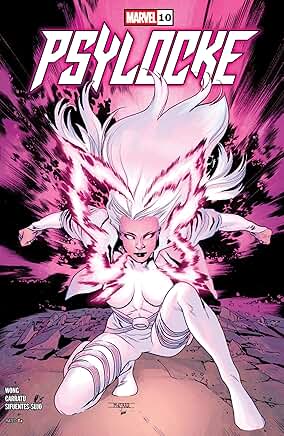 PSYLOCKE vol 2 #10
“Unmoored and Unmourned”
Writer: Alyssa Wong
Artist: Vincenzo Carratù
Colour artist: Fer Sifuentes-Sujo
Letterer: Ariana Maher
Editor: Darren Shan
COVER: Psylocke, possessed by the Lady in White.
This is the final issue of the series.
PAGES 1-2. Kwannon dreams of meeting the Lady in White.
The previous issue ended with Kwannon being possessed by the Lady in White after rejecting Mitsuki’s offer of an alliance to take over the Hand. In that issue, Mitsuki described the Lady in White as a yokai who “cares for the lost dead, especially lost children, and avenges them by tormenting their abusers until they lose their minds”. According to Mitsuki, the Lady saw Kwannon as one of the guilty, but Mitsuki used her powers to force the Lady to lure Kwannon to Japan as a potential ally instead. The Lady’s own comments about Psylocke earlier in the arc broadly confirmed that.
In this dream, however, Kwannon appears as a child, accompanied by a non-speaking Mitsuki. The scene broadly echoes flashbacks from issues #7 and #8, earlier in the arc. This version of Kwannon – a victim of the Hand – is obviously one much more likely to be viewed sympathetically by the Lady, and indeed that’s how the Lady treats her here (though she turns on her in their next scene). As in issue #6, the Lady gives Kwannon a vision of her lost child Hideko, but this time it’s in the context of inviting Kwannon to accept the Lady as a mother figure.
Note also that, despite Mitsuki claiming to control the Lady in White last issue, her non-speaking version here appears standing by the Lady’s side. Perhaps the Lady isn’t quite so far under Mitsuki’s control as she thinks; certainly, Mitsuki’s personality change and her brutal revenge on Hiyashi last issue seem more in keeping with the Lady’s personality.
The lullaby is the same one that “Hideko” and Deathdream sang in issue #6.
PAGES 3-6. Mitsuki leads her forces against the Hand’s Tokyo sanctum.
We saw this implausibly prominent citadel last issue.
Mitsuki claimed last time that she had already taken over the Kyoto branch of the Hand, and mentions that again later in the issue. But we don’t see any regular Hand members who are loyal to her – instead, her attacking force consists entirely of the yokai who were with her in the previous issue. No particular reason is given for this, but presumably she wants a bigger power base before starting intra-Hand fighting. Maybe the Kyoto branch isn’t on the scale of this one.
Another possibility is that Mitsuki is more interested in avenging herself on the Hand than leading it, despite what she said last issue. Certainly, she talks as if the aim is more to destroy the Tokyo branch and fill the vacuum. Maybe this bunch of oddities is the Kyoto branch of the Hand, post-Mitsuki. Later in the issue, her aim seems to be more to get her hands on the Equinox Blade and build a power base around her yokai.
Under the Lady in White’s control, Psylocke appears to have Iceman-style powers, and can turn enemies to brittle ice crystals. She says something about using their “sins” and “secrets” to do this, to be fair, so maybe the Hand ninja are particularly susceptible.
The script repeatedly insists that Mitsuki’s attack on the Hand is a bloodbath, but we really don’t see any sign of that in the art, beyond the Lady shattering the two statues here.
PAGE 7. Devon and Greycrow learn about the attack.
Devon’s “rat cameras” were mentioned last issue.
PAGE 8-9. The Lady talks to Kwannon.
Mitsuki referred to Kwannon being a “gate” last issue – she claimed that Kwannon’s long history of mind alteration and mind control made her easy to possess.
The Lady tacks from treating Kwannon as a child victim to an adult abuser (note that Hideko now appears as a child rather than a baby). Her speech about Kwannon’s guilt echoes a similar rant from issue #7.
Kwannon is shown what’s happening with her body in the outside world and is horrified that she’s being forced to break her vow not to kill any more people; the Lady seems to see this as some appropriate form of punishment for her.
PAGE 10. Devon and Greycrow amidst the fight.
PAGES 11-12. Mitsuki claims the Equinox Blade.
Mitsuki asks Kwannon if she remembers “being summoned to the Sanctum to meet Master Hayashi”. This would be the scene was saw in a brief flashback in issue #1, where they were apparently just two among a number of candidates. This location doesn’t particularly resemble the one from the flashback, but nobody said it was the same room.
The Equinox Blade, and the mission to recover it for the Hand, were in a flashback in issue #8.
PAGES 13-14. Devon and Greycrow try to intervene.
Mitsuki apparently wants to absorb their souls into the Equinox Blade, to the great annoyance of the Lady in White, who apparently just assumes them to be “condemned souls” – until examining Devon and declaring them innocent. To be fair, it’s not a wild leap of logic to assume that anyone running around a Hand sanctum is morally compromised.
Astoundingly, Devon can recognise the Equinox Blade from across the room, and remember what it does, based solely on having seen pictures of it “on a dark-web forum”. This is so far beyond Devon’s established area of inerest that it feels terribly contrived, especially because nothing that follows really seems to turn on Devon knowing this.
PAGES 15-16. Kwannon makes a deal with the Lady.
Kwannon spells out for us that her possession by the Lady combines her worst nightmares: being used as a weapon without agency, and “losing control of my body again” (i.e., her body swap with Betsy Braddock).
Kwannon’s pitch to the Lady is that Mitsuki is going to kill everyone in the building, including the Hand’s current crop of child trainees. We get a single panel of one of these kids trying to defend the others against a yokai, in parallel to young Kwannon and Mitsuki. Was this book expecting an issue #11? Kwannon offers the Lady an extremely non-specific price – “my life, my death, my everything” – on the basis that she deserves everything that’s coming to her, but she’s more in line with the Lady’s mission of saving lost children.
It’s not really made clear why the Lady is able to accept this offer and turn on Mitsuki, despite Mitsuki claiming to have her under control last issue. But, as noted above, there’s at least some indication that this arrangement is not as one-way as Mitsuki thinks it is, and besides, Kwannon’s pitch is that the Lady is being compelled to participate in something that goes against her fundamental nature – Mitsuki may simply be pushing her luck too far.
PAGES 17-19. Psylocke defeats Mitsuki.
She puts Mitsuki into a coma, and the Lady takes her away. Kwannon claims that the Lady takes her “to the same place she took me”, but that was a mindscape – it really doesn’t answer Greycrow’s question about where Mitsuki is physically going. Of course, Kwannon may reasonably think that the fate of Mitsuki’s body isn’t the point.
Presumably, if the book had continued, future storylines would have involved the question of what the Lady’s price might ultimately be, and the potential for Mitsuki to be redeemed.
PAGE 20. Closing montage.
We’re told that the Hand trainees are taken to the Factory, though again, we don’t see them.
Panel 2 is Shinobi Shaw, along with his display of the Taxonomist’s butterflies from the first arc. The accompanying narration is talking about Psylocke’s own “moving forward” and “healing”, but presumably we’re meant to view Shinobi’s face turn in a similar light.

I didn’t realize that was supposed to be Shinobi at first.
This issue was rushed. The final issues of NYX, X-Factor and X-Force were also rushed. The writers apparently didn’t realize that unless sales were good, they were only getting ten issues and thus planned longer arcs. This is partially Breevort’s fault- he should have told the writers about the 10-issue rule. But really the writers deserve a lot of the blame too. In today’s market, they should have realized that they’re likely not to get long runs and planned accordingly. This is a KWANNON book- it was very likely it wouldn’t last very long.
To be fair, I don’t blame the writer on X-Factor or X-Force to expect their books to be quickly cancelled. That’s what happens when you use Social Darwinism as a book publishing strategy. Let all the X-books compete and only the strongest will survive. OK, Tompocalypse.
Mark Russell, at least, seems like he was upset at not being informed about the reality of his X-Factor gig. He doesn’t seem excited to work for Marvel again anytime soon. Sure, his book wasn’t well received and it sold badly (but Phoenix still gets ten chances), but it was X-Factor he signed on for, not Psylocke; and so Brevoort is at fault for not informing writers like Russell or Thorne that they only had ten issues to win over fans, or their books were getting axed.
Brevoort probably thought that books like X-Factor, X-Force, Psylocke, and the rest had a snowball’s chance in hell of lasting long. The problem is that 1. Psylocke is a mid-tier character. She is just not going to pull numbers like Deadpool or Wolverine. It probably would have worked better as a mini-series. What all these cancellations do is damage the brand. I just wonder if this era is heading toward a major reset after AOR.
Well , as a Kwannon/Revanche fan from the 1990’s , I am just happy she even got her own solo-series at all , when I was personally fan-lobbying X-editorial during the Decimation Era in the 2000’s to bring her back (as then-head-X-writer Mike Carey mentioned in his very first CBR X-related interview that he was interested in writing her) I would never have dared dreamed she’d not only be back in her original Japanese body (I resigned myself to accept the bodyswapping was permanent) Kwannon-as-Psylocke would be as prominent in 2025 as Betsy-as-Psylocke was during the 2010’s.
I’m sincerely uncertain on what the complaint is exactly. We got ten issues of a fine solo series by Psylocke with good plot, good characterization and fine art, thereby giving a talented young writer and a talented perhaps-young artist an entry into the X-Books while raising the profile and improving the characterization and world-building of one of the less developed X-characters. Leaving behind some plot seeds that may be followed on, no less.
Is that a bad thing?
@Luis Dantas
Look, Marvel can do whatever they want, and if you enjoyed the book, that is fine. It’s just after a string of failures in a short period, it simply isn’t the right look. I understand it would not be easy after the Krakoa era, but many people were hoping that Marvel and Brevoort would be improving by now. It would probably have worked better if they had done a mini-series for characters like Magik and Psylocke rather than dedicate an ongoing series to them.
I don’t think I acknowledge this period as one of failures – or at least not by the same criteria that you do.
Me, I will gladly take these Magik, Psylocke, X-Men and, yes, X-Force series over most of their immediate predecessors. I’m still bummed by “Sins of Sinister” and “X-Men Red Vol 2”. I can hardly blame Brevoort and company for wanting to avoid repeating those mistakes and experimenting a bit.
Nor do I see a real point in declaring 10-issue trial series as explicitly miniseries. What would the upside be?
@Luis Dantas: There’s a significant difference in both perception and production between an ongoing series that gets *cancelled* at #10, and a 10-part miniseries that comes to a natural conclusion and/or is extended if it’s successful.
Whether you acknowledge it or not, cancellation *is* failure – failure to market the book correctly, failure to write it compellingly enough to attract and maintain an audience, etc.
It’s great that you think this is going to raise Psylocke’s profile, but in reality, the lesson Marvel will take is (charitably) that Psylocke doesn’t sell as a solo character and thus she won’t be getting a second chance anytime soon, or (uncharitably) that women-led solos aren’t financially viable and perhaps there should be fewer of those (not especially outlandish considering Marvel editorial has come to similar conclusions in the fairly recent past).
@sagatwarrior: There’s little point in relaunching the line while Brevoort remains its editor – in twenty-five years the “kitchen sink” mentality has been his only long-term strategy when it comes to launching and coordinating books. It’s just going to be another wave of random series with similar premises post-AoR, and most of those will be gone in a year too.
Personally I enjoyed X-Men Red Vol 2 over most of what we got post-Krakoa.
@sagatwarrior- By most accounts, Magik sold pretty well. It might be coming back after Age of Revelation, so I can see why Breevort greenlit it. The problem is launching a Psylocke series at the same time, when both of them are “sexy women with swords and dark pasts who are protective of children”. it’s no surprise one of them failed.
Diana-Your third paragraph, especially, is very perspicuous.
The first scenario happened with Gambit. After the 2012 Gambit series and the X-Factor team with Gambit were both quickly cancelled, Marvel had an edict that they would not publish a new Gambit-centric series for a very long time, as the character was no longer viable.
While I realize it was a different market, I should note that X-Factor lasted twice as long as 10-issue X-Factor, and that Gambit series also lasted nearly twenty issues.
————————————-
I’m not sure how X-Men Red wasn’t experimenting on Marvel’s part, as it featured a cast of untested characters and starred a character whose last series got canceled much quicker than Gambit’s prior solo book. Nor do I see how “Sins of Sinister”, a crossover event, is relevant to “experimentation or learning from mistakes”, as Brevoort is drawing from the same well water, again, with “Age of Revelation”.
@Michael: Erica Schultz’s Laura Kinney: Wolverine is also essentially that.
X-Men Red was not experimentation nearly as much as it was egotrip indulgence. I expected far better from Al Ewing.
Magik and Psylocke are completely different characters far as personality and even powers go. More to the point, the books themselves are entirely different in what they are telling.
But clearly, we do have very different expectations.
Marketing a book as a miniseries would in no way make more business sense for Marvel.
A 10-issue miniseries would sell worse at the outset than a 10-issue ongoing series. And it leaves no room for continuing the series if it’s still selling well after the initial 10 issues. You can’t market your way from “miniseries” to “ongoing.” Once people think it’s a miniseries, that’s it. That’s apparently what happened — or at least one of the things that happened — to Joe Casey’s “Wolverine and Friends” series.
Given those realities, it’s up to the creative and editorial teams to ensure that the book’s initial 10 issues form a well-paced story with clear breaks that leaves room for expansion should the title continue being published. This was the problem with X-Factor and X-Force — poor communication of the series’ limits. Weirdly, Phoenix doesn’t seem to have this problem even though it has many others.
Conceptual overlap is an interesting question in this round of X-Men solo books. Magik, Psylocke, and Laura Kinney all have some similarities that have been noted. Storm and Phoenix, on the other hand, seem like very different characters until you promote both as cosmic beings interacting with the greater Marvel universe. That’s a weird decision.
@Thom H. Weapon X-Men was originally solicited as an ongoing.
@Diana- it’s a bit more complicated than that. Joe Casey describes what happened here:
https://thejoecasey.substack.com/p/post-mortem-part-two
Basically Casey submitted a proposal intending for it to be an ongoing, but it was approved as a limited series, so Casey and Breevort decided to promote it like it was an ongoing, hoping that it would be approved as an ongoing if sales were high enough. But word leaked out that it was a limited series.
@Michael: That’s all well and good for the portion of the readership that’s “in the know”, but insofar as public channels are concerned, the book was initially marketed as an ongoing. So it’s perhaps not the best example for an argument that one can’t transition from “miniseries” to “ongoing”.
Glad this is finally over. The first arc was interesting enough, but the second one dragged on endlessly. It felt like I was reading the same ‘Hand’ flashbacks over and over again because there was barely any actual story to fill the pages. No surprise this book plummeted in the sales rankings after the first arc and ended up a commercial failure. Expect this whole ‘Lady in White’ nonsense to be quietly forgotten. Marvel has clearly learned that not every character can carry their own solo.
@Amanda, well , FWIW , it gives Marvel-616 2 new ethnically-Japanese female characters who can be either anti-heroines or anti-villainesses (since they’re both conventionally attractive and have combat-ready powers)
I agree with those who say a ten-issue limited series would just mean the same ten issues we got anyway, only they’d sell worse. I also can’t imagine Psylocke’s being canceled after ten hurts the brand much. Nightcrawler, Cyclops, Bishop, and loads of others have had ongoings that didn’t last long. Wolverine and the Rob Liefeld creations aside, solo X-books don’t have a reputation for longevity.
The quick end to X-Force and X-Factor is a bit worse.
I hadn’t thought about how focused on heroines the line has been lately—Psylocke, Phoenix, Magik, Storm, Lauraverine. It’s a good development but coming all at once it seems,Ike an IP development or corporate marketing strategy. If I’m right, the point wasn’t that series would last long, but they’d give execs copious examples series with women. Word is some at Disney aren’t fond of “X-Men” as a gendered brand. But maybe there are other corporate reasons for the new focus.
Well, Marvel’s Transformers famously was launched as a four issue miniseries and lasted until #80, but I realise that’s a very specific, and very different, situation.
🙂
Walter Lawson> Word is some at Disney aren’t fond of “X-Men” as a gendered brand.
I’d be more concerned with “X” given who most prominently uses it nowadays…
thekelvingreen> Well, Marvel’s Transformers famously was launched as a four issue miniseries and lasted until #80, but I realise that’s a very specific, and very different, situation.
Well, it’s not unique. Hell, over at the Distinguished Competition, the current Poison Ivy series started as a limited series and is up to *checks* #36 as of next week.
I dunno, I’m actually MORE likely to pick up something that’s a miniseries rather than an ongoing, since to me that means it has a planned beginning-middle-end, and if it sucks, my completionist tendencies won’t bankrupt me. Starting to get burned on so many of these “ongoings” getting cancelled earlier than the author thinks and having crap endings because of it (in part).
But, wouldn’t surprise me at all that I’m in the extreme minority on that compared to the general masses.
I’d usually agree that some blame goes to the writers – Thorne in particular clearly was thinking he’d be getting 30, 40, 50 issues – but in this case I get the impression the “minimum 10 issues, beyond that we’ll see” wasn’t communicated very clearly. Either that or all of these authors failed to properly plan for their stories to fit into nice 5-issue chunks that would still read nicely even if ended earlier than desired.
@ SanityOrMadness
Well, that’s probably why Feige is talking about the “Mutant Saga” rather than the X-Men.
Easy way to avoid two problematic words!