Daredevil Villains #61: Willow
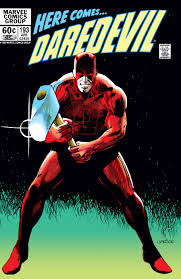 DAREDEVIL #193 (April 1983)
“Bitsy’s Revenge”
Writer: Larry Hama
Artist: Klaus Janson
Letterer: Joe Rosen
Editor: Denny O’Neil
Frank Miller’s run ended with issue #191, and by most standards he left the book in a much healthier state than he’d found it. Sales had turned around, it was back on a monthly schedule, and it was a book everyone was talking about. But all of that rested heavily on Miller himself, and left Marvel with the question: what now?
Klaus Janson stuck around for a few more issues on art. That gave the book some degree of visual continuity during this transition, although to be honest, less than you might expect. His layouts are more traditional and his issues feel a little more restrained, though there are still visual flourishes to be found. But it’s still Klaus Janson, and there’s still some consistency.
Who would even want to put themselves forward as the next regular writer of Daredevil, though? As it turns out, the answer seems to have been “nobody”. After two issues by fill-in writers, editor Denny O’Neill wound up writing the book himself – in his own words, “mostly because there didn’t seem to be (m)any other viable candidates for it”. But we’ll get to that next time.
The first fill-in, issue #192, was by Alan Brennert, mostly a TV and SF writer. It’s actually pretty good; it’s a Ben Urich story which picks up on some points from Miller’s run, has some reasonable things to say about corruption, and rises respectably to the challenge of following Miller. Presumably he simply wasn’t available to be the regular writer. But the villain is the Kingpin, so the issue is beyond our remit. Instead, we’re here to talk about issue #193. This one’s by Larry Hama, who was in the first year of his G.I. Joe run at the time.
The story opens with Daredevil swinging by the New York armoury to visit his never-before-mentioned friend Sarge, only to find the veteran mortally wounded by a gunshot. Sarge explains that the attackers have stolen the new Dragon anti-tank missiles. Even worse, they stole his .45, “Bitsy”, a family heirloom that he took to Vietnam with him.
The robbers are double crossed by their getaway driver, who escapes with the loot as soon as they’ve loaded it into the back of the truck. That leaves everyone else to get beaten up by Daredevil, and he learns that they were hired by a guy called Carmine Pesca. Pesca plans to target the SS Madagascar, a cruise ship that sails for France in the morning, with millions of dollars worth of diamonds in the hold.
So Matt decides to join the cruise as a passenger – you’d have thought his diary would be busier, but apparently not. Pesca turns out to be a passenger on the ship, and Matt also meets the ship’s magician, “Willow the Phantasmagoric”. She has a remarkably elaborate act for a cruise ship act: she’s using holograms to make it look as if she’s conjuring up an elephant on stage and she can make volunteers vanish into the rafters with a harness and wire. (She’s entirely unbothered about the fact that Matt knows how it’s done, but there’s nothing particularly unrealistic about that.)
She also has two rather stereotypical assistants called Ali and Akbar – which would be more of a problem if they didn’t turn out to be disguised thugs. As it is, they’re basically hiding in plain sight.
That night, the ship is attacked with the stolen Dragon missiles. The idea is to knock out the ship’s radio and to intimidate the captain into surrendering the diamonds. But it also knocks the ship’s radar dish out of line. This somehow messes with Daredevil’s radar sense, giving us a set piece where he has to climb the mast blind in order to hack off the damaged dish with an axe. (Yes, that’s why the cover shows a maniacal Daredevil wielding a sharp implement.)
Pesca turns out to be a stooge hired by Willow as an audience plant, and of course the real villain is Willow herself. A brief fight leads to Willow melodramatically producing Sarge’s stolen gun – remember that? – and trying to shoot Daredevil. Unfortunately for her, the gun doesn’t work; it’s been jammed with shrapnel ever since Vietnam when Sarge survived a premature grenade explosion by sheer fluke, and he only carried it as a keepsake. So it blows up in her face, which either knocks her out or kills her. It’s left unclear.
It’s a superior fill-in story, and it gives Janson plenty to get his teeth into, but it’s also very much an all-purpose story. Hama tailors it to Daredevil up to a point: there’s the set piece with the radar dish, and a bit of colour in how he reacts to Willow’s act. But as a story set mostly on a cruise ship, with none of the regular supporting cast or settings coming into play, you could plug pretty much any Marvel solo hero into this one. It’s easy to imagine Hama writing this exact same story for Wolverine in the 1990s, and it would have worked just as well – perhaps better, because Wolverine would be able to see Willow’s act. But you could do this one with Spider-Man or Captain America or Batman without much difficulty. In fact, you could even do it as a format-breaking issue of GI Joe and play up the missiles more.
In that sense, it’s not really a Daredevil story. Still, in terms of tone, it’s within regular Daredevil parameters. And stories like this stand or fall on how interested you are in the guest villain. Willow is engaging, at least as a one-off. The misdirection setting up Pesca as the villain is well executed, the stage magic is completely unrealistic but still feels like stage magic within the context of the Marvel Universe. And Willow’s personality switch at the end comes off well. The moral about the gun feels tacked on, though – it doesn’t really connect to the main plot at all, beyond a very vague “bad person gets comeuppance” aspect, and there’s absolutely no good reason for Willow to produce the Gun That Is A Metaphor which she happened to steal at the beginning of the story, rather than just having her own gun.
Obviously, Willow is not a character designed to return. Aside from the fact that this is a fill-in story, her gimmick is a reveal which can only be done once. As a recurring character she’d be a budget Mysterio, and that wouldn’t work. In fact, we’ll get exactly that with another magic-themed fill-in villain within the next year. But as a one-off character here, in a story designed mainly to keep the book ticking over, she does her job well.

Interesting, I remember the layouts in issue 192 by Klaus to be pretty interesting and imaginative at times.
As for the layouts of 193, if those are more conventional … those are Hama’s layouts, not Klaus’, aren’t they?
Another magic-themed villain? Ah, yes…the one with the name that certainly wasn’t intended to be political at the time.
Regarding Alan Brennert, he’s mostly known for a series of one-off stories at DC in the 1980s and early 1990s. He was primarily a screenwriter, including work for the revivals of The Twilight Zone and The Outer Limits, so he’s perhaps an early example of a writer from another medium getting to do a few comics stories. But he wasn’t a celebrity, so it seems to have come about through his love of comics and his friendships with writers and editors.
The bulk of his stories at DC take on the task of giving thoughtful, poignant endings or epilogues for various characters who’d long fallen out of fashion or been killed off. His stories there tend to be less about the action and more about characters coming to terms with the past and finding closure.
I don’t know how I managed to misread “Alan Brennert” as badly as I did, but just for a second I was struck by the notion of the entire issue being Ben Ulrich delivering a monologue straight to camera, which starts out vaguely twee and then goes to some very dark places indeed.
I accept that the comics will always wobble on whether “rader sense” is shorthand for how DD’s heightened hearing and somatosensory system combine to create a picture of his surroundings, or an actual extra sense, but I still prefer it not to be actual radar.
“Sarge explains that the attackers have stolen the new Dragon anti-tank missiles. Even worse, they stole his .45, “Bitsy”, a family heirloom that he took to Vietnam with him.”
Yep, this is a Larry Hama story alright.
Daredevil after Frank Miller wasn’t the only time someone didn’t want to write one of the major Marvel books. Supposedly, it happened to Hulk twice. PAD was the only one who wanted to write the Hulk, since after Al Milgrom’s run the sales were horrible. And Tom Breevort has claimed that Bill Mantlo was the only one who wanted to write the Hulk after Roger Stern’s run. Which is odd, because the sales were good, partly due to the fact that the TV series was still on the air.
Brennert also won Emmys for his work on LA Law. And perhaps his greatest achievement might be that Harlan Ellison endorsed him adapting his work for TV.
There’s a collection of his DC work, including a great issue of Brave andThe Bolinvolving the Earth-2 Batman and Catwoman.
Alan Brennert would also go on to win a “best short story” Nebula Award for the horror story “Ma Qui”, and wrote a somewhat famous historical novel title Moloka’i, which I believe became a best-seller. That was in Brennert’s future though.
His issue of DD was one of my favourites. I thought the issue was O’Neil’s first for the longest time and was surprised to discover it was by the person who was responsible for some stories on the revived Twilight Zone.
Speaking of Ellison, he would contribute some of his rare comic book work for this very series in a few years.
As for this issue of DD, it was another issue of DD. It was fine. Yeah, it was definitely a Larry Hama issue, the only thing missing was a ninja. Surprising as this was Daredevil right after Miller, but I guess this was before Hama decided that ninjas were the one thing missing from stories about soldiers and Vietnam vets.
I only thought about “Daredevil Villain #61” being “Willow” with a 1983 cover date. This barebones description: It’s a comic from the 1980s featuring a magician named Willow. Somewhere, some fans would be very disappointed that this isn’t fantasy fiction that would become the basis for a movie.
“As for the layouts of 193, if those are more conventional … those are Hama’s layouts, not Klaus’, aren’t they?”
Janson is the credited artist.
From Marvel Wikia:
“According to writer Larry Hama in an interview, he created uncredited undersized storyboards for this issue (in essence, art breakdowns) which were blown up to comic art size and finished by Klaus Janson, due to deadline pressure.”
https://www.manwithoutfear.com/daredevil-interviews/Hama
@ Michael – There’s a bit of a difference between “I don’t want to write this book because I think it’s poison” and “I don’t want to write this book because it’s a hell of an act to follow.” (Also, Brevoort became a Marvel intern nine years after Mantlo took the Hulk job, so his account is second-hand at best.)
Yeah, but it would be odd that writing for the Hulk comic was considered an uphill climb at the time of the TV show. I call “suspect” with Brevoort’s account considering he starts his opinion piece by writing “I get the sense that…”. His only proof being, “That tended to be the way Mantlo got books.”
“PAD was the only one who wanted to write the Hulk, since after Al Milgrom’s run, the sales were horrible.’
I don’t understand why that would be a reason for a writer to turn down a series.
@Moo-The way PAD explained it was this:
https://www.peterdavid.net/2013/08/02/looking-back-on-the-hulk-2/
“It wasn’t as if there was a ton of interest from other writers. People simply weren’t falling over each other to hop onto a book that many considered to be a dead end.”
it’s true that often the lower-selling books at Marvel in the ’70s and ’80s often got the least important writers. That’s why Kurt Busiek and Jim Owsley both got their starts on Power Man & Iron Fist- it was one of the lowest selling books in Marvel, so it made sense to assign new writers to it. The exception, of course, was if one of the “hot” writers loved the character and always wanted to write them.
I couldn’t stop reading that interview with Hama. It was fascinating to learn what else he completely didn’t care about.
Creatively, I can see a writer being fearful of writing the Hulk during the TV era, if editorial wanted you to mirror the show and not get too outside the box.
On the other hand, if the TV show drove sales up, it,ight be worth it from a financial pov.
Yeah, I can see how Incredible Hulk may have been seen by writers as a dead-end from a purely creative standpoint, but I don’t see how the book being a low-seller would put them off. It’s salary pay, not commission pay.
I mean, even if they didn’t have
royalti–“incentive payments” at the time, one suspects that a higher-selling book paid a better page rate than a “low-selling” one.@SanityOrMadness I wouldn’t suspect that. I don’t think it works that way. I think your page rate depends on who you are and how much a publisher is willing to pay you to have your name on the book.
Going back at least as far as the Roger Stern run (late 1970s), Hulk must have been a very difficult book to write for.
The premise was rigid, well trodden, and increasingly difficult to suspend disbelief for. It did not really make sense that Banner would choose to live as a fugitive with no lasting relationships when his face, name, and plight were common knowledge and he could have easily chosen instead to pursue some oversight arrangement in search of a cure. By that point he was a core member of the Defenders alongside Doctor Strange, and on a first name basis with many of the main Avengers to boot.
How hard could it be to convince even Thunderbolt Ross that there was mutual benefit in quarantining him and building some form of brain trust to seek a solution? Greenskin and Gamma Base troops sure could use a respite from their usual routine of shooting pointlessly at the Hulk before he jumped towards them and trounced them with his bare hands, only to find out later that Hulk was actually trying to protect them all from a much more serious danger. One has to assume that the costs of all those destroyed tanks and planes added up and became an embarrassment. And how come the Avengers, the FF and the Defenders only sporadically attempted to contain him and convince him to choose that path?
So, creatively, it must have been a very challenging book – and I very much doubt that talent working on it was paid particularly well at the time. So it became something of a new talent showcase, mainly for Bill Mantlo to explore some of the most exotic forms of that rigid setup and eventually bring it to some of its logical consequences. And then, after a period of some uncertainty that included a brief Byrne vanity run, it proved to be a good plataform for Peter David to run wild. But that was a personal risk for David to take.
You wonder what PAD’s workload priority was, given his varied work load in that era. Aquaman, Supergirl, Hulk, novels , movie and TV work, CBG column and eveything else he was doing.
I may be conflating his 90s work into too small a time period.
Mark, the cover of the 1st issue of his Supergirl run says September ’96, and it looks like his Aquaman run started in ’94, running into ’98. The end of his Hulk run (#467), came out in summer of ’98. So there was at least some overlap, although I have no idea how far ahead he was on writing some of those books.
but I don’t see how the book being a low-seller would put them off. It’s salary pay, not commission pay.
Being the writer on a book that’s about to be cancelled can’t be great for career advancement, unless you turn it around.
@Oldie – I highly doubt that sales of The Incredible Hulk, low as they may have been, were so low that the series was actually in danger of cancelation in 1987.
Regarding PAD’s workload in the late 90’s…
In the back half of that decade, he was also writing Soulsearchers & Company bimonthly, the Young Justice series, Captain Marvel, maybe more. Fallen Angel for IDW and Spy Boy for…someone…fit in there too.
I feel like his output was something 4-5 comics a month, two Star Trek novels a year, maybe an oroginal novel, Babylon 5 scripts, Space Cases, maybe more.
Somewhere in there his divorce happened (separated in ’96, divorced in ’98 according to Wikipedia) and he has talked about being cleaned out by his first wife. This plus three daughters (at the time) approaching college age probably motivated his output.
Parenthetically, his death still hits me in the gut. He had his writing tics and faults, but consistently entertained. And he should have had a lot more left in him.
Mad Martigan will save the Man Without Fear
Daredevil’s two greatest adversaries combined: wizards and dwarves.
How will DD survive?
@Midniter, Ah, thanks! I knew I’d read it somewhere … I had forgotten that Hama’s layouts were uncredited.
Moo>> I wouldn’t suspect that. I don’t think it works that way. I think your page rate depends on who you are and how much a publisher is willing to pay you to have your name on the book.
It’s symbiotic that way. Nextwave was famously cancelled not because the book was below the normal cancellation point, but because Warren Ellis & Stuart Immonen were too expensive for the sales, and Ellis refused to have a different (cheaper) artist.
@SanityOrMadness – Well, that’s interesting. Not to mention kind of funny.
I like Immonen, but if having his name attached to a series didn’t drum up enough sales to warrant paying him what he figured he was worth, then I’d say he overvalued himself.
It might’ve been a good thing as it was a way to get Warren Ellis at that time to actually finish a series (an amazing ending too, so it was possible for Ellis to write a satisfying ending). Otherwise, Ellis might have written up to issue #14 (halfway through a story-arc) before getting bored and deciding to go write other things while promising he’d get back to NextWave soon (soon never comes). As it stood, Ellis promised that he’d return to NextWave as a series of mini-series, which never materialized. Leaving NextWave alongside approximately 96% of his other comic work from that time period. As stated, at least the twelve issues of NextWave we got were able to stand on their own.
Warren “I can’t finish this project because my dog ate my homework” Ellis.
I’m sure there’s a joke to be made about famously bizarre fantasy trilogy Claremont wrote as an official sequel to Willow (1988). I can’t see it, but I’m sure it’s there.
Makes you wonder what kind of sales Planetary had (when it ever came out) to pay the salaries of Ellis, Cassaday and company.
Remember newuniversal?
I do remember Newuniversal and being very upset that it ultimately went nowhere.
I was a big fan of that series (and the concept of the New Universe in general) yet we get six issues, a bunch of one-shots and then nothing else.
Incredibly disappointing.