Magik #9 annotations
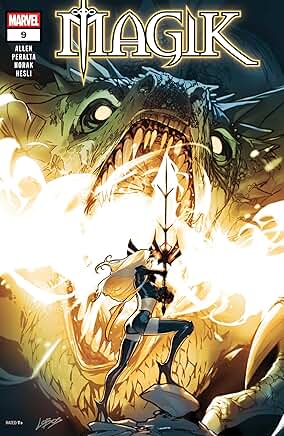 MAGIK vol 3 #9
“Above All”
Writer: Ashley Allen
Artists: Germán Peralta with Matt Horak
Colour artist: Arthur Hesli
Letterer: Ariana Maher
Editor: Darren Shan
PAGES 1-2. Lexi Larsen attacks Magik, Mirage and Liminal on the Las Vegas Strip.
Last issue, the Embodiment (the leader of Society of the Eternal Dawn) sent Magik and Mirage to Las Vegas to retrieve Zosimos’ Quill, a magical artefact supposedly capable of exorcising Liminal from Cal Isaacs’ body. The mission looked suspiciously like a suicide mission, the Quill turned out to be in the possession of a Society splinter group and the Society’s “Examplar of Recruitment” Lexi Larsen showed up at the cliffhanger to wipe everyone out and leave no witnesses.
For some reason, the immediate resolution of that cliffhanger has taken place off panel between issues: Magik teleported herself, Mirage and Liminal to the Strip, and Lexi is in pursuit. It’s not entirely clear why Magik didn’t simply leave the city entirely, but presumably she still has designs on the Quill.
“Proeliuz.” This doesn’t seem to be an actual word in any language, but “proelium” is Latin for “battle”.
PAGES 3-7. Magik and Mirage fight off the Society.
Mirage’s bow. Mirage explained in issue #4 that the Society had given her an enchanted bow, “Dawn Piercer”, which allowed her to use her psionic arrows to repel demons. The Society shuts off the bow once Mirage has turned on them, though the storytelling is confusing on this point – she fires an arrow which seems to explode on contact with Lexi’s dragon, and then immediately declares that something is wrong. In the art, the arrow seemed to work just fine.
At any rate, shutting off Dawn Piercer really doesn’t take the Society very far, because its function was to extend her powers to fighting demons. She can handle the rank and file Society members just fine without it, leaving Magik to deal with Lexi’s dragon.
According to Dani, she was given the bow by Yanisa Suwan, the “Exemplar of Weaponry”, whom we law saw in issue #7. She shows up later in the issue.
Liminal. As in the previous issue, Liminal continues to entreat the heroes to trust him and to remove his bonds. A possible reading of what’s going on here – supported by Magik’s reaction to him in the next scene – is that Cal is managing to influence what Liminal says up to a point, and is trying to drop hints where he can.
“We have to get Cal’s heart back.” The Embodiment magically removed Cal’s heart, supposedly in order to keep Liminal under control when he was in Magik’s custody, at the end of issue #7.
PAGES 8-9. Magik, Mirage and Liminal fight their way through the Society base.
Note that Liminal/Cal makes a point of stopping to admire the “inverted star” (which we heard about in issue #7) and to draw attention to some information that he thinks will be useful later. Magik appears to dismiss this as mere distraction or timewasting.
The two caped figures are the other two Exemplars – the aforementioned Yanisa Suwan, and the Exemplar of Prophecy, Kian Mir. (He’s the one in the blindfold.) The wider Society membership appear to be unaware of what’s going on, and the Exemplars try to pass the fight off as a “drill”.
We saw this route to the Embodiment’s office (including the white room with the free standing door) in issue #7.
“For a moment, he almost sounded like…” Presumably Magik is about to say that Liminal sounds like Cal.
PAGES 10-11. Magik and Mirage confront the Embodiment.
The two golems in the room seem to be the ones that were controlled by Lexi in issue #7.
The Embodiment is holding Cal’s heart in her hand.
“After all, there’s an opening for an Exemplar.” Is there? Are there meant to be more than three, or has Lexi been expelled for failure? (It seems unlikely that Magik killed Lexi, since Mirage would have reacted to that.) Anyway, all of this gives Mirage her moment to reject the Embodiment’s offer and for Magik to side with her, finally drawing a line under their tension in this series.
The Embodiment claims, presumably on the basis of her precognitive powers, that it “will be the world’s downfall” if Mirage side with Magik. Again, it’s not clear why – is she worried about something specific that they’ll do, or simply concerned about the downfall of her Society?
PAGES 12-16. The Embodiment’s origin story.
In a nutshell: Eloise Bennett was born into the Sevenths, one of a number of American magical sects of the 19th century. From the art, she appears to have a white father and a black mother; this isn’t directly mentioned in dialogue, but presumably this is at least part of the reason why she says that her mother was ignored by the Sevenths’ leaders.
When Eloise developed precognition, her father James assumed that they were magical powers. But the Society’s leader Clement identified that she was a mutant, and rejected her as an abomination. James died trying to defend her, and the Society forced Eloise to use her powers to probe the future for them. (Eloise is shown being hooked up a machine, which is presumably meant to play into the parallel with the Industrial Revolution drawn in the dialogue.) We see her having apparent visions of a nuclear holocaust and the Sentinels.
Eventually her mother Sarah rescues her by getting access to the “machine” and using it to work out a rescue plan. Sarah dies in the escape attempt, but transfers Clement’s life force into Eloise in order to slow her ageing. Clement’s last words are to call mutants “the embodiment of the end”. The fact that Eloise has chosen to take on this name is not encouraging, but she goes on to talk about taking up the mission of her parents (who seem to have been unequivocally good).
According to Eloise, she created the Society she knew that the existing magical sects would reject her as a mutant. We get a montage flashback which includes her buying the Quill from the previous issue, and recruiting the Exemplars. The lesson she appears to have drawn from all this, if we’re to take her at face value, is that she has created no more than a pale imitation of her parents’ sect, which would have survived and provided a better defence for humanity if only she had been able to accept her role as a machine. Thus, she considers herself to be an ends-justify-the-means hero.
Blackstone River Valley, Rhode Island. One of the earliest sites of the Industrial Revolution in the USA – the opening panel shows us the mills, and the Embodiment draws a comparison between the Industrial Revolution and her society’s “magical” revolution. But the Industrial Revolution was decades before the time frame of this flashback – the first textile mills in Blackstone River Valley date from the 1790s.
“The Sevenths and my family were destroyed…” It’s clear enough why Embodiment blames herself for the death of her parents (who were trying to save her from the fate that she now believes she should have accepted). It’s more interesting that she refers to the destruction of the Sevenths – all we actually see is a building set on fire and the death of Clement. Is the implication that she consciously wiped out the Sevenths when escaping, and only later came to the view that the world would have been better off if the Sevenths had stayed around?
PAGES 17-20. Magik, Mirage and Liminal retrieve Cal’s heart.
Magik has evidently been persuaded to remove Liminal’s bonds as the lesser of two evils. Presumably this happens between the first two panels of page 8. It can’t be a reaction to noticing that Liminal sounds like Cal, because that happens after they’re in the building, and Magik expressly says that she removed the bonds before coming in.
Krakoa. This point was brought up in dialogue back in issue #4, when Magik questioned why the Society hadn’t prevented Liminal’s rise. Mirage’s answer at the time was that Liminal had moved more quickly than expected and that their resources were limited. She then went on to give Krakoa as a specific example of something that she could have averted with access to the Society’s information. Back in that scene, Magik was openly sceptical about the Society’s intentions and an obvious possibility here is that the real answer to Magik’s question is that the Embodiment foresaw Liminal’s rise and chose not to intervene (if only because she knew it would work out anyway).
The Embodiment did foresee Krakoa’s fall but chose not to take any steps to avert it. To be fair, her claim is that the alternatives would have been a world war, and that the Society is concerned with existential threats to the whole global population. The issue isn’t for her isn’t that it was a mutant nation, but simply that it was just one nation. However, she certainly doesn’t have any sense of mutant identity, despite her back story.

“The Embodiment claims, presumably on the basis of her precognitive powers, that it “will be the world’s downfall” if Mirage side with Magik. Again, it’s not clear why – is she worried about something specific that they’ll do, or simply concerned about the downfall of her Society?”
I think this is a reference to the future we saw in Age of Revelation. Not only ia Illyana the Darkchild in that future but her “death” sets in motion the chain of events that leads to Doug taking over half of the United States. Presumably if the Embodiment kills Illyana now that future won’t happen.
is there a reason why Illyana can’t just teleport herself, Dani and Cal to safety at the end? Some anti-teleportation spell in the Society’s headquarters?
Ah yes. A mutant we’ve never seen before, who turns out to be a precognitive, who foresaw the whole Krakoa thing but just didn’t bother to tell anyone.
I expect that, as a precognitive, she also foresaw things like the Morlock Massacre (screw those guys), the Age of Apocalypse reality shift (meh), Onslaught (whatevs), Genosha (16 million dead? Who cares?) Decimation (hate you all), and so forth.
She’s clearly focused on the big picture rather than avoiding any actual large-scale tragedies.
Of course, if anyone had known about her, she’d definitely not have been welcome on Krakoa anyway thanks to Moira’s rules about precogs.
I do wonder, as I saw speculated elsewhere, if Embodiment’s back story is at all related to the historical mutants seen in Gail Simone’s X-Men, as they both seem to cover similar ground in expanding the role of pre-modern era mutants in America, especially amongst marginalized communities.
I can understand why she didn’t bother to say anything about Krakoa. The rest of the events mentioned are just conveniently forgotten, as they can’t be explained away as easily. What would she do about Krakoa? Tell them that the project is doomed? I’m pretty sure that Moira told Xavier and Magneto that exact fact (“Mutants always lose.”), and it didn’t change anything. It explains that she didn’t want to save Krakoa, as Krakoa’s existence would eventually lead to a World War, as it did in Hickman’s Life 10A. Eventually, humanity unites and attempts to stop Krakoa, leading to Krakoa declaring war on the rest of the world. She wanted to avoid that and felt Krakoa’s fall was by far the lesser of two evils.
I don’t understand the Embodiment backstory either. If Eloise was born to parents who were members of an occult order, wouldn’t they assume that she had occult powers? If Clement rejected her, certainly it’d be for different reasons/terminology than somehow recognizing her as a mutant, especially if she was really being rejected more due to racial reasons.
The term “mutant”, as we know it, didn’t exist until the early-20th century.
Ilyana might be taller than Peter in those heels.
@Chris V- It’s clearly explained in the story. Originally, the Embodiment’s parents assumed her powers were mystical in nature. “We didn’t have a word for mutants then.” Unfortunately, their leader, Clement realized her powers weren’t magical. He had been in contact with another sect of magicians who had encountered a child who could use powers without magic and considered such children unnatural.
Well, that wraps that mystery up. It looks like Allen’s plot checks out. Nothing else to see here.
Yeah, I’m obviously not reading the comic. I was going by the annotations.
If I was a precog who foresaw Krakoa, I’d shut up about it too. One of their most aggressive rules was “no precogs”.
I know it’s foolish to complain about a retroactively introduced precognitive (retroprecog? Is that just a cognitive?) who clearly foresaw but didn’t prevent any of the things which happened after her powers activated but before she was created, but it still takes some narrative handwaving to explain the paradox of existence without intervention.
Too busy/in another dimension/dead for a while/in hibernation/retired/lost their memory/lost their powers/had really severe agoraphobia for a decade/foresaw that their intervention wouldn’t go any good/foresaw everything would work out just fine if you just gave it a few years/it’s just not their specialty, thanks…
But it’s like introducing the mutant doctor in Storm and being all “yeah, they’ve been around for ages we just never met them before despite all the times someone like this might have come in handy.” Retconning people in is always a little tricky.
Well, OK. Let’s apply the logic used for Krakoa to other events mentioned.
Morlock Massacre? If they’re only concerned about events at a global perspective, it’s not really her concern.
Age of Apocalypse and Onslaught? She foresaw everything would work out fine. Reality was reset after AOA, and the heroes made it back fine after Heroes Reborn.
Genosha and Decimation? She foresaw that if it wasn’t for those events culling mutants that Krakoa/Orchis would have happened even sooner. She foresaw it was for the best that Krakoa be founded later rather than sooner.