Daredevil Villains #63: Tarkington Brown
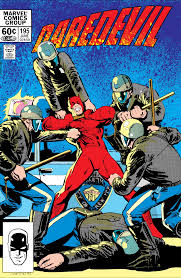 DAREDEVIL #195 (June 1983)
“Betrayal”
Writer: Denny O’Neil
Artist: Klaus Janson
Letterer: Joe Rosen
Colourist: Glynis Wein
Editor: Linda Grant
Technically, Denny O’Neil’s run as writer began with issue #194, which we covered last time. But that story reads as if it was intended to be a fill-in. This story is really where we begin his run, which will take us through to issue #226 in 1985 – albeit with more than a scattering of fill-ins along the way.
At first, O’Neil sticks with the crime milieu that had become the book’s established format. He’ll start deviating from that fairly quickly, and the villains will get rather more eccentric. But we’ve just had some format-breaking fill-in issues, so it’s probably a good idea to go back to basics.
“Tarkington Brown” is a strange name for a villain. It sounds like a firm of estate agents from Cornwall, or a whimsical otter voiced by Stephen Fry. In fact, Tarkington Brown is the mastermind behind an NYPD vigilante death squad, who hunt down and kill mobsters that escaped conviction. The story opens with Daredevil stopping the death squad from killing Bruno Ponchatrane, who is not just a mobster, but a child murderer to boot. Ponchatrane got off on a technicality, thanks to the efforts of Foggy Nelson. Foggy wasn’t desperately keen on representing him either but couldn’t see a reason to turn down the instructions.
Brown himself is not a police officer. He’s a computer expert from the mayor’s office who’s been seconded to the NYPD. There are some vague mutterings about him using his computing skills to identify NYPD officers with the right personality for this sort of thing. To modern eyes, this seems rather unlikely. Even if he could write the psychological profiling software, surely the NYPD weren’t digitising files to that extent in 1983, or keeping a personnel database with a handy “Vigilante Killer Y/N” field.
But this is 1983, so computers are basically still magic. And besides, that line is only really in the story so that it can handwave away the question of how Brown put this group together. He’s not presented otherwise as being any sort of technical genius. Instead, he’s a rich, urbane, political-establishment type who hangs around at Tony Stark’s parties.
At one of those parties, he meets Heather Glenn. She gives him a rambling, drunken speech about her personal problems, in the course of which she blithely reveals that Matt Murdock is Daredevil. Brown acts on this information by ordering his squad to kill Murdock, although he doesn’t tell them why. Meanwhile, Heather tries to make amends – she tells Matt what she’s done, and then she tries to persuade Brown to keep the secret. But instead, Brown decides that Heather needs to die too, because otherwise she’ll be able to expose the group.
The plotting here is all very ropey. Matt’s only stopped one of the kill squad’s attacks – does that really merit Brown seeing him as the top obstacle to his agenda? And why does Tarkington decide to kill Heather? Maybe she’d put two and two together if Matt was shot just after she revealed his true identity, but how would she prove anything? And if Brown thinks it’s such a risk, what was he going to do about her if she hadn’t shown up uninvited at his office? And once he’s decided that she has to die, why does he hold her at gunpoint for several pages while he waits for a phone call to confirm that Matt is dead? What’s he planning to do – shoot her in a busy office building when he gets the call? Let her go if he gets word that Matt escaped? If the idea is that he can’t kill her right away because people will hear, then what’s he ultimately planning to do with her – frogmarch her through the building at gunpoint and hope nobody notices?
Anyway, Daredevil singlehandedly defeats the kill squad, shows up in time to help Heather escape, and then confronts Brown. It turns out that Brown is terminally ill, and believes he’s making a contribution to the city in his final months, as he explains in a very right-wing speech about the need to eliminate “the punks and the terrorists and the hoodlums”. O’Neil’s script only really seems to have a problem with this once he starts going after Daredevil (for getting in his way) and Heather (for being a witness); up to that point, he’s a desk bound Punisher and O’Neil seems okay with that.
Janson’s art, on the other hand, gives Brown a wide-eyed naivety as he’s explaining his agenda. Thanks to Janson, he becomes a character who claims to represent moral clarity, but actually has the chilling self-certainty of a moral simpleton. It gives him an edge that isn’t really there in the script.
Somewhat remarkably, Daredevil’s response is to strike a deal with Brown, and agree to leave him alone if he promises to keep Matt’s secret. Presumably the idea was meant to be that the kill squad have already been captured and Brown will die soon anyway, so there’s no point in escalating the situation. In practice, it comes across as if Daredevil doesn’t much care, and hey, a bit of light murder is fine if you’re ill and wearing a suit. The story ends with an epilogue in which we learn that Ponchatrane has killed another little girl – see, it’s morally complex!
It doesn’t help that Brown shows no signs at all of actually being terminally ill. He has no visible symptoms whatsoever. He’s not lying – he dies off panel a few issues later. But if the idea was that Matt was showing mercy to a man near the end of his life, then that doesn’t come across. Instead, Brown’s illness feels more like a device to get him off the board once he knows Daredevil’s secret identity.
This isn’t strictly a two-part story, but it’s followed up in issue #196, where Wolverine and Daredevil team up against Lord Dark Wind’s henchmen. O’Neil’s Wolverine was a throwback even by the time of 1983 – the Wolverine miniseries had been published by this point, but O’Neil writes Wolverine as a smirking, violent thug. He treats Daredevil as a liberal geek who’s fun to wind up.
Brown turns out to be a friend of Wolverine. There’s nothing to indicate that he knows about the death squad already, but it’s hard to imagine what else they might have in common, and Wolverine certainly doesn’t seem very bothered to be told about it. Like O’Neil, Wolverine only really seems to have a problem with Brown when he tries (again) to kill Daredevil. At that point, Wolverine does step in and claw the guy before running off in pursuit of some henchmen. Daredevil reluctantly delivers Brown to the hospital, in what they both recognise as a rather pointless exercise, given that he’ll die soon anyway.
At one point, Brown mentions similar groups having existed elsewhere: “the so-called murder squad in Argentina and the group in San Francisco”. This seems to be O’Neil’s nod to his source material, since “the group in San Francisco” would be the death squad from Magnum Force, the 1973 sequel to Dirty Harry. This isn’t the worst idea in the world. In Magnum Force, the point is contrast the antihero cop with versions of himself who have gone too far; in Daredevil, at least in theory, Brown is forcing Daredevil to confron the logic of his commitment to the system.
The concept could have worked for a longer storyline. But once Brown has learned Daredevil’s secret identity, he can’t really stick around. The usual fate of villains who learn that sort of thing is to conveniently die through a cause for which the hero has no responsibility. That’s essentiall what happens here, with a passing mention of Brown’s off-panel death in issue #200. Matt’s response is that he seemed like a good man. We’re probably supposed to take it that Matt is biting his tongue. Probably.

Scenes from this issue are duplicated in iron Man 171, which was also written by O’Neil. Marvel seemed to like having the same scenes appear in two issues at this time. It happened in two consecutive issues of Doctor Strange. In Doctor Strange 58, a scene with Doctor Doom is duplicated in an issue of Fantastic Four. And in Doctor Strange 59, a scene with Dracula is duplicated in an issue of Thor.
Daredevil is being a bit self-righteous with Wolverine though. He was angry with Wolverine for stabbing Tarkington Brown even though he saved Daredevil’s life by doing so. It’s odd, because when Lady Deathstrike saves Daredevil by killing her father a few issues later, Matt actually DOES thank her.
“The so called murder squad in Argentina” is an odd reference, since the death squads in Argentina were aimed at leftists, not merely criminals, and were associated with the government.
“But this is 1983, so computers are basically still magic.”
In the 80s computers were either magic or could be easily defeated. In an Iron Man story in 1988, the Grey Gargoyle whose name is Paul Pierre Duval, adopts the identity of a sculptor named Paul St. Pierre. The conceit of the story is that even though the FBI told Monica Rambeau the Gargoyle’s name, nobody ever told Tony the Gargoyle’s MIDDLE name, so Tony doesn’t realize St. Pierre is the Gargoyle. But at one point, Tony asks a hacker in his employ to find out who St. Pierre is and his search program can’t turn up anything. Of course, a modern search engine would have easily determined that St. Pierre was the Gargoyle.
“The usual fate of villains who learn that sort of thing is to conveniently die through a cause for which the hero has no responsibility.”
The funny thing is this happened to Hugo Strange twice. He learned Batman’s secret, conveniently died, came back, conveniently died again, and came back again. Finally, Bruce tricked Hugo Strange into thinking he had been hypnotized into believing Batman was Bruce Wayne. And Bruce was able to turn Hugo over to the authorities without him conveniently dying.
O’Neil probably was listening attently to reader response to this issue. His time as editor of the Azrael period of Batman is still about ten years in the future, but he was already an experienced writer of Batman stories and had just been editor over one of the darker takes on street level superheroes since before the CCA. We are just a couple of years and a half away from the first Punisher solo book at this time. His use of Wolverine is further indication that he was very interested in learning how readers reacted to vigilante-type antiheroes – and, in this book, whether Daredevil should fully become one and how he should deal with them.
We will see much of that up ahead during his run on DD, particularly once Micah Synn in #202-214. At times I wonder if wanted readers to help him understand the popularity of the mugger-styled protagonist.
Denny O’Neil has always liked colorful, unusual names for characters.
His DC stories are full of non-costumed characters with names like Osgood Peabody, Ferlin Nyxly, Guano Cravat, Orson Payne, Bing Hooley, and so forth.
And at Marvel in this era, he’ll create characters with similarly colorful names. Obadiah Stane is familiar enough now that we don’t blink at it, but O’Neil also gives Marvel such colorfully named minor villains as Commodore Donny Planet, Benedict Closet and George Fistal. There’s also a crooked Old West villain named Rance Keeno in one of O’Neil’s DD issues, but I suspect we won’t see that name in this feature given the nature of that story.
It’s worse when O’Neil tries to give the characters more, ah, appropriate names. Why, in this very title, we’ll see an Irish assassin codenamed “the Gael,” real name Paddy O’Hanlon (*groan*). After that one, I’ll happily take more in the vein of “Tarkington Brown, vigilante death squad supervisor.”
It’s not surprising from a writer who used the pen-name of Sergius O’Shaughnessy. O’Neil obviously took up fictional naming conventions from Norman Mailer.
Tarkington Brown’s parents were fans of Booth Tarkington’s novels and GK Chesterton.
I don’t comment a lot but I’ve really enjoyed this dive into Daredevil and everyone’s comments. I’ve learned a lot and taken an interest in a character I didn’t like very much – probably because I usually encountered him as a guest star, played off of the Punisher or Spider-Man, where he came off as sanctimonious.
I was shocked to see the name Tarkington Brown at the header of this. I knew I knew the name, somehow. Paul’s summary of issue 196 jogged my memory, because I have that issue. It was a reasonably priced back issue Wolverine guest appearance I bought at the height of my Wolverine fandom around 1990 or so when I couldn’t afford the pricey appearances
I didn’t notice at the time that Wolverine was acting out of character. I only started reading Uncanny with issue 268. (I have since amended this error) I was only reading his ongoing solo book, where he was kind of an obnoxious brawler.
It strikes me that of all the secret identity obsessed superheroes Marvel has to offer, Daredevil rivals Spider-Man for the most amount of trouble in people discovering his secret identity.
Now, part of this is obviously due to their longevity and the sheer amount of stories told about them. But I also suspect part of this is a callback to their soap opera/romantic influences, which were such a big part of Marvel’s Silver Age lineup. (Spider-Man, Daredevil, Thor, Iron Man all suffering from love triangles, doomed love interests, remote pining, and the like).
But I feel like Matt Murdock’s had it the worst over the years, especially with such hits as “My Twin Brother Is REALLY Daredevil, Now He’s In a Love Triangle With My Secretary–Oops He’s Dead” and “My Ex-Girlfriend, the Drug-Addicted Porn Star” and “My Girlfriend, the Assassin–Ooops She’s Dead.”
@The Other Michael- Matt definitely surpasses Peter when it comes to secret-identity problems. One of his girlfriends revealed his identity while drugged (Natasha, to the Mandril, while under his powers), one of his girlfriends revealed his identity while drunk (Heather) and one of his girlfriends revealed his identity while on drugs (Karen).
And Matt actually had to fake his death in the 90s to keep people from learning his identity and stayed “dead” for two years. Which is not to be confused with the time that he faked his “brother”‘s death. Which is not to be confused with the time he tricked Karen into thinking he was dead during the Machinesmith story.
People have been making fun of Matt’s secret identity problems for decades. I remember that there was a thread in the ’90s making fun of Daredevil’s “secret” identity.
I’m sorry, but “Guano Cravat”?
Denny O’Neil predated Captain Planet. Guano Cravat was an evil industrialist from O’Neil’s 1970s Richard Dragon comic. Tell me that doesn’t sound like one of the villains from Captain Planet.
Oh yeah, Daredevil just doesn’t give any Fs when it comes to maintaining his secret identity. He’s completely careless about it, going back to the Silver Age, which is what always leads to these insane fixes like Michael Murdock when he has to put the genie back in the bottle.
He’s faked his death like four times, and on several of those occasions he’s even found a convenient body-double to play his corpse.
I’m nervous, because we’re getting into a run of Daredevil that I read as a kid, from issue 202 to 214. They were formative comics for me. I’m not looking forward to seeing everybody rip into them.
LEAVE MICAH ALONE, YOU GUYS
I really enjoy the Denny O’Neil run on DD. I’d rank it as the third best work on Daredevil vol. 1, behind Nocenti (my favourite) and Miller. Well, OK, outside that nice stretch of issues in the 1980s, there isn’t much to recommend for the first volumn of DD. I found the strongest issues of O’Neil’s Daredevil were towards the back part, especially a great issue that humanizes the Jester. That issue won’t be covered, but I’d rank that as O’Neil’s top story. I really enjoy the Vulture issue too.
Micah Synn is actually a character I don’t feel strongly about one way or another. He’s not a bad character and his story-arc is decent (the ending was something different and stood out), but I don’t have fond memories of the story either.
Didn’t Joe Kelly have a run in the 90s that was well recieved?
As someone who has read a limited number of Daredevil stories and only recently learned about Micah Synn, I’m weirdly excited for him to show up here.
Yeah, Karl Kesel and Joe Kelly each did about ten or eleven issues right near the end of volume one. Kesel left some loose threads which Kelly picked up, and their writing styles are similar enough that they feel like two halves of a single run.
(Issues 353-375 plus the Negative One issue and an annual, for what it’s worth.)
I like that run a lot too, although speaking personally, it doesn’t have the nostalgic power over me that the Denny O’Neil run does. Also the O’Neil run has better art, with Mazzuchelli drawing the latter part of it.
Having never read old Daredevil, my favourite Mike Murdock bit is when Charles Soule had his pet Inhuman character bring Mike into existence because he didn’t know Mike was fictional.
…and then Chip Zdarsky actually made me care about *Mike Murdock*.
(and then he died)
“…and then Chip Zdarsky actually made me care about *Mike Murdock*.
(and then he died)”
What? Noo! Chip Zabrowski died? Why God, why? Why did you cash in Chip?
Nah, Chip isn’t dead. He’s alive and writing the return of SHIELD. It’s that hipster doofus, Mike Murdoch, who is dead.
Micah Synn is the sort of awesome Daredevil villain that only the early Bronze Age could have given us. Gritty enough to not be in the Silver Age but not as urban and grim as the Miller era that just ended. This was the pre-DKR era of comics, when modern things were happening but within reason (i.e. Batman still acted in daylight and occasionally smiled or acted like a human being and not a sociopath, but wasn’t in camp mode). He’s basically Evil Tarzan, with a dash of Conan thrown in. In 1978, Marvel did WHAT IF #13 which was all about Conan the Barbarian existing in modern NYC, where he infamously becomes a pimp, complete with white suit, hat, and a big cat on a leash. I kind of see Micah Synn as similar, only canon. He’s a big tough jungle barbarian who winds up involved in organized crime, somehow. Or at least involved enough that he garners Kingpin’s attention. Along with a commentary about how shallow the press is, since Micah and his tribe of throwbacks become celebrities despite their brutish behavior. Then again, in 2025 they’d be mainstream Republicans. Heck, the big taboo Micah did which put off the Kingpin — trying to openly and at times physically steal other husband’s wives — is so common in the GOP it’s a page 15 story now. Micah for President!
Plus, he appeared in about 9 issues across a year, and technically isn’t dead, so he’s waiting for some arrogant writer with a dream of an Eisner to revive him. Hey, if the King Of the Sewers can come back, why not? Maybe because these days if a writer on Daredevil wants to have him fight Kraven the Hunter, they just do that instead of finding a similar counterpart like Micah. Who cares if Kraven was in 16 other comics that month? The editors sure don’t!
But before him will be Lord Dark Wind, because if the early 1980s cried out for anything, it was an awkward yellow peril villain whose name still makes my inner 10 year old think it is a code for a fart.
I love this Daredevil series, Paul. Keep them coming and thanks for all the great work.
“Chip Zabrowski died?”
He had to die so that Chip Zdarsky could have a body double when faking his own death. It was his destiny. Mike Murdock covered it up so well that most of us didn’t even notice.
@wwk5d, Jason- I think the reason why Kesel’s and Kelly’s runs aren’t remembered is because they failed to halt the decline of Daredevil’s sales. After Chichester’s disaster of a run, sales on Daredevil were at an all time low. JM Dematteis, Kesel and Kelly did what they could to fix the mess that Chichester left behind. They had Foggy learn Matt’s secret, got rid of the battle armor, had Matt reveal he was alive and had Matt practice law again. They laid the foundation for future good Daredevil runs. But nothing they did arrested the decline of Daredevil’s sales. Finally, Kevin Smith and Joe Quesada relaunched the book and Daredevil was back near the top of the sales charts again. So Smith and Quesada got credit for “saving” Daredevil and Dematteis, Kesel and Kelly went down in the comics history books as having failed to improve sales. Dematties, Kesel and Kelly DID fail to halt the book’s sales decline. Although their task probably would have been a lot easier if someone had removed Chichester from the book BEFORE sales hit record lows.
@AMRG- The Bronze Age is usually considered from the early 1970s to about 1986. So 1984 would be late Bronze Age, not early Bronze Age.
So apart from the stupid battle armor, what was so bad about Chichester’s run?
Everything. It was so ‘90s kewl with the grim ‘n’ gritty. It was trying so very hard to be just like Frank Miller. Outside of the armour was also Matt faking his own death, again. I’ve never enjoyed Chichester’s writing.
It’s fine up to issue #300 (i.e. small doses). I wasn’t impressed with the early issues either because the writing is so average (especially with the distinctive voices which came beforehand), but it’s fine. After the fall of the Kingpin though, it becomes an unreadable mess that finally culminates in the black armour.
I actually enjoyed Chichester’s run, pre-“Fall from Grace” (so, say #291-318) back in my youth, enough that I bought Chichester’s recent DAREDEVIL: BLACK ARMOR miniseries. I liked how Chichester wrote Murdock’s first-person narration, the frequent mentions of what all his senses were experiencing. Lee Weeks was on the art for a while, followed by a young and fairly grounded Scott McDaniel. The stories were gritty. DD was back in the Big Apple. Kingpin’s fall was a high point.
Obviously the “Fall from Grace” direction didn’t work for anyone, and in addition to that, McDaniel entered a phase in his artistic development wherein his work was (at least to me) really unattractive and often flat-out confusing (tho’ he eventually evolved into something I liked, over on DC’s NIGHTWING). But I have sympathy for the whole mess: As Chichester explained later, the title was completely invisible again in the market, and the team tried to remedy that by swinging big. It just didn’t work out.
I’ll never understand how Macchio let Chichester do Taskmaster like that, tho’.
To be fair, almost all of Marvel’s titles were a mess at that time. It’s not as if Chichester’s DD stands out (it just didn’t have the hype of the Image-style artists and started to bleed consumers after issue #300, probably because speculators couldn’t find anything that they thought was going to be the next Amazing Fantasy #15).
With neverending “Clone Sagas”, stripper Sue Storm and bleeding head wound Ben Grimm, Eric Masterson Thor, the bomber jacket Avengers etc. nothing in DD made me blink.
Peter David managing to salvage Hulk was the only one of Marvel’s “main books” that seemed anything remotely familiar.
Actually, Iron Man somehow avoided being terrible during the early-‘90s (not must-read or anything, but readable), so Marvel must have realized their mistake and doubled down with Teen Tony (which almost made the above seem kind of forgivable).
“Nah, Chip isn’t dead. He’s alive and writing the return of SHIELD.”
And you don’t think that’s suspicious? That a dead guy is suddenly alive again and writing SHIELD? What’s one of the things SHIELD is known for? Can you spell Life Modul Decoy? I can’t, so it’s a good thing there’s an acronym for it: LMD. This “Chip” is obviously an LMD. You’ve been fooled by a counterfeit Chip!
The real Chip Zalinsky is dead. Dead!
R.I.P-ple Chip.
That last comment was enough like something Zdarsky would actually write that now I’m wondering if this is the blog where Chip Zdarsky comes to troll readers.
Wait, I’m confused— is the real Chip Zdarsky the android writing SHIELD, or the vigilante wearing an armored suit?
Are a Chip Zdarskteen or Cyborg Zdarsky on the horizon?
@Chris V: Good point. At a time when many titles were changing the heroes’ costumes and identities and so forth, Chichester’s DAREDEVIL could be said to have hardly stood out.
@Taibak: To clarify, Matt adopting a fake identity and getting a mostly new supporting cast didn’t work, and the book fell hard into gimmicky, meandering multi-parters dressed up to look like “events.”
So there was a long story arc with Dardevil battling HYDRA’s new agents, the extremely in-the-moment and poorly named System Crash, featuring the likes of Bitmap, Infomorph, Technospike, Steel Collar, and Wirehead. And along the way, Gambit, Iron Fist, and Captain America show up.
Before that “Fall from Grace” managed to alienate Frank Miller by bringing back Elektra in an excruciatingly convoluted manner involving her inner evil being temporarily manifested as a separate character and also tossed in gratuitous appearances by Morbius and Venom.
“Humanity’s Fathom” drafts vintage DD villains the Kingpin and Bushwacker for star power, but the central threat is the return of the King of the Sewers, now working with a demonic entity called the Devourer for some reason.
The whole thing was a bad mix of faux-edginess and turgid, overstuffed storytelling. The book lost Chichester’s initial, interesting approach to the title as a slick noir with psychological and body horror overtones.
It turned into as generically 1990s speculator-era a sales-chaser as possible. It was stuffed to the gills with random antihero and C-list hero guest stars. Reading it felt like watching a music video for one of Bush’s singles (the Gavin Rossdale one, not one of the U.S. presidential dynasty).
Chip Zdarsky is absolutely the sort of wild name Denny O’Neil would give to a secret android. I mean, ‘Chip’? It’s almost too obvious.
It is interesting to look at the ways writers put the secret identity genie back in the bottle. If they’re a minor villain or it’s a movie, they’re probably going to die accidentally. If the villain is too big to kill, they’ll better have some reason to not exploit that info like finding it dishonorable or they’re likely to get conveniently mindwiped. Or dead and resurrected mindwiped.
“Of course, a modern search engine would have easily determined that St. Pierre was the Gargoyle.”
Though if equipped with an AI overview, it could easily determine that Isaac Christians is the Grey Gargoyle instead.
As great as waids run was, I still DD peaked with Kesel’s “duck rabbit duck” issue with DD and Spidey as Bugs and Daffy,
“Benedict Closet”
Very Toast of London.
@Michael … Yeah, DeMatteis’ brief run was good too, even though it was only there to do damage control and clean up Chichester’s mess. I like that whole post-Chichester, pre-Smith/Quesada sequence on DD. Really underrated material.
@AMRG … If I ever got to write Daredevil, absolutely the first thing I would do is Micah Synn Saga II: The Micah-ning.
@Chris V … It is true that in the context of its times, Chichester’s DD doesn’t seem so bad. It’s more that, in the context of the DD runs that both preceded and followed, the Chichester run is suuuuch a low point for the character. For my money, it’s the worst the character has ever been post-Frank Miller. (Though I agree with the general consensus that his first year was decent. It’s from roughly issue 304 onward to the end that it’s just … yikes.)
@Omar … For what it’s worth, Chichester didn’t write that arc about the King of the Sewers. That was Gregory Wright, doing a little guest-stint. Then after that, Chichester came back for his final story: a weird five-issue arc under a pseudonym, with the strange premise that several key members of Daredevil’s supporting cast — Foggy, Karen, Ben Urich, Glori O’Breen, and the Kingpin — somehow were all in the same diner on the same fateful night, years and years before they ever met each other. It’s an odd one.
Everybody hates the Chichester run – or at least the post-300 issues – but as bad as it got I never thought they were anywhere near the book’s worst. The Kevin Smith run, which as pointed out earlier gets the credit for saving the series, is just an absolutely terrible story from start to finish, powered by the baffling idea “what if a Spider-Man villain was dying, and wanted to go out tormenting Spider-Man, but Spider-Man was busy that day?” At the time a celebrity stunt writer was a novel idea, and the art is great – enough to remind you why people were excited about Quesada back in the day – but the whole thing’s a dumb mess at best and deeply offensive at worst, and probably cemented the idea that if you’re desperate to do a “big” Daredevil story you just nuke Matt Murdock’s life, a well that’s been visited so many times it’s bone-dry now.
Awwww yeah long-ass given name and short plain family name