Daredevil Villains #64: Lord Dark Wind
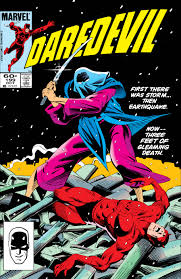 DAREDEVIL #196-199 (July to October 1983)
“Enemies” / “Journey” / “Touch of a Stranger” / “Daughter of a Dark Wind”
Writer: Denny O’Neil
Pencillers: Klaus Janson (#196-197), Larry Hama (breakdowns on #196 and “art assist” on #197) & William Johnson (#197-199)
Inkers: Klaus Janson (#196-197), Mike Mignola (#197) & Danny Bulanadi (#198-199)
Colourists: Christie Scheele (#196-197), Glynis Wein (#198) & Bob Sharen (#199)
Letterer: Joe Rosen
Editor: Linda Grant
We’ve been through a string of fill-ins, but with issue #200 around the corner, it’s time for an actual storyline, and for Denny O’Neil’s run to get into full swing.
The change of creative team is completed here, with Klaus Janson leaving the book after the opening scene of issue #196. His replacement is William Johnson, who’ll be with us for less than a year. Compared to the artists who came before and after him, Johnson isn’t particularly well known. His only previous work for Marvel had been the final four issues of Master of Kung Fu, and he moved over to Daredevil when that book was cancelled.
His opening splash page in issue #197 is frankly not great, but once he settles in, his art is perfectly good – if rather conservative compared to what’s come before. Reportedly, he was taken off the book because he couldn’t handle a monthly schedule. This seems highly plausible, since he drew only eight out of eleven issues during his run, and as far as I can tell, he never worked as a regular penciller on an ongoing title again. He did some scattered fill-in work on Marvel’s licensed books over the next few years before apparently dropping out of the industry.
You can see why artist who had been hired for Master of Kung Fu might seem like a good match for Daredevil, especially with all the ninjas that Frank Miller had brought into the series. And as it happens, this arc takes us to Japan. But O’Neil resists the temptation to go anywhere near the Hand. Instead, we have Lord Dark Wind, Japanese retro-nationalist. He’s here to Make Japan Great Again.
In issue #196, Dark Wind sends his men to abduct Bullseye from hospital (where he’s been lying paralysed since issue #181). Dark Wind’s plan is that his surgeons will heal Bullseye, who can then be put to use as an assassin. This seems like an awful lot of work when you could just hire a different assassin, but apparently Bullseye’s reputation is just that good. Daredevil and Wolverine fail to stop the abduction, and so in issue #197, Matt flies to Japan in pursuit.
Dark Wind’s boat does show up, but when Daredevil boards it, he finds that Bullseye has already been dropped off for treatment at the villain’s private island. Instead, Daredevil finds Dark Wind’s daughter Yuriko being held prisoner (for reasons that are never terribly clear), and rescues her. She promptly teams up with him against her father.
Yuriko relays Dark Wind’s origin story: he was a kamikaze pilot who survived an attack by a fluke when his bomb failed to explode. He wants to atone for this disgrace, and has weird ideas about restoring traditional Japanese culture. Apparently his own face is scarred from the plane crash, and he scars his children’s faces with what appears to be Japanese writing (though nobody translates for us and some dialogue suggests that it’s meaningless). Dark Wind’s sons have already been killed while trying to assassinate the Japanese prime minister on his behalf. The scarring angle is a little confused and doesn’t get developed; later on, Dark Wind claims that he’s wearing a mask until Japan is righteous again, so he may not actually be scarred at all.
Issue #198 sees Matt and Yuriko travelling across Japan to Dark Wind’s island, evading his Yakuza allies along the way. Naturally we get a scene on a bullet train. Those had been around since 1964, but O’Neil evidently thinks his American audience are a bit behind the times in this regard. “Funny,” muses Matt, “I always thought of Japan as quaint – almost primitive…”
Now, to be fair, the actual depiction of modern Japan in the story is pretty inoffensive. It’s presented as a modern place full of normal people, even though Matt can’t interact with any of them because of the language barrier – the story gets some mileage out of the fact that Matt can’t do his usual thing of beating up the henchmen for info. Admittedly, on his flight to Japan, Matt is attended by a stewardess in a kimono. But a bit of digging suggests that Japan Airlines stewardesses did occasionally wear them, at least in publicity material, so I’ll give Johnson a pass on that one.
During this journey, Yuriko expands on her motivation. Her beloved Kira has joined Dark Wind’s private army, and she wants to rescue him. She regards her father as a reactionary lunatic, but also hates him for getting her brothers killed. She’s also a bit bloodthirsty, and keen to see any defeated henchmen killed. But mainly, she’s about getting Kira out of Dark Wind’s influence. We get some scenes of Kira with Dark Wind, which establish that Kira desperately wants to be a noble warrior, while Dark Wind clearly regards him as a halfwit dogsbody. Later on in the story, Yuriko gives a slightly more balanced speech about her father, saying that she understands the loyalty of his followers: “He gives them something to die for. It is only himself and his ideals, but that is more than most men have.”
While all this is happening, Dark Wind has indeed managed to heal Bullseye. Something about herbs is involved, as well as modern science. Dark Wind wants Bullseye to kill the Japanese trade minister during an upcoming visit to New York, because he symbolises the “new Japan – a nation of merchants”. This, apparently, is a betrayal of the heritage of a warrior nation. Bullseye dismisses Dark Wind as a “nutcase” but accepts the lift back to New York.
Matt and Yuriko make it to the island, and spend the night in a shelter together (where it is inexplicably implied that they sleep together, despite Yuriko’s motive being to rescue her boyfriend). They fight their way past Dark Wind’s private army to confront the man himself, just as an earthquake starts. There’s no plot reason for the earthquake, it just seems to be the sort of thing that happens in Japan.
Daredevil gets trapped under some rubble and Dark Wind is about to kill him – his only physical action in the story, really. But then Yuriko kills him from behind. And that’s it. That’s Lord Dark Wind.
Kira’s subplot ends with the poor guy proclaiming himself a failure while Yuriko consoles him: “Be quiet, beloved. Be at peace. You are free of him forever.” As for Bullseye, he escapes back to America, but has no interest whatsoever in going anywhere near the Japanese trade minister. Trade ministers are boring.
On one level, this whole story could be seen as a device to get Bullseye back into circulation so that he and Daredevil can face one another in issue #200. Dark Wind himself is weirdly underwhelming: he has a plan with an obvious loophole, in that it involves assuming Bullseye to be a man of honour, so all he actually achieves is to heal a lunatic and get nothing in return, before getting killed by his own daughter. His credibility comes less from anything he actually does in the story, and more from the evident loyalty of his followers.
But 1983 was awfully late for a story about the spectre of reactionary radicalism in Japan. Sunfire’s origin story played off a somewhat similar idea, and that was in 1969. The story also suffers from the fact that O’Neil wants to show a modern “real” Japan to contrast with Dark Wind, but doesn’t really have any reference points with which to do so, resulting in a generic modern country with a language barrier. Then again, perhaps that’s the point. Yuriko’s thesis is that Dark Wind represents a reactionary vision that lacks any logical merit, but can still fill the void left by a mundane modern world.
We should, at last, address the elephant in the room. This story is now remembered principally as the debut of Lady Deathstrike. Yuriko returns in Alpha Flight #33-34, which aren’t available on Marvel Unlimited, but by all accounts rewrite the ending of this story. Kira committed suicide in response to Dark Wind’s failure, and Yuriko dedicates her life to avenging her father. You know, the one that she killed. Her more ruthless moments in this story, and a passing suggestion that Dark Wind had something to do with Wolverine’s adamantium skeleton, become the new anchor points of her character. She becomes obsessed with revenge on Wolverine, even though they never actually meet in the original storyline.
Lady Deathstrike is an almost total inversion of O’Neil’s character. If the idea was that she snapped after killing her own father, then that’s long since fallen by the wayside. But at this point, does anyone really want to do a story about Yuriko’s struggles with her father’s weird nationalist politics? Better to sweep all that under the carpet and have him be the metal skeleton guy. He’s served that role in absentia for decades now, and it feels like the best use of him.

He feels like a character who could be revived if Japan’s ultra-right is ever ascendant again, but they peaked when Yukio Mishima killed himself in 1970.
While I’m at it, has anyone ever explained why adamantium slowly poisons Wolverine but not Bullseye?
@Dave White: After the Wolverine element was established, there was a passing mention somewhere of Bullseye taking some kind of pills to stave off the negative effects.
Beyond that, Bullseye has since been infused with nanites and altered in other ways to fix an additional bout of injury-induced paralysis in the Warren Ellis Thunderbolts run, killed and then magically resurrected during the “Shadowlands” event and its aftermath, and then further magically healed to get him back to his usual status quo in one of the later Elektra series, so who knows what the deal is now.
I’m surprised no one has ever had Lady Deathstrike run across Daredevil again, though I suppose she’s a bit out of his league these days.
Lady Deathstrike was used as a generic Japanese ultranationalist villain in, of all places, the first issue of the “Heroes Return”-era Captain America series back in 1998.
It’s weird how Wolverine completely disappears from the plot after issue 196.
It’s not clear in this story that Bullseye’s bones are supposed to be adamantium. Wolverine says that Lord Dark Wind might be connected to the people who gave him his adamantium skeleton and he might not. Lord Dark Wind says that Bullseye’s bones are laced with “metal” but it’s not explicitly stated to be adamantium. It isn’t explicitly stated to be adamantium until Alpha Flight 33.
It’s weird that Lady Deathstrike winds up becoming a villain after the end of this story. The story’s ending makes it clear that while Yuriko no longer believes in her father’s ideology, Kira still does. So if the writers needed a new Lord Dark Wind, then why not use Kira?
“and Yuriko dedicates her life to avenging her father. You know, the one that she killed.”
To be fair, in Alpha Flight 33-34, she’s not seeking revenge for her father. She’s seeking to complete his scientific work but needs a previous subject to complete his work and can’t find Bullseye so she goes after Wolverine. The reason for this is that the Elektra Lives Again Graphic Novel was in production and Bullseye dies in it. But Elektra Lives Again got delayed until 1990 and in the meantime Bullseye appeared again in the Streets of Poison storyline in Captain America and the dialogue in that story makes it clear that Bullseye’s been in prison the whole time. So Elektra Lives Again got declared out of continuity. And Yuriko’s motivation got changed from “needs Wolverine to complete her father’s scientific work” to “wants revenge against Wolverine because her father’s process was stolen and used on Wolverine against his will”, which is just completely nonsensical.
It’s weird how O’Neil’s female characters get turned into villains when they start out heroic or morally ambiguous. There’s Lady Deathstrike and Clytemnestra Erwin. Even Talia went from being torn between Bruce and her father to being a leader of the Secret Society of Super Villains who raped Bruce.
Lady Shiva is a weird example, since she went from morally ambiguous when O’Neil first wrote her to an assassin when he returned to her years later.
“He feels like a character who could be revived if Japan’s ultra-right is ever ascendant again, but they peaked when Yukio Mishima killed himself in 1970.”
Surely if the last few years have taught us anything, it’s that fascists and the authoritarian-curious never die for good — they just scurry under rocks and dumpsters for years until a useful tool emerges to champion their cause and install them into positions of power. Lord Darkwind’s revival may come yet.
The thing about Lord Dark Wind (which feels like the name a college student would give his beer farts) possibly not being scarred under the mask could be a thing where he’s pretending he was scarred to show even if he didn’t kamikaze like he was supposed to he, he did still suffer fighting for his country.
Like he can’t accept he made it out unscathed because he thinks his country was injured by how things have gone, and so he ought to be as well. Heck, maybe he even scarred himself later, and just claims it was from the crash.
“It’s weird how O’Neil’s female characters get turned into villains when they start out heroic or morally ambiguous. There’s Lady Deathstrike and Clytemnestra Erwin”
Well, in Greek mythology Clytemnestra murdered her husband, so there’s that.
Her villain career was short-lived anyway as it was obviously an excuse to bump her off. Michelinie and Layton were clearing decks going into their return run on Iron Man.
On a side note, it’s a bit odd for someone to name their daughter Clytemnestra anyway, especially when they have a son as well and for him decide to go with “Morley”. It’s like naming your twins Persephone and Steve.
It’s pretty evident that Lord Dark Wind was based on Yukio Mishima. Some of Mishima’s ideology was given to Dark Wind. Mishima attempted a coup against the government of Japan, and he committed suicide due to his perceived loss of honour after his coup failed.
While the artwork doesn’t portray O’Neil’s purposes, even though at the time of publication the story was twelve years out of date, perhaps doing this story does work in the Marvel Universe where Japan has usually been presented as a culture trapped in the medieval period with everyone obsessed about honour. It was about time to do a story at Marvel that addressed the fact that this bore little resemblance to real-world Japan in the 1980s.
The word kamikaze, so popularized in English, translated to “divine wind”, so the villa in’s name of “Dark Wind” is a play on Kamikaze.
Also, speaking of a daughter named Persephone…I once knew a Goth female who named her first daughter Persephone. I haven’t seen her in nearly thirty years. I’m guessing she outgrew her Goth phase, and assuming she had other children, she probably gave them names like Joe and Mary.
A lot of Wolverine villains debut in odd places. Sabertooth in Iron Fist. Silver Samurai and Lady Deathstrike in Daredevil. Wendigo is an inherited Hulk foe.
I just find it odd.
I half remember an on page throw away line about Logan’s adamantium being pure, while Bullseye’s having either secondary adamantium or an adamantium alloy.
Does anyone remember this?
There’s a theory that Marvel villains find other Marvel heroes too powerful and end up going after that wimp, Logan.
Look at Sabretooth’s history. He was beaten repeatedly by street-level powered characters like Iron Fist, Spider-Man, and even the Black Cat. So, he finds Wolverine and suddenly becomes his arch-enemy.
We’ve been incredibly mislead by Marvel for years. Everyone today acts like Wolverine is nearly as powerful as the Silver Surfer. Really, his power level makes him suitable for stories like the Greg Rucka run on Wolverine. He can easily defeat a random guy with a gun. Any character with any superpowers? Wolverine is totally outmatched.
Sabretooth decided to find Wolverine and concoct lies about a history together so that he finally had a chance to defeat a superhero. That’s the truth about Wolverine. He’s the “best there is at what he does”, and what he does is get beaten by villains who aren’t in the Black Cat’s league.
When Wolverine does get a villain all his own, it’s Romulus. (Yes, I’m ignoring some other earlier villains, such as 1950s-era Logan’s high school coach, but let’s go with this.)
@The new kid: That is interesting. Some theories:
1. Wolverine is the one X-Man who can consistently hold down a solo book, so he’s really the only member of the team who needs individual villains. Apart from maybe Charles. I can’t think of a Storm-specific villain, for example. Forge?
2. Wolverine has never been the face of mutant-kind the same way Charles or Storm or Kitty have been. He’s more of a stabby punch guy, so he needs stabby punch villains. If they happen to be mutants (or have a connection to Japan), then all’s the better. But existing X-villains like Mystique or Sebastian Shaw or even Magneto (otherwise a natural fit) don’t quite work, probably because they’re too much about being mutants at their core.
3. Claremont liked to get his mitts on characters from across the Marvel universe and import them into the X-Men (kind of like Wolverine was imported by Wein). I’m pretty sure Claremont is responsible for pitting Wolverine against all of the villains you listed. Except Wendigo, but he did drag Wendigo into Uncanny eventually.
There’s at least one letter printed in either the original Iron Fist series or in Power Man & Iron Fist (can’t quite remember where I read it) where a fan suggested Sabretooth fight Wolverine. It’s funny now to think there was actually a time where it hadn’t happened yet and readers were writing in to suggest it.
Jason Aaron’s run on Wolverine attempted to position Mystique as a Wolverine villain, even setting up a shared past between the two long-lived X-characters.
It was Claremont who also first made Wendigo into a Wolverine villain (well, outside of the fact that the Hulk was fighting Wendigo when Wolverine first appeared). The first appearance of Wendigo in Uncanny X-Men was a Wolverine/Nightcrawler story.
Chris V: Goth is probably one of the easiest subcultures for people to not grow out of. It’s easy enough to dress “corporate goth” and have a job.
Thom H: A while ago I wanted to try and figure out which X-characters have had the longest combined solo runs. I never figured it out, but it’s kind of wild to think that X-Man had 75 issues when I’m not sure if anyone other than Wolverine, Cable, (and Deadpool), and Gambit have even had 50 combined issues. X-23/Laura Kinney probably has at this point. And who else am I missing?
@Chris V
That was Uncanny 139. Great issue. Somewhat overlooked over as it and the second part of the story (issue 140) fell right between the Dark Phoenix Saga and DOFP but there’s several things notable about this issue:
1) It’s the debut of Wolverine’s brown and tan costume.
2) It’s Kitty’s debut as a member of the team and her first appearance in costume. She gets the codename of Sprite in this issue after rejecting the suggestion of Ariel (which she eventually adopts later, though briefly)
3) It’s the first appearance of Heather Hudson.
4) This is the issue where the X-Men find out Wolverine’s name is Logan (strictly speaking, it’s only Nightcrawler who learns this as he’s the only X-Man present when the name gets dropped but the other X-Men start calling him Logan after this).
And yes, the Wendigo turns up here although I wouldn’t say he’s being used as a “Wolverine villain” per se. He’s just the villain of an X-Men story in which Wolverine and Nightcrawler are the only X-Men present.
I must admit I kinda enjoy comic book stories in which other countries are portrayed as bizarrely stuck in the past (e.g., Nightcrawler fleeing pitchforks and torches in Germany) in the same way I enjoy the physics of stories in the 1960s. Would that Daredevil had met and teamed up with a Portuguese missionary to sneak into Japan under the nose of the shogun.
I should add that I am aware of how such portrayals can and often are a problem, and it is of course better to portray other cultures with accuracy. Still, I titter when the portrayals are silly and ignorant without being racist, etc.
@Chris V- But remember, in the same story where Sabretooth and Wolverine have their first fights, Sabretooth defeats Rogue by punching her three times. So Rogue can also be beaten by villains who aren’t in the Black Cat’s league.
Regarding Mystique, Claremont had earlier tried to set up a shared past between Logan and Mystique. She was implied to be the “Mr. Raven” in X-Men: True Friends, which takes place in the 1930s, and in Dream’s End Logan and Mystique make multiple references to their past together.
Matthew Murray-It’s sad about X-Man. Out of those 75 issues, only twelve are worth reading.
Adam-Good point. It’s wasn’t only Japan. The Marvel Universe Bavaria was also shown to be stuck in time. They should have explained Kurt’s back-story as being the result of a villain taking control of Kurt’s village and turning it into a German Brigadoon (which play was said to be based on an older German story too, which would have make Len Wein’s portrayal of 1950s-era Germany seem clever).
@Chris V- And then there’s Transylvania, of course, which is never depicted like post-World War II Romania in Marvel comics.
@Matthew Murray – X-Man (Nate) was always a solo character which is likely why his series lasted longer. You have more creative freedom with a character who doesn’t appear in any other books and isn’t obligated to be anywhere else. You can take that character in any direction you want. If he were actually in the X-Men and appearing regularly in the two core X-Men titles at the time, I doubt his solo book would have lasted as long as it did (or that he’d even have one in the first place). It’s too restrictive. All you can do is “What so-and-so gets up to on their days off from doing X-Men stuff.” Wolverine is popular enough to get away with a flimsy premise like that. The rest not so much.
@thenewKid, Chris V – Sabretooth was at least intended to be a foe for Wolverine, based on John Byrne’s concept for what the X-Men would look like under the mask.
When Dave Cockrum went in a different direction, Byrne repurposed it as the face of a foe for Wolverine, and he and Claremont used him in the book they shared, Iron Fist.
But that left Sabretooth with that book’s editors, and he was only free to be introduced to the X-books after Power Man and Iron Fist was cancelled.
I wonder if Claremont had any input into the Silver Samurai. He was apparently a bit of a gopher for Steve Gerber at one point, and after the Samurai’s odd one-off appearance in Gerber’s Daredevil,, the Samurai was forgotten until Claremont started using him as an ally of the Viper in Marvel Team-Up — complete with his familiar second design — and then in Spider-Woman.
Since Claremont had tied the Viper to Japanese terrorists in those stories, I suppose it was easy to use them in his X-Men run as the villains messing with Mariko Yashida, and from there he became a Wolverine baddie.
@Michael: It was pretty funny when the Marc Guggenheim/Howard Chaykin Blade series had Blade and Hannibal King go to Dracula’s castle, which was shown as a tacky tourist attraction in an urbanized Romania.
It’s too bad that X-Man spent fifty of those seventy-five issues doing absolutely nothing except have a romantic relationship with his genetic mother.
Think about that in regard to the popularity of the X-franchise in the ‘90s. A character who was defined for a good chunk of his early history by his yearning for an incestuous relationship got a 75 issue series.
@Moo- All of the main X-books (that is excluding books like X-Men 2099, X-Men: the Animated Series, Professor Xavier and the X-Men) that started after 1988 lasted until Quesada decided to end them. The exception is Maverick and I’m not sure why anyone thought a Maverick series would work. So it’s basically a function of when the book was launched. X-Men was launched at the start of 1995, so it had about 6 years before Quesada became editor in chief.
In the 1990s. how long a series lasted often depended partly upon when it was launched. For example. in 1990, Spider-Man, Ghost Rider, New Warriors, Guardians of the Galaxy and Namor were launched. All lasted at least 62 issues. Books like Morbius and Sleepwalker, which were launched later, had much shorter runs.
Woodswalked> I half remember an on page throw away line about Logan’s adamantium being pure, while Bullseye’s having either secondary adamantium or an adamantium alloy.
>
> Does anyone remember this?
Closest I remember is a bit that may have been setting up a dropped plotline in Hama’s Wolverine just after Fatal Attractions, suggesting that healing factors turned adamantium into “adamantium beta”.
Also, I think Bullseye just had an adamantium *spine*, not a whole skeleton.
@SanityorMadness: Perhaps it was established that Bullseye only had an adamantium spine later, but in Quesada and Smith’s run, DD gets punched by Bullseye and thinks to himself that the blow confirms Bullseye now has a metal skeleton. But as someone else remarked, so much has happened since, and I haven’t kept up with it all.
@Omar: Dracula’s Castle-as-tourist-trap sounds hilarious. It also has the benefit of being somewhat true, too—I just checked on a hunch and yes, the locals in that region have made some hay of their literary fame.
Sadly, I have to second Drew in doubting that communities ever get over fascism in any meaningful sense.
Even leaving aside the current dramas in the USA and here in Brazil were I live, there are plenty of other red flags elsewhere. “The Lost Cause”, “The Stab in the Back” and the “Manifest Destiny” myths have plenty of simile elsewhere, definitely including Japan. The attachment to the Confederate Flag has not died out in 160 years, and I do not expect Japanese ultranationalism to be anywhere near extinct after just eighty. To this day revisionism about the ocupation of China is the official line.
I have not actually read #196-200 yet, but I read plenty of comments about those issues. Apparently O’Neill wrote plenty of plot seeds and left them hanging for possible future use – including the telepathic connection between Daredevil and Bullseye and the odd, difficult to predict motivations of Yuriko.
Perhaps he felt the need to get the protagonist away from his most usual situations in order to better acquaintance himself with the character without doing too many obvious mistakes. Perhaps he wanted to have a couple of exotic elements at hand for a bit of innovative plotting (a wise consideration for a character such as Daredevil, who has a hard time rising above standard street level vigilantism). And perhaps he initially thought that tying DD to Japan could be a good move, then realized that at that point in time it would only make him look like a Wolverine imitator.
I do think that in practice this storyline is a dry run of sorts for what I see as his most daring and controversial DD storyline, which is of course the confrontations with Micah Synn. I’m not sure Micah succeeded as a character, but he was certainly an attempt at something new.
The one cultural anachronism I find weird is Black Panther. In the 2020s, we have comics, TV shows and movies depicting high rise buildings with thatched straw roofs, lasers built into spears, and various other weird and impractical throwbacks to primitive culture. And these are lauded? I don’t know much about Afro-futurism, it doesn’t really touch my part of the world, maybe this is normal, but I can’t see the difference between this and portraying the Japanese as a bunch of samurai and geisha.
It’s the fact that Wakanda is supposed to represent an African country which was never colonized by another nation. So, Wakanda has developed its own culture which preserves elements of the past while embracing the discovery of advanced technology.
Black Panther being a king has always been problematic though and is only rarely addressed (Ta-Nehishi Coates finally started to address it head-on though).
The difference is that Japan is usually portrayed as a country stuck in the distant past doing the same sorts of things that “Western” countries would only be able to relate to had they been stuck at the level of around the year 1400.
There’s also the fact that Wakanda is a fictional country while Japan does, in fact, actually exist. It has existed past the year 1600.
Notice how people now lose their mind at the thought that there could be a tribe in Kenya without access to TV, atheism, modernity, or the English language as pertains to Storm’s (admittedly dated) origin.
I think it’s a tightrope that most creators walk between a racist “Orientalist” view of non-Indo-European cultures versus a globalist, homogenized view of a “foreign” culture, one where it’s, “Eh, everyone in the world is pretty much exactly like white, English-speaking, Liberal, European people, and it’s racist to say otherwise!”, which is, in effect, as problematic and steeped in colonialism as the “Orientalist” orientation.
It seems to me that Wakanda is attempting to tread this fine line. Which making the entire country of Japan into an anachronism is not.
@Chris V- Storm was particularly ridiculous. She didn’t seem to understand the concept of nudity taboos. There are MILLIONS of Christians and Muslims in Kenya. I’m sure that are Kenyans who don’t BELIEVE in nudity taboos but I doubt there are Kenyans who have never heard of them. Claremont later tried to explain this as Storm running away from her humanity.
There’s nothing particularly Aftican about spears or thatched roofs. Though they are instantly recogniseable as *primitive technology*. And that’s the rub. It couldn’t be that hard to come up with recognisably African objects that aren’t just a slur plus laser beams.
@Matthew Murray: I found a Reddit discussion suggesting Dazzler had a long-running solo X-series, which is funny and wrong for obvious reasons.
Similarly, I don’t think we can count any book starring Namor, either before or after he was officially an X-Man.
But aside from the characters you mention, Iceman and Magneto might be climbing up the charts. Even then, they have maybe 16 issues apiece? Bishop might be in the same range or a little higher if we count series like District X.
> But aside from the characters you mention, Iceman and Magneto might be climbing up the charts. Even then, they have maybe 16 issues apiece? Bishop might be in the same range or a little higher if we count series like District X.
Magneto has, not counting reprints/Amalgam/Aaron’s Heroes Reborn, or the four-issue Joseph series from 1996 (all of which should arguably count)…
• Magneto Rex (3 issues, 1999)
• Magneto: Dark Seduction (4 issues, 2000)
• X-Men: Magneto Testament (5 issues, 2008, origin story)
• Magneto (one-shot, 2011)
• Magneto: Not a Hero (4 issues, 2012)
• Magneto (21 issues, 2024)
• X-Men Black: Magneto (one-shot, 2018)
• Giant-Size X-Men: Magneto (one-shot, 2020)
• X-Men: The Trial of Magneto (5 issues, 2021)
• Magneto (4 issues, 2023)
• Resurrection of Magneto (4 issues, 2024)
So, a 21 issue ongoing, and 53 total on that list (and some more I left out but could be arguably included)
“I can’t think of a Storm-specific villain, for example. Forge?”
John Byrne created Deluge for X-men Hidden Years, which I took a a sincere attempt at making a Storm specific villain. An African weather based character – positioned as Stormy’s shadow self like Sabretooth is to Wolverine. I don’t think anyone else has used him since.
If you squint a little you could say Candra or Callisto and Marrow are Storm foes. They’re more situational conflicts than playing into the Storms core themes.
Wow — I seriously underestimated Marvel’s Magneto output.
While Mystique has a lot in common with Wolverine (e.g., long lives, espionage, anti-heroism), I think she would thematically work better as a Storm villain. They overlap in areas like leadership, personal identity/authenticity, motherhood, and ruthlessness without matching too closely.
I guess what I’m saying is that Mystique could bring up some uncomfortable feelings in Storm, which would be interesting. Like an amped up version of Callisto.
Searching for series with “Iceman” in the title in the GCD I found:
• Iceman (1984) – 4 issues
• Iceman (2001) – 4 issues
• X-Men Origins: Iceman (2010) – 1 issue
• Iceman and Angel (2011) – 1 issue (maybe?)
• Iceman (2017) – 11 issues
• Iceman (2018) – 5 issues (and Uncanny X-Men: Winter’s End?)
• Astonishing Iceman (2023) – 5 issues
• Plus, if you’re including anything with “Iceman” in the title, two “Spider-Man, Fire-Star and Iceman” freebie one-shots from the 1980s.
So, somewhere in the 30s for Iceman comics, which seems low, but I think Cyclops is about the same and Marvel put out more issues of “Disney’s Beauty and the Beast” (13) than comics with the X-Men’s “Beast” (12) in the title. (Wait, shoot, I forgot Amazing Adventures featuring The Beast, that’s seven more…)
the Wendigo turns up here although I wouldn’t say he’s being used as a “Wolverine villain” per se. He’s just the villain of an X-Men story in which Wolverine and Nightcrawler are the only X-Men present.
Beg to differ. It’s a Wolverine story in an X-Men book from a time before solo titles were a thing. The whole story is Logan taking a trip to see old friends, and Kurt tagging along. It has nothing to do with the X-Men.
Marvel Comics Presents had a number of solo X-Men stories featuring Cyclops, Wolverine, and others. Marvel Fanfare too. Of course, no single character was meant to sustain those showcase titles (unlike Marvel Team-Up and Marvel 2-in-1). But some characters had longer runs than others.
@Oldie – Beg to differ. In Uncanny X-Men 139 & 140, the Wendigo is the villain of an X-Men story that puts the spotlight on Wolverine. Doesn’t matter that the whole team isn’t there. It’s still the X-Men comic (and in fact, the other X-Men are in it. They just don’t go to Canada) and therefore an X-Men story. Just as Uncanny X-Men 144 is an X-Men story that puts the spotlight on Cyclops, who goes up against D’Spayre.
Sure, we see the Wendigo as a Wolverine villain *now* but that perception about came over time. At this stage, he’s just the X-Men villain of the month.
William Johnson did “some scattered fill-in work on Marvel’s licensed books” that included two issues of THE TRANSFORMERS that were so far ahead of the art in the preceding and following issues.
Reading this now makes me understand a bit more why he didn’t do more issues of the book, because it was some stand out work in the early Transformers comics.
Holy smokes, had not thought of the character Clytemnestra Erwin in at least 30 years. Pretty sure high school Sol was greatly offended at her heel turn…
@SanityOrMadness
Yes! That was exactly it. Thank you!
Wolverine takes a leave from the X-Men to go home and clean up “my mess” with the Canadian government. Xavier says he shouldn’t go alone, so Kurt volunteers to tag along. They surprise Heather Hudson, and get drawn into solving an Alpha Flight caper because Logan wants to help his friends.
Logan gives a speech about how the Wendigo was his “first mission” and “only failure.” Logan tells Kurt not to call the X-Men because “this caper isn’t just business, it’s personal,” just lo,e his relationship with the Hudsons.
The X-Men never fought the Wendigo before that, and to my knowledge have never fought him since. The villain is entirely tied to Logan’s origin story and has no relationship to the X-Men.
This is a Wolverine solo story, with Nightcrawler and Alpha Flight guest starring.
@Oldie – So, what was all the other stuff concerning Angel and Kitty? A commercial?
Issue 139 opens with a Danger Room exercise revealing that Angel is back on the team and sorely out of practice, while Kitty is a bit freaked out to discover that something called a Danger Room has some dangerous stuff in it. Later, Storm takes Kitty into town where we are introduced to Stevie Hunter. In the following issue, Angel has a brief conversation with Colossus who is doing yard work. Afterwards, he complains to Xavier about Logan’s personality and his “freaky claws”. He thinks his wings are always going to be feathery. Meanwhile Ororo receives her closest depiction to “real-life woman” to date by becoming jealous of another woman for no good reason.
It’s an X-Men story. Wolverine is absolutely at the forefront of the story by quarterbacking the A plot, but Claremont is still spinning other plates in the background.
Oldie:
There was an entire Amazing X-Men storyline called World War Wendigo.
https://www.housetoastonish.com/?p=2744