Daredevil Villains #66: The Trump
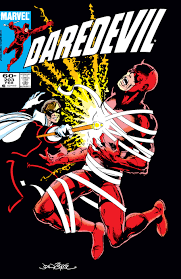 DAREDEVIL #203 (February 1984)
“Trumps!”
Writer: Steven Grant
Penciler: Geof Isherwood
Inker: Danny Bulanadi
Letterer: Jim Noavk
Colourist: George Roussos
Editor: Dennis O’Neil
Daredevil went into 1984 with regular penciller William Johnson struggling to keep up a monthly schedule. Having started his run on issue #197, he managed to do six consecutive issues. But this is where we hit our first fill-in, evidently commissioned back when Denny O’Neil was still the editor. Johnson only manages two further issues – #205 and #207 – before leaving the book.
Steven Grant had been writing for Marvel on and off since 1979, but hadn’t yet had a regular run on a series, unless you count seven issues of Marvel Team-Up. We’re still a couple of years away from him writing the first Punisher miniseries. Penciller Geof Isherwood was relatively new to Marvel: prior to this, he’d done an anthology story for Bizarre Adventures #33, and a fill-in issue of Power Man & Iron Fist (also written by Grant). In the same month as this, another Grant/Isherwood fill-in story appeared in G.I. Joe. You get the idea.
Their contribution to Daredevil is about what you’d expect given their position on the pecking order. It looks fine, it has a few good set pieces and there’s a reasonably solid story hook.
Matt Murdock finds himself defending Stymie Schmidt, one of the neighbourhood kids who bullied him as a teenager. Stymie is blatantly guilty, but Matt mounts the sort of aggressive defence that’ll just land him with an increased sentence when he’s inevitably convicted. Foggy realises that Matt is sabotaging Stymie, and persuades him to pass the case to someone more neutral. That’s basically the story. It’s left ambiguous whether Matt is consciously sabotaging Stymie or whether he’s convinced himself that he’s doing the right thing, but either way it doesn’t reflect brilliantly on Matt.
Still, as a fill-in there’s nothing wrong with this idea. There’s an interesting theme, the art is decently polished, and the emotional angle is sold quite effectively.
The problem comes when Grant tries to shoehorn a villain into the story. That’s the Trump, and ostensibly he’s this issue’s villain. He’s even a proper supervillain with costume and mask, something that we’ve been drifting away from for a while in favour of organised criminals, ninjas, masterminds and assorted weirdos. Daredevil hadn’t debuted an old-style costumed supervillain since the 1970s.
But the story is about Matt and Stymie, so the Trump has the disadvantage of being the B-plot in his own debut. The link between the two plot threads is that Stymie was working for the Trump, and so the Trump wants to kill him to stop him talking. But that’s just plot mechanics. The heart of the story is Matt’s conflicted feelings about his childhood tormentor, and the Trump has nothing to do with that at all.
The Trump’s gimmick is that he’s a stage magician, who uses his sleight of hand and illusion techniques to keep opponents off balance. That might be a viable idea, but you never get the sense that Grant or Isherwood believe in it. His costume is completely generic, and entirely fails to tie in to the gimmick. He’s not using illusion to fake superpowers as some sort of misdirection, he’s just a stage magician in a costume. Grant finds a couple of reasonable ways to use the gimmick – producing a handgun out of nowhere by sleight of hand, or scattering playing cards as a distraction – but it really is just gimmickry, with no real connection to the wider story.
Besides, if that’s the Trump’s gimmick, then you might expect him to be a trickster villain. And that sort of character needs to be a lot more imaginative. Aside from silencing Stymie, the Trump’s main goal in this story is to steal some guns. Apparently they’re hard to come by in New York. Who knew? The guns are just a macguffin, of course, but they contribute to making the Trump feel terribly mundane. He needs to be pulling off elaborate and creative heists . Instead, he’s loading some guns into the back of a truck, and telling us that “These little babies will revolutionise crime.” How? They’re just ordinary guns! And besides, the Trump is stealing them from the mob. So even if you were somehow willing to buy that they’re really special guns, they’re already in criminal hands. All the Trump is doing is moving the guns from one criminal to another.
Another problem is that it’s been less than a year since issue #193, another fill-in which also features a villain with a stage magic gimmick. And that issue is a lot better. Willow isn’t shoehorned into being a conventional supervillain but simply has a criminal scheme worked around her stage act. Her magic is pitched at a slightly exaggerated level that works for the Marvel Universe. And she has a convoluted, inventive plan to outwit everyone. The Trump is just a heist guy who knows some prestidigitation.
And what does “the Trump” have to do with this gimmick, anyway? We’re told that it was his nickname as the two-time prison bridge champion, but that seems like a hangover from a different concept – some sort of card shark character. And… bridge? I’ll grant you it’s more cerebral than poker, but it doesn’t score well on the intimidation factor. Perhaps he’d have been more at home in Murder, She Wrote.
Understandably, the Trump never appeared in Daredevil again. He did appear in some other comics, where he’s basically used as a bozo. He has a handful of cameos in early 90s Captain America as a Z-list joke villain, and made one further appearance in 2009’s Iron Man & The Armor Wars #1, where he gets thrashed by Iron Man in the first three pages. Some of these stories lean into the goofiness of the stage magic angle rather more effectively than this story does, presenting him as more of a show-off and inveterate performer. But essentially he’s only been brought back as a mockable failed character.
Frankly, even this scattering of appearances is more than he deserved. The underlying concept of a villain using stage magic isn’t awful; you can make him a subtler Mysterio. But the execution is bland and half-formed, the costume is just misconceived, and anyone wanting to do the idea properly would have been well advised just to start again from scratch.

One would think given the current occupant of the White House it’s time to resurrect the Trump as a flim-flam man building a towering edifice of crime from deception and lies…
That’s a nice cover in Byrne’s “pared down FF” style of the period.
As for a “mockable failed character” called The Trump, the jokes basically just write themselves.
Steven Grant had created his Whisper series, which was far better than his work at Marvel, by this point. Unfortunately, it was for Capital Comics, so Whisper was only able to get a two-issue introduction before Grant wrote this DD comic. It would be a few years yet before Grant showed his writing ability with the Whisper character returning for First Comics.
Considering the premise of Grant’s Whisper, bringing The Trump back as a villain for a story featuring Whisper sounds like a good idea for a comic in 2025.
“Steven Grant had been writing for Marvel on and off since 1979, but hadn’t yet had a regular run on a series, unless you count seven issues of Marvel Team-Up.”
He also wrote or co-wrote the last nine issues of Spidey Super-Stories. Not much of an endorsement.
Sleight of hand and stage magic sounds particularly useless against an opponent who doesn’t have conventional sight.
DD has a propensity for facing villains whose powers might be a threat to a different hero, such as the aliens who decided they could conquer Earth after making everyone blind…coincidentally coming up against Daredevil. The Trump might be a proper threat to…oh, the Human Fly, maybe…but he had to come up against Daredevil in his first appearance.
Daredevil has a lot of villains whose powers are uniquely ineffective against him, which is broadly fine as long as they’re highly effective against everyone else. Unfortunately the Trump isn’t.
“oh, the Human Fly”
Holy crap. I’d forgotten about him. I had the whole run of his series. I loved that book.
@Michael: Writing Spidey Super Stories is a glorious endorsement. It’s an absolutely insane comic that delights at every turn.
@Eric G – Loved that book too, and I remember the thrill of seeing Spider-Man’s segment on The Electric Company (“Where are you coming from, Spider-Man? Nobody knows who you are!”)
Morgan Freeman will always be “Easy Reader” to me.
@Moo, Eric G- but Grant didn’t write any of the memorable bits- like the Wall or the Thanos-Copter or “Don’t mock the Shocker”.
Congratulations on your restraint, Paul.
I would not manage. The jokes _do_ write themselves.
Trump isn’t a bad concept, but it is not the most original either. Also a bit difficult to write well. It is probably also a bit too close to the Jester.
Then again, this is an obvious fill-in. You don’t publish your best ideas and stories as fill-ins, with remarkable exceptions.
The actor who played the Electric Company Spidey passed away recently.
Possibly on interest to HTA listeners, Grant wrote the original Contest of Champions.
I like the idea of a slight of hand villain, but 1) they’d have to go up against someone very low-level, maybe even just a conventional detective, and 2) they’d be absolutely useless against someone with unconventional senses like Daredevil.
The only way I could see a character like this working against Matt Murdock is as a comedy. The villain just gets more and frustrated that Daredevil sees right though his mirrors and slight of hand, and in the end it turns Matt had no idea the guy was even trying to decieve him.
Next Official Handbook of the Official Handbook character?
@MasterMahan
It’s sleight of hand, not slight.
Slight of hand refers to someone with small hands. So, the other Trump. Not this one.
@SanityOrMadness They did him in the Official Handbook a few years back! (At my suggestion)
Release the Stymie Schmidt files.
Marvel has a few lame “stage magician” villains, going all the way back to the Ant-Man and Wasp foe creatively named “the Magician.”
More generally, it seems like the whole stage magician archetype is pretty dead in superhero comics these days. Zatanna and the Injustice Society’s Wizard at DC are the only significant examples I can think of.
Just as the classic adventure characters such as John Carter, Tarzan, and so forth seem hard to use successfully, the proto-superhero “stage magician” character modeled on Mandrake the Magician doesn’t seem to work in the superhero genre.
It still seems to work in caper films and adventure TV shows, albeit updated to reflect current stage magic style.
But in superhero comics, even the modern style of stage magic isn’t used as the basis for a serious character. When Nick Spencer introduced a new Magician in his Astonishing Ant-Man run modeled on more current stage magic, the character was played for laughs as a neophyte Z-list villain.
I would love it if a Criss Angel analogue called Mindfreak showed up in the MU just to be punched repeatedly. I could see Moon Knight smacking him around for a couple pages before having to deal with the issue’s actual villain.
The Trump’s real name is Carlton Sanders, though I forget if that was actually revealed in his debut issue or if he’s one of those lame villains who only got a new name once his Official Handbook biography was made. His specific gimmicks, besides the whole “lame magiciab” angle, are entangling ribbons and a cane which acts as a cattle prod like electric zapper. Considering Kingpin’s had the latter since the 60s (and by the 80s it was usually played down), it didn’t bode well for him.
And yes, it is amazing that this guy got 4 different appearances in other comics over the span of 25 years, even if that’s only been as a lame jobber. I mean, even the Scourge always missed this guy, and the Trump’s racket (smuggling and selling firearms) is an actual legitimate crime which indirectly kills people.
By 1984, the predominant costumed villain in DD’s rogues gallery was Bullseye. Most of the others rarely showed up or were played as relics of a bygone era. Even Gladiator got some revisions in the Miller era.
@ Mike Loughlin — Technically, the Trump DID fight Moon Knight in 1994’s Starblast #1. Yes, as part of the lame Starblast crossover with Quasar. The Starblasters were messing with the Moon, which was messing with Moon Knight’s concentration, but that didn’t stop him from beating the tar out of the Trump on one of his capers. So they did meet.
About 80% of the Trump’s appearances were because of Mark Gruenwald and his love for obscure villains. Nowadays writers just create new lame villains and then either drop them or kill them off before they leave a book.
Carlton is also one of those villains who wears a domino mask over his eyes and/or nose but also can wear a full latex mask over that, so a mask over a mask. That has to get sweaty.
A lot has been said of Daredevil having many villains whose gimmicks or skills or weapons happen to be useless against him because he’s blind. Well, the Trump’s proven to be useless against a whole bunch of other superheroes who don’t have a radar sense, at least. If anything, Daredevil actually struggled against him more than anyone else.
Our current president makes the usage of this guy ever again virtually impossible, but that’s likely for the best.
Finally, the notion that inmates in prisons play bridge is one of those silent proofs that out of touch white men used to write comics predominently. That is probably the last card game played in prisons. Anyone who offered it wouldn’t survive the next trip to the shower.
AMRG: Given that there are prisons in the U.S. where Magic: The Gathering is popular among the inmates, bridge wouldn’t surprise me in the slightest.
“That is probably the last card game played in prisons.”
No, fifty-two pickup would be the last card game played in prison as it requires bending over.
Bridge, on the other hand, is indeed played by inmates in prison. I Googled it.
1984 John Byrne cover. This is when he was one of the bigger names in the industry, still doing Fantastic Four.
I had no idea bridge is actually played in prisons. But was it so big in 1984?
I still contend the inmates playing it are probably older. Bridge is predominantly played by seniors, at least after the 1950s. I can evision prison “lifers” in their 60s playing it, though.
More to Paul’s point, in 1984 someone reading that the lastest masked criminal was a prison bridge champion is not going to be impressed, since it’s a game they only know about from their grandparents or, like he said, “Murder, She Wrote.” Stick to poker or blackjack themes, writers.
“I had no idea bridge is actually played in prisons. But was it so big in 1984?”
*shrugs*
I can’t imagine why it wouldn’t have been. Especially since Magic: The Gathering hadn’t been invented yet.
I come to speak in defense of bridge against the barbarians. If you haven’t played bridge at all and all you know about it is from wikipedia, then I’m not going to take you very seriously.
I learned bridge at college. And during the years I went to college, Age of Apocalypse happened. So that is just to start off putting things in context that, yes, young people can play bridge.
At the time this comic would have come out, virtually every major newspaper would have had a bridge column. It’s usually the bit by the comics pages with a daily bridge puzzle. I’m not sure whether newspapers still have bridge columns, but they were still out there even a dozen years ago. In contrast, the World Series of Poker has been shuffled around from ESPN to CBS to PokerGO.
Bridge is a very strategic card game. There’s the bidding system where you exchange information about your hand without saying it. When hands are played, each player sees half of the cards (their hand and the dummy’s hand which is displayed for all to see), so you have an idea of who’s got what where (and explains why all those bridge columns exist). During play, good players will count cards, signal to their partner, and generally try to trick their opponents to make or break the bid contract. While there is luck involved, there is a lot less than any card game I can think of.
Incidentally, there are slight differences between the American and European system of bidding. It’s not hard to go back and forth between them, but there are some subtle differences.
To be clear, I have nothing against bridge as a game. My mother played on the national team. I just don’t find it very intimidating. And honestly, it’d be more impressive if he’d been a champion in the outside world – being able to beat a bunch of prisoners who’ve been learning Acol to pass the time probably just marks him as an above-average club player.
“If you haven’t played bridge at all and all you know about it is from wikipedia, then I’m not going to take you very seriously.”
Cool. So anyway, according to Wikipedia, a survey conducted in 1941 found that bridge was played in 44% of US households. Obviously, that percentage has declined since, but to answer AMRG’s question, it was almost certainly more popular in 1984 than it is today.
I’m so excited that the one-two punch of Crossbow and the Gael are the next two entries in this series.
I feel like everything has been building up to this.
Not just the “Daredevil Villains” series, but EVERYTHING.
@Paul: Beating a bunch of prisoners at bridge may be more impressive than it sounds, given how little else there is to do in there.
It’s the same reason why the California penitentiary system has a disproportionately high number of chess grandmasters.