X-Men: Book of Revelation #2 annotations
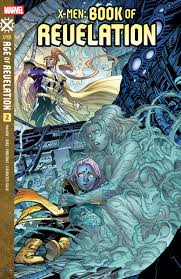 X-MEN: BOOK OF REVELATION #2
Writer: Jed MacKay
Penciller: Netho Diaz
Inkers: Sean Parsons with Livesay
Colourist: Fer Sifuentes-Sujo
Letterer: Clayton Cowles
Editor: Tom Brevoort
COVER: Kitty Pryde shields Elbecca from Fabian Cortez.
PAGES 1-3. Kitty saves Elbecca.
This picks up directly from the cliffhanger of the previous issue, which Elbecca helpfully recaps for us.
PAGE 4. Flashback: Revelation turns Kitty into a ghost.
“When the X-Virus kicked off, when [Revelation] organized the relief in Philadelphia…” This is the official version of Revelation’s role in history, as recounted in X-Men: Age of Revelation #0. We’ve been told in other books that Revelation was actually responsible for the X-Virus in the first place, but Kitty may or may not know that.
“One of my generation of mutants…” Even though she was principally an X-Men character and he was in New Mutants, Doug was first introduced as Kitty’s friend and peer.
Babels, of course, have turned up in plenty of books throughout the “Age of Revelation” event.
“Fade away, Kitty.” Revelation is able to force Kitty to discorporate – something did nearly happen when her powers ran out of control after the Morlock Massacre, so it might be within her ability to do anyway. Presumably she doesn’t need food or drink in this state, since otherwise she’d have starved to death long ago.
PAGES 5-6. Elbecca asks Kitty for help.
“The Sapiens in the Yeweseh.” “Yeweseh” is obviously a corrupted version of “USA”, but we’re not so far into the future that the name of the country next door is likely to have been forgotten. The surface-level explanation is that people don’t talk much about things beyond the Revelation Territories and that Elbecca is too young to have picked up the details, but the twist at the end of the story is that Elbecca is actually an Arakkii infiltrator with a sleeper personality. Her inability to name the country next door might be a reflection of that. Equally, Elbecca’s pleading with Kitty for help is probably driven in part by her underlying real persona – though her reasoning that Cortez is bound to try and kill her again to prevent her reporting what happened is surely sound anyway.
“Cortez isn’t going to hurt Doug, Elbecca. His entire station depends on Doug.” This is basically what Cortez himself said last issue. His agenda is entirely about being in a position to be near to power, and he wants Revelation to be dependent on him for power-boosting, rather than having to share that influence with other Choristers.
“You’re not the first Chorister he’s tried to snuff…” We’ll find out in the next scene who the other one was.
PAGES 7-16. Elbecca exposes Cortez, but is drawn back under Revelation’s sway.
“I can’t have Council without all my Choristers.” Why not? The Choristers are important to Revelation for practical reasons – they keep his powers at the levels he needs in order to maintain control – not because they’re particularly insightful advisers. Is “Council” actually just some sort of power-boosting session, or an exercise in keeping the Choristers informed? They do have to hang around for top secret events, after all.
Topaz. She was assassinated by Glob Herman in X-Men: Age of Revelation – Overture. Psylocke pointed out in that story that she clearly had been tipped off by someone to expect her, and now we know that it was indeed Cortez trying to get her killed by the X-Men. As Elbecca points out later in the scene, in Overture, Revelation jumped to the conclusion that his wife Bei was the responsible, and had her killed. He wasn’t entirely wrong – she had in fact turned against him, and was alerting Arakko to what he was up to – but she wasn’t responsible for the leak about Topaz. In fact, she denied it to Psylocke in that issue.
“This is a challenge.” “…And you Arakkii love a challenge, huh?” Foreshadowing, as Khora tells us very directly that Elbecca’s rather out of character behaviour is perfectly in character for an Arakkii spy.
“The fewer Choristers there are, the more important Cortez is. He told me that…” Last issue.
“And he put the blame on your wife.” This is apparently why Revelation thought that Bei had betrayed him in Overture, and had her killed at the end of the story.
Cortez is actually able to resist a direct instruction from Revelation to “speak the truth” – Revelation has to get Chance and Khora to back him up. This is odd, because most people find Revelation irresistible (including the likes of Psylocke), and Cortez isn’t normally in the category of being so strong willed. Perhaps long involvement with Revelation has given him some degree of resistance.
Shadowkat. This is the ninja assassin persona that Kitty had during the “Fall of X” post-Krakoa run. Somewhere along the line, Kitty evidently decided to try and assassinate Revelation by ambush, which she understandably didn’t share with Elbecca. Kitty’s flashback at the start of the issue had her wearing her X-Men uniform rather than her Shadowkat costume, but apparently that’s how it happened, since she reappears in the same X-Men uniform with Elbecca’s help. So… apparently Kitty tried to kill Revelation as Shadowkat but escaped and got captured again as Kitty Pryde?
Despite her original motivation being to stop Revelation’s tyranny, Kitty’s motives seem to have slipped over time into simply wanting take revenge on Revelation for its own sake and to hurt him emotionally – so Elbecca’s reaction is entirely understandable. Years stuck in ghost form are unlikely to have done wonders for Kitty’s sanity.
“Can’t you just tell him to be good?” This is a fair enough question from Elbecca, and gets the curious answer “I suppose I could, but not in so many words.” Revelation clearly doesn’t have any sort of compunction about mind control, and we see in the next scene that he does respond to this provocation by telling Cortez to be good – with unhappy side effects. Obviously the idea is that the, uh, revelation that Cortez manipulated him into killing his wife has provoked Revelation into doing something that he would otherwise have held back from. The mention of Bei also provoked him into losing his temper with Death last issue, so Elbecca knows that Kitty’s information is likely to have this effect.
The question is why he hasn’t done this to Elbecca before, and why he doesn’t reverse it afterwards. It certainly does have the effect of mentally hobbling Cortez, presumably because it cuts so far against his personality; perhaps the point is simply that Revelation needs Cortez on hand as his power-booster and, since the Choristers are public figures, Cortez needs to be in a fit state to appear alongside him.
PAGES 17-20. Elbecca reveals her true identity and kills Cortez.
Cortez interprets his order to “be good” are removing his ambition and leaving him mentally adrift without his core personality trait. Elbecca then reveals that she’s an Arakkii infiltrator with a cover personality who’s been sent to weaken the Choristers – and hence weaken Revelation – before Apocalypse shows up, as threatened last issue.
It wasn’t clear in the previous issue where Elbecca had come from, but evidently someone has engineered her way into Revelation’s citadel. Could it be Khora, the other prominent Arakkii character in the book? She did tell Elbecca last issue that it would have been better if the X-Men had killed Cortez.
Cortez’s death also begs the question of when the Choristers’ appearance in Sinister’s Six #2 takes place – Cortez, Elbecca, Chance and Khora all appear there. There are no obvious gaps in the action of this story, unless Cortez is able to appear there between pages 16-17 and put on a brave face; issue #3 might make this clearer. Otherwise, it may have to be shoehorned into the story during the course of a day.

it’s nice to actually see one of Doug’s friends reacting to what he’s become. That’s something that’s been missing from this crossover.
“There are no obvious gaps in the action of this story, unless Cortez is able to appear there between pages 16-17 and put on a brave face; issue #3 might make this clearer. ”
I think that the “days later” caption is meant to suggest that Sinister’s Six 2 takes place between pages 16 and 17.
I’ve been thinking about the name Elbecca. That means something in Hebrew, right? It seems there are different interpretations of the name Rebecca, but number one is “to tie firmly”. And El relates to God. I’d think it’s a bit of a stretch, except the event is all about Biblical themes.
As for “Yeweseh”, when I was a kid I knew another kid who was certain that “elemena” was a letter of the alphabet, between K and P. It happens.
I don’t believe it has any meaning. “Becca” is a shortened form of Rebecca, which wouldn’t have been used in Hebrew. “Becca” does mean “to cry” in Arabic, but El is a Semitic form of “god”, but not from the Arabic. So, no, I don’t believe it translates to anything in particular.
It’ll be interesting to see how well MacKay can stick the landing with Apocalypse here and in Amazing. I think Marvel could have done a better job of communicating that all the main story was in these two books – unlike Age of Apocalypse, the other stories aren’t sidequests that will lead into the final resolution, but just stories set in that universe (or, in the case of Storm and Uncanny, stories that have a time skip).
@Si: “beka” in Hebrew means “rupture/rift”, so one could certainly read it as Elbecca being the most direct expression we’ve had so far of the schism between Apocalypse and Revelation.
@John: Honestly, from the moment it was made clear that the idea for AoR came from MacKay, I just assumed his titles would be the most directly relevant to the story. Certainly there’d be no reason to think Justina Ireland or Cavan Scott would be making major plot decisions for a line they’re not actually part of
@Chris V
Actually “Becca” is not “To cry” in Arabic. But “Elbecaa” could be, while “Becaa” would just be “Crying”. Also Arabic is a semitic language, but yes, “El” would not be “God” in Arabic (“El” = “The”).
Yeah, I know Arabic is a Semitic language. There were typos in my comment that I just let stand because there’s no edit function, and I thought it was understandable as it read. It was supposed to read, “and El is a Semitic form of ‘god’ but not from the Arabic”.
Diana-Are you sure? In Hebrew, Beqa (spelled “beka” in translations of the Old Testament) means “half” but is in reference to measurement of currency.
So how do we think Doug gets rehabilitated after this is all over? Blame it on Poccy’s influence? Evil doppleganger? Replaced by younger self? Or does he just get purged of the Revelation power-up in the present, and then technically he’s blameless because none of this future will ever happen?
@Drew- The question is whether Doug was already planning on creating the X-Virus when he offered to join Scott’s X-Men. If he wasn’t, then he’s blameless, like you say, and they just have to return him to normal. If he went to Scott as part of a plan to create the virus, then it’s a bit more complicated.
@Chris V: Quite sure, yes.
https://www.morfix.co.il/%D7%91%D7%A7%D7%A2
@Drew: Watsonian: Poccy’s influence has excused plenty of bad behavior before, and it’s not clear whether Doug was changed more than the power boost and the glow-up.
Doylist: It really depends on whether creators want to run with it or ignore it. Beast and Havok can’t seem to escape the taint of their AoA versions being evil, whereas Bishop’s war crimes are just sort of glossed over.
@MasterMahan- Alex’s problems go back to at least Inferno.