Daredevil Villains #68: The Gael
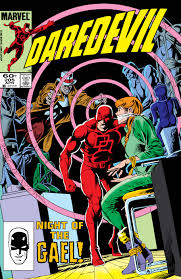 DAREDEVIL #205 (April 1984)
“The Gael”
Writer: Denny O’Neil
Penciller: William Johnson
Inker: Danny Bulanadi
Letterer: Joe Rosen
Colourist: George Roussos
Editor: Bob Budiansky
Gather round, children! An American is going to tell us about the IRA! This always goes well!
Daredevil #205 brings in Matt’s new love interest, Glorianna O’Breen. She’ll stick around as a regular until issue #233. But we first meet her as Debbie Nelson’s photographer niece from Ireland, on the run from “terrible danger” back home. Her father Fergus is a member of the IRA – “the anti-government rebels”, as she describes them – but he’s been falsely accused of betraying the organisation, and so he’s sent her to America to keep her safe from retribution.
Soon afterwards, Daredevil stops two IRA men from trying to bundle Glorianna into a van. But of course, the IRA couldn’t possibly be doing anything bad – it turns out that they’re actually trying to keep her safe from the Gael, an IRA hit man who “went bad”. We’ve already seen the Gael in the opening scene: he’s a man in a trenchcoat who kills one of his informants for the hell of it, has a shamrock motif on his gloves, and leaves a paper shamrock on his victim’s forehead as a calling card. You’d think it would blow away. Maybe he makes them with Post-it notes.
At any rate, the traitor plot is almost immediately dropped; Fergus has already been killed off panel, which presumably exonerates him in the IRA’s eyes. Instead, the story seems to be that Fergus discovered the Gael’s true identity, and that the Gael killed him to protect the secret. Fergus has chosen to share that secret with Glorianna – not by actually telling her, but by concealing it in her camera and giving cryptic hints about where to look. Since the Gael is actually family friend Paddy O’Hanlon, who knows precisely how to get in touch with Glorianna, it might have been a good idea to actually tell her to keep away from him. But then the plot couldn’t happen, so Fergus doesn’t do that.
In theory, then, the Gael’s primary motive in going after Glorianna is to stop her from exposing his identity. When he finally corners her – by the simple expedient of showing up at her door, because he’s a family friend – he gives us a speech about how he joined the IRA, but then came to realise that he enjoyed homicide more than he cared about patriotism. It’s made very clear that, although the Gael isn’t targetting the O’Breens completely at random, mostly he’s just a sadistic murderer, and he’s really looking forward to the sadistic murder bit.
Daredevil shows up, leading to a curious scene in which the Gael threatens to strangle Glorianna unless Daredevil handcuff his own hands behind his back. Daredevil does so, but of course he’s just playing along, and he handily defeats the Gael anyway as soon as he moves in for the kill.
The Gael himself is not especially problematic, despite O’Neil’s rose-tinted view of the IRA. He’s a psychopath who signed up for a patriotic cause simply because it was a pretext to kill people. It’s implicit in that concept that the IRA is the sort of organisation that might represent an attractive career opportunity for such a person. And the Gael somehow manages to come across as a sinister creep despite using a shamrock motif and calling himself “the Gael” – all of which might seem a bit on the nose for an Irish nationalist hitman, particularly one who doesn’t care about the nationalism. Conceivably the idea is meant to be that he’s mocking the patriotism of his more sincere compatriots, but it really plays more as Oirishness.
The Gael returns later in O’Neil’s run, in issues #216-217. In order to escape jail, he sticks his head in the prison laundry pressing machine, ensuring that he gets taken to a civilian hospital at the minor cost of mutilating his own face. Once there, he kills all his guards and makes a break for it. Obviously, this kicks him up a gear in the psycho stakes. He shows up later in the issue, back in his hat and trenchcoat but with a scarf covering most of his face, to kill an IRA cell for no particular reason – in Daredevil’s words, at this point “the man is a complete homicidal maniac”. In fact, not only does he kill the cell, he paralyses them with drugs so that he can torture them first. By this point, O’Neil is essentially repositioning the Gael as a slasher serial killer.
The Gael decides to go after “the Old Woman of Beare” – a woman in Victorian garb and a veil who hangs out in an Irish bar and, we’re told, “makes travel arrangements for the Irish Republican Army’s agents in America”. Daredevil shows up at the bar, only to find everyone dead apart from the Old Woman. She then turns out to be the Gael in drag, with the real Old Woman locked away in a cupboard. So Daredevil fights a facially scarred man dressed as an old lady, and naturally enough, he wins again.
It then turns out that the Old Woman of Beare was Glorianna . This is all rather bizarre, because O’Neil seems to be telling us both that Glorianna has only just arrived from Dublin and that the Old Woman of Beare is a fixture of the IRA’s New York operations. (A subplot establishes that Crossbow also knows about her.) But if Glorianna has been travelling back and forth to New York for years, then why did she need to ask Debbie for somewhere to stay in issue #205? If she was trying to get away from the IRA, why did she go to the one city in the world where she had established IRA contacts? And how does “meet me in a bar, I’ll be in Queen Victoria cosplay” qualify as an inconspicuous way of offering support services to terrorists?
But the plot problems aren’t the real difficulty with this story. When Daredevil asks Glorianna why she was helping terrorists, she responds by insisting that the IRA are not terrorists, but “good people fighting to free their home from oppression, any way they can”. She also insists that she was only involved in making travel arrangements. The Gael shows up later in the issue to have another go at killing her, but gets derailed by the A-plot, in which all of New York becomes temporarily blind. Naturally, he gets recaptured and send to jail. Finally, the Black Widow makes some calls and verifies that “Glorianna O’Breen is the soul of innocence”.
I mean. It’s fine to draw a distinction between the IRA, who have a cause, and the Gael, who is a slasher taking advantage of the opportunity that they provide. It’s fine too for Glorianna herself to reject the characteristion of the IRA as terrorists – as an IRA sympathiser, so she should. The problem comes when the story tries to assure us that helping terrorists to cross borders for fund raising purposes is “the soul of innocence”, and Daredevil seems to be okay with that.
It might be worth taking a step back here. In the early 17th century, James VI and I decided that it would be a really good idea to colonise Ulster with Scottish Protestants. This resulted in a permanent Protestant majority in the area which is now Northern Ireland, which endured for centuries. The Irish War of Independence ended with Northern Ireland voting to stay in the UK and being given home rule. But since Northern Irish politics divided along sectarian lines, the result was a permanent Unionist majority and anti-Catholic discrimination. The violent suppression of Catholic civil rights protests then led to the Troubles and the emergence of this version of the IRA.
The original IRA was the army which fought the Irish War of Independence in the 1920s. The IRA of the Troubles regarded itself as the successor of that group, and didn’t even regard the Irish government in Dublin as legitimate. Still, the fundamental difficulty with the demand for Irish unification was that the majority of the population of Northern Ireland didn’t want it, and however dubious the Plantation of Ulster might have been in 1610, the Protestants had been there for over 300 years by this point.
When O’Neil was writing the first Gael story, the IRA’s bombing campaign was mainly directed at targets in Northern Ireland and targets in England that had some sort of military connection (even if that meant things like parades in Hyde Park rather than military installations as such). The Gael debuted just as the IRA started to shift towards civilian targets. His first appearance is cover dated April 1984, but under the bizarre dating conventions of the time, that actually means that it came out in December 1983 – just as an IRA car bomb outside Harrods killed three civilians. The IRA claimed that it was a rogue operation. The second Gael story, published nearly a year later, came out not long after the Brighton hotel bombing, a failed attempt to assassinate Margaret Thatcher which killed five people and injured 30 more.
There is as problem, then, with having Matt accept that Glorianna assisting the IRA is consistent with her being “the soul of innocence”. O’Neil was not alone in this sort of thing; it was something of a commonplace in the 1980s to view Irish Americans as gullible terrorist funders, even if the actual contribution of Noraid to the IRA’s finances was probably overplayed. But by 1985, when the IRA planned a bombing campaign of English seaside resorts, it was getting rather harder to depict them romantically.
The Gael exists in that slightly odd limbo of having a codename and an extreme personality but not quite being an actual supervillain; in that respect, he’s another Daredevil villain cut from the mould of Batman’s rogue’s gallery. But for those of us old enough to remember their bombing campaign without actually encountering it on a day to day basis, having them show up in superhero comics is tonally weird on any view. Superhero comics exist in a fantasy world; the IRA were the reason why train stations didn’t have litter bins.
In theory, the Gael can exist independently of the IRA – the whole idea is that he’s gone rogue, after all. But there’s not a great deal of point in using him unless you want to say something about the IRA – without that back story and his Irish angle, he’s simply a serial killer. O’Neil does set him up very effectively in that role, as a torturer who’ll go to any lengths, even seemingly self-destructive ones. But the Irish angle was meant to provide him with an extra hook. And by the time O’Neil had finished with the Gael, perhaps writing about the IRA wasn’t looking as attractive to Americans as it once had.

“Gather round, children! An American is going to tell us about the IRA! This always goes well!”
Just be glad this isn’t the Web of Spider-Man issue that butchers Ireland’s history.
” gets derailed by the A-plot, in which all of New York becomes temporarily blind.”
As a result of a scheme by the Cossack, ANOTHER villain whose schtick works fine against normal people but is useless against Matt.
Glorianna O’Brien is killed off in D.G. Chichester’s final arc. The arc appeared under the name “Alan Smithee”, so you can tell Chichester wasn’t happy with the final product. The idea is that Karen Page, Foggy Nelson. Glorianna O’Brien and Ben Urich witnessed an incident between the Kingpin’s men and a rogue former agent of the Kingpin named Kruel. This was before Daredevil 1, so all of theml being at the same place was a coincidence. The Kingpin then drugged them so they forgot about it. The dumbest part of this is that when Matt realizes that multiple members of his supporting cast are being attacked, he logically assumes it had something to do with him. But the narrator insists that Matt reaches this conclusion because of his arrogance. Should Matt have assumed that the members of his supporting cast all met before they knew him, witnessed a crime and then didn’t tell him about it for some reason? ANOTHER former love interest of Matt was fridged for no real reason.
…and O’Niell fridged another Matt love interest in what is arguably his best issue.
Needless to say, this is my nominee for Worst DD Run Ever (Yes, Chichester has the Motocross DD run, but he had a solid close to three years before that, and the Motocross run was written under EXTREME pressure from editorial to give Matt his own Death o’ Superman moment). I sometimes try to tell myself that this was O’Niell’s dry run for his Question run once he’s back at DC…but then I remember there’s more IRA nonsense coming our way from the GORDON OF GOTHAM miniseries in his future, and that knocks THAT misconception right out of my mind.
O’Neil’s later story also seems to be referencing the 1970s and 1980s instances of gunrunning from the U.S. to Northern Ireland, which led to a number of prosecutions in the U.S.
There were some particularly big events in 1982. One IRA supporter was arrested trying to buy anti-air missiles. And that year also saw the trial of the primary IRA gunrunners in the U.S., Irish War of Independence (and Irish Civil War) veteran Michel Flannery and IRA member George Harrison (not the Beatle), who managed to win acquittal by claiming that they believed their activities were part of a CIA operation.
IRA arms smuggling from the U.S. was enough of a topic in U.S. pop culture to inspire an episode of Columbo in the late-1970s involving an IRA plot to bring in weapons. At Marvel Comics, Chris Claremont brought in a repentant former IRA bomber as a minor supporting cast member in his Iron Fist stories.
Nowadays, though, it’s hard to see the Gael and his shamrock calling card without thinking of the “Lucky Charms” assassin from the first Austin Powers.
“and a rogue former agent of the Kingpin named Kruel“
I’m not sure if that spelling is more dumb or less dumb than the Crule we got in the 90s (the External who appeared in X-Force).
This story sounds terrible. I like that cover, though.
I wonder if anyone’s done a breakdown of how Matt’s powers were depicted over the years. That would be interesting.
Most people in Britain don’t have a good grip of the history between England, Wales, Scotland and Ireland. From the pale to the plantations to the famine to the union to the rising to partition and the troubles, we don’t cover much of it in our schools. So. We can’t expect Americans to have a grip of subtleties of Northern Ireland when most us don’t either. This tied to a romanticised view of Irish diaspora of the old country did leave in a lot of American culture in the 80s and 90s to make the IRA seem a lot more cuddly then they were.
It odd because with a few exceptions other conflict areas like the middle east, Latin America and eastern Europe where all covered by fictional proxies. Because it always gets to close to bone when you blend the fictional with real issues. Genosha was more successful then Stan Lee’s coal Tigger ff and panther in south Africa story.
The geal works as a sadist who uses nationalism as an excuse for his actions he could functioned with our the baggage of a real organisation and this could have separated gloriana from. Needing to be tied to IRA.
Finally she always seems an character that no one knew how to use after O’Neil such as her being passed over to foggy once Matt was over her.
“I’m not sure if that spelling is more dumb or less dumb than the Crule we got in the 90s (the External who appeared in X-Force).”
Ha! I remember him. Only because my grandmother bought me his action figure for Christmas. I remember pretending to be thrilled and politely thanking her and then I whispered into my mother’s ear, “Is grandma aware that I’m twenty-two years old?”
“Genosha was more successful then Stan Lee’s coal Tigger ff and panther in south Africa story.”
A little OT, but that was Roy Thomas, not Stan (Stan skipped FF #115-119).
And that was a fictitious country called Rudyarda, not South Africa. (As opposed to the other South Africa-stand in called Azania that was seen in the 1988 Black Panther series and the Night Thrasher series.)
Can’t have a discussion of Irish Marvel characters without mentioning everyone’s favorite contest of champions super hero.
Micheal and Dave, I stand corrected, it has been a long time since I read that tale.
Mark, Shamrocks father was also IRA, maybe they were aquatinted and the gloves were to show support her and he was killing people to increase her powers from the victims of war.
I knew the Gael entry wouldn’t disappoint!
I actually love this issue, even though the whole “the answer is IN the camera!” thing is such a silly and pointless high-concept. It seemed cool when I was a kid, what can I say.
Also, isn’t Franklin’s wife Deb referred to as “Deb Whitman” at some point in this issue? And she’s a Spider-Man love interest or something, right? Denny was gettin’ his Debs all mixed up.
@Thomas Deja:”Needless to say, this is my nominee for Worst DD Run Ever”
***Opinions can’t be wrong, but I would say Chichester’s is far worse than O’Neil’s.
“(Yes, Chichester has the Motocross DD run, but he had a solid close to three years before that,”
***The year and a half leading up to Fall From Grace was, to me, some of the worst superhero comics ever. Not just worst Daredevil comics, just worst comics.
“and the Motocross run was written under EXTREME pressure from editorial to give Matt his own Death o’ Superman moment).”
***According to Chichester, all of the stunts in Fall From Grace — the costume, the Elektra resurrection — were Chichester’s own idea, because he wanted to increase readership. There was no pressure from editorial to do it, in fact he says in an interview that when he pitched Fall From Grace to E-i-C Tom DeFalco, DeFalco explicitly didn’t like it. But Chichester and company did it anyway, and nobody stopped them — presumably because the comic was such a low seller that there really wasn’t much in the way of editorial scrutiny. There may have been pressure on Spider-Man and X-Men to deliver big numbers in that era, but not on Daredevil.
That said, anyone who enjoyed the Chichester run, more power to you. I’m envious. I wish I liked it, since Daredevil is my favorite character, and the Chichester run is the only post-Frank Miller sequence that I just can’t get through in its entirety. I simply have to skip some of it.
@Michael: Quite an accurate assessment of that Kruel arc. Just nonsensical. I actually came up with an elaborate fan theory in order to make that story make sense. I’m quite pleased with it, actually. 🙂
@Thom H: There’s a book called “Being Matt Murdock” that looks like a rather interesting attempt on that theme. I keep meaning to buy it, and I keep on failing to pull the trigger on it. One of these days …
Shamrock! Who went from “luck powers” to “luck powers actually facilitated by the ghosts of innocents killed by war” as a way of doubling down on the stereotyping.
And who retired to become a schoolteacher.
And then retired to open a hair salon.
And then retired to open a pub in New York.
It’s like Marvel is more interested in her NOT being a superhero than anything else, when they actually remember she exists.
Me, I’d form a superteam that was entirely made up of luck/probability manipulators: Shamrock, Longshot, Black Cat, Roulette, Domino, and let every adventure escalate into increasingly unlikely chains of coincidence.
(Sorry Wanda, but you’ve basically power creeped yourself right out of probably manipulation via hexes.)
I have to admit, I like the conceit of naming an apartheid nation Rudyarda. By Roy Thomas standards, that’s almost subtle.
“In the early 17th century, James VI and I decided that it would be a really good idea to colonise Ulster with Scottish Protestants.”
Look, I know what you’re saying, but it really reads like you, Paul O’Brien, is either a time traveller or an ageless immortal person who was involved in organizing this.
Much of the Chichester run (#292-342) was a slog, but for the time it was something of a bright spot. 1991-1995 Marvel comics were some of the worse the industry ever saw materialize.
If nothing else, Chichester at least tried to give some resolution to the embarrassing stalemate between Daredevil and Kingpin as soon as he had the chance. “Regicide” was a great idea and I wish it had been allowed to have consequences.
@Luis Dantas
It’s funny, as this was the period when I first got into comics via the X-Men. X-Force #1 sent me back scouring for New Mutants back issues and the X-tinction Agenda crossover and the Muir Island Saga. The X-books were pretty interesting at that time, with Jim Lee and Rob Liefeld and a gonzo new version of X-Factor coming out and Larry Hama & Marc Silvestri on Wolverine was amazing, and then X-Cutioner’s Song came along…
And every time I tried to branch out to look at other books, I was like, what the hell is this? I think the only non-X books I bought during that time were Infinity Gauntlet tie-ins. Oh yeah, and Infinity Gauntlet was a non-X banger.
But I could barely stand to read half an issue of anything else.
@Luis- To be fair, it did take the Kingpin several years to recover from the effects of issue 300.
@Matthew Murray – Paul confirmed as an External?
I will bet that his cover story will be that he went through the trouble of learning a bit of History.
Of course he would say that.
@Maxwell’s Hammer – that was certainly a peculiar time, and X-Force was a big part of the reasons why.
Its wild levels of success shook Marvel deep, and apparently far too many people tried far too desperately to learn from that.
Many… just failed bad.
If Paul is an External, to go through all the X-books for so long, his concept must be stubbornness.
If Paul’s an External, my guess is that he discovered his immortality after he survived reading “The Draco.”
Paul better not be that old. Been around for 400 years and yet hasn’t found the time witin the past 35 to finally index the Claremont run? He’s either reviewed, indexed or annotated every issue of X-Men ever published otherwise.
That’s like making a Beatles documentary that covers the individual band members lives from their births to their deaths/or present date, but skips over the 1960s completely.
Well, I feel as though I’ve gone too far in the comment section yet again.