Amazing X-Men #3 annotations
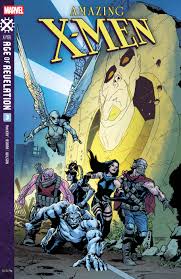 AMAZING X-MEN vol 3 #3
“Philadelphia”
Writer: Jed MacKay
Artist: Mahmud Asrar
Colourist: Matthew Wilson
Letterer: Clayton Cowles
Editor: Tom Brevoort
COVER. The X-Men in the ruins of Philadelphia (rather worse than it actually looks in the stories), with a mural of Revelation.
Notionally this is the final issue of the miniseries, but in practice the story continues into X-Men: Age of Revelation – Finale. Counting the Overture issue as well, this is really more issue #4 of 5 than issue #3 of 3.
PAGES 1-4. Psylocke tells the X-Men what she learned from Bei.
Last issue, Cyclops won a duel against the Darkchild, who agreed to transport them from her territory in Providence to Revelation’s capital city of Philadelphia. Presumably that happened between issues and she’s dropped them off on the outskirts. Glob Herman seems genuinely surprised that they escaped Darkchild, which is clearly not a common experience – certainly the Age of Revelation X-Men seemed terrified of the place when they arrived there in issue #1.
All the material about Glob killing Topaz, and Psylocke being sent to kill Bei, comes from Overture. Psylocke’s account of what happened is correct as far as it goes. Interestingly, she comes across as much more sympathetic than the future X-Men – certainly than Glob Herman, who actively laughs about it, but all of the X-Men seem to have much more of a “this is war” attitude than Psylocke. Compared to the others, Schwarzchild seems the most reasonable, since at least he makes a fair point about Psylocke’s selectivity rather than just brushing Topaz’s death off.
The flashback page is simply a recap of a scene from Overture #1. That scene ended with Bei telling Psylocke that “In telling you the truth, I will take my revenge. Because once you hear my words, your life will be over as well.” Psylocke refers back to that here, by saying that her “life was ended” – presumably meaning that she could never go back to her life as one of Revelation’s Seraphim. Apparently signing up for low-grade misery in Providence seemed like the most promising way to escape.
“Ego the Living Planet all over again.” We now learn what Bei told Psylocke: that the X-virus is ultimately designed to convert the whole Revelation Territories into an extension of Revelation himself, ultimately leading to him becoming the whole planet. As the Beast says, this is indeed somewhat like the origin story of Ego the Living Planet, which (per Thor #228) involves a scientist winding up as the consciousness of his whole planet – although he wasn’t trying to do that.
PAGES 5-11. The X-Men fight off a group of Seraphim.
The Seraphim here seem to be entirely new characters.
Psylocke is wearing an X-Men logo partly because she rejoined the team last issue, but mainly because Revelation compelled her to wear it in Overture. Given the reaction of the Seraphim here, this seems like a fairly serious obstacle to her doing her job – though in fairness, Redgarden doesn’t the chance to do much more than express confusion before Glob Herman shoots him.
Glob really does seem to be a psychopath in this timeline, shrugging off Cyclops’ orders, and nicknamed “Mad Dog” by the Seraphim.
Once again, the future characters acting most like traditional X-Men are Psylocke, making the case for sparing their opponent’s lives, and Schwarzchild, who works sensibly with Scott.
The Beast tells Psylocke that “The future is worth any betrayal”. She broadly agrees with him, but flags this as out of character. More of this below.
PAGES 12-15. The X-Men reach the “X-Mansion” in Philadelphia.
This “X-Mansion” is simply an underground base occupied by Wiz Kid, who must have been the “agent” in Philadelphia mentioned in issue #1. It’s the first mention we’ve had of him in this timeline, and we haven’t seen his mainstream counterpart in the post-Krakoan era.
“The Angel of Death ambushed us.” Animalia means Wolverine, in Overture and in issue #1.
“The teleporter… glitched.” Issue #1 again. Schwarzchild suggested in issue #1 that the teleporter had glitched because of the ghosts swarming the X-Mansion (which were no longer under Deathdream’s control), but perhaps there’s a suggestion in Animalia and Wiz Kid’s exchange that something else might have been the problem.
“Revelation’s got three Choristers left, and one of them is a little kid.” X-Men: Book of Revelation #2. The remaining Choristers are Chance, Khora and Elbecca (the “little kid”). What Wiz Kid doesn’t know is that Elbecca is a sleeper agent for Apocalypse.
PAGES 16-18. Animalia talks to the Beast.
The Beast seems to have got up in the night to use the computer – or perhaps he sent everyone else to bed so that he could use the computer – but we’re not told what he’s doing with it. To be fair, Animalia can presumably see the screen, and Beast doesn’t seem too concerned about that.
According to Animalia, the future Beast insisted on being one of the X-Men to travel back to the past because he believed that they would be “steal[ing] the life of an X-Man in the past”. This rather sounds as if the plan was never to swap them back, and that future Beast thought that he would at least be inflicting this on a version of himself. Note that in the previous scene Animalia was actively lobbying to sent the time travellers back anyway.
In issue #1, the Beast referred to Jen as “Ms Starkey”, prompting her to comment that he didn’t know her yet. He didn’t seem to dispute that. In this issue, the Beast refers to Animalia being in a relationship with a “future” version of himself. But all of this is inconsistent with what we’ve seen in regular X-Men, where Hank and Jen are already starting their relationship. There are two obvious possibilities. One is that Beast went back to a different point in the past. The other is that this is the Krakoan X-Force Beast – who is the original, after all, and who was bound to show up alive and well at some point. That would fit more with his exchange with Psylocke earlier in the issue. It seems unlikely that Cyclops has spent this long around Beast and future Jen without picking up on these points.
The Beast’s promise to Jen that “you will get him back” could equally be read as a promise that he is going to get himself home.
PAGES 19-20. The X-Men’s plans are interrupted.
The big development here is that future Wiz Kid has never heard of “resurrection-linked degeneration syndrome”, which Magneto is supposed to be suffering from in the present day X-Men stories. He does remember Magneto having a hover-chair but recalls it being an affectation.
This is, obviously, weird. One possibility is that Wiz Kid is simply wrong; after all, R-LDS isn’t widely known about and he’s out of the loop in the present day, so perhaps the whole thing gets sorted out and covered up before Wiz Kid has any occasion to know about it. Another possibility is that we’re not in a possible future timeline after all, but rather in a timeline that diverged at some other point. And another is that something has happened to alter the past.
The issue ends with Apocalypse and Professor X arriving from Arakko, with a pointer to Book of Revelation #3 for the next part of the story. Professor X was established as an ally of Apocalypse in this timeline in the Arakko story in World of Revelation.

>Glob really does seem to be a psychopath in this timeline, shrugging off Cyclops’ orders, and nicknamed “Mad Dog” by the Seraphim.
Glob remains just the worst in pretty much any book in which he appears (though Wiz Kid gives him a run for his money on being an ass here). I guess he’s here to give a contrast to Cyclops, who continually gets to dunk on him, and to Schwartzchild, who turns out to actually be a pretty reasonable guy.
I’m pretty okay with the amount of telegraphing “Beast” is doing. After all the mysteries around The Chairman and the new secret boss of ONE, and whatever else, I think it’s okay for MacKay to give us some breadcrumbs on some of the mysteries so readers can feel clever before the reveal.
The X-Men seem to have a lot of information about Ego. I don’t remember any X-Men meeting Ego, and while they may be familiar with Ego, I can’t see them being aware of Ego’s origin. I guess that issue of Thor was also published in the Marvel Universe.
That line should probably read, “The X-virus was designed to convert Doug into a Dominion.”
Maybe that line about R-LDS was dropped in there to randomly wrap up that plot, similar to how Simone randomly dropped in a line revealing the identity of the “Endling”.
AOR-The place to dispose of long-running, unwanted mysteries.
“The X-Men seem to have a lot of information about Ego.”
Actually, it’s Beast, who (whether it’s the original or the clone with memories dating back to around Defenders 122) was a member of the Avengers and therefore would have had access to the files on Ego based on Thor’s accounts.
But then that origin of Ego was disavowed in the pages of Astonishing Thor, or am I mistaken? Or was it a story invented by the Stranger?
Nothing happened again.
Doug’s purpose in becoming the Living Planet seems to be to make sure that the purposes that Xavier and Apocalypse tasked him with both come true. Xavier expected him to help bring about peace between humans and mutants. Apocalypse tasked him with ensuring the survival of the fittest. Once the entire population of the planet has become one with Doug, everyone will presumably be immortal and at peace with one another. It’s warped but it makes sense.
(Why do the evil future versions of Doug- the True Friend, Revelation- always want to bring about peace in the most twisted way possible?)
This reads like a leftover plot from Hickman. Hickman seemed to have planned for Doug to go evil and become a Dominion. Hank compares Doug’s plan to Ego the Living Planet not a Dominion but that seems to be the idea.
It definitely was a mistake to do this less than three years after Sins of Sinister. How many bad futures where the villain is trying to turn the entire population into an extension of himself do we need?
Another clue that something’s wrong with Beast- he’s fascinated by Doug’s plan to become a Living Planet. And then when Scott says Doug has to be stopped, Beast says “Of course”.
Note that the time travel Future Hank rigged up involves a black hole. Krakoan Beast supposedly died when a “black hole gun” he was using exploded. That’s got to be significant.
I think that Wiz Kid would know about Magneto being unable to walk. Remember, he’s been working with Future Scott, Future Hank, Glob and Jen for years at this point. Plus, Glob and Jen are in the room and they don’t correct him (although they might not have heard Scott).
There’s considerable evidence in the tie-ins that this is a divergent reality, not a true possible future. In the Infinity Comics Illyana remembers how when she was a child she used to play Peter and Mikhail against one another . Which is impossible since Mikhail was trapped in another dimension since before Illyana was born. In Binary 2-3, Carol doesn’t recognize Maddie when she meets her and thinks Maddie is Jean even though Maddie was wearing an identical costume when Carol and Maddie worked together during One World Under Doom. Unfortunately, the tie-ins have been so poorly written that I’m not sure if these are deliberate clues or just bad writing.
Re: Magneto’s sickness- I think that (a) it was caused by 3K and (b) 3K have a time machine. Magneto became sick shortly after fighting a Sentinel that was apparently sent by 3K. And earlier in MacKay’s run the X-Men wonder how Cassandra Nova hooked with 3K when she was trapped in the past by Kitty. One obvious possibility is that 3K has a time machine.
Regarding Ego, Beast could have been referring to the events of Maximum Security. The Earth was nearly terraformed into a new Ego. Gambit played a role in stopping that so the X-Men would be aware of what happened.
I always got/had the impression that R-LDS was a crock of red herrings anyway. It just felt a little too isolated of a case given how many mutants were resurrected and yet no one else was suffering from this disease (or hardly anyone) and Magneto’s resurrection was a weird case already.
I’m really hoping MacKay sticks the landing on this storyline. Far too many of the side stories are exactly that–three issues of wheel-spinning set in the future to explain where some of these characters are while the actual plot happens.
*looking at YOU, Binary*
I can believe Hank heard Thor getting drunk at one of Nick Fury’s poker games and telling all kinds of stories, be it about Ego, the Ferris Wolf, or the Stone Men from Saturn.
I enjoyed this. The McKay written issues are solid. The Magneto thing may be a convenient plot shift, to line up better with the end of the Krakoa storyline, like a course correction. (It still baffles me that the incoming editorial team couldn’t coordinate with the outgoing editorial team.) So was Magneto faking being sick?
I’m very curious to see Scott’s approach to Shwartzchild after this arc.
“And…And you think Ego is just a giant head…thing. But, but no! He’s actually a scientist who acci…accident…ly, uhh, he, uhh, turned his mind into this whole big planet! It’s true, verily.”
“Oh my stars and garters.”
“Uhh…veri…verily.”
————————————
Doug’s plan is also basically the same as the intended agenda of Onslaught. A combination of Xavier’s belief in peaceful coexistence between humans and mutants using Magneto’s methods of force to bring about his dream. Onslaught planned to take control of the mind of every being and enforce peace upon the world. Very little of that came about on the page.
“It still baffles me that the incoming editorial team couldn’t coordinate with the outgoing editorial team.”
Oh they certainly COULD have, It seems to me that Brevoort was too busy insulting everyone instead. “Rockstar” Harley Quinn writer Stephanie Philips came to Marvel under Brevoort and produced jaw-droppingly bad work. Now under Jordan D White she can suddenly write again. Preferences aside, it is professional quality work. It seems perfectly believable that Brevoort is not the only problem, but other than hiring talent, I don’t see that he done much right.
@Michael Wrong Beast can’t have come straight from the black hole gun, though. He knew who Jen Starkey was. Animalia doesn’t even appear to be known to the public yet, so someone from the present recognizing her would likely need to be connected to the X-Men, O-Force, or 3K.
(I say The Chairman is a surviving Krakoa Beast. Since no one in the Age of Revelation knows 3K’s deal, AoR Beast didn’t realize there was a second Hank he might accidentally swap with. The fallout from this event will be The Chairman now knowing how to create his own X-Virus)
“Oh no! Thanks to their Moira Engine, 3K now know how to become a Dominion! It’s a race against time to see who becomes Enigma!” Oh wait, I’ve got my plots all crossed. Better send in the Phoenix to fix all of this so we can move on to something else.
It seems weird to me that the person whose entire deal is about communication would want to make the entire planet a single organism. Who is he going to communicate with then?
@Pat: Magneto can’t be faking it, he had Beast cook up an experimental drug to fight Piper’s sister. Seems like an unnecessary risk if there’s nothing wrong with him
@MasterMahan: The Chairman theory does seem to be getting more and more likely, though I’m still bothered by the fact that he doesn’t have the physical proportions of any version of Hank McCoy (he should be Wyre’s size, not Astra’s). It would also be a bit odd for present-day Hank to be collaborating with Cassandra Nova, considering their history.
I have to wonder if there was ever anything that could possibly have happened on panel that would convince readers that Krakoa Beast died for good.
If an explosion from the black hole-related gun that he was carrying can’t do the trick.. I suppose the only recourse left is having him fight the current version of Storm to the death.
Well, there’s two points there:
1) There’s a history in Marvel of black hole thingies actually turning out to be teleporters
2) That Krakoa-Beast was already a clone with downloaded memories (separate from the removed logs on Krakoa itself). Yeah, Current-Beast was already supposedly the last clone, but how many times has Ultron been Finally Destroyed only to turn out to have more backups elsewhere?
So, “no”? Marvel characters are not allowed to actually be mortal anymore?
It’s just ridiculous. There is already the Dark Beast if Marvel wants Hank McCoy to be a villain. There is the current X-Men’s Beast who is heroic. Why does Marvel feel there is a need for a completely separate evil Beast, making for three different Hank McCoys? If ever there was one character that Marvel could be content to allow to remain dead, it is Superfluous Beast.
I thought it was bad that Marvel decided to keep Secret Empire Steve Rogers around as a recurring villain. If Marvel is bringing back the Krakoa-era Beast as the evil mastermind behind 3K, it adds a new level of stupidity to Marvel’s recent decisions.
“Marvel characters are not allowed to actually be mortal anymore”
At some point, were they ever mortal?
I like Krakoa Beast being around, because he’s not really Evil Beast from AoA, he’s Beast Who Crossed Too Many Lines, and having him around gives a cautionary tale to Retro Beast. It wasn’t just the war crimes he committed for Krakoa they had to wipe away it was decades of questionable choices, from weaponizing the Legacy Virus against the Skrulls to teaming up various geneticist villains to reverse the decimation to everything he did in the Illuminati in Hickman’s New Avengers.
While I would have rather seen him benched for a few years, I think now is an okay time to bring him out to comment on how Krakoa didn’t last more than a few months after he stopped doing horrible things to protect it, and how mutants are once again on their back foot.
Luis> So, “no”? Marvel characters are not allowed to actually be mortal anymore?
Let’s put it this way – there used to be a saying that no-one stayed dead in Marvel except Bucky and Uncle Ben…
Yeah, it sucks now. I can’t recall which issue it was, but it was the issue of Uncanny X-Men where they’re fighting Deathbird and the issue ended with Colossus being impaled by a spear or something. I bought that issue when it came out and child me was absolutely horrified. I was genuinely worried that he was dead. Jean had only recently died, Colossus was a fave of mine and there wasn’t much of a precedent for superhero resurrections at the time (Xavier came back from the dead but that was before my time). I was worried about it for the next thirty days until the following issue came out and I was so relieved that he had survived.
You don’t get that anymore. Worrying about characters. They die now and who cares? They’ll be back soon enough. Even though it involved me being traumatized for a month, I
miss that feeling of actually giving a shit about these characters. They’re just intellectual properties now. Granted, they always were but now they’re just mostly that.
Yeah, the question in older superhero stories was “how will X get out of this one?” which created some tension.
Now the question is “what contrived way will they bring X back from the dead?” which creates no tension, just more books to buy.
Hickman at least had the decency to not pretend we should care when a mutant died because their resurrection was assured.
@Moo,
I remember when Colossus died sacrificing himself to cure the legacy virus. Possibly the last time before widespread internet spoilers. It was a genuine surprise and for all it was convoluted, the character had been in a rut, it fitted his arc, and we got several good send off issues. It felt very final!
Similarly Psylocke in the second issue of X-Treme X-Men, which was shockingly abrupt after she’d been under the spotlight in the issue. Then they took her away in a body bag! Talk about driving the point home.
Those two, and Jean at the climax of New X-Men. Jean always worked best as a memory for the team too, I think. But yes, they are all intellectual properties now so perma death ever again! Which is why Krakoa and resurrection (with a lingering question over one’s soul…) was an effective in-universe solution, with plot beats hanging off it.
“I miss that feeling of actually giving a shit about these characters. They’re just intellectual properties now.”
Or you’re decades older now.
They had made Colossus so utterly miserable that there was nothing left to do except kill him. On his deathbed, you could imagine him saying, “There was something in that syringe other than air? Oh.” I fully expected Colossus to stay dead since no one cared about the character by that point thanks to ‘90s Marvel. The only thing left for him was to hideously murder his cat, like a scene from Morrison’s The Filth.
Jean, I knew she’d eventually be back as Marvel immediately began telling us, “Almost nothing you read in the Morrison issues actually happened, ok?”. I’m surprised she stayed dead so long.
I think characters feeling like little more than intellectual property has to be understood with the emphasis on “little more than.”
If that’s the first thing that springs to mind, it may suggest that recent or current stories aren’t offering much more at this point, not even a solid sense of the traditionally appealing or applicable elements that made the franchise successful to begin with.
The X-Men may get a little more personal investment for two reasons. First, they’re set up to connect to all sorts of marginalized experiences, albeit with a lot of fudging. This makes a lot of folks see themselves or their group reflected in the mutant metaphor.
Second, given the extremely long-lived influence of Claremont, the X-Men really did “belong” to one writer for a long time, a writer who made a lot of efforts to make their saga his own. And the more celebrated runs since then — Morrison, Hickman — have similarly been received as distinct creative visions of the premise, not just as trademark service.
@ASV – Yeah, I’m decades older now, but it isn’t that. I can still be worried about the fates of characters. Just not in superhero comics. Not anymore. But I can watch like, a drama TV series, for example, get invested in the characters and feel a genuine since of dread when they’re in mortal danger.
@Evilgus – I remember as well, but I had already become jaded and cynical about comic book deaths by the time they offed Colossus back in ’01. Consequently, neither his death issue nor his sendoff issue moved me or affected me. I didn’t believe for a moment that it would be permanent. When Colossus made his brief but memorable live-action debut in X2, I remember thinking, “Some editor is going to see this and decide it’s time to bring him back.” A year later, he was back.
“I’m surprised she stayed dead so long.”
That surprised me as well. Not that she was killed again and not that she came back again, but that her Morrison death lasted longer than her Claremont death.
The problem with Krakoan resurrection is that some plots just don’t work if a character can be resurrected every time they die. For example, in Escapade’s introductory arc, the plot revolved around her trying to prevent a prophecy of her death. Why should she care if resurrection exists? In SWORD. Abigail Brand goes to great lengths to weaken Cable’s telekinesis. Why does she bother if the X-Men can just shoot him and resurrect him at full power? Resurrection gave the X-Men less reason to avoid death then the average person has to avoid a mild pulled muscle.
Psylocke’s death in Xtreme X-Men was SUPPOSED to be temprorary- Claremont planned to revive her back in her original body. But then Quesada shut that down because he claimed it violated his “dead is dead” edict- never mind that Magneto was also killed and brought back by Morrison. Quesada later tried to argue that the difference was that Morrison asked him first but that seemed like hair splitting.
It’s been said that Jean’s resurrection was the start of death at Marvel being devalued but plenty of people stayed dead after Jean was brought back- look at the 1987 Official Handbook book of the dead. (The majority of whom have now been brought back.) Death at Marvel really started getting devalued in the 1990s. starting with Thanos’s resurrection and then more resurrections of people like Baron Strucker (yes I know he’s weird because he appeared after his death by mistake and they had to retcon it into a robot) and Norman Osborn.
@Moo- Jean’s staying dead was due to two factors. The first was that Quesada thought that Jean returning from the dead was a mistake so he decided to rectify it by keeping her dead. (Quesada also thought that there were too many mutants and that Spider-Man shouldn’t be married and we all know how those went.) The second reason was that Jean’s younger self came to the present with the Original Five and there was no less need for an adult Jean when we had a Teen Jean.
Other characters who stayed dead unexpectedly long were Mockingbird and Lilandra. They’re both the main love interests of major Silver Age characters. And they both stayed dead a decade and a half.
And then there’s Moira. She was the X-Men’s major human supporting character but she stayed dead for almost two decades and when she came back she was a mutant with an unrecognizable personality.
“Quesada also thought that there were too many mutants and that Spider-Man shouldn’t be married and we all know how those went”
I agreed with him on both counts. I just wouldn’t have tackled those problems the way they did.
He was right about the mutants in the sense that with millions of mutants everywhere, either every book published by Marvel becomes an X-Men spin-off, or you very clearly have two divergent realities while pretending that they’re not.
M-Day affecting ~99% of mutants but only maybe 2% of X-Men and x-related characters was the mistake.
@Krzysiek- It should be noted that there weren’t “millions of mutants” until Morrison’s run and Quesada was the editor-in-chief then.
The problem with M-Day was that (a) it prevented the creation of NEW mutants, therefore robbing the books of their purpose and (b) major characters like Jubilee lost their powers for over a decade.
Yeah they suddenly went from thousands or hundreds of thousands worldwide to suddenly millions (Genosha alone had 16 million before Cassandra Nova’s attack).
The X-Men have always been a hard fit with the Marvel Universe. They cry out to be allowed to be their own science fictional concept, but they are stuck in a shared superhero universe. Morrison showed a way forward for characters who had been stuck in a rut for a decade (regardless of the sales figures for half that decade). “M-Day” firmly placed the X-Men back into being little more than a corporate property, stuck repeating the same stories over and over again, forever. Unfortunately, there’s no easy solution…Morrison’s answer would break the shared Marvel Universe, while the inverse is that the X-Men are just another Marvel superhero team doing stock plots originally established in 1963. “M-Day” was simply the worst possible response to Morrison, pretty much for the reasons given by Michael.
I agree that the X-Men concept really ought to exist in its own universe entirely separate from the Marvel Universe. The public’s general acceptance of non-mutant superheroes doesn’t square away with their fear and distrust of mutants.
Joe Citizen: “How did you get your powers?”
Non-Mutant Superhero: “Lab accident. I was doing crazy experiments and something went awry.”
Joe Citizen: “Okay. I trust you. And you? How did you get your powers?”
Mutant Superhero: “Born with them. Not my doing. Had no choice in the matter.”
Joe Citizen: “I don’t trust you.”
Moo— the short and unfortunately fitting answer is that bigotries aren’t rational.
Plus this is the Marvel Universe, where the average person on the street is as likely to praise a hero as throw a rock at them, depending on the day. I recall Kurt Busiek having a couple amusing lines about this in JLA/Avengers.
I still don’t quite get the whole problem with millions of mutants everywhere, or even with stuff like Mutant Town. Why would mutants have to be any more ubiquitous than other groups that have millions of members everywhere?
Not every book has people with hearing impairments, for instance, and not every book has a character from every single heritage, religious, or ethnic group with millions of members scattered across the United States.
Similarly, why would, say, Spider-Man or the Avengers need to have stories set in Mutant Town or Genosha any more often than the have stories set in Little Italy or Madagascar?
The problem with mutants being dialed back to a much smaller overall number is that it plants the franchise firmly in the “extremely small group threatened with total extermination” setting, in which case the X-teams really do have to be on a constant war footing just to survive.
I think it’s the extreme degree to which anti-mutant prejudice has been portrayed, down to secret concentration camps, that makes the “millions of mutants as a global minority” concept hard to buy into, not to mention making it hard to buy into the X-Men as part of a shared superhero universe.
But this problem is easily solved by dialing that element back and making the Sentinels and so forth more the equivalent of, say, a controversial racist movement with some powerful, politically connected supporters rather than every government’s multi-billion dollar policy.
Spider-Man, the Avengers, and so forth also don’t have to fight the Sons of the Serpent or the Klan or whatever in most of their storylines either.
The problem was that Morrison said that mutants would eventually be the majority with baseline humanity as the minority. Plus, we run into the problem of competition as mutants gain acceptance. Why would a business hire eight workers to do a job over two days, when they could hire one mutant with the proper powers to do all the work in five minutes? Maybe due to racism, but if a corporation is making that much more profit while saving so much cost, the racist businessmen are soon going to be out of business.
These are stories I’d be interested in reading, as otherwise, what’s the purpose of having millions of mutants and concepts like a mutant town? Just to show even more how miserable mutants are, even though we’ve seen that some of them have the power to terraform an entire planet?
I’m fine with following Morrison’s promise and reading about society changing, but it’s not a story you can tell in a shared superhero universe.
So, we’re stuck with the exact same doom ‘n’ gloom stories we’ve been seeing for decades: persecuted minority, “hated and feared”, Xavier’s dream failing, “Days of Future Past” looming, etc.
Some properties actually do think hard about the juxtaposition of superpowered individuals in society and how they’d affect every aspect of life. Heck, sometimes even individual titles within a larger media franchise think about it.
The problem is that you have to either approach this intelligently and with full dedication to examining how society would work and accept permanent, lasting, radical change… or you have to handwave it to maintain a semblance of “world outside your window.”
Marvel and DC rarely want to commit that hard. The best you get is “super strong guy does the work of 10 on the docks and the union gets pissed off” or “superspeed delivery in a flash” or “superhero temp agency” or “superhuman law is weird, yo.”
Marvel’s afraid of letting things get too far into the realm of speculation, even when Reed Richards or Tony Stark could permanently change the world in a single day. Look how quickly status quo returns after any major event like Secret Empire or One World Under Doom.
[…] X-MEN #3. (Annotations here.) This is more like it. Sure, the pacing of Amazing X-Men is weird if you try to see it as a […]
I feel like if you’re reading a superhero comic and asking questions like “what impact does telekinesis have on the labor force” you’re seriously overthinking things. I also don’t really see “millions of mutants” as being much more fundamentally world-breaking than, say, Reed Richards inventing a new groundbreaking super-technology that should radically transform society once a month. Forget the political implications of the sentinels, Mr. Fantastic probably should have ended hunger, pollution and global warming by now – if you’re working overtime to take every superhero comic in real world terms, which you absolutely should not do.
There have been people at Marvel trying to dial things back to “the world outside your window” for decades, and it’s lead to some really dumb editorial moves, like the era in the 80s when they decided to destroy the Savage Land, take away the skrulls’ shapeshifting powers, and have Scourge kill a ton of C-listers to “clean up” a fictional world that had become too cluttered with the fantastic. The problem is the fantastic stuff is what made the comics fun and interesting to read. Who wants to read about the skrulls when they’re just generic green angry aliens? And who wants to read about mutants when they’ve gone from an oppressed minority group to a couple dozen people on the verge of extinction? These are bad solutions to problems that never existed in the first place.
Marvel was never really “the world outside your window” anyway – that was some excellent Stan Lee-era hype, but all it really meant was that Marvel characters acted more like, and found themselves in situations a lot more similar to, the real world than anything you’d find at DC in the 1960s. Which was groundbreaking at the time but was also a really low bar.
Morrison started developing mutant sub-cultures and showing what it would be like if mutants became integrated into human society. There was still hostility and violence, but mutant music and fashion were objects of curiosity for some humans. Mutant town was established in NYC. Kick and MGH were drugs associated with mutants. Morrison’s focus was on other matters for most of his run, but I thought the fact that they moved mutant/human relations up a step was one of their notable achievements.
Almost everything reverts to the status quo, however, and that development was lost. The tension of an outside group trying to assimilate (complete with superpowers) was an interesting direction, but instead we got more of the same. There were some good X-comics published post-Morrison, but few that were as interesting until Krakoa.
“And who wants to read about mutants when they’ve gone from an oppressed minority group to a couple dozen people on the verge of extinction?”
Well, I didn’t. I dropped the books because of that, but that was an over-correction.
Millions is still too many. An oppressed minority numbering in the millions, and for some reason it’s only a dozen or so mutants in Westchester that have been sticking up for them.
Incidentally, the reason Claremont wrote the Mutant Massacre in the first place was because he felt Paul Smith drew too many of them in the tunnels.
I’ve never found there to be any problem with mutants being in the same setting as Avengers, FF, etc. and I always find it odd that people do think it’s an issue.