Uncanny X-Men Annual #1 annotations
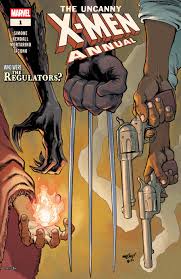 UNCANNY X-MEN ANNUAL vol 6 #1
“The Rise of the Regulators”
Writers: Gail Simone & Mikki Kendall
Artists: Francesco Mortarino with Elisabetta D’Amico (inks)
Colour artist: Mattia Iacono
Letterer: Clayton Cowles
Editor: Tom Brevoort
COVER. It’s a homage to the cover of issue #1 of the current series, with the hands of the Regulators instead of the X-Men.
THE X-MEN:
Wolverine. In the present day section of the story, he shows up at a club to protect one of the bar staff, Mala, from her stalking Emery. For some reason he shows up in a full tuxedo to a nightclub (he surely can’t be this out of touch with modern nightlife, and it’s not like a tuxedo would be his first choice of clothes outside Madripoor). Mala is apparently the great-great-granddaughter of Slaughter Freedman, hence Logan’s interest.
In the 1920s portion of the story, he’s been poisoned by someone and then ambushed and buried alive by the robbers who go on to attack Slaughter Freedman. The poisoners are never identified and for the purposes of this story their main function is to explain how he managed to lose a fight to these robbers in the first place – as well as giving him a mission to justify leaving Haven House at the end.
Slaughter rescues him and takes him to Haven House, where Mother Witchfire heals him. He then spends a couple of weeks at Haven – although it’s described as a mutant community, it seems to be unusual at this point for white mutants to show up there. It turns out that Logan was at Haven House during the flashback scenes in “Dark Artery” (Uncanny X-Men #13-16) but kept out of sight in case he scared off Henrietta; we did establish during that storyline that the two of them had met before. He then claims credit for killing the robbers (who were actually killed by Slaughter) in order to draw the heat off Haven House.
Jubilee. She’s basically serving as a sounding board for Wolverine in this story.
SUPPORTING CAST:
Michael St. Juniors. As of the 1920s, the current protector of Haven House. Though he’s presumably a mutant, he simply carries a rifle. He’s more interested in keeping Haven House safe than anything else, and he’s decidedly unimpressed that Slaughter has come there immediately after killing four white men. However, he seems more sympathetic on learning about the death of Slaughter’s son, and implies that he’s also had a child killed by anti-mutant types.
We previously saw Michael, Slaughter and Mother Witchfier in the flashback sequences of Uncanny X-Men #15-16.
John Slaughter Freedman. A mutant with four arms. Given that he’s somehow able to shoot one of his attackers through both eyes while firing backwards over his shoulders with two guns at once, he seems to have some sort of superhuman aim as well. In Uncanny #15-16 he looked a lot more slender than he does here, but that seems to be just artistic licence.
Slaughter is coming to Haven to bury his son, in keeping with its established role as a 1920s mutant graveyard in the “Dark Artery” arc. He strongly implies that he has already killed his son’s murderers. He doesn’t like the term “mutate” (which “Dark Artery” told us was the normal one at the time among the mutant community).
According to Slaughter, he’s a former Buffalo Soldier (i.e., a soldier in a black regiment of the US Army) and a former US Marshal in “Oklahoma Territory”. Oklahoma didn’t become a state until 1907, so the implication is that Slaughter served as a Marshal before that. It was indeed possible for a black man to hold that position.
Slaughter seems inclined to play along with the robbers until they take an interest in his son’s coffin, at which point he kills them all. He does rescue Logan from his grave and take him to Haven House for treatment, but seems decidedly sceptical of any white man, even knowing that Logan is a mutant. That said, once Logan is actually able to talk to him, Slaughter seems to come round to him fairly quickly.
The song that he’s singing at the start of the issue seems to be original.
The name “Regulators” is used for the Haven group in the title and in Slaughter’s narration but isn’t expressly adopted by the team as a whole in the story.
Mother Witchfire. She seems to be a healer who’s literally able to extract the poison from Logan’s body psychically. She also has visions from time to time. She seems able to kill one of the lynch mob just by putting her hand on his face.
Like the others, her children were also killed by anti-mutant types. A slightly cryptic flashback to her family history implies that she’s had a long string of families and friends die in a similar way.
Lady Henrietta. The falshback sequences in this story take place before and after her arrival at Haven in the flashbacks in Uncanny X-Men #13-16.
Selah and Gabriel. Two black mutant children from 1920s Haven (“sharecropper kids”) who are get blamed for the deaths of the robbers that Slaughter killed. They seem to have a shared power which they describe as “the sight”, and which they’ve only previously used on animals. When used on someone who’s trying to shoot them, it conjures up smoke-like demonic creatures to drag him away; whether this is anything more than an illusion is unclear.
Ransom. He tries to get the Outliers to play soccer for training, though only Jitter really seems interested. He wears the Argentinia national football strip and Jubilee claims that he’s “outstanding”.
Jitter. She’s up for playing soccer, wearing a jersey over her costume. With her powers, she can copy Pele for short periods, at which point she’s better than Ransom.
Calico. More interested in feeding Ember than in playing the game, but celebrates delightedly with Jitter after a single goal because she seems to assume that they’ve won. (They’re evidently playing girls versus boys.)
Deathdream. Has no interest at all in soccer and mainly wants to inspect a dandelion.
Mala. A barmaid at a club, who has no idea why Wolverine is taking an interest in her. She’s an alcoholic and 90 days sober. Logan indicates that she’s the great-great-granddaughter of Slaughter Freedman. He also mentions that her apartment is right next to Haven’s former lynching tree, which was destroyed by Mother Witchfire.
VILLAINS:
Assorted 1920s racists. There’s a group of four gunmen robbing people on the road to Haven – the leader is named as Caleb, and one of the others is called Virgil. Virgil calls the other three his “brothers”, though he might not mean that literally.
While they’re clearly racists, they seem to be stopping anyone who goes along the road, since they did also attack Logan. They don’t fare so well with Slaughter, though he has the element of surprise against them.
As already noted, the town of Haven are going to lynch Selah and Gabriel for the murder of the gunmen. The sheriff doesn’t think they’re guilty but joins in anyway.
Emery. Mala’s stalker has been hassling her for weeks, according to Logan. He seems obsessed with her and to expect her to comply. He claims to be able to buy off the law.

“Jubilee. A”
I rate her as more of a B+ here. 🙂
An interesting story, though I see we once again fall into the trap of introducing mutants with weirdly nebulous and unexplained powers. Still, I wouldn’t mind seeing more of the Regulators in some form or fashion.
I do feel like the framing sequence could have been stronger. Mala and Emery needed more fleshing out, or perhaps something else altogether to justify Logan basically stalking her until he steps in to save her. Mala seemed to take it all rather well at the end. Better by far if, perhaps, Mala had discovered his contact information passed down through the family tree and used it? Shrug.
I figure by this point, Logan must have a whole ton of people he looks after, based on “I met your ancestor and I owe them a favor” as a running theme in his stories. Though given his memory issues, he probably lost track of a lot of them for a few decades.
“Jubilee. A”
The rest of this paragraph appears to be missing.
@Michael: On the contrary, it’s actually a brilliant commentary on Simone’s use of Jubilee so far, which can indeed be summarized as “Jubilee. A”
I’d personally say Simone’s use of Jubilee is about a B- : component but not particularly good
It’s worth noting that there’s a long history of real-world U.S. vigilante and citizen militia groups calling themselves “Regulators,” mostly in the 18th and 19th centuries.
The nature of this group might suggest an allusion to the vigilante Regulators organized in the pre-Civil War era to stop the various roving criminal groups collectively called the Banditti of the Prairie.
But John Slaughter Freedman’s Old West sort of background might also suggest Slaughter Freedman might suggest the Regulator faction in the Regulator-Moderator War that took place over land and local political power in eastern Texas, also in the antebellum mid-1800s.
The Lincoln County Regulators, who counted Billy the Kid among their number, seem less likely, as the flashback team in this story is supposed to be a more heroic group acting to defend themselves.
Why does the cover show Wolverine’s adamantium claws if, on the inside pages, he has bone claws?
Does the beginning of the comic—with Wolverine poisoned and buried—connect to any previous storyline, or is it something completely new for this comic? I’m asking as someone who hasn’t read many of the character’s older comics.
A) Because clearly the adamantium claws are more recognizable from a marketing standpoint. That’s how you signify “hey kids! Wolverine is in this!”
B) Nope. It’s a brand new incident from Logan’s century+ of random violence, escapades, encounters, exploits, and meeting everyone of any significance. Maybe it’ll be further explained, maybe not. My head canon is that Mystique tried to kill him. 🙂
Maybe Romulus did it. He’s responsible for everything else in Logan’s backstory, after all.
This whole story only exists to force Paul to update the complete Wolverine.
I remember going “woah Wolverine knew Puck before superheroing, cool backstory”. It was actually novel back in the 80s.
I love that Paul’s correction to Jubilee’s section is just a single line which confirms that she’s been little more than lawn furniture in this run (with Nightcrawler being little better).
For a bit of irony (considering Simone coined the whole “fridged” trope), does Jubilee pass Kelly Sue DeConnick’s Sexy Lamp Test? Is the only distinction being Logan being unlikely to talk to actual furniture? Though he does talk to trees that have “LOGAN & SILVER FOX” carved on them.
DC lured Simone back for a strip in the SUPERMAN/SPIDER-MAN one shot, and she’s been announced as writing the She-Spawn 5 issue mini for Image. Still no offerings of a Southern Gothic Horror comic from Vertigo.
If those aren’t bone claws on the cover than why are they so uneven?
I know the story says “over a century ago” which could include as recent as 1925, but I didn’t notice anything that said 1920s. Oklahoma Territory was 1890-1907. Either he has Logan-like lack of aging or he held office as an infant. I read this as he was traveling back from Oklahoma Territory directly and current to the story. My thought was that 1895 is much more likely for this story than 1920. Did I miss something? Of course, if we take the Marvel sliding timescale than ‘over a century ago’ could mean the 1990’s. One of us will have to ask Steve Rogers the next time we see him. If he has thawed out yet again, of course.
I liked this story.
@Woodswalked- the problem is that the flashbacks in this issue are meant to be taking place at roughly the same time as the flashbacks in issues 13-16. Unfortunately, the references Simone made to real world historical events in those issues are contradictory- see Paul’s annotations for Uncanny X-Men 14 for a detailed discussion of the issues.
@Michael – yeah, Paul waa gracious in calling it “a but confused” There is no way to square this with the reference to the Dust Bowl. Chalked it up to blurry history at that story, squinted and dismissed it. I am adding this to the list of contradictions that I forgot about. This is exactly what I missed. Thank you. I am still blaming the Marvel sliding timeline.
The Depression-era setting and the villains being a bunch of racists suggests that Gail Simone saw Sinners.
I’m a bit late to this issue but I came to the annotations hoping to find out who the guy with the sling was after they rescue the kids. He’s standing with Henrietta. Did I miss something?